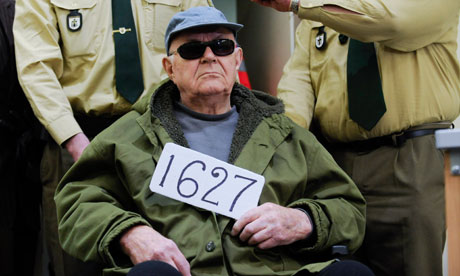
It was announced on Saturday that John Demjanjuk, the man variously
accused as being “Ivan the Terrible” and an evil guard at the Sobibor
concentration camp, died at the ripe old age of 91 years old. He died a
free man at a nursing home in southern Germany, awaiting the appeal of
his recent conviction of being accessory to the murder of 27,900 Jews at
the Sobibor death camp in Poland. His death has brought to an end a
most extraordinary sequence of events which has raised significant
doubts about the value of hunting down Nazi murderers and their
collaborators.
It is almost certain that Demjanjuk was involved in the murder of
Jews during the Holocaust. He admitted that the scar under his armpit
was an SS tattoo which he removed after the war. There continue to be
accusations that he was, in fact, the feared “Ivan the Terrible” who
operated the diesel engines of the gas chambers at the Treblinka death
camp, and who tortured and tormented prisoners in his spare time. A
special tribunal at the Jerusalem District Court found Demjanjuk guilty
of this charge in 1988, and sentenced him to death as a result (the
death sentence is available in Israel only for those found guilty of
Nazi war crimes). It was the Israeli Supreme Court that overturned this
conviction in July 1993 on the basis that there was reasonable doubt as
to whether the person on trial had been correctly identified as Ivan
the Terrible. The judges agreed that Demjanjuk was probably a Nazi
guard at Sobibor, Majdanek and Flossenbürg camps. But this was not the
charge that the court had been called upon to adjudicate, and the judges
were forced to set him free on the grounds of reasonable doubt on the
charge of being Ivan the Terrible.
Demjanjuk returned to his adopted home in Cleveland, Ohio. The
American government, that had previously withdrawn his US citizenship,
was forced to reinstate him as a citizen. Demjanjuk was tried again
earlier this year in Munich, accused of being a guard at Sobibor
extermination camp. A total of 27,900 charges of being an accessory to
murder were brought against him, one for each man, woman and child who
were brutally murdered at the camp. The trial was something of a
spectacle, with the accused being brought into the courtroom each day in
a wheelchair and refusing to take any part in the trial. He was
eventually found guilty, and sentenced to 5 years in prison! He was,
however, immediately released having spent two years in prison awaiting
trial, and many more years in prison during his trial in Israel. His
defense team had appealed the conviction, and the appeal was in the
process of being prepared when he died.
There are many who have questioned the logic of spending years and
millions of dollars prosecuting somebody who was a fairly low rung in
the Nazi ladder. It seems as though he was a lowly guard at a death
camp, and not one of the key decision-makers driving the “Final
Solution”. Even though he was clearly evil and caused a great deal of
suffering and torment for thousands of innocent people, is this enough
to justify the enormous effort when there were much bigger fish to fry?
The prosecution of Demjanjuk cannot, for example, be compared to the
Eichmann trial. It did not come close to the spectacle and the
importance of the Eichmann trial, largely due to the very senior
position that Eichmann held in the Nazi death machine. There were so
many other senior Nazis, who were in the decision-making ranks, and who
were never held to account for their appalling behaviour. So why was
this low-level individual pursued for so long, and at such great cost?
I think it was to do with the fact that there was such a substantial
failure to bring many of the key Nazi figures to justice. Except for
the Nuremberg trials and Eichmann’s trial, there was little
international justice meted out to the architects and operatives of the
greatest genocide known to man. This was despite the untiring efforts
of Nazi hunters such as Simon Wiesenthal and others. They played an
important role in bring to the public’s attention how easily some of the
big fish had evaded identification and justice. When the accusation
arose that Demjanjuk could have been the feared “Ivan the Terrible”, he
was pursued relentlessly as something of an example to try to show some
justice. Even these attempts ultimately failed, although it did succeed
in raising the issue of justice for Nazi war criminals into the public
domain again.
One of the reasons that the prosecution of Nazi war criminals was not
more widespread, was because the Israeli government decided not to
pursue this following the execution of Eichmann. He was the example
that was used to publicly demonstrate some of the atrocities that took
place, but the Israeli government chose not to pursue this avenue
further. Instead, the Israeli government decided to use its scarce
resources, both financial and intelligence, in the building and the
protection of the State of Israel. In retrospect, this was probably the
right decision even though we would have liked to see all war criminals
brought to justice. A choice had to be made, and I believe that the
right one was made.
The death of Demjanjuk probably brings this chapter to an end. It is
difficult for me to see the possibility of finding any war criminals
still alive, and who could face justice. Even if such individuals are
found, so much time has passed since the crimes were committed that the
realistic prospects of a prosecution must be extremely low. Interest
groups have long called for the money that was channelled into searching
for war criminals, to be redirected towards providing assistance for
the survivors. For them, this would be money better spent.
Some feel that some sort of revenge was achieved because Demjanjuk
was kept on the run for the last 25 years of his life as prosecutors
tried, and failed to bring justice for those who suffered by his hands.
I don’t really feel this. The fact that he was able to enjoy such a
good life in America in the years following the war, and that he
ultimately died a free man, is indication to me that justice was not
ultimately served. I do feel, however, that some revenge was extracted
by him living long enough to see how the Jewish people have survived,
grown and flourished despite his efforts and those of his
collaborators. I love the fact that he was brought to the State of
Israel to stand trial, so that he could see the failure of his
endeavours. This was surely real justice. I also feel sure that 27,900
souls were waiting for him when his time was up to extract the ultimate
justice.
Showing posts with label Poland. Show all posts
Wednesday, 21 March 2012
Sunday, 6 September 2009
The March of the Wealthy?
My 17 year-old son recently returned from a trip to Poland together with more than 100 of his classmates. This is a trip made available each year to all 12th grade students to allow them to visit the sites of the greatest and cruellest tragedy on earth - the holocaust. It is a pilgrimage that tens of thousands of Israeli schoolchildren make each year, and one which many thousands of Jews from around the world make under the banner of the "March of the Living".
Despite the obvious difficulties associated with a 17 year-old visiting the sites which saw such horrific tortures and killings of innocent people, I am happy that my son went to Poland. I am happy that he saw first-hand the sites of Treblinka, Majdanek, Auschwitz and Birkenau as well as the remains of the Warsaw Ghetto. In my view, the youth of today who are now 3 and 4 generations removed from the victims and survivors of the holocaust need to see this with their own eyes so that they will never forget. After his visit, I am convinced that my son will never forget. He took with him the names of the members of our family - my grandfather's brothers and their families - who perished. He lit candles in their memory at Auschwitz and said the mourner's prayer. This will surely remain with him for ever.
There can be no doubt that Jewish youth who grow up without strong Jewish education can easily forget that the holocaust took place. There are so many holocaust-deniers around these days, some of whom seem very convincing in their arguments. There are less and less survivors to convince us with their eye-witness accounts of events. All of this surely leads to a dilution in the awareness of the holocaust and the threat that it presented to the Jewish people and to the free world.
And yet there are those, even in Israel, who object to the trip made to Poland by the high school students. The main reason is because of the cost. The trip to Poland is sponsored almost entirely by the parents. The cost to our family was NIS 6,000 excluding spending money, equivalent to almost US$2,000. This covers a well organised and intensive 8 day trip including comfortable hotels, most meals, guides, security and transport and entrance to all sites of interest. Despite the fact that attractive payment options are offered, this amount is not something that all Israeli families can afford and immediately excludes those children whose parents are unable to finance this sum. It can also create some embarrassment amongst school mates between those who are able to travel and those who are not. The school did make an effort to raise funds for those students in need of financial assistance. Even this, however, does not seem to fully solve the problem.
An ideal situation would be that the Ministry of Education would budget sufficient money to finance all students who qualify to travel and wish to participate. There are some children opt out of the trip due to the fact they simply cannot cope with facing such horrors. With the current budget cuts, however, there is not sufficient money to cover the basic education requirements. So the prospect of having budget for the trip to Poland is as remote as ever. Under the circumstances, what is the correct action? The trip can either be cancelled completely, or continue to operate under the current circumstances? If this is the stark choice, I choose the second option such that at least some of our youth have the chance to "never forget".
Another issue that has been raised in reference to the Poland trip is whether it is even appropriate for our youth to be exposed to such horrors. There is a view that the holocaust is "stuffed down the throats" of our children at school from the age of 7. Every year sees the sirens wailing on Holocaust Day with the associated educational programs implemented in all schools. Holocaust study is a compulsory subject for all Israeli students to gain a matriculation (Bagrut). There is a view that this is simply too much, especially for children of this age. This view seems to be more pronounced in the community of Jews originating from Middle Eastern countries than the community of Jews originating from Europe. This may be due to the fact that the Middle Eastern community was spared the horrors of the holocaust while their European brethren suffered unimaginable horrors in Europe. I believe that too much is not good, but it is better than too little.
So, with all the arguments and politics which surround this trip, I remain convinced that it is a practice that should continue. My son, who together with his friends will be recruited to the IDF within the next 2 years, now has a much better understanding of the value and importance of the State of Israel to the Jewish community and to each Jew individually. Although he has always been a proud citizen of Israel and Zionist, his understanding of the need for a Jewish army is clearer than before. His commitment to the defence of the State of Israel and the Jewish people is absolute, and exactly what is needed prior to his period of service.
Despite the obvious difficulties associated with a 17 year-old visiting the sites which saw such horrific tortures and killings of innocent people, I am happy that my son went to Poland. I am happy that he saw first-hand the sites of Treblinka, Majdanek, Auschwitz and Birkenau as well as the remains of the Warsaw Ghetto. In my view, the youth of today who are now 3 and 4 generations removed from the victims and survivors of the holocaust need to see this with their own eyes so that they will never forget. After his visit, I am convinced that my son will never forget. He took with him the names of the members of our family - my grandfather's brothers and their families - who perished. He lit candles in their memory at Auschwitz and said the mourner's prayer. This will surely remain with him for ever.
There can be no doubt that Jewish youth who grow up without strong Jewish education can easily forget that the holocaust took place. There are so many holocaust-deniers around these days, some of whom seem very convincing in their arguments. There are less and less survivors to convince us with their eye-witness accounts of events. All of this surely leads to a dilution in the awareness of the holocaust and the threat that it presented to the Jewish people and to the free world.
And yet there are those, even in Israel, who object to the trip made to Poland by the high school students. The main reason is because of the cost. The trip to Poland is sponsored almost entirely by the parents. The cost to our family was NIS 6,000 excluding spending money, equivalent to almost US$2,000. This covers a well organised and intensive 8 day trip including comfortable hotels, most meals, guides, security and transport and entrance to all sites of interest. Despite the fact that attractive payment options are offered, this amount is not something that all Israeli families can afford and immediately excludes those children whose parents are unable to finance this sum. It can also create some embarrassment amongst school mates between those who are able to travel and those who are not. The school did make an effort to raise funds for those students in need of financial assistance. Even this, however, does not seem to fully solve the problem.
An ideal situation would be that the Ministry of Education would budget sufficient money to finance all students who qualify to travel and wish to participate. There are some children opt out of the trip due to the fact they simply cannot cope with facing such horrors. With the current budget cuts, however, there is not sufficient money to cover the basic education requirements. So the prospect of having budget for the trip to Poland is as remote as ever. Under the circumstances, what is the correct action? The trip can either be cancelled completely, or continue to operate under the current circumstances? If this is the stark choice, I choose the second option such that at least some of our youth have the chance to "never forget".
Another issue that has been raised in reference to the Poland trip is whether it is even appropriate for our youth to be exposed to such horrors. There is a view that the holocaust is "stuffed down the throats" of our children at school from the age of 7. Every year sees the sirens wailing on Holocaust Day with the associated educational programs implemented in all schools. Holocaust study is a compulsory subject for all Israeli students to gain a matriculation (Bagrut). There is a view that this is simply too much, especially for children of this age. This view seems to be more pronounced in the community of Jews originating from Middle Eastern countries than the community of Jews originating from Europe. This may be due to the fact that the Middle Eastern community was spared the horrors of the holocaust while their European brethren suffered unimaginable horrors in Europe. I believe that too much is not good, but it is better than too little.
So, with all the arguments and politics which surround this trip, I remain convinced that it is a practice that should continue. My son, who together with his friends will be recruited to the IDF within the next 2 years, now has a much better understanding of the value and importance of the State of Israel to the Jewish community and to each Jew individually. Although he has always been a proud citizen of Israel and Zionist, his understanding of the need for a Jewish army is clearer than before. His commitment to the defence of the State of Israel and the Jewish people is absolute, and exactly what is needed prior to his period of service.
Subscribe to:
Posts (Atom)
