Showing posts with label Israel Navy. Show all posts

Tuesday, 19 June 2012

Airing the Dirty Laundry in Public

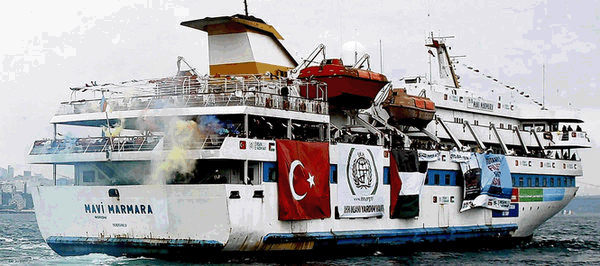
During the course of last week, the Israeli State Comptroller published his report into the events that took place when the IDF halted the entry of the Gaza Flotilla into Israeli territorial waters in May 2010.  The State Comptroller is answerable only to the Knesset, and has the responsibility to supervise and review government policies and operations.  He has looked at the Gaza Flotilla incident by examining the planning and decision-making by the government and the defence establishment in the period leading up to the incident.  The actual military operation mounted, and the unfortunate events that took place on that fateful day when an IDF boarding party was lynched by the activists on the Mavi Marmara, did not form part of the report.  The resulting defensive actions taken by the IDF soldiers on the ship resulted in the deaths of nine Turkish activists.  These events have been the subject of investigations and well-documented reports published by the United Nations, by Turkey and by the IDF itself.  The State Comptroller has a free hand in Israel to examine and report on all actions taken by the government, and related organisations, and the report into the Gaza Flotilla incident is an excellent example of the extent to which this free hand is exercised.

The report is filled with criticisms of the way in which the Israeli government handled the incident.  Although the actual decision to board the ships to stop them entering Israeli waters is not specifically addressed or criticised, the way in which the decision was reached comes in for a great deal of condemnation.  Even the prime minister is not beyond reproach in the report.  Amongst its many criticisms, the report mainly criticises the prime minister.  He is taken to task for holding informal and undocumented meetings that discussed how to deal with the flotilla in the period leading up to the incident.  It is reported that government officials who should have attended these meetings were frequently not in attendance.  Special mention is made of the fact that the National Security Council, a body established by the government especially to deal with situations like this, was essentially kept in the dark in the lead-up to the incident.  The report is quite clear in holding the prime minister responsible for these failings.  He was personally involved in many of the discussions and much of the planning surrounding the incident, and the buck stops with him as far as overseeing legal and effective preparations for events like these.  No punches are spared in the 153 page report.  Every misstep in the process is laid out in black and white, and has been extensively reported in the international press.

It is common knowledge that Israel has come in for much international criticism regarding the events of the Gaza Flotilla.  International relations between Israel and Turkey are at a low point, and Turkey is determined to extract an official apology from Israel for the deaths of the 9 activists.  Israel has expressed regret for their deaths, but is refusing to issue an official apology.  Israeli soldiers have been cited in a Turkish court action, charging with them crimes relating to the deaths.  In light of these and other international condemnations of Israel, there is a real question as to why the Israeli government has permitted the State Comptroller and the international press to publicise the severe criticism of the senior government officials?  Surely, this can only fan the flames of the international disapproval that Israel continues to experience in relation to this issue.  It may even strengthen any legal cases in Turkish law courts or other international law courts against individual Israelis who were involved in the events.  What is the value of airing all Israel's dirty laundry in public?

The answer to these questions lies in Israel's democracy and democratic process.  As the only democracy in the Middle East, Israel often finds herself behaving in ways that are alien to those countries that surround her.  This even applies to Turkey, which was held out for a long time as the only Muslim democracy in the world.  We have yet to see a state comptroller's report into the actions of Turkish Prime Minister Recep Tayyip Erdogan prior to the Gaza Flotilla, and we are also highly unlikely to ever see one.  In Israel's democracy, however, this is standard practice.  The public demands to know the truth about the behaviour of politicians and leaders, and holds them accountable for their actions.  The role of the State Comptroller is to provide the public with the information that it needs for its evaluation.  This information could potentially be vital ahead of general elections now slated for later during 2013 (the truth is that I don't believe that the criticism of the prime minister has done his election prospects any damage at all).  Although the state's national security is of paramount importance and there are numerous laws that prevent publication of sensitive information, this cannot and does not come at the expense of Israel's democracy.  This is a pillar of strength in the State of Israel in that it is vital for citizens to know that bad leaders and leadership will be publicly identified, and we need only wait until the next general election for them to be jettisoned.  The price of this democracy is that we may be  forced to air our dirty laundry in public from time to time.

If there is any consolation for the Israeli voting public, it is that the examples of poor governance displayed by Netanyahu and his colleagues and discussed in the report, seem not to be uncommon elsewhere in the democratic western world.  In an article published in the Jerusalem Post over the weekend, former White House deputy national security advisor Elliott Abrams revealed that similar problems exist in the hallowed halls and corridors of power in the USA.  He said that some of the best meetings held in the White House were informal and not documented.  On the other hand, a formal decision-making process that complies with all governance requirements does not necessarily result in the correct decision being taken.  He used the example of the decision taken by former US President George W. Bush not to take any decisive military action against the Syrian nuclear reactor.  He claims that the wrong decision was taken despite impeccable reports and intelligence having been presented, and all the correct procedural steps having been followed. In this case, Israel was left to destroy the Srian nuclear reactor, an act which is particularly apprecicated these days during the unrest in Syria.  Abrams claims that the most important thing in such situations, is having the right decision-maker, and not relying too much on the process.

The case against any Israelis relating to the nine Turkish activists will surely firstly need to examine the role played by the Turkish prime minister in allowing the flotilla to set out from Turkish ports.  The Greek government demonstrated in a subsequent attempt to convene a flotilla from Greek ports, that it was possible to prevent the flotilla from sailing and avoid confrontation.  Once the boats were already on the water and approaching Israeli territorial waters with hostile intentions, the Israeli government's only decision was how to stop them from proceeding rather than whether to stop them from continuing.  The combination of boats approaching Israel, hostile activists on board armed with all manner of weapons and the IDF determined not to allow the flotilla to enter Israeli waters was always going to be recipe for disaster.  One did not need any special intelligence to work this out, and the Turkish prime minister must surely have known this.  Prime Minister Netanyahu made reference to this fact by saying that, despite the extensive preparations made by the Israeli government and the IDF for the arrival of the flotilla, he was convinced that the Turkish prime minister would not allow the ships to set sail.  He was wrong, and the rest is now history.

As a concerned citizen of Israel, I feel assured by the State Comptroller's report, and by the fact that this has been made public.  We have a right to know, even if we decide not to punish the guilty parties.  Those who have erred also know that they will be held to public account in all that they do.  This is an important tool of a democratic state.  We will need to overcome the public humiliation of the dirty laundry having been aired, but this is a small price to pay for the defence of our democratic rights.  Well done to the State Comptroller.

Sunday, 4 September 2011

What Are Turkey's Real Intentions?

Events in the relationship between Israel and Turkey moved very quickly on Friday after the publication of the Palmer Report which is the UN sponsored investigation into the Gaza Flotilla incident.  The Palmer Report had been scheduled for release a number of weeks ago.  Its release was delayed in order to facilitate efforts to try to reconcile the opposing positions that have been adopted by Israel and Turkey on the issue of the Gaza Flotilla incident.  Ultimately, no real progress was evident in reconciling the opposing camps, and the report was formally released.

The release of the report did not reveal anything new due to the fact that most of the report's contents had been leaked to the press in the weeks leading up to its formal release.  So, it would have been known that the report supports Israel's right to impose the Gaza blockade in order to counter the threat posed by terror groups in the strip.  Palmer recognises both the extent of the threat that these groups represent to the safety of the State of Israel, and also the fact that the Gaza blockade is a legitimate and legal way of preventing the flow of arms that feed these terror activities.  More than this, the Palmer report also recognises Israel's legal right to defend her territorial waters from those who seek to compromise her security in any way.

The report did reserve some criticism for Israel, for the way in which her security forces dealt with the protestors who mobbed them after they boarded the Marvi Marmara.  Palmer decided that the response of the Israeli soldiers was "excessive" and "unreasonable". Although I don't agree with Palmer's conclusion when considering the type of attack that these soldiers came under when they boarded the ship, I do agree that the soldiers should have considered the tactics used to board the ship more carefully, given the level of threat that was already evident from the protestors on the ship.

In view of the conclusions reached by the Palmer report, the response by the Turkish government on Friday took many people by surprise.  No longer had the report officially been released, and the announcement came from Ankara that the Israeli ambassador was to be expelled from Turkey.  This was accompanied by a downgrade of diplomatic relations to the lowest possible level, and the cancellation of all military agreements in place between the two countries.  Many have asked what justification Turkey has for this extreme response to the Palmer report, when the bulk of the report actually supports Israel's position.

Ever since the events of the Marvi Marmara which resulted in the death of 9 Turkish activists after they attacked the Israeli boarding party, Turkey has insisted that Israel issues a formal apology to Turkey for the deaths.  Turkey has also insisted that Israel pays compensation to the families of the 9 victims.  Israel has refused to issue a formal apology, even though the Israeli government did express regret for their deaths.  There are those, even senior Israeli government officials, who hold the view that it would be best for Israel to issue an apology in the interests of preserving the relationship between Israel and Turkey.  I believe that Prime Minister Netanyahu has made the correct choice not to issue a formal apology, even if this means the deterioration of diplomatic relations between the two countries.

The main reason that I support Netanyahu's position not to issue a formal apology, is because I feel that this would admit guilt on Israel's part.  The only thing that Israel was guilty of, was protecting its territorial waters and enforcing the Gaza blockade.  The Palmer report has already confirmed Israel's rights to these two activities.  Additionally, issuing an apology would conceal the role of the Turkish government in the Marvi Marmara incident.  The Gaza Flotilla was largely facilitated by a Turkish NGO known by the acronym IHH.  This was the organisation that purchased the Marvi Marmara with the intention of sailing to Gaza to break the Israeli blockade.  There are those who have accused the Turkish government of providing at least some of the financing to the IHH for the purchase of the Marvi Marmara.  Even if this was not the case, there can be no doubt that the IHH had the support of the Turkish government in its quest to confront the Israeli government over the Gaza blockade.  A year later, the efforts that the Greek government made to prevent the flotilla from departing Piraeus were in stark contrast to the tacit (or even active) support given by the Turkish government to the first flotilla.  It seems only logical that the Turkish government be held responsible for its role in facilitating the fiasco.  The truth remains that the Turkish government should have prevented the confrontation from taking place in the first place by preventing the flotilla from departing its shores.  Placing the entire blame of the confrontation on Israel is a gross misrepresentation of the truth.

The speed with which the Turkish government moved to expel the Israeli the envoy, and the manner in which the demand was made for a formal apology without any option of a compromise, has made me wonder whether the Turks were not simply looking for an excuse to downgrade their relations with Israel.  The Marvi Marmara incident may have given them the perfect pretext to do so.  One could possibly even trace the start of the downward trend in relations between the two countries to the re-election of Prime Minister Erdogan and his (Islamic) Justice and Development Party in 2007.  Turkey has come under greater influence of the Islamists, and this is clearly not compatible with close relations with Israel.  The Gaza flotilla incident is simply one significant point along a line that has been sloping downward for some time.  Could it be that Turkey's newest ally, Iran, has demanded that it break ties with Israel because Iran is unable to contemplate close relations with a country that counts Israel as one of its strategic friends?  This is certainly not inconceivable.

Turkey's behaviour in the Gaza flotilla affair, starting with its support for the flotilla through its demands of Israel for a formal apology, and now ending with its rejection of many of the conclusions of the Palmer Report risks alienating Turkey.  Whereas it had the chance to try to seek a compromise solution, there now seems to be no way down from its current position.  In downgrading its diplomatic relations with Israel, Turkey also risks damaging any relationship that it has with the USA and other European countries.  This is not because these countries are so concerned about Turkey's relations with Israel, but because it seems as though this decision pushes Turkey into the firm clutches of Iran. 

Having recovered from being the "sick man of Europe", a term attributed to the Ottoman Empire around the time of the First World War, Turkey has succeeded in achieving unparalleled economic and cultural development over the past twenty years.  It has also suffered disappointment, particularly in connection with its efforts to be accepted for membership to the European Union.  Any step, however, that takes it nearer to Iran and alienates it from the west will, in my estimation, be extremely damaging for Turkey in the longer term.  It also makes Turkey a much less attractive friend for Israel.  If Turkey continues to court Iran as a friend, Turkey is not an ally that Israel would wish to keep.

Saturday, 1 August 2009

A Sub in Suez

It was recently reported that an Israeli submarine passed through the Suez Canal, apparently in an exercise linked to the escalation in tensions with Iran. It felt a little strange to be reading about Israeli naval exercises. The Israeli Navy (IN), after all, seems to be the area of the Israel Defence Force (IDF) that one seems to hear least about. In an attempt to try to redress the balance, I wish to write some words about the IN, and about its submarine fleet in particular.

The IN was established along with the state of Israel in 1948. Its first ship was "A16", an old reconditioned American icebreaker. A16 would later become the INS Eilat and see service in the War of Independence. Eilat was later joined by other ships that were originally illegal immigrant ships, and were later reconditioned to join the IN. IN ships were in action during all of Israel's wars and military operations. Unfortunately, INS Eilat was lost during a routine patrol in October 1967. She was struck by four missiles 14 miles east of Port Said with the loss of 47 out of the 199 crew on board.

Today, the IN fleet numbers approximately 85 water craft to protect its 273 kilometre-long coastline. The craft include Corvettes, missile boats, patrol boats, commando boats, support ships and of course submarines. Naval bases are located in Haifa, Ashdod, Eilat and Atlit with the naval headquarters at the Kirya military headquarters in Tel Aviv.

The IN currently has three submarines in its fleet. They are all Dolphin class- Type 800 coastal submarines based at the Haifa naval base. Two of the submarines were acquired in 1999 with the third a year later. All three submarines were acquired with the help of German military financing. Prior to the Dolphins, Israel relied on three Gal-class subs. Two of its three decommissioned Gal-class submarines were reported to have arrived at a German shipyard in 2003 for refit and modernisation. They are due to be reactivated for the IN.

There has been significant interest in the weapons capabilities of the Dolphin-class submarines. The submarines were reported to have been delivered to Israel including standard missiles for such a vessel i.e. four 650mm torpedo tubes. It is believed that the missile systems were adapted and that the submarines were fitted with cruise missiles armed with nuclear warheads. The range of the missiles fitted to the submarines is unconfirmed and also the subject of much speculation. There are those who claim that Israel fired a cruise missile in a test in the Indian Ocean in 2000. This missile, which is claimed to be nuclear-capable, was reported to have hit targets 1,500 kilometres away. This has been denied by the IN. Ongoing reports of missile tests by the Israeli submarine fleet, and its unsuccessful attempts to acquire US Tomahawk cruise missiles at the end of the Clinton presidency continue to fuel discussion and speculation. It is widely believed that Israel will have the ability to fire nuclear weapons from its submarines if this is not already the case. At the end of 2005, the German government also approved the sale to Israel of two additional Dolphin-class submarines.

It is difficult to write about Israel's submarine fleet without mentioning the sad story of INS Dakar. She sank on her maiden voyage from Portsmouth to Haifa following an extensive refit in 1968 with loss of all 69 crew members. Her last reported position was in the Eastern Mediterranean not far from the Greek island of Crete. For many years, the location of the Dakar and the reason for her sinking were unknown. The remains of the Dakar were finally discovered in 1999, but the cause of her sinking remains a mystery.

The story of the submarine crossing the Suez Canal made world headlines for a number of reasons.
1. It is well known that the submarines are based in Haifa and the IN has made it clear that there is no intention to base submarines in Eilat. If this is the case, the submarine was clearly on its way to another undisclosed destination south of the Red Sea. This gives rise to speculation about where the sub was going, and for what purpose.
2. Israeli submarines are not known to have sailed through the Suez Canal before. This act, with the canal under Egypt's control, demonstrates ongoing Egyptian cooperation with Israel and its military activities.
3. The submarine sailed unsubmerged through the canal indicating that the Israelis were not attempting to hide the sub from Egypt or others who may have been watching.
4. With the escalation of the hostilities with Iran over its nuclear program, this was viewed as a show of strength against Iran.

As is often the case with Israeli military exercises, it is difficult to know precisely what is intended. We will be sure to keep a watch for any further activities.