The entire process that led to the forming of Israel's 34th
government in 68 years of independence was filled with drama and
unexpected events.
Opinion polls in the weeks leading up
to the election predicted that the two largest parties, the Likud and
the Zionist Union (formed out of a pact between the Labour and Hatnua
parties), would be fighting each other off to form the new government.
The feeling was that one or two seats would separate the parties. Even
the election's exit polls did not predict the extent to which voters
ultimately favoured the Likud over Zionist Union. When the election
result was announced showing that the Likud won 6 seats more than the
Zionist Union, it took everybody in the country by surprise. Even the
members of the Likud were shocked at the size of the victory, especially
in view of the earlier predictions.
The pendulum of
expectation swung in the opposite direction. All of a sudden, there was
the expectation that Prime Minister Netanyahu would form a broad-based,
strong, right-wing coalition government in double quick time. As it
turned out, the formation of the government took way longer than
expected, is the narrowest possible government and is not nearly as
strong as people thought and hoped it would be. With these fluctations
came swings in the public's expectation about how long this government
can reasonably survive, and whether it has the ability to govern and
make the changes that are so needed in Israeli society.
If
the lead-up to the new government contained its fair share of
surprises, the process of forming the government has also been less than
inspiring. The prime minister has been forced to compromise on many
fundamental ideas that his electorate stand opposed to, in the interests
of attracting coalition partners into the government. For example, he
has been forced to go back on legislation, that was put in place during
the previous government, to force ultra-Orthodox yeshivah boys to
undertake military or national service like all others of their age. He
has also been forced to redirect huge sums of money to the
ultra-Orthodox sector, at a time when the Israeli government has
implemented large budget cuts as part of an austerity plan. Many Likud
voters are horrified at these and other concessions.
One
of the persistent rumours that refuses to go away concerns the reported
approach that Prime Minister Netanyahu made to Labour leader Isaac
Herzog to join the coalition. The prime minister is reported to have
approached Herzog on condition that he agrees to abandon his pact with
Tzipi Livni, and bring only the Labour faction into the new government
while leaving Livni and her Hatnua members out of the coalition. Herzog
refused, thereby turning down the opportunity to be part of a national
unity government, and provide Israel with a much more stable coalition.
Has he spited the people of Israel by preferring to see Prime Minister
Netanyahu fail in his endeavours? There are many who believe that he
has chosen the egotistical path, rather than setting his ego aside in
the interests of serving the Israeli electorate.
The
make-up of the new cabinet is also not a huge source of inspiration.
For starters, there are a total of 21 ministers in the new government,
surpassing the 18 ministers that were recently legislated as being the
maximum allowed in any government. Netanyahu was forced to pass an
amendment law through the Knesset to allow him to appoint 21 ministers
to have sufficient jobs to dish out to all coalition partners. The
important job of foreign minister has been left vacant and has been
assumed by the prime minister. He has also retained the communications
ministry, ministry of health and ministry of regional cooperation for
himself. It seems as though Netanyahu may be reserving these in case he
is able to convince Lieberman or others to join the coalition in the
future.
Aryeh Deri, head of Shas, is the new economics
minister. He has recently served a jail sentence and now come out of an
exclusion period, during which he could not serve in a public position,
as a result of having been found guilty of taking bribes while a
government minister. Yoav Galant is the minister of construction. This
is highly controversial seeing as Galant was prevented from taking up
his appointment as the IDF Chief of General Staff due to irregularities
found in the construction of his personal residence on public property.
Miri Regev is the new minster for culture and sport, despite having
made it quite clear that she really wanted to have the welfare
portfolio. Habayit Hayehudi's Ayelet Shaked is probably the most
surprising and high profile appointment to the new government, having
been appointed as the minister of justice. In this position, she has a
huge influence over the appointment of judges to the supreme court, as
well as many other aspects of Israel's judicial policy and justice
system. She has also secured herself a seat in the security cabinet,
the narrow inner cabinet that is responsible for formulating and
implementing Israel's security, defense and foreign policy on a daily
basis. At 39 years-old, she is considered an extremely young
appointment to a critical position, despite clearly being very capable.
It is reported that Likud old-timer Benny Begin only knew of his
appointment to the cabinet, as minister without portfolio, at the moment
that it was announced in the Knesset.
The Knesset
session to present the new government was held on Thursday 14 May. The
session epitomised a circus more than a meeting of Israel's
legislature. At first, Arab members of Knesset created an intentional
and sustained disruption during the prime minister's address, that
resulted in a number of them being evicted from the chamber. A few
other Arab members decided to leave of their own accord in sympathy,
although they did return during the address by the leader of the
opposition. Miri Regev was also issued a warning for heckling and
disruptive behaviour, although managed to survive without being
ejected. Leader of the opposition, Isaac Herzog, delivered a stinging
rebuke and criticism of the prime minister and his new government. He
was heckled by members from the religious parties, who were also issued
with warnings. While the job of the official opposition (and its
leader) is to ensure that the government is held to account, there are
times when it is appropriate for the opposition to support the
government and to show some unity in helping with its efforts. There
are many who feel that this occasion was the perfect opportunity to show
some unity and support.
The inconspicuous start to the
new government continued further with a reshuffle coming less than 10
days into the life of the new government. Likud number 2, Gilad Erdan,
decided that he would be better off working within the new government
rather than from the back benches. While his disagreement with Prime
Minister Netanyahu has not been resolved, Erdan finally agreed to accept
the ministries of public security, strategic affairs and public
diplomacy. Despite him trying to put a spin on why he changed his mind
to justify his actions, it is clear to all that this is a big U-turn on
Erdan's party. Netanyahu was happy to reshuffle his new government in
order to accommodate Erdan. Benny Begin, who was asked to resign his
position as minister without portfolio to accommodate Erdan joining the
cabinet, was not happy to comply with the request.
Despite
the problematic manner in which the government has finally come into
office, it does not detract from the fact that new government has a lot
of important work to do. Israel is under much pressure on the
international diplomatic front to move forward to a peace agreeement
with the Palestinians. It also has to maintain firm security against
those who are determined to destroy her and her people while also
addressing the social and welfare needs for the weakest members of
society in a tough economic climate. All of this needs to achieved in a
climate of lower levels of government spending to manage the economy
responsibly. Israel needs a firm, stable and decisive government that
can make the difficult decisions that confront it. Even though the
manner in which the new government has started out life does not seem to
bode well for the future, we all hope that we will be confounded by the
extent to which the government is able to achieve great things. We
wish them much success.
Showing posts with label Demonstration. Show all posts
Friday, 29 May 2015
Sunday, 10 May 2015
Converting the Missionaries
It may come as a surprise to some that missionary groups are alive and very active in Israel. Groups like the Jehovah's Witnesses have been operating in Israel for some time, as they have operated all around the world for many years. It is their belief that they should make every effort to convert as many people to their way of thinking as possible. And their reason for being in Israel is entirely understandable. When seeking out potential converts, it is known that the Jehovah's Witnesses consider the conversion of Jews is of much greater value than converting anyone else. Now that Israel houses the largest community of Jews in the world, Israel is an obvious target for them.
The issue has become very public over the past few weeks, with the Jehovah's Witnesses trying to hire a hall in the city of Ra'anana for their meeting. Some have labelled the meeting as an annual conference or convention, and others have described it as a baptism for some of their recent converts. The Municipality of Ra'anana initially declined the request for a municipal hall to be hired to them, and then acceded to their request. Their agreement to rent out the hall was challenged in a district court by those opposed to the municipality allowing such a group to hold a meeting in its hall. The court decided that Israeli democracy is the primary issue at stake here, and that the Jehovah's Witnesses are as entitled as anybody else to rent a municipal facility, and have their right to freedom of speech, religion and expression. An appeal lodged with the Supreme Court of Israel upheld this decision, and the event was allowed to go ahead.
Many hundreds of Orthodox Jews turned out to protest against the event, and held prayers outside the hall in which the meeting took place. There were even sporadic outbreaks of violence against the Jehovah's Witnesses and their supporters when they arrived at the hall. While such an event being held in the midst of a Jewish city certainly represents a provocation to those living within the proximity of the event and in the city of Ra'anana, the Supreme Court of Israel has made its decision regarding the important issue of democracy and how this ought to be applied in our country. It is, of course, the democratic right of all those who oppose this, to voice their opposition. This should, however, be undertaken within the confines of what the law allows. If that was not enough, members of the religious community in the city have turned on each other to make scapegoats out of those who are held responsible for allowing such an event to take place.
For me, the question was not about the work that the Jehovah's Witnesses are doing to try to convert Jews to their belief system, or about the municipality for allowing their meeting to take place here. They are fully within their rights to do this, even though many are affronted by their efforts. The greater question is why so many Jews feel that they are forced to find their spiritual fulfilment with the Jehovah's Witnesses. Nobody observed any Jews being forced against their will to convert to the Jehovah's Witness belief system. This indicates that these Jews are doing so out of their own choice. It also indicates that they have rejected the possibility of finding their spiritual home within Judaism. Instead of protesting against the work that the Jehovah's Witnesses are doing to convert Jews, the religious community should be asking themselves why Orthodox Judaism does not provide this home to its own people?
It seemed to me not to be coincidental that these events took place in the same week as the United Torah Judaism Party signed a coalition with the Likud to enter the new government. This coalition agreement is sprinkled with concessions that the new government will make to give religious Jews certain rights that other citizens of Israel do not have. There are also agreements that will ensure that government funding is allocated to religious groups and institutions at the expense of others. When considering that Israel is currently experience a period of austerity when the government does not have funding available for additional requirements, and when considering the relatively small amount that Haredi Jews contribute to government coffers, this agreement is highly controversial amongst many Israelis. To make matters worse, the agreement requires the reversal of legislation that was recently passed in the Knesset in an attempt to bring the treatment of ultra-Orthodox Israelis in line with everybody else. It seems little wonder that there is such a large stigma attached to the notion of secular Israelis reconnecting with their religious roots when seeking spiritual fulfilment. The behaviour of those who are the public face of these religious roots is so unattractive and opposite to anything that good, law-abiding people consider to be acceptable, that they would not wish to be associated with anything that these people represent.
It would appear as though the success of the Jehovah's Witnesses in Israel has little to do with the authorities permitting them to operate here, or decisions made by the Supreme Court. If there was no public need or desire to listen to the alternatives that they offer, they would have left these shores a long time ago. The fact that they continue to be successful in Israel says more about the religious alternatives that Judaism offers, than it says about those public officials who allow them to hold meetings in our municipal facilities.
Judaism certainly offers attractive alternatives to those who wish to seek it out. In order to attract people to seek this out, people need to be attracted to those who practise this Judaism as much as they are attracted to the Judaism itself. It is extremely unfortunate that the lie of the religious land in Israel favours the ultra-Orthodox community at the expense of the secular and modern Orthodox Jews. And as much as Jewry offers many different strands for those who are interested to choose from, the headlines that are attracted by the negative activities of the ultra-Orthodox serve to drown out the good aspects that Judaism can offer. The storm created by the Jehovah's Witness event is an easy scapegoat for the failure of Judaism to make itself attractive to its own people. This is a classic case of throwing the baby out with the bathwater.
of proselytising has raised its head again in Israel following attempts by a group known as
The issue has become very public over the past few weeks, with the Jehovah's Witnesses trying to hire a hall in the city of Ra'anana for their meeting. Some have labelled the meeting as an annual conference or convention, and others have described it as a baptism for some of their recent converts. The Municipality of Ra'anana initially declined the request for a municipal hall to be hired to them, and then acceded to their request. Their agreement to rent out the hall was challenged in a district court by those opposed to the municipality allowing such a group to hold a meeting in its hall. The court decided that Israeli democracy is the primary issue at stake here, and that the Jehovah's Witnesses are as entitled as anybody else to rent a municipal facility, and have their right to freedom of speech, religion and expression. An appeal lodged with the Supreme Court of Israel upheld this decision, and the event was allowed to go ahead.
Many hundreds of Orthodox Jews turned out to protest against the event, and held prayers outside the hall in which the meeting took place. There were even sporadic outbreaks of violence against the Jehovah's Witnesses and their supporters when they arrived at the hall. While such an event being held in the midst of a Jewish city certainly represents a provocation to those living within the proximity of the event and in the city of Ra'anana, the Supreme Court of Israel has made its decision regarding the important issue of democracy and how this ought to be applied in our country. It is, of course, the democratic right of all those who oppose this, to voice their opposition. This should, however, be undertaken within the confines of what the law allows. If that was not enough, members of the religious community in the city have turned on each other to make scapegoats out of those who are held responsible for allowing such an event to take place.
For me, the question was not about the work that the Jehovah's Witnesses are doing to try to convert Jews to their belief system, or about the municipality for allowing their meeting to take place here. They are fully within their rights to do this, even though many are affronted by their efforts. The greater question is why so many Jews feel that they are forced to find their spiritual fulfilment with the Jehovah's Witnesses. Nobody observed any Jews being forced against their will to convert to the Jehovah's Witness belief system. This indicates that these Jews are doing so out of their own choice. It also indicates that they have rejected the possibility of finding their spiritual home within Judaism. Instead of protesting against the work that the Jehovah's Witnesses are doing to convert Jews, the religious community should be asking themselves why Orthodox Judaism does not provide this home to its own people?
It seemed to me not to be coincidental that these events took place in the same week as the United Torah Judaism Party signed a coalition with the Likud to enter the new government. This coalition agreement is sprinkled with concessions that the new government will make to give religious Jews certain rights that other citizens of Israel do not have. There are also agreements that will ensure that government funding is allocated to religious groups and institutions at the expense of others. When considering that Israel is currently experience a period of austerity when the government does not have funding available for additional requirements, and when considering the relatively small amount that Haredi Jews contribute to government coffers, this agreement is highly controversial amongst many Israelis. To make matters worse, the agreement requires the reversal of legislation that was recently passed in the Knesset in an attempt to bring the treatment of ultra-Orthodox Israelis in line with everybody else. It seems little wonder that there is such a large stigma attached to the notion of secular Israelis reconnecting with their religious roots when seeking spiritual fulfilment. The behaviour of those who are the public face of these religious roots is so unattractive and opposite to anything that good, law-abiding people consider to be acceptable, that they would not wish to be associated with anything that these people represent.
It would appear as though the success of the Jehovah's Witnesses in Israel has little to do with the authorities permitting them to operate here, or decisions made by the Supreme Court. If there was no public need or desire to listen to the alternatives that they offer, they would have left these shores a long time ago. The fact that they continue to be successful in Israel says more about the religious alternatives that Judaism offers, than it says about those public officials who allow them to hold meetings in our municipal facilities.
Judaism certainly offers attractive alternatives to those who wish to seek it out. In order to attract people to seek this out, people need to be attracted to those who practise this Judaism as much as they are attracted to the Judaism itself. It is extremely unfortunate that the lie of the religious land in Israel favours the ultra-Orthodox community at the expense of the secular and modern Orthodox Jews. And as much as Jewry offers many different strands for those who are interested to choose from, the headlines that are attracted by the negative activities of the ultra-Orthodox serve to drown out the good aspects that Judaism can offer. The storm created by the Jehovah's Witness event is an easy scapegoat for the failure of Judaism to make itself attractive to its own people. This is a classic case of throwing the baby out with the bathwater.
of proselytising has raised its head again in Israel following attempts by a group known as
Thursday, 5 July 2012
The Social Protest Risks Self-Destruction
The social protest movement has been making a come-back over the past
few weeks, after capturing the imagination of the citizens of Israel
during their summer demonstrations in 2011. Having decided that the
progress made by the government over the past 12 months has not been
sufficient to satisfy the demands made a year ago, the protest movement
has taken to the streets once again. But things are very different now
than they were a year ago, and this summer’s protest can never be the
same as the one that was held last year. This creates a risk for the
protestors that they will not be able to continue to carry the support
of the general public with them.
The biggest difference this year when compared to last year, is that the government and the authorities are ready for the protest. This means that they will not allow the establishment of the tent cities that sprang up in towns and cities across Israel in the summer of 2011. These served as constant reminders to the general public of the ongoing protest. This act, more than anything else, captured the hearts and minds of Israelis and succeeded in gaining the vital support of the press pack. In order to keep the protest in the public eye this year, more ingenuity will be required to replace the constant reminder that the tent cities represented. The protestors will also have to continuously outfox the authorities, who are determined to avoid having the constant irritation that the government was forced to endure last year.
The first clashes have already taken place, and have not necessarily helped the protest movement in the eye of the general public. A small group of protestors took to the streets of Tel Aviv on a busy Friday morning. Police were quickly on the scene to force the demonstrators off the streets. Some protestors who refused to cooperate were arrested, and the press was filled with pictures depicting aggressive police arresting peaceful demonstrators. These scenes mobilised other protestors to take to the streets of Tel Aviv on Saturday evening. This time, the demonstrations were not only focused against the government’s economic policies, they also vented anger against treatment received by the protestors at the hands of police and officials of the city of Tel Aviv. Illegal demonstrations turned into sit-down protests in various locations in Tel Aviv, disrupting traffic and causing general chaos. Once again, police and city officials removed protestors by force. Some protestors also vented their rage at banks in the street near to the protest location, and rocks were hurled into bank windows causing damage to property. The stand-off between the parties escalated further when sympathisers of the protest movement decided to disrupt activities in Tel Aviv’s “White Night” annual street party. These attempts were only partially successful, with “White Night” proving to be a success albeit with a few less activities than were originally planned. By this stage, however, the press started losing their positive spin on this story and the general public were displaying less sympathy for the cause. It seems as though the protestors may have scored an own-goal through their actions, by losing the support of their greatest group of supporters.
Around the time that these events were taking place, the Minister of Finance announced that the government decided to increase the budget deficit in 2013 from the previous target of 1.5% of GDP to 3%. This is in addition to tax increases that are anticipated next year. The extra money is required to fund some of the concessions that have been granted in response to the social protests. Bank of Israel Governor, Stanley Fisher, came out immediately in opposition to these steps. It is predicted that the increase in the budget deficit will cause interest rates to rise and will weaken the Shekel even further. The general public is not enthusiastic at all about these measures, and has realised that the social concessions do not come without cost. These measures will hit the average person in the pocket in no uncertain terms. Suddenly the social protest movement is having to bear responsibility for this cost, causing it to look increasingly isolated.
One of the greatest successes of the social protests in the summer of 2012, was the extent to which the general public supported their action. Demands for cheaper housing, tax and welfare improvements and cheaper prices for consumer goods seemed to strike a chord with all members of the public. This was true as long as the price of these concessions was not yet been factored into the public’s considerations. Now that there is a realisation that there is a price to pay, the public is regarding the concessions with much less enthusiasm and the social protestors are carrying the responsibility for the costs involved.
The combination of the violent protests and the economic measures introduced by the government has certainly caused damage to the protest movement. The press is not nearly as supportive of their efforts as they were last year, and the general public is scrutinising the protests with a much keener eye. Further damage to the protest movement’s cause was done when it became obvious that many of the demonstrators were not quite sure what they were protesting against. When asked for details of the cause and its objectives, some of the demonstrators seemed to be participating for reasons not remotely linked to the main social cause. They were made to look more like rent-a-crowd than a unified group of people with a common objective.
Israel’s economy is sending out mixed messages. Things seem to be very stable at a macro-economic level. The banking system has held up well while the banks in countries all around have collapsed or required public funding to stay afloat. Israel is the only country to have its credit rating raised (to A+) by S&P in the past year. Germany is the only western country which has a lower budget deficit than Israel. For individuals within the economy, however, things don’t look so rosy. Approximately half of the citizens of Israel live on or below the bread line. Despite the fact that employment is currently at one of its highest levels in recent years (meaning that whoever wishes to work has a job), families are still not managing to cover their ever-increasing costs. This is almost worse than people not being able to make a living because they are out of work. It is clear that attention is required to correct this situation.
The social protest movement has done a good job of bringing the issue of social justice to the top of the public agenda. Now, the protest leaders will have a tough path to navigate in encouraging the government to implement the changes without losing the public’s support. In addition, the protest movement will need to continue to take the moral high ground, and not allow its organisation to be hijacked by those with unrelated causes, and those intent on causing chaos, disruption and damage. Indications are that they are not succeeding.
The biggest difference this year when compared to last year, is that the government and the authorities are ready for the protest. This means that they will not allow the establishment of the tent cities that sprang up in towns and cities across Israel in the summer of 2011. These served as constant reminders to the general public of the ongoing protest. This act, more than anything else, captured the hearts and minds of Israelis and succeeded in gaining the vital support of the press pack. In order to keep the protest in the public eye this year, more ingenuity will be required to replace the constant reminder that the tent cities represented. The protestors will also have to continuously outfox the authorities, who are determined to avoid having the constant irritation that the government was forced to endure last year.
The first clashes have already taken place, and have not necessarily helped the protest movement in the eye of the general public. A small group of protestors took to the streets of Tel Aviv on a busy Friday morning. Police were quickly on the scene to force the demonstrators off the streets. Some protestors who refused to cooperate were arrested, and the press was filled with pictures depicting aggressive police arresting peaceful demonstrators. These scenes mobilised other protestors to take to the streets of Tel Aviv on Saturday evening. This time, the demonstrations were not only focused against the government’s economic policies, they also vented anger against treatment received by the protestors at the hands of police and officials of the city of Tel Aviv. Illegal demonstrations turned into sit-down protests in various locations in Tel Aviv, disrupting traffic and causing general chaos. Once again, police and city officials removed protestors by force. Some protestors also vented their rage at banks in the street near to the protest location, and rocks were hurled into bank windows causing damage to property. The stand-off between the parties escalated further when sympathisers of the protest movement decided to disrupt activities in Tel Aviv’s “White Night” annual street party. These attempts were only partially successful, with “White Night” proving to be a success albeit with a few less activities than were originally planned. By this stage, however, the press started losing their positive spin on this story and the general public were displaying less sympathy for the cause. It seems as though the protestors may have scored an own-goal through their actions, by losing the support of their greatest group of supporters.
Around the time that these events were taking place, the Minister of Finance announced that the government decided to increase the budget deficit in 2013 from the previous target of 1.5% of GDP to 3%. This is in addition to tax increases that are anticipated next year. The extra money is required to fund some of the concessions that have been granted in response to the social protests. Bank of Israel Governor, Stanley Fisher, came out immediately in opposition to these steps. It is predicted that the increase in the budget deficit will cause interest rates to rise and will weaken the Shekel even further. The general public is not enthusiastic at all about these measures, and has realised that the social concessions do not come without cost. These measures will hit the average person in the pocket in no uncertain terms. Suddenly the social protest movement is having to bear responsibility for this cost, causing it to look increasingly isolated.
One of the greatest successes of the social protests in the summer of 2012, was the extent to which the general public supported their action. Demands for cheaper housing, tax and welfare improvements and cheaper prices for consumer goods seemed to strike a chord with all members of the public. This was true as long as the price of these concessions was not yet been factored into the public’s considerations. Now that there is a realisation that there is a price to pay, the public is regarding the concessions with much less enthusiasm and the social protestors are carrying the responsibility for the costs involved.
The combination of the violent protests and the economic measures introduced by the government has certainly caused damage to the protest movement. The press is not nearly as supportive of their efforts as they were last year, and the general public is scrutinising the protests with a much keener eye. Further damage to the protest movement’s cause was done when it became obvious that many of the demonstrators were not quite sure what they were protesting against. When asked for details of the cause and its objectives, some of the demonstrators seemed to be participating for reasons not remotely linked to the main social cause. They were made to look more like rent-a-crowd than a unified group of people with a common objective.
Israel’s economy is sending out mixed messages. Things seem to be very stable at a macro-economic level. The banking system has held up well while the banks in countries all around have collapsed or required public funding to stay afloat. Israel is the only country to have its credit rating raised (to A+) by S&P in the past year. Germany is the only western country which has a lower budget deficit than Israel. For individuals within the economy, however, things don’t look so rosy. Approximately half of the citizens of Israel live on or below the bread line. Despite the fact that employment is currently at one of its highest levels in recent years (meaning that whoever wishes to work has a job), families are still not managing to cover their ever-increasing costs. This is almost worse than people not being able to make a living because they are out of work. It is clear that attention is required to correct this situation.
The social protest movement has done a good job of bringing the issue of social justice to the top of the public agenda. Now, the protest leaders will have a tough path to navigate in encouraging the government to implement the changes without losing the public’s support. In addition, the protest movement will need to continue to take the moral high ground, and not allow its organisation to be hijacked by those with unrelated causes, and those intent on causing chaos, disruption and damage. Indications are that they are not succeeding.
Tuesday, 19 June 2012
Airing the Dirty Laundry in Public
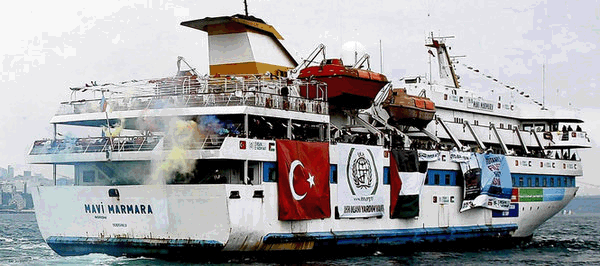
During the course of last week, the Israeli State Comptroller published his report into the events that took place when the IDF halted the entry of the Gaza Flotilla into Israeli territorial waters in May 2010. The State Comptroller is answerable only to the Knesset, and has the responsibility to supervise and review government policies and operations. He has looked at the Gaza Flotilla incident by examining the planning and decision-making by the government and the defence establishment in the period leading up to the incident. The actual military operation mounted, and the unfortunate events that took place on that fateful day when an IDF boarding party was lynched by the activists on the Mavi Marmara, did not form part of the report. The resulting defensive actions taken by the IDF soldiers on the ship resulted in the deaths of nine Turkish activists. These events have been the subject of investigations and well-documented reports published by the United Nations, by Turkey and by the IDF itself. The State Comptroller has a free hand in Israel to examine and report on all actions taken by the government, and related organisations, and the report into the Gaza Flotilla incident is an excellent example of the extent to which this free hand is exercised.
The report is filled with criticisms of the way in which the Israeli government handled the incident. Although the actual decision to board the ships to stop them entering Israeli waters is not specifically addressed or criticised, the way in which the decision was reached comes in for a great deal of condemnation. Even the prime minister is not beyond reproach in the report. Amongst its many criticisms, the report mainly criticises the prime minister. He is taken to task for holding informal and undocumented meetings that discussed how to deal with the flotilla in the period leading up to the incident. It is reported that government officials who should have attended these meetings were frequently not in attendance. Special mention is made of the fact that the National Security Council, a body established by the government especially to deal with situations like this, was essentially kept in the dark in the lead-up to the incident. The report is quite clear in holding the prime minister responsible for these failings. He was personally involved in many of the discussions and much of the planning surrounding the incident, and the buck stops with him as far as overseeing legal and effective preparations for events like these. No punches are spared in the 153 page report. Every misstep in the process is laid out in black and white, and has been extensively reported in the international press.
It is common knowledge that Israel has come in for much international criticism regarding the events of the Gaza Flotilla. International relations between Israel and Turkey are at a low point, and Turkey is determined to extract an official apology from Israel for the deaths of the 9 activists. Israel has expressed regret for their deaths, but is refusing to issue an official apology. Israeli soldiers have been cited in a Turkish court action, charging with them crimes relating to the deaths. In light of these and other international condemnations of Israel, there is a real question as to why the Israeli government has permitted the State Comptroller and the international press to publicise the severe criticism of the senior government officials? Surely, this can only fan the flames of the international disapproval that Israel continues to experience in relation to this issue. It may even strengthen any legal cases in Turkish law courts or other international law courts against individual Israelis who were involved in the events. What is the value of airing all Israel's dirty laundry in public?
The answer to these questions lies in Israel's democracy and democratic process. As the only democracy in the Middle East, Israel often finds herself behaving in ways that are alien to those countries that surround her. This even applies to Turkey, which was held out for a long time as the only Muslim democracy in the world. We have yet to see a state comptroller's report into the actions of Turkish Prime Minister Recep Tayyip Erdogan prior to the Gaza Flotilla, and we are also highly unlikely to ever see one. In Israel's democracy, however, this is standard practice. The public demands to know the truth about the behaviour of politicians and leaders, and holds them accountable for their actions. The role of the State Comptroller is to provide the public with the information that it needs for its evaluation. This information could potentially be vital ahead of general elections now slated for later during 2013 (the truth is that I don't believe that the criticism of the prime minister has done his election prospects any damage at all). Although the state's national security is of paramount importance and there are numerous laws that prevent publication of sensitive information, this cannot and does not come at the expense of Israel's democracy. This is a pillar of strength in the State of Israel in that it is vital for citizens to know that bad leaders and leadership will be publicly identified, and we need only wait until the next general election for them to be jettisoned. The price of this democracy is that we may be forced to air our dirty laundry in public from time to time.
If there is any consolation for the Israeli voting public, it is that the examples of poor governance displayed by Netanyahu and his colleagues and discussed in the report, seem not to be uncommon elsewhere in the democratic western world. In an article published in the Jerusalem Post over the weekend, former White House deputy national security advisor Elliott Abrams revealed that similar problems exist in the hallowed halls and corridors of power in the USA. He said that some of the best meetings held in the White House were informal and not documented. On the other hand, a formal decision-making process that complies with all governance requirements does not necessarily result in the correct decision being taken. He used the example of the decision taken by former US President George W. Bush not to take any decisive military action against the Syrian nuclear reactor. He claims that the wrong decision was taken despite impeccable reports and intelligence having been presented, and all the correct procedural steps having been followed. In this case, Israel was left to destroy the Srian nuclear reactor, an act which is particularly apprecicated these days during the unrest in Syria. Abrams claims that the most important thing in such situations, is having the right decision-maker, and not relying too much on the process.
The case against any Israelis relating to the nine Turkish activists will surely firstly need to examine the role played by the Turkish prime minister in allowing the flotilla to set out from Turkish ports. The Greek government demonstrated in a subsequent attempt to convene a flotilla from Greek ports, that it was possible to prevent the flotilla from sailing and avoid confrontation. Once the boats were already on the water and approaching Israeli territorial waters with hostile intentions, the Israeli government's only decision was how to stop them from proceeding rather than whether to stop them from continuing. The combination of boats approaching Israel, hostile activists on board armed with all manner of weapons and the IDF determined not to allow the flotilla to enter Israeli waters was always going to be recipe for disaster. One did not need any special intelligence to work this out, and the Turkish prime minister must surely have known this. Prime Minister Netanyahu made reference to this fact by saying that, despite the extensive preparations made by the Israeli government and the IDF for the arrival of the flotilla, he was convinced that the Turkish prime minister would not allow the ships to set sail. He was wrong, and the rest is now history.
As a concerned citizen of Israel, I feel assured by the State Comptroller's report, and by the fact that this has been made public. We have a right to know, even if we decide not to punish the guilty parties. Those who have erred also know that they will be held to public account in all that they do. This is an important tool of a democratic state. We will need to overcome the public humiliation of the dirty laundry having been aired, but this is a small price to pay for the defence of our democratic rights. Well done to the State Comptroller.
The report is filled with criticisms of the way in which the Israeli government handled the incident. Although the actual decision to board the ships to stop them entering Israeli waters is not specifically addressed or criticised, the way in which the decision was reached comes in for a great deal of condemnation. Even the prime minister is not beyond reproach in the report. Amongst its many criticisms, the report mainly criticises the prime minister. He is taken to task for holding informal and undocumented meetings that discussed how to deal with the flotilla in the period leading up to the incident. It is reported that government officials who should have attended these meetings were frequently not in attendance. Special mention is made of the fact that the National Security Council, a body established by the government especially to deal with situations like this, was essentially kept in the dark in the lead-up to the incident. The report is quite clear in holding the prime minister responsible for these failings. He was personally involved in many of the discussions and much of the planning surrounding the incident, and the buck stops with him as far as overseeing legal and effective preparations for events like these. No punches are spared in the 153 page report. Every misstep in the process is laid out in black and white, and has been extensively reported in the international press.
It is common knowledge that Israel has come in for much international criticism regarding the events of the Gaza Flotilla. International relations between Israel and Turkey are at a low point, and Turkey is determined to extract an official apology from Israel for the deaths of the 9 activists. Israel has expressed regret for their deaths, but is refusing to issue an official apology. Israeli soldiers have been cited in a Turkish court action, charging with them crimes relating to the deaths. In light of these and other international condemnations of Israel, there is a real question as to why the Israeli government has permitted the State Comptroller and the international press to publicise the severe criticism of the senior government officials? Surely, this can only fan the flames of the international disapproval that Israel continues to experience in relation to this issue. It may even strengthen any legal cases in Turkish law courts or other international law courts against individual Israelis who were involved in the events. What is the value of airing all Israel's dirty laundry in public?
The answer to these questions lies in Israel's democracy and democratic process. As the only democracy in the Middle East, Israel often finds herself behaving in ways that are alien to those countries that surround her. This even applies to Turkey, which was held out for a long time as the only Muslim democracy in the world. We have yet to see a state comptroller's report into the actions of Turkish Prime Minister Recep Tayyip Erdogan prior to the Gaza Flotilla, and we are also highly unlikely to ever see one. In Israel's democracy, however, this is standard practice. The public demands to know the truth about the behaviour of politicians and leaders, and holds them accountable for their actions. The role of the State Comptroller is to provide the public with the information that it needs for its evaluation. This information could potentially be vital ahead of general elections now slated for later during 2013 (the truth is that I don't believe that the criticism of the prime minister has done his election prospects any damage at all). Although the state's national security is of paramount importance and there are numerous laws that prevent publication of sensitive information, this cannot and does not come at the expense of Israel's democracy. This is a pillar of strength in the State of Israel in that it is vital for citizens to know that bad leaders and leadership will be publicly identified, and we need only wait until the next general election for them to be jettisoned. The price of this democracy is that we may be forced to air our dirty laundry in public from time to time.
If there is any consolation for the Israeli voting public, it is that the examples of poor governance displayed by Netanyahu and his colleagues and discussed in the report, seem not to be uncommon elsewhere in the democratic western world. In an article published in the Jerusalem Post over the weekend, former White House deputy national security advisor Elliott Abrams revealed that similar problems exist in the hallowed halls and corridors of power in the USA. He said that some of the best meetings held in the White House were informal and not documented. On the other hand, a formal decision-making process that complies with all governance requirements does not necessarily result in the correct decision being taken. He used the example of the decision taken by former US President George W. Bush not to take any decisive military action against the Syrian nuclear reactor. He claims that the wrong decision was taken despite impeccable reports and intelligence having been presented, and all the correct procedural steps having been followed. In this case, Israel was left to destroy the Srian nuclear reactor, an act which is particularly apprecicated these days during the unrest in Syria. Abrams claims that the most important thing in such situations, is having the right decision-maker, and not relying too much on the process.
The case against any Israelis relating to the nine Turkish activists will surely firstly need to examine the role played by the Turkish prime minister in allowing the flotilla to set out from Turkish ports. The Greek government demonstrated in a subsequent attempt to convene a flotilla from Greek ports, that it was possible to prevent the flotilla from sailing and avoid confrontation. Once the boats were already on the water and approaching Israeli territorial waters with hostile intentions, the Israeli government's only decision was how to stop them from proceeding rather than whether to stop them from continuing. The combination of boats approaching Israel, hostile activists on board armed with all manner of weapons and the IDF determined not to allow the flotilla to enter Israeli waters was always going to be recipe for disaster. One did not need any special intelligence to work this out, and the Turkish prime minister must surely have known this. Prime Minister Netanyahu made reference to this fact by saying that, despite the extensive preparations made by the Israeli government and the IDF for the arrival of the flotilla, he was convinced that the Turkish prime minister would not allow the ships to set sail. He was wrong, and the rest is now history.
As a concerned citizen of Israel, I feel assured by the State Comptroller's report, and by the fact that this has been made public. We have a right to know, even if we decide not to punish the guilty parties. Those who have erred also know that they will be held to public account in all that they do. This is an important tool of a democratic state. We will need to overcome the public humiliation of the dirty laundry having been aired, but this is a small price to pay for the defence of our democratic rights. Well done to the State Comptroller.
Tuesday, 29 May 2012
The African Migrant Problem Needs to be Solved Quickly
Israel has become inundated with African migrants, and this has raised some very difficult questions for the government about how to deal with them. The problem started out as a humanitarian one. Individuals and groups of people began turning up along Israel's southern border with Egypt. They were filled with horrifying stories about the countries that they had run away from, and the murder and destruction that was taking place there as part of the series of ongoing civil wars that are plaguing the African continent. The experiences that these individuals were forced to endure along their route to Israel was equally as horrendous. Marauding groups of thugs in the deserts and soldiers from national armies, most notably the Egyptian army, stripped these poor people of the few belongings that they had, and raped and murdered many of those with them.
The Israeli authorities remembered too well the experiences that Jews were forced to endure during the Holocaust, when few nations were prepared to accept Jewish refugees who had nowhere to go to escape the evil Nazi extermination camps. The African migrants were admitted across the border, given food shelter and basic medical treatment. They were also allowed to seek out employment despite their exact status being unsure. Children were sent to local schools, and policies regarding how to deal with this new phenomenon were being established on the fly. It is astonishing how quickly the desert telephone works. Word soon got back to Sudan and to Eritrea that the pot at the end of the rainbow is buried somewhere between Eilat and Tel Aviv. Within no time at all, thousands of migrants were clambering across the border in search of the pot of gold. Although they were running from horrendous situations in their home countries, these people could be classified more as economic migrants than as asylum seekers.
Fast-forward a few years to the current time, and the situation is extremely complicated. In some areas like Southern Sudan, the civil war is over, a new country has been established and Israel was one of the first to move to recognise the new country. Despite this fact, the citizens of Southern Sudan seem to have no intention of leaving Israel and returning to their newly-established homeland. Instead, more and more seem to be arriving at the borders. They have established communities of their own in towns and cities around Israel. They are working in hotels, running coffee shops, Internet cafes, bars, restaurants and market stalls and their children are attending Israeli schools. Their presence is becoming increasingly permanent in spite of the fact that the government has still yet to determine their legal status. Suddenly, the African migrant community numbers 60,000 people and is beginning to make its presence felt in Israeli society in every possible way.
An undercurrent of dissatisfaction has been building below the surface about the newest of Israel's immigrant communities. Economic times are tough, and there is a feeling amongst the weaker members of Israeli society that the African migrant community is receiving resources that should be channelled towards Israeli citizens instead. Many charities have decided to route their efforts to help African migrants, often at the expense of Israeli citizens. Cheap housing units are occupied by African migrants and often lead to price rises, making it difficult for others around. There are accusations that school places that should be available to Israeli children, are being occupied by African children. The character of some of Tel Aviv's oldest neighbourhoods is reported to have changed dramatically to reflect the increasing number of Africans living there.
The situation came to a head in the past few weeks with a number of incidents of violence having been blamed on African migrants. A few rape accusations have been made against Africans, while reports have surfaced from areas where they live accusing them of burglary and other violent crimes. While none of these accusations have yet been proven, it has allowed the undercurrent of dissatisfaction amongst some Israelis to boil over into full-blown rage. Protests have taken place across Israel to demonstrate against the continued presence of African migrants, and the government is now being forced to take a stand. Unfortunately, the protests have turned violent showing a really ugly side to Israeli society. African migrants and their businesses and homes have been attacked as part of these protests, some of which were also attended by members of Knesset and other politicians.
In the first instance, the violence against others living in Israel should not be tolerated. It is right that the police have arrested some of the perpetrators of this violence, and that they should be prosecuted under the law. In the second place, it is right that the government should be held to account for the lack of policy on the migrants. While the migrants had no alternative safe haven, it was acceptable and desirable for Israel to give them shelter. Now, however, they have place to return to, and Israel should insist that they do so. No visitor to Israel should be allowed to outstay their welcome, particularly if they will be utilising scarce resources that should be made available to the weakest in Israeli society. The fact that the economic and social conditions in Southern Sudan or Eritrea are not quite up to the same level in the State of Israel is not the consideration. If they are able to return in a manner that does not risk their personal safety, this should be enough to justify their repatriation.
Over the years, Israel has been forced to deal with a number of migrant communities. There are thousands of Filipinos working to look after the elderly and the weak who require close care. There are also thousands of Chinese workings employed in agriculture and construction. Once these people have lived and worked here for a few years, and even had families here, the decision to deport them becomes much more difficult.
I feel really proud that Israel was willing and able to open its doors to people in desperate need, and in immense physical danger. This reflects our empathy as a nation for the homeless and the weak in the world. Now that the job has been done and the charity administered, the migrants should return home to allow Israel to put her own house in order. After all, we wish to be there again should the need arise in the future. By sending the migrants to their places of origin, it will mean that Israelis will be able and willing to help again if required. By allowing them to remain indefinitely, it puts this help at grave risk, and risks a great deal in our own society.
The Israeli authorities remembered too well the experiences that Jews were forced to endure during the Holocaust, when few nations were prepared to accept Jewish refugees who had nowhere to go to escape the evil Nazi extermination camps. The African migrants were admitted across the border, given food shelter and basic medical treatment. They were also allowed to seek out employment despite their exact status being unsure. Children were sent to local schools, and policies regarding how to deal with this new phenomenon were being established on the fly. It is astonishing how quickly the desert telephone works. Word soon got back to Sudan and to Eritrea that the pot at the end of the rainbow is buried somewhere between Eilat and Tel Aviv. Within no time at all, thousands of migrants were clambering across the border in search of the pot of gold. Although they were running from horrendous situations in their home countries, these people could be classified more as economic migrants than as asylum seekers.
Fast-forward a few years to the current time, and the situation is extremely complicated. In some areas like Southern Sudan, the civil war is over, a new country has been established and Israel was one of the first to move to recognise the new country. Despite this fact, the citizens of Southern Sudan seem to have no intention of leaving Israel and returning to their newly-established homeland. Instead, more and more seem to be arriving at the borders. They have established communities of their own in towns and cities around Israel. They are working in hotels, running coffee shops, Internet cafes, bars, restaurants and market stalls and their children are attending Israeli schools. Their presence is becoming increasingly permanent in spite of the fact that the government has still yet to determine their legal status. Suddenly, the African migrant community numbers 60,000 people and is beginning to make its presence felt in Israeli society in every possible way.
An undercurrent of dissatisfaction has been building below the surface about the newest of Israel's immigrant communities. Economic times are tough, and there is a feeling amongst the weaker members of Israeli society that the African migrant community is receiving resources that should be channelled towards Israeli citizens instead. Many charities have decided to route their efforts to help African migrants, often at the expense of Israeli citizens. Cheap housing units are occupied by African migrants and often lead to price rises, making it difficult for others around. There are accusations that school places that should be available to Israeli children, are being occupied by African children. The character of some of Tel Aviv's oldest neighbourhoods is reported to have changed dramatically to reflect the increasing number of Africans living there.
The situation came to a head in the past few weeks with a number of incidents of violence having been blamed on African migrants. A few rape accusations have been made against Africans, while reports have surfaced from areas where they live accusing them of burglary and other violent crimes. While none of these accusations have yet been proven, it has allowed the undercurrent of dissatisfaction amongst some Israelis to boil over into full-blown rage. Protests have taken place across Israel to demonstrate against the continued presence of African migrants, and the government is now being forced to take a stand. Unfortunately, the protests have turned violent showing a really ugly side to Israeli society. African migrants and their businesses and homes have been attacked as part of these protests, some of which were also attended by members of Knesset and other politicians.
In the first instance, the violence against others living in Israel should not be tolerated. It is right that the police have arrested some of the perpetrators of this violence, and that they should be prosecuted under the law. In the second place, it is right that the government should be held to account for the lack of policy on the migrants. While the migrants had no alternative safe haven, it was acceptable and desirable for Israel to give them shelter. Now, however, they have place to return to, and Israel should insist that they do so. No visitor to Israel should be allowed to outstay their welcome, particularly if they will be utilising scarce resources that should be made available to the weakest in Israeli society. The fact that the economic and social conditions in Southern Sudan or Eritrea are not quite up to the same level in the State of Israel is not the consideration. If they are able to return in a manner that does not risk their personal safety, this should be enough to justify their repatriation.
Over the years, Israel has been forced to deal with a number of migrant communities. There are thousands of Filipinos working to look after the elderly and the weak who require close care. There are also thousands of Chinese workings employed in agriculture and construction. Once these people have lived and worked here for a few years, and even had families here, the decision to deport them becomes much more difficult.
I feel really proud that Israel was willing and able to open its doors to people in desperate need, and in immense physical danger. This reflects our empathy as a nation for the homeless and the weak in the world. Now that the job has been done and the charity administered, the migrants should return home to allow Israel to put her own house in order. After all, we wish to be there again should the need arise in the future. By sending the migrants to their places of origin, it will mean that Israelis will be able and willing to help again if required. By allowing them to remain indefinitely, it puts this help at grave risk, and risks a great deal in our own society.
Wednesday, 16 May 2012
Bibi Does Election U-Turn
Within the space of three short days, early elections were on and
then off again. The timescale of this U-turn was quite astonishing. On
Sunday evening, Prime Minister Netanyahu announced to his Likud party
convention that early elections would be held. On Monday morning, the
first reading of the bill to dissolve the Knesset was passed. In the
early hours of Tuesday morning, the new coalition agreement was signed
with Shaul Mofaz and the Kadima Party, and early elections were
cancelled. By bringing Kadima into the coalition, Bibi has almost
created a government of national unity. The only main party which is
now outside of the coalition is the Labour Party, and its new leader
Shelly Yachimovich becomes the leader of the official opposition.
There are a number of people, both within political circles and outside, who feel that Bibi's conduct on the issue of the elections has been less than fair and honest. It transpires that he was holding coalition discussions with Shaul Mofaz for at least a week before the announcement that an agreement had been reached. This begs the question why Bibi decided to make a public announcement about early elections and allow the Knesset to debate the first reading of the dissolution bill, when he was on the verge of concluding a new coalition agreement? Was this a negotiating tactic to force Mofaz to make the final concession? The formal announcement that an early election would take place certainly put the cat amongst the pigeons. No sooner had electioneering got into full force, when it was all frozen.
Even though the way in which it was done raises big questions, I believe that the act of delaying the election is probably more beneficial for the State of Israel and its citizens than proceeding to early elections. Israel is currently confronting a number of critical issues, and there was a huge danger of these issues becoming too wrapped up with a general election. Despite the international focus having been moved away from Iran over the past few months, this issue probably remains Israel's largest challenge in the short to medium term. Some parties are taking a much more aggressive approach advising Israel to take military action against Iran. Others are advising a more cautious and conciliatory approach. Even former heads of intelligence have weighed in with their "words of wisdom", only in an attempt to exact political revenge on those that they don't like. This is a fraught subject that has major implications for Israel and her citizens. A decision taken by a stable almost-unity government is surely better than airing this issue in election platforms.
There is also the controversial issue of the replacement to the Tal Law. This is an issue which is split down party political lines as the religious parties are doing their utmost to convince lawmakers to enact a replacement law that will still allow yeshivah boys to be exempt from military service. Opponents wish to see at least some minimum form of national service which will apply to all of Israel's citizens, without exceptions. This is a messy political hot potato that is best kept out of election platform politics.
The passing of the new budget is almost always held to ransom by coalition negotiations. Parties negotiating possible inclusion in the coalition frequently predicate their support of the budget on receiving key concessions in the coalition agreement. At a time when the economic stability of many countries in the world is so much under threat, economic high jinks cannot be afforded in Israel. It would be good to get the budget approved without the need to bow to parties looking to extract value from the coalition negotiations.
For Kadima, the extension of the Knesset term has saved it from election decimation. There is little doubt that a general election at this time would have substantially reduced its Knesset faction. At the same time the new coalition agreement has raised doubts in the minds of many Kadima members, particularly those who came from parties on the left of the political spectrum, about whether this is a first step towards uniting with the Likud. The most senior of these doubters, Kadima council chairman Haim Ramon, immediately tendered his resignation from the party. He was followed by many grass-roots members of the party in a move which threatens to split the party, even before a single ballot is cast in a general election.
The big winner in this move is Prime Minister Netanyahu. He has shown himself to be a shrewd political player, even though he has trodden on more than a few toes in the process. The upshot of all of his political manoeuvring is that Bibi is king of Israel, just as his supporters like to chant at public gatherings. He currently holds all the cards in his hands, and has a very strong political position to see him through to the end of the Knesset session and into the next general election. He will need to see out at least one more summer, which is promising to be a summer with greater social protest than we saw last summer. This is certainly a threat to him, but the electorate has little or no alternative choices to select from. Opposition parties to the Likud are disparate and decimated.
The electorate has been spared an election this summer. This will save a substantial sum of money, and will delay the inevitable filthy negative politics associated with election campaigns for at least another year. I hope that, by the time we reach the start of the next campaign in a year or 18 months from now, many of the critical issues mentioned above that urgently require attention will have been dealt with.
There are a number of people, both within political circles and outside, who feel that Bibi's conduct on the issue of the elections has been less than fair and honest. It transpires that he was holding coalition discussions with Shaul Mofaz for at least a week before the announcement that an agreement had been reached. This begs the question why Bibi decided to make a public announcement about early elections and allow the Knesset to debate the first reading of the dissolution bill, when he was on the verge of concluding a new coalition agreement? Was this a negotiating tactic to force Mofaz to make the final concession? The formal announcement that an early election would take place certainly put the cat amongst the pigeons. No sooner had electioneering got into full force, when it was all frozen.
Even though the way in which it was done raises big questions, I believe that the act of delaying the election is probably more beneficial for the State of Israel and its citizens than proceeding to early elections. Israel is currently confronting a number of critical issues, and there was a huge danger of these issues becoming too wrapped up with a general election. Despite the international focus having been moved away from Iran over the past few months, this issue probably remains Israel's largest challenge in the short to medium term. Some parties are taking a much more aggressive approach advising Israel to take military action against Iran. Others are advising a more cautious and conciliatory approach. Even former heads of intelligence have weighed in with their "words of wisdom", only in an attempt to exact political revenge on those that they don't like. This is a fraught subject that has major implications for Israel and her citizens. A decision taken by a stable almost-unity government is surely better than airing this issue in election platforms.
There is also the controversial issue of the replacement to the Tal Law. This is an issue which is split down party political lines as the religious parties are doing their utmost to convince lawmakers to enact a replacement law that will still allow yeshivah boys to be exempt from military service. Opponents wish to see at least some minimum form of national service which will apply to all of Israel's citizens, without exceptions. This is a messy political hot potato that is best kept out of election platform politics.
The passing of the new budget is almost always held to ransom by coalition negotiations. Parties negotiating possible inclusion in the coalition frequently predicate their support of the budget on receiving key concessions in the coalition agreement. At a time when the economic stability of many countries in the world is so much under threat, economic high jinks cannot be afforded in Israel. It would be good to get the budget approved without the need to bow to parties looking to extract value from the coalition negotiations.
For Kadima, the extension of the Knesset term has saved it from election decimation. There is little doubt that a general election at this time would have substantially reduced its Knesset faction. At the same time the new coalition agreement has raised doubts in the minds of many Kadima members, particularly those who came from parties on the left of the political spectrum, about whether this is a first step towards uniting with the Likud. The most senior of these doubters, Kadima council chairman Haim Ramon, immediately tendered his resignation from the party. He was followed by many grass-roots members of the party in a move which threatens to split the party, even before a single ballot is cast in a general election.
The big winner in this move is Prime Minister Netanyahu. He has shown himself to be a shrewd political player, even though he has trodden on more than a few toes in the process. The upshot of all of his political manoeuvring is that Bibi is king of Israel, just as his supporters like to chant at public gatherings. He currently holds all the cards in his hands, and has a very strong political position to see him through to the end of the Knesset session and into the next general election. He will need to see out at least one more summer, which is promising to be a summer with greater social protest than we saw last summer. This is certainly a threat to him, but the electorate has little or no alternative choices to select from. Opposition parties to the Likud are disparate and decimated.
The electorate has been spared an election this summer. This will save a substantial sum of money, and will delay the inevitable filthy negative politics associated with election campaigns for at least another year. I hope that, by the time we reach the start of the next campaign in a year or 18 months from now, many of the critical issues mentioned above that urgently require attention will have been dealt with.
Sunday, 6 May 2012
A Little Election Excitement
Despite the fact that Prime Minister Netanyahu has been out of
circulation as he has been sitting shiva following the death of his
father, the Likud machine is working hard to arrange the next general
election. According to the law, the election could be called anytime
until November 2013. The prime minister and his advisers, however,
have decided to accelerate the date to September this year.
A bill to dissolve parliament ahead of the next election is due to be discussed in the Knesset today (Sunday 6th May) which could see the Knesset dissolved in one week’s time. Even before the Knesset has been dissolved, I notice that campaigning has begun. Advertisements have already been plastered onto buses and primary campaigns have sprung into action. The election campaign has gained such rapid momentum that it is difficult to believe that only two weeks ago, there was no official speak of an election at all.
The prime minister has decided to call an election now because he is obviously riding something of a wave of popularity right now. He has had a fairly stable term in office without any major ups and downs. He has done nothing remarkable, but has also not really put a foot wrong. His popularity seems largely to have depended on the things that have been happening in the other parties rather than actions of his government. The other parties have been very helpful in assisting Netanyahu’s fortunes over the term of this Knesset. The contest for the leadership of the Labour Party resulted in considerable damage to the party as the two main rivals bitterly vied for the top position. Since then, the new leader, Shelly Yachimovich, has not really asserted herself in any major way in the public eye. Now that there is talk of an early general election, she has suddenly made a public statement saying that Labour could defeat Likud in the election. This is nothing more than wishful thinking. Tzipi Livni’s defeat as leader of Kadima and her subsequent resignation from the Knesset have left the party languishing. Opinion polls suggest that Kadima could be demoted from the largest party to the fifth largest after the next election.
In addition, the prime minister would have been dreading another summer of social protests. He managed, somehow, to cling on last summer during the height of the tent protest when his government was being held responsible for the constant and dramatic increases in the cost of living. He certainly would not wish to repeat that experience if he can possibly avoid it. The election campaign over the summer months is, I think, partially designed to divert attention away from the social protests and bring other parties into play in the economic discussion.
It will take the Israeli public a little more time to get enthusiastic about the election. The truth is that it would be very surprising if Netanyahu is not reelected as prime minister. Most people have already resigned themselves to this outcome, and have moved on. So what is there to be excited about in an election that is not expected to deliver anything new? Many will be voting for Netanyahu to register a protest vote against the others, who all seem unelectable. Even Ehud Barak, who is a previous prime minister, seems a million miles away from the prime minister’s residence in Jerusalem’s Balfour Street in the eyes of most voters. The minor details of whether the Likud gains 31 seats in place of its current 27 seats, or if Kadima is the largest or the smallest party in the Knesset all seem unimportant in the grand scheme of things. Voters may be tempted to vote for one of the smaller parties if they believe that strengthening this party’s position within a coalition government may help to promote certain policies or legislation. This been proven to be effective by the Yisrael Beiteinu party in the existing coalition, which has been prepared to vigorously pursue issues that are of unique interest only to its voting constituency. It has enjoyed some success where this is concerned, and this fact is likely to secure it a similarly strong position in the next Knesset.
Despite the fact that the election seems not to inspire much excitement amongst the Israeli voting public, especially at this stage of the campaign, there are many reasons why Israelis should be excited and motivated by the election. We need always to bear in mind that this is the only true democracy in the Middle East, a fact for us all to be proud of. The election campaign is the greatest example of this democracy at work. This is also, uniquely, a Jewish democracy. This gives the chance to debate and vote on issues that are particular to us as Jews, and especially issues that concern our ongoing safety and security within the family of nations. In this respect, the Israeli elections have an impact on Jews living outside of Israel as well as within her borders. The more democratic the outcome of the election, the greater is our security and the more secure our future as Jews in the world. We should remember that the Arab citizens of Israel are also voters, and have their own parties which will send representatives to the Knesset as they have done since Israel was founded.
This democracy is not only important to Israelis and Jews, but is also important to the free world. Israel is a beacon of light in a dark Middle Eastern ocean that supports and finances Muslim extremism and terrorism in all corners of the earth. The fact that Israel contributes to a first line of defense against the threats of Iranian nuclear plans, Syrian government violence and Hamas and Hezbollah terrorism amongst others things, will always be a source of comfort and relief to many in the free world.
Unfortunately, democracy does not always deliver the right or the desired result. There are times that it could be argued that democracy has got things wrong. The best thing about democracy, however, is that it ensures the people the right to have their say again within a few years, and to hopefully put the wrongs right. This is certainly the character of Israel’s democracy, and is a cause for celebration. For so many years, Jews were denied the right to vote in the countries of their residence, and yearned for the opportunity to control their own destiny even in the smallest way. With the birth of the democratic State of Israel, Jews have been granted the opportunity to exercise this right under the Law of Return. It requires simply to prove that you are the grandchild of a Jew, and to turn up at the immigration desk at Ben Gurion Airport.
So, while Israelis consider who will deliver the best economic solution for them for the next four years or who will give them the best religious or ecological answers, we should not lose sight of the big picture that this election represents for Jews within and outside of Israel. Many generations of Jews would have been astonished and grateful for the little things that we take for granted. We are living their dream. Long live democracy in the State of Israel.
A bill to dissolve parliament ahead of the next election is due to be discussed in the Knesset today (Sunday 6th May) which could see the Knesset dissolved in one week’s time. Even before the Knesset has been dissolved, I notice that campaigning has begun. Advertisements have already been plastered onto buses and primary campaigns have sprung into action. The election campaign has gained such rapid momentum that it is difficult to believe that only two weeks ago, there was no official speak of an election at all.
The prime minister has decided to call an election now because he is obviously riding something of a wave of popularity right now. He has had a fairly stable term in office without any major ups and downs. He has done nothing remarkable, but has also not really put a foot wrong. His popularity seems largely to have depended on the things that have been happening in the other parties rather than actions of his government. The other parties have been very helpful in assisting Netanyahu’s fortunes over the term of this Knesset. The contest for the leadership of the Labour Party resulted in considerable damage to the party as the two main rivals bitterly vied for the top position. Since then, the new leader, Shelly Yachimovich, has not really asserted herself in any major way in the public eye. Now that there is talk of an early general election, she has suddenly made a public statement saying that Labour could defeat Likud in the election. This is nothing more than wishful thinking. Tzipi Livni’s defeat as leader of Kadima and her subsequent resignation from the Knesset have left the party languishing. Opinion polls suggest that Kadima could be demoted from the largest party to the fifth largest after the next election.
In addition, the prime minister would have been dreading another summer of social protests. He managed, somehow, to cling on last summer during the height of the tent protest when his government was being held responsible for the constant and dramatic increases in the cost of living. He certainly would not wish to repeat that experience if he can possibly avoid it. The election campaign over the summer months is, I think, partially designed to divert attention away from the social protests and bring other parties into play in the economic discussion.
It will take the Israeli public a little more time to get enthusiastic about the election. The truth is that it would be very surprising if Netanyahu is not reelected as prime minister. Most people have already resigned themselves to this outcome, and have moved on. So what is there to be excited about in an election that is not expected to deliver anything new? Many will be voting for Netanyahu to register a protest vote against the others, who all seem unelectable. Even Ehud Barak, who is a previous prime minister, seems a million miles away from the prime minister’s residence in Jerusalem’s Balfour Street in the eyes of most voters. The minor details of whether the Likud gains 31 seats in place of its current 27 seats, or if Kadima is the largest or the smallest party in the Knesset all seem unimportant in the grand scheme of things. Voters may be tempted to vote for one of the smaller parties if they believe that strengthening this party’s position within a coalition government may help to promote certain policies or legislation. This been proven to be effective by the Yisrael Beiteinu party in the existing coalition, which has been prepared to vigorously pursue issues that are of unique interest only to its voting constituency. It has enjoyed some success where this is concerned, and this fact is likely to secure it a similarly strong position in the next Knesset.
Despite the fact that the election seems not to inspire much excitement amongst the Israeli voting public, especially at this stage of the campaign, there are many reasons why Israelis should be excited and motivated by the election. We need always to bear in mind that this is the only true democracy in the Middle East, a fact for us all to be proud of. The election campaign is the greatest example of this democracy at work. This is also, uniquely, a Jewish democracy. This gives the chance to debate and vote on issues that are particular to us as Jews, and especially issues that concern our ongoing safety and security within the family of nations. In this respect, the Israeli elections have an impact on Jews living outside of Israel as well as within her borders. The more democratic the outcome of the election, the greater is our security and the more secure our future as Jews in the world. We should remember that the Arab citizens of Israel are also voters, and have their own parties which will send representatives to the Knesset as they have done since Israel was founded.
This democracy is not only important to Israelis and Jews, but is also important to the free world. Israel is a beacon of light in a dark Middle Eastern ocean that supports and finances Muslim extremism and terrorism in all corners of the earth. The fact that Israel contributes to a first line of defense against the threats of Iranian nuclear plans, Syrian government violence and Hamas and Hezbollah terrorism amongst others things, will always be a source of comfort and relief to many in the free world.
Unfortunately, democracy does not always deliver the right or the desired result. There are times that it could be argued that democracy has got things wrong. The best thing about democracy, however, is that it ensures the people the right to have their say again within a few years, and to hopefully put the wrongs right. This is certainly the character of Israel’s democracy, and is a cause for celebration. For so many years, Jews were denied the right to vote in the countries of their residence, and yearned for the opportunity to control their own destiny even in the smallest way. With the birth of the democratic State of Israel, Jews have been granted the opportunity to exercise this right under the Law of Return. It requires simply to prove that you are the grandchild of a Jew, and to turn up at the immigration desk at Ben Gurion Airport.
So, while Israelis consider who will deliver the best economic solution for them for the next four years or who will give them the best religious or ecological answers, we should not lose sight of the big picture that this election represents for Jews within and outside of Israel. Many generations of Jews would have been astonished and grateful for the little things that we take for granted. We are living their dream. Long live democracy in the State of Israel.
Monday, 2 January 2012
The Best and Worst of 2011
As we welcome 2012, it gives the opportunity to reflect on the best
and worst parts of 2011. In Israel, 2011 was an eventful year, including a number of interesting and challenging events. For some, it was a year that they would prefer to forget. Despite many negative aspects to the year, I think
that Israelis will regard 2011 as having been a year that was more
positive than negative. Here are the main reasons why I think that this
was the case.
The best story coming out of 2011 was the release of captured Israeli soldier, Gilad Shalit. It is not only the fact that Gilad was returned safely to the arms of his family that makes this story good. The fact that the Israeli government was finally able to agree and execute this deal sends some amazingly strong and positive statements to all Israelis. For me, this is a classic story where the right thing finally triumphed. Like all good stories, this has a negative side to it as well. I really cannot blame all of those who opposed the deal due to the "price" that had to be paid in terms of the number of Palestinian prisoners who were released, even those who have murdered Israelis. I also know how paranoid the Israel Defense Force (IDF) is about the possibility of soldiers being kidnapped in the future, and the measures that have been put in place to try to avoid this at any price. I feel that working to avoid future kidnappings is a better reaction than leaving Gilad in captivity under the conditions that he was held. This was, by far, the highlight of the year in my view.
Another good story of 2011 was that of the social protests. Hundreds of thousands of people took to the streets to demonstrate against lack of social justice, and of the dramatic increases in the cost of living without commensurate increases in earnings. This was a great story for a number of reasons. It was good to see the Israeli public having the time and energy to devote to social issues, and behaving in a manner that most "normal" countries behave. In the 63 years since Israel's independence, most of the time has been spent worrying about an existential threat. Wars have been fought, terror attacks overcome and many people have been left dead and injured. This allows little time or energy to give even a fleeting thought to daily social issues. The fact that hundreds of thousands of Israelis were able to come out into the street to protest social issues gives some indication that the existential threat is not quite at the same level as it has been in the past. It also shows what Israelis really care about, and shows the real democracy that exists in Israel. On all of these levels, the protests were extremely encouraging. These good points, however, should not cause us to lose sight of the core issue of these protests - the economic inequality and hardships that many people are suffering. Unfortunately, the government has not responded sufficiently to the message of the protest marches, and this issue is likely to plague us for some time yet.
A further good story for 2011 was the extent to which the economy succeeded in holding up during the year. Even though this seems to be at odds with the message brought by the social protest movement, more Israelis were in employment during 2011 than at any other time in Israel's history. In addition, while economies around the world were floundering and suffering all types of economic problems, Israel somehow managed to keep its economy on track. This does not mean that the year translated into a boom year for Israel. It does, however, continue the theme of displaying a real underlying strength to Israel's economy that was shown during 2008 when the credit crunch hit many economies so hard. Once again in 2011, Israel's economy has performed admirably. Along with the good things, come some very difficult questions. Why are so many Israelis struggling financially when the economy is at almost full employment? This is clearly something that needs to be addressed as part of the social equality agenda.
The major regional story this year was the unfolding of the Arab Spring in countries in the Middle East and North Africa. The way in which the Arab Spring has swept through the region could never have been predicted. Even though this is great news for democracy in the Middle East, it has created an instability that is proving to be negative for Israel, and many countries in the western world. While the free world has an obligation to support the move towards democracy in principle, there is a real problem about whether these countries are really ready to embrace democracy. In many respects, stability in the Arab world is more important than democracy. As things seem at the moment, the two don't seem to be able to live side by side. The change of regime in Egypt is particularly concerning, with the increasing popularity of the Muslim Brotherhood. The protest movement in Syria also promises some dramatic changes to regional politics, and they are not necessarily all going to be positive.
The second major regional story surrounds Iran's development of nuclear weapons. 2011 can be characterised as a year of confirmation and inaction where this is concerned. The international community were presented with irrefutable evidence of Iran's development of nuclear missiles. Even the International Atomic Energy Agency were forced to accept that Israel's representations about Iran's nuclear program have been correct all along. Having had this fact confirmed, the best that the international community could muster up, were a few ineffectual sanctions. It has become clear that Iran is not only setting out to threaten Israel. The events over the past few days in the Straits of Hormuz are a clear challenge to the US. The military exercise on this occasion closed the straights for only a short period of time. The next time could be for longer, precipitating a potential military conflict with the USA.
Despite the fact that 2011 was a hugely eventful year, it seems only to have set the scene for what awaits us in 2012. Israel's social justice movement is likely to be more vociferous, particularly if the economy suffers more than it did in 2011. The government will need to be prepared to commit to spend more money on social issues, and to see these promises through. This is an issue that is no less imporant than Israel's security challenges.
The Arab Spring will come to a head in Syria. It seems as though the Sunni Muslims, who represent over 70% of the population, are likely to gain the ascendancy after having been ruled by the minority Alawites for many years. The Spring could yet spread to other countries in the region, and this could present a greater threat to Israel as more of her neighbours became destabilised by these events.
I expect that 2012 will also see the Iranian nuclear issue come to a head, as Iran continues to intimidate and provoke Israel, the USA and other western countries. All of this adds up to 2012 looking to be a tough year.
In between the pessimistic expectations are a few rays of light. Even though I expect a great deal of instability during 2012, it is my hope that this will then bring a period of greater stability as is often the case. I also hope that the unfolding Arab Spring can create a new, more compromising, reality with the Palestinians to allow moves towards a genuine peace based on mutual recognition and respect.
It is my hope and prayer that 2012 holds only great things for all of you. Happy new year!!
The best story coming out of 2011 was the release of captured Israeli soldier, Gilad Shalit. It is not only the fact that Gilad was returned safely to the arms of his family that makes this story good. The fact that the Israeli government was finally able to agree and execute this deal sends some amazingly strong and positive statements to all Israelis. For me, this is a classic story where the right thing finally triumphed. Like all good stories, this has a negative side to it as well. I really cannot blame all of those who opposed the deal due to the "price" that had to be paid in terms of the number of Palestinian prisoners who were released, even those who have murdered Israelis. I also know how paranoid the Israel Defense Force (IDF) is about the possibility of soldiers being kidnapped in the future, and the measures that have been put in place to try to avoid this at any price. I feel that working to avoid future kidnappings is a better reaction than leaving Gilad in captivity under the conditions that he was held. This was, by far, the highlight of the year in my view.
Another good story of 2011 was that of the social protests. Hundreds of thousands of people took to the streets to demonstrate against lack of social justice, and of the dramatic increases in the cost of living without commensurate increases in earnings. This was a great story for a number of reasons. It was good to see the Israeli public having the time and energy to devote to social issues, and behaving in a manner that most "normal" countries behave. In the 63 years since Israel's independence, most of the time has been spent worrying about an existential threat. Wars have been fought, terror attacks overcome and many people have been left dead and injured. This allows little time or energy to give even a fleeting thought to daily social issues. The fact that hundreds of thousands of Israelis were able to come out into the street to protest social issues gives some indication that the existential threat is not quite at the same level as it has been in the past. It also shows what Israelis really care about, and shows the real democracy that exists in Israel. On all of these levels, the protests were extremely encouraging. These good points, however, should not cause us to lose sight of the core issue of these protests - the economic inequality and hardships that many people are suffering. Unfortunately, the government has not responded sufficiently to the message of the protest marches, and this issue is likely to plague us for some time yet.
A further good story for 2011 was the extent to which the economy succeeded in holding up during the year. Even though this seems to be at odds with the message brought by the social protest movement, more Israelis were in employment during 2011 than at any other time in Israel's history. In addition, while economies around the world were floundering and suffering all types of economic problems, Israel somehow managed to keep its economy on track. This does not mean that the year translated into a boom year for Israel. It does, however, continue the theme of displaying a real underlying strength to Israel's economy that was shown during 2008 when the credit crunch hit many economies so hard. Once again in 2011, Israel's economy has performed admirably. Along with the good things, come some very difficult questions. Why are so many Israelis struggling financially when the economy is at almost full employment? This is clearly something that needs to be addressed as part of the social equality agenda.
The major regional story this year was the unfolding of the Arab Spring in countries in the Middle East and North Africa. The way in which the Arab Spring has swept through the region could never have been predicted. Even though this is great news for democracy in the Middle East, it has created an instability that is proving to be negative for Israel, and many countries in the western world. While the free world has an obligation to support the move towards democracy in principle, there is a real problem about whether these countries are really ready to embrace democracy. In many respects, stability in the Arab world is more important than democracy. As things seem at the moment, the two don't seem to be able to live side by side. The change of regime in Egypt is particularly concerning, with the increasing popularity of the Muslim Brotherhood. The protest movement in Syria also promises some dramatic changes to regional politics, and they are not necessarily all going to be positive.
The second major regional story surrounds Iran's development of nuclear weapons. 2011 can be characterised as a year of confirmation and inaction where this is concerned. The international community were presented with irrefutable evidence of Iran's development of nuclear missiles. Even the International Atomic Energy Agency were forced to accept that Israel's representations about Iran's nuclear program have been correct all along. Having had this fact confirmed, the best that the international community could muster up, were a few ineffectual sanctions. It has become clear that Iran is not only setting out to threaten Israel. The events over the past few days in the Straits of Hormuz are a clear challenge to the US. The military exercise on this occasion closed the straights for only a short period of time. The next time could be for longer, precipitating a potential military conflict with the USA.
Despite the fact that 2011 was a hugely eventful year, it seems only to have set the scene for what awaits us in 2012. Israel's social justice movement is likely to be more vociferous, particularly if the economy suffers more than it did in 2011. The government will need to be prepared to commit to spend more money on social issues, and to see these promises through. This is an issue that is no less imporant than Israel's security challenges.
The Arab Spring will come to a head in Syria. It seems as though the Sunni Muslims, who represent over 70% of the population, are likely to gain the ascendancy after having been ruled by the minority Alawites for many years. The Spring could yet spread to other countries in the region, and this could present a greater threat to Israel as more of her neighbours became destabilised by these events.
I expect that 2012 will also see the Iranian nuclear issue come to a head, as Iran continues to intimidate and provoke Israel, the USA and other western countries. All of this adds up to 2012 looking to be a tough year.
In between the pessimistic expectations are a few rays of light. Even though I expect a great deal of instability during 2012, it is my hope that this will then bring a period of greater stability as is often the case. I also hope that the unfolding Arab Spring can create a new, more compromising, reality with the Palestinians to allow moves towards a genuine peace based on mutual recognition and respect.
It is my hope and prayer that 2012 holds only great things for all of you. Happy new year!!
Monday, 21 November 2011
Assad Keeps Fighting, But Cannot Survive
The uprising in Syria has continued unabated for the past 8 months. Despite the fact that thousands of people have already been killed in the process, the uprising shows no signs of being quelled by the strong-arm tactics adopted by President Bashar al-Assad. Despite Assad fighting the civilian uprising using all military options available to him, he cannot survive this challenge to his leadership. In the interests of preventing further loss of life, Bashar should accept the inevitable as soon as possible and leave office.
The Syrian uprising has progressed in a substantially different way to the uprisings that took place in Tunisia, Egypt, Yemen and Libya. The biggest difference in Syria is the fact that the regime has managed to survive for as long as 8 months, despite constant protests by the opposition and Syrian civilians over this time. We all know that the long-ruling and well-established governments of Gadaffi, Mubarak and others were unable to survive the attacks that they came under for more than a few months. So what is it about Assad and Syria that has allowed him to survive for this period of time, despite having already killed more than 3,000 civilians (according to the UN) in his attempt to put down the uprising?
Despite the fact that the uprisings in other countries in the region proved to be the catalyst for the demonstrations in Syria, Assad has benefited from the fact other countries have been suffering unrest. This has diverted the attention of the world and the international media elsewhere, while he tries to take care of his own back yard. So far, he has managed to escape the fates that Mubarak and Gadaffi suffered when the world's leaders and media were focused on the events in these countries. While there have been a few reports and international condemnation of events in Syria, these have not been anywhere as directed as those that were directed at Mubarak and Gadaffi before the demise of these two leaders. In Assad's case, there are indications that this is about to change over the coming weeks and months now that Syria has been brought into target by the international community.
In the case particularly of Libya, oil had much to do with the decision by NATO to take an active part in Libya's uprising. There can be no doubt that Gadaffi would probably still have been in power, if it was not for the role played by NATO war planes. Even though oil exploration and export is an important part of the Syrian economy accounting for as much as 25% of the government's income, Syrian oil only makes up about 0.5% of the world's oil production. As such, the world has not looked upon Syria with the same concern for its stability as it did when chaos ensued in Libya. It also means that NATO has no interest in getting involved in Syria. It enjoys little strategic relevance to the world, either in terms of its location or in terms of its production of oil. The only possible point of strategic relevance relating to Syria is its ongoing dispute with Israel over the Golan Heights. It is clear that the world would wish for this issue to be resolved in order to reduce the threat of a war between Syria and Israel which would, undoubtedly, drag other countries in the region into conflict.
Perhaps the most important reason why the world has not come down more harshly on Syria until now, relates to its connections with Iran. Despite not sharing a common border, Syria and Iran have forged extremely close links over the past few years. Ahmadinejad's Iran has proved to be the "catching net" for those countries seeking international links, but which have been rejected by countries in the west. As one of the world's major sponsors of terror, Iran has cast its influence far and wide. It has also stood up to huge criticism by the international community over its nuclear program, thereby showing itself as a leader of the renegade countries which oppose the influence of the USA and other western powers. In this respect, Iran has shown itself to be quite an attractive ally for Turkey, Syria and other countries that are struggling to gain acceptance into international circles. The world has realised that any action against Syria, effectively equates to action against Iran.
On the basis of the close links between Syria and Iran, it is difficult to separate action against Iran's nuclear program from action against Syria's extreme crackdown against protestors. There is a view that says that the world, by escalating Iran on its nuclear program, is trying to divert Ahmadinejad's attention away from Syria in order to allow the world to take a separate position on this. There seems to be an attempt to divide and rule. The Arab League has taken a bold and significant stand against Syria over the past week, by suspending it from the organisation, and threatening to take further diplomatic actions against Syria if Assad does not pull his military forces out of civilian areas and halt the violence. Although there is no love lost between the Arab League and Iran, the Arab League has taken its time in adopting this stand against Syria in view of the fact that it clearly represents taking a stand against Iran at the same time.
Despite Assad's closeness with Ahmadinejad, he will not be able to survive this uprising against his leadership. He is destined to go the same route as Gadaffi, Mubarak and other casualties of the Arab Spring. The question is whether he has learned any lessons from those that have fallen before him. By hanging on to power longer than he should have, Gadaffi issued a death sentence for himself. When his demise came, the hatred against him was such that he was never going to survive being captured by the opposition forces. If Assad is sensible, he still has the opportunity to remove himself from power, thereby saving his life and that of his young family. Continuing to direct his military forces to kill more civilians will make this outcome less likely, and will endanger his life further at that moment when he is driven from power.
Israel is watching carefully to see where events in Syria will lead. The fall of Assad's regime will surely weaken Ahmadinejad's influence in the region. Equally, any action taken against Iran's nuclear program will weaken Syria. Assad has warned that any action taken by the international community against Syria will cause an earthquake in the region. He knows that this is likely to drag Iran into a broader war in the Middle East, and the international community knows this too.
Ahmadinejad, it seems, is the big winner in all of this. Leaders like Assad are running to him like little puppies in order to gain his acceptance and support. He is standing up to the international community with his continued defiance of their calls against his nuclear program, and by continuing to fund international terrorism. His name is on everyone's lips in the international press, and at organisations like the UN and the IAEA. He is the modern-day version of Stalin that all seem to fear. Even Ahmadinejad, however, cannot save Assad's head. Assad will need to decide whether he is prepared to jump, or whether he is waiting to be pushed. The latter option will not be without its consequences for him and his family. Either way, Assad's eventual downfall can only be good for the region and the world by weakening Iran's influence.
The Syrian uprising has progressed in a substantially different way to the uprisings that took place in Tunisia, Egypt, Yemen and Libya. The biggest difference in Syria is the fact that the regime has managed to survive for as long as 8 months, despite constant protests by the opposition and Syrian civilians over this time. We all know that the long-ruling and well-established governments of Gadaffi, Mubarak and others were unable to survive the attacks that they came under for more than a few months. So what is it about Assad and Syria that has allowed him to survive for this period of time, despite having already killed more than 3,000 civilians (according to the UN) in his attempt to put down the uprising?
Despite the fact that the uprisings in other countries in the region proved to be the catalyst for the demonstrations in Syria, Assad has benefited from the fact other countries have been suffering unrest. This has diverted the attention of the world and the international media elsewhere, while he tries to take care of his own back yard. So far, he has managed to escape the fates that Mubarak and Gadaffi suffered when the world's leaders and media were focused on the events in these countries. While there have been a few reports and international condemnation of events in Syria, these have not been anywhere as directed as those that were directed at Mubarak and Gadaffi before the demise of these two leaders. In Assad's case, there are indications that this is about to change over the coming weeks and months now that Syria has been brought into target by the international community.
In the case particularly of Libya, oil had much to do with the decision by NATO to take an active part in Libya's uprising. There can be no doubt that Gadaffi would probably still have been in power, if it was not for the role played by NATO war planes. Even though oil exploration and export is an important part of the Syrian economy accounting for as much as 25% of the government's income, Syrian oil only makes up about 0.5% of the world's oil production. As such, the world has not looked upon Syria with the same concern for its stability as it did when chaos ensued in Libya. It also means that NATO has no interest in getting involved in Syria. It enjoys little strategic relevance to the world, either in terms of its location or in terms of its production of oil. The only possible point of strategic relevance relating to Syria is its ongoing dispute with Israel over the Golan Heights. It is clear that the world would wish for this issue to be resolved in order to reduce the threat of a war between Syria and Israel which would, undoubtedly, drag other countries in the region into conflict.
Perhaps the most important reason why the world has not come down more harshly on Syria until now, relates to its connections with Iran. Despite not sharing a common border, Syria and Iran have forged extremely close links over the past few years. Ahmadinejad's Iran has proved to be the "catching net" for those countries seeking international links, but which have been rejected by countries in the west. As one of the world's major sponsors of terror, Iran has cast its influence far and wide. It has also stood up to huge criticism by the international community over its nuclear program, thereby showing itself as a leader of the renegade countries which oppose the influence of the USA and other western powers. In this respect, Iran has shown itself to be quite an attractive ally for Turkey, Syria and other countries that are struggling to gain acceptance into international circles. The world has realised that any action against Syria, effectively equates to action against Iran.
On the basis of the close links between Syria and Iran, it is difficult to separate action against Iran's nuclear program from action against Syria's extreme crackdown against protestors. There is a view that says that the world, by escalating Iran on its nuclear program, is trying to divert Ahmadinejad's attention away from Syria in order to allow the world to take a separate position on this. There seems to be an attempt to divide and rule. The Arab League has taken a bold and significant stand against Syria over the past week, by suspending it from the organisation, and threatening to take further diplomatic actions against Syria if Assad does not pull his military forces out of civilian areas and halt the violence. Although there is no love lost between the Arab League and Iran, the Arab League has taken its time in adopting this stand against Syria in view of the fact that it clearly represents taking a stand against Iran at the same time.
Despite Assad's closeness with Ahmadinejad, he will not be able to survive this uprising against his leadership. He is destined to go the same route as Gadaffi, Mubarak and other casualties of the Arab Spring. The question is whether he has learned any lessons from those that have fallen before him. By hanging on to power longer than he should have, Gadaffi issued a death sentence for himself. When his demise came, the hatred against him was such that he was never going to survive being captured by the opposition forces. If Assad is sensible, he still has the opportunity to remove himself from power, thereby saving his life and that of his young family. Continuing to direct his military forces to kill more civilians will make this outcome less likely, and will endanger his life further at that moment when he is driven from power.
Israel is watching carefully to see where events in Syria will lead. The fall of Assad's regime will surely weaken Ahmadinejad's influence in the region. Equally, any action taken against Iran's nuclear program will weaken Syria. Assad has warned that any action taken by the international community against Syria will cause an earthquake in the region. He knows that this is likely to drag Iran into a broader war in the Middle East, and the international community knows this too.
Ahmadinejad, it seems, is the big winner in all of this. Leaders like Assad are running to him like little puppies in order to gain his acceptance and support. He is standing up to the international community with his continued defiance of their calls against his nuclear program, and by continuing to fund international terrorism. His name is on everyone's lips in the international press, and at organisations like the UN and the IAEA. He is the modern-day version of Stalin that all seem to fear. Even Ahmadinejad, however, cannot save Assad's head. Assad will need to decide whether he is prepared to jump, or whether he is waiting to be pushed. The latter option will not be without its consequences for him and his family. Either way, Assad's eventual downfall can only be good for the region and the world by weakening Iran's influence.
Labels:
Ahmadinejad,
Arab Spring,
Arab World,
Assad,
Demonstration,
Gaddafi,
Iran,
Mubarak,
NATO,
Protest,
Syria,
Terrorism
Sunday, 11 September 2011
Israel's Half Million Man March
It started with a call for a million Israelis to take to the streets in a demonstration that would serve as the culmination of the social protests that have been taking place for the past two months. For a country with a population of only 7 million, this was always going to be a tall order. Ultimately, the call for a "million man march" to protest against economic hardships, struck a chord with enough people to mobilise more than 400,000 people. This, in itself, was a record number of demonstrators that have ever attended a protest in the history of the State of Israel. The equivalent in the USA would see 22 million people coming out to protest, and the equivalent in the UK would be more than 4 million. I doubt very much that these numbers could be seen in demonstrations.
The social protests have the sympathy of most Israelis, including those who are not living below the breadline in the way that so many people are. This was in evidence last Saturday evening, when many of those who took to the streets were not necessarily struggling to pay their monthly rental. The notion of social justice impacts all aspects of Israeli society, and does not only affect those who are coping with financial difficulties. Services such as health and education are provided by the government for all sectors of society, and have been used even by those who could afford to pay separately for private services. Until now, the government-funded services have been of sufficiently high quality to satisfy all sectors of our society. For me, this has been one of the most pleasant aspects of Israeli as a country, and one which contributes to one of the flattest societies in the western world. There is nothing more pleasing than to see the rich and poor of the country receiving the same level of medical treatment and education, all provided by the government out of tax contributions. Although this has been the case in Israel to now, the quality of services provided by the government have deteriorated in recent times. This has contributed to all Israelis feeling the need to come out in protest to demonstrate their dissatisfaction at this situation.
It is true that many of those in the upper income brackets are able to buy these services privately. Private schools and health centres have begun to appear in recent years to satisfy this demand. I feel that a great deal is lost in the process. It is not only the fact that a two-tier system arises where the wealthy can buy what they need, and those who are in tougher financial circumstances are forced to take what they are offered. For me, it is also the connection that one sees at schools and medical health centres between different sectors of our society that will be lost. This will serve to enlarge the wealth gap that is already making itself evident in Israel. I feel that this lost connection will be harmful to Israeli society. In this respect, I was heartened to see the number of people who took to the streets, and to note that they were not only restricted to one sector of society or another. It is a credit to the event organisers that they succeeded in appealing to so many different Israelis, and managed to entice them out of their homes to demonstrate their displeasure to the government. All ages of the Israeli people could be seen together, including men, women and children of all ages including those in pushchairs and on the shoulders of their parents.
One of the most surprising aspects of the demonstrations, was the good atmosphere in which the gatherings were held. At the main event in Tel Aviv's Kikar Hamedina which attracted almost 300,000 people, a stage was constructed on which some of Israel's biggest names in music and entertainment appeared during the course of the evening of protest. Not only did this demonstrate their identification with the important cause, it also lent something of a party spirit to the event. So, while anger was in evidence against the government's seeming lack of willingness to engage with the protestors and their cause, there was also a great spirit in evidence when the entertainers took to the stage. Once the show was over, everybody returned quietly to their homes without any major incident or violence. The traffic may have been heavy, but crowd never got out of control, and always remembered the reason that they had come out on that evening.
I could not help comparing this event to some other protest events that have taken place around the world in recent months. The protest events in countries around the Arab world comprising the Arab Spring all resulted in violence and deaths or injuries initiated either by the protestors, or the authorities against which they were protesting. The recent riots which took place in London got completely out of control, and resulted in extensive damage to personal property affecting many hundreds of people. In contrast to these events, we saw real democracy at work. The rule of law was exercised by both the protestors as well as by the authorities, while people were afforded their democratic right to have their say. There could be no greater display of mutual respect of personal and social rights, than was seen during the course of this protest. Israel is a stronger country for having experienced these demonstrations.
The protest movement has decided to take down their tents, and move to a different phase of negotiation and lobbying to bring their demands to fruition. The fact that the tents will not be visible on the streets any longer does not mean that the protest is not continuing. Whether or not their aims are ultimately achieved, it would be safe to say that Israel will not be the same country after the protests of the summer of 2011. These protestors have forever changed the face of Israeli politics, protest and demonstration. They have also unwittingly chosen an excellent time to demonstrate this. It could not be more stark how the Arab spring and the Israeli summer have contrasted each other.
The social protests have the sympathy of most Israelis, including those who are not living below the breadline in the way that so many people are. This was in evidence last Saturday evening, when many of those who took to the streets were not necessarily struggling to pay their monthly rental. The notion of social justice impacts all aspects of Israeli society, and does not only affect those who are coping with financial difficulties. Services such as health and education are provided by the government for all sectors of society, and have been used even by those who could afford to pay separately for private services. Until now, the government-funded services have been of sufficiently high quality to satisfy all sectors of our society. For me, this has been one of the most pleasant aspects of Israeli as a country, and one which contributes to one of the flattest societies in the western world. There is nothing more pleasing than to see the rich and poor of the country receiving the same level of medical treatment and education, all provided by the government out of tax contributions. Although this has been the case in Israel to now, the quality of services provided by the government have deteriorated in recent times. This has contributed to all Israelis feeling the need to come out in protest to demonstrate their dissatisfaction at this situation.
It is true that many of those in the upper income brackets are able to buy these services privately. Private schools and health centres have begun to appear in recent years to satisfy this demand. I feel that a great deal is lost in the process. It is not only the fact that a two-tier system arises where the wealthy can buy what they need, and those who are in tougher financial circumstances are forced to take what they are offered. For me, it is also the connection that one sees at schools and medical health centres between different sectors of our society that will be lost. This will serve to enlarge the wealth gap that is already making itself evident in Israel. I feel that this lost connection will be harmful to Israeli society. In this respect, I was heartened to see the number of people who took to the streets, and to note that they were not only restricted to one sector of society or another. It is a credit to the event organisers that they succeeded in appealing to so many different Israelis, and managed to entice them out of their homes to demonstrate their displeasure to the government. All ages of the Israeli people could be seen together, including men, women and children of all ages including those in pushchairs and on the shoulders of their parents.
One of the most surprising aspects of the demonstrations, was the good atmosphere in which the gatherings were held. At the main event in Tel Aviv's Kikar Hamedina which attracted almost 300,000 people, a stage was constructed on which some of Israel's biggest names in music and entertainment appeared during the course of the evening of protest. Not only did this demonstrate their identification with the important cause, it also lent something of a party spirit to the event. So, while anger was in evidence against the government's seeming lack of willingness to engage with the protestors and their cause, there was also a great spirit in evidence when the entertainers took to the stage. Once the show was over, everybody returned quietly to their homes without any major incident or violence. The traffic may have been heavy, but crowd never got out of control, and always remembered the reason that they had come out on that evening.
I could not help comparing this event to some other protest events that have taken place around the world in recent months. The protest events in countries around the Arab world comprising the Arab Spring all resulted in violence and deaths or injuries initiated either by the protestors, or the authorities against which they were protesting. The recent riots which took place in London got completely out of control, and resulted in extensive damage to personal property affecting many hundreds of people. In contrast to these events, we saw real democracy at work. The rule of law was exercised by both the protestors as well as by the authorities, while people were afforded their democratic right to have their say. There could be no greater display of mutual respect of personal and social rights, than was seen during the course of this protest. Israel is a stronger country for having experienced these demonstrations.
The protest movement has decided to take down their tents, and move to a different phase of negotiation and lobbying to bring their demands to fruition. The fact that the tents will not be visible on the streets any longer does not mean that the protest is not continuing. Whether or not their aims are ultimately achieved, it would be safe to say that Israel will not be the same country after the protests of the summer of 2011. These protestors have forever changed the face of Israeli politics, protest and demonstration. They have also unwittingly chosen an excellent time to demonstrate this. It could not be more stark how the Arab spring and the Israeli summer have contrasted each other.
Tuesday, 30 August 2011
Learning Lessons From the Doctors' Strike
It is shameful that it took five months of strikes by the doctors to finally convince the treasury to agree to the new deal. Under its terms, hospital doctors will receive an average pay increase of 49%. Doctors working in the periphery of the country, and doctors working in specialities which suffer an acute shortage of personnel, will receive a substantially higher increase. These increases give an indication of how far behind market rates, doctors pay scales have fallen over the past few years. In return for the better salary levels, doctors have agreed to clock in and out of their shifts. A further 1,000 positions have also been added by the government to reduce the shortage of manpower that has been plaguing Israeli hospitals. Overall, this agreement is set to change the face of Israeli medicine and medical treatment in the country over the next few years.
The Israeli medical health system is one of the best that I have come across. One does not find the phenomenon here like in the USA and other countries around the world, that people who are at an economic disadvantage are unable to receive medical treatment. In Israel, all citizens have the right to have access to basic medical treatment which is of a high standard. One does also not experience the issue which the UK's National Health System suffers from of lengthy waiting lists for treatments to be carried out. In Israel, even though it may require some patience, treatments are usually available within a reasonable period of time. Now that pay scales have been rectified, it will ensure that those delivering this service will be remunerated accordingly. It will also mean that high quality individuals will be attracted to the medical field, and will be incentivised to practice their art in Israel as opposed to seeking more lucrative opportunities abroad.
For me, the main lessons to be learned from the new deal are the ones arising from the process that it took until the time that it was agreed. One can learn many things from the behaviour of the doctors in this process, as well as the way in which government officials acted. One of the toughest lessons that new immigrants to Israel are forced to learn, frequently via the most difficult route, is that there is no such thing as automatic entitlement in this country. Even if you have a caste-iron agreement in place which says that you are entitled to a certain increase in salary or other entitlement, you will not receive this unless you are prepared to go in and demand what you are entitled to. Whereas in other countries, companies usually have a date upon which salaries are reviewed and pay increases are awarded (or not as the case may be), this type of behaviour is not typical for Israel. Companies will award pay increases to those who shout the loudest, and may completely overlook those who are not willing to make a big noise. The doctors' strike was one of necessity. It should be clear that, without the industrial action and public relations exercise that went with it, the doctors would not have achieved a small fraction of what they deservedly achieved.
The way that the action was taken, is of equal importance. Emergency services were never interrupted. Instead, the doctors professionally separated the cases into those whose treatment was essential, and those whose treatment could be delayed. Any treatment that was essential went forward without consideration of the industrial action. Doctors administering chemotherapy and psychiatric treatment did not interrupt their regular work day in the interests of taking best care of their patients. The strike was immediately lifted ten days ago in the area of the terror attacks in the south until such time as all casualties from these attacks had been taken proper care of. Although there is now a substantial backlog of non-emergency treatments that have been delayed, the doctors have somehow managed their medical responsibilities under their Hippocratic Oath, while also succeeding in placing the required pressure on those who only understand the language of industrial action.
The behaviour of the government officials in this sorry story have less sympathy and respect from me. To begin with, the demands of the doctors were completely ignored. Even when the industrial action was initiated, the treasury refused to give sufficient consideration to the effects of below-market pay rates to the country's medical professionals. It eventually took a hunger strike on the part of the chairman of the Israel Medical Association, and a complete walkout of all medical residents from their hospitals until the proper attention was given to this important issue. When the agreement was finally signed last week, the treasury officials did their best to keep the signing low-key and behind doors.
It is true that the government has an obligation to keep its spending under control, especially at the current time when inflation threatens to increase. With huge security obligations, Israel's government spending is always tough to keep under control. This should not, and cannot serve as an excuse for not allocating the correct public money to build the future of this young country. Education, medical services, infrastructure and many other services cannot be ignored due to the military and security requirements. It does mean, however, that public officials have extra responsibility to ensure that each Shekel of tax money goes as far as it possibly can. In this, unfortunately, our country fails miserably. The amount of waste, corruption and unnecessary spending of money that is evident is a huge disappointment to the citizens of Israel. Why should the defense minister feel justified to request a new Audi A8 at a cost to the taxpayer of 2 million Shekels, when his current A6 is more than adequate. The state comptroller's reports are regularly critical of unnecessary wastage of tax money. Such lack of consideration to where the money really needs to go, should not be tolerated.
I feel that citizens of the State of Israel owe a deep debt of gratitude to our medical professionals. For many years, they have provided a high quality service in line with the most recent developments in technology and treatment, while being paid far less than their real value. When the moment came to bring this situation to a head, they did so in the most respectful way possible, while still insisting upon the maintenance of their own rights and dignity. If some of our government officials and elected politicians behaved in this way, Israel would be in a much better overall state.
Sunday, 7 August 2011
Being Uplifted From a Most Unlikely Place
In Israeli supermarkets, the checkout counter is usually a place to increase your tension levels. Queues are long, other shoppers are rude and inconsiderate and the checkout clerks usually slow and uncaring. On this occasion, our checkout clerk was an Ethiopian lady with a big welcoming smile. We recognised her from a few weeks ago when she also checked us out, and we immediately got chatting. She remarked on how tired I looked (I guess that she figured this out from the fact that I sat down on the chair of the next checkout counter that was not in operation, and let my wife and son get on with bagging our goods). She was interested in the fact that we spoke English amongst ourselves, and asked where we came from. I told her that we originate from South Africa, and she remarked that we are cousins by virtue of our common African heritage. I asked how long she has been in Israel, and she told me that she came on aliyah from Ethiopia 27 years ago in 1984. This means that she has lived in Israel for most of her life, and probably came as part of Operation Moses that airlifted some 8,000 Jews from the Gondar region of Ethiopia.
I asked about life in Ethiopia. She said that now, life in Ethiopia is not too bad. This is in contrast to the starvation that was being experienced at the time of her immigration in the mid 80's. Despite the improvements in the situation in Ethiopia, she said that life there is not good for the Jews. Tongue in cheek, I responded by saying that life in Israel is also not good for the Jews. My comment was a throw-away line which referred mainly to the massive demonstrations against economic hardships. I knew that she would almost certainly not have things easy. The immigrants from Ethiopia have been forced to endure a great deal of hardship during their time in Israel. Many of them were not recognised as Jews and were not extended the rights available to Jews under Israel's Law of Return when they arrived. A great number have been forced to convert to Judaism to be recognised as Jews by Israel's Ministry of the Interior. Their gentle character and system of respect has been taken advantage of in the aggressive rough-and-tumble that is prevalent in Israel. The fact that so many of the Ethiopian immigrants have been through the Israeli education system, completed their army service and integrated themselves fully into Israeli society is a huge achievement. I was also aware that this lady, as a checkout clerk, is probably earning the minimum wage of approximately 24 Shekels an hour. If people earning twice this amount are camped out in tent cities across Israel protesting economic hardships, how much more somebody like her. My expectation was that she would simply agree with my comment that things are not easy.
Instead, she looked at me, smiled and said, "but this is our country". She told me how good she feels that she can identify freely as a Jew in Israel, and eat kosher food without worrying about who may be watching her. Despite having lived in Israel for so many years, she clearly still values and appreciates the freedom that she has a Jew in the Jewish homeland. I left the supermarket still feeling tired, but really uplifted from my short conversation. In the space of a few sentences, the Ethiopian lady had really made me appreciate again what it is to be a Jew in Israel despite all the hardships. The truth is that I am usually aware of this fact, and how privileged I am to be able to live as a Jew in a Jewish country. One only has to go back one generation, to the time of my parents, to know how Jews were forced to live "under the radar" in order to survive. With anti-Semitism rife in many countries, this is still the case today in some parts of the world. The checkout clerk helped to remind me of this at a time that I was thinking more about how tired I felt, and about the economic hardships that people are feeling in Israel at the current time. She somehow managed to focus on the half full part of the glass, rather than the half empty.
Life is certainly not easy these days for many of Israel's citizens. Many people are working hard simply to stay on the bread line. Thousands of people are camped in tent cities across Israel protesting against economic hardships. The fact that fully 5% of the population were involved last nght in demonstrations against the economic situation in Israel, is evidence of the hardships being experienced by so many. Despite all of this, our Ethiopian checkout lady was able to keep smiling, and radiate her positive energy in a way that really lifted my spirits. On my next visit to the supermarket, I will definitely lookiout for my Ethiopian friend.
Sunday, 31 July 2011
What is the Answer to the Tent City Protests?
The phenomenon of oversupply and lack of demand seen in the rest of the world has not taken place in Israel, with prices somehow remaining fairly constant over the time that the bottom has dropped out of the market elsewhere. This means that Israelis, who have also suffered significant financial hardships over the period of the economic downturn, are not enjoying any relief from lower house prices. This fact extends itself into the rental market where rentals for ordinary apartments cost a great deal, and add to the financial woes of the average Israeli citizen. After experiencing price rises on a range of goods and services without commensurate increases in earnings, the Israeli consumer has eventually decided that he cannot tolerate the situation any further, and has spilled out onto the street in protest. The main target of the protest has been the inflated prices that citizens are required to pay for housing. Tent cities have sprung up in the central areas of many Israeli towns and cities, and protestors are sleeping on the street to demonstrate against the government for not paying sufficient attention to providing cheaper housing options.
In the 13 years since I moved to Israel, house prices have increased dramatically. Somehow the Israeli housing market has not seen the same ups and downs that have been evident in other markets. An apartment that cost approximately 800,000 Shekels back in 1998 will cost around 1.2 million Shekels today, an increase of 50%. Admittedly, there were years in which house prices did drop. Overall, however, the increase in the price of housing and of rentals has outstripped inflation by some distance. The reason for this comes from a number of different sources.
The most obvious issue driving house prices, is the fact that land in Israel is scarce. The entire area of the State of Israel is approximately 20,000 square kilometres, a similar size to the US state of New Jersey. Even the land that we have is not secure, with continuing demands by the Palestinians for Israel to relinquish further land claimed by them for a Palestinian state. With so little land available, it is inevitable that this will contribute to higher land prices. Attempts to build higher to use land more intensively have also not helped much to reduce the land cost element of the cost of property.
Along with the lack of supply, demand for property in Israel seems to be ever-increasing. Some of it is being fuelled by the upper classes who are not sensitive to the economic downturn, and who are constantly searching for bigger, better and more ostentatious properties. This is particularly true of the Israeli nouveau riche, some of them hi-tech and Internet millionaires. Demand is also being driven by Jews from outside of Israel who are looking for a piece of the Holy Land to use as a holiday pad. This demand has increased in recent years, and has contributed to parts of Jerusalem turning into ghost neighbourhoods with holiday apartments remaining empty between holiday visits. In addition, with approximately 20 years having passed since the gates of the former Soviet Union opened to allow Jews to leave for a new life in Israel, we are now seeing the effects of the children of these immigrants leaving the nest. A surprisingly high number of these new immigrants have succeeded in buying their own homes over the years, and now their children wish to emulate this example as they set out on their own paths. I recently attended an interesting seminar which showed that this generation will be driving demand for property and other major expense items for some time in the future.
All of this does not look optimistic for the man in the street. Israeli unemployment is currently at an all-time low of approximately 5.7%. For the economists amongst us, this means that Israel is nearing full employment, a situation where all those who wish to work are working. The problem is that this is not helping to reduce poverty. Salaries have remained so low despite increasing inflation, that Israel is increasingly becoming a nation of working poor (see my blog A Country of Working Poor). Most of those who are inhabiting the tent cities across Israel are not unemployed and homeless. The vast majority have jobs and homes, but are finding it impossible to keep making the rent or mortgage payments despite long working hours. For many people, the cost of keeping a roof over their heads is costing 50% and more from the money they bring home each month. Surely, this is an intolerable situation.
More than a hundred thousand people took to the streets last night in towns and cities from Rosh Pina to Eilat to protest the lack of action on the part of the government. The slogan being shouted at these protests is "an entire generation demands social justice". The feeling is that the government is pandering to the Israeli tycoons at the expense of the man in the street. This has enabled the tycoons to build and live in luxury developments which are under construction across Tel Aviv. Some of these sites have become targets for the protest0rs. The government has been unable to express what they have done so far to provide more affordable housing for young couples and lower income earners. The prime minister has been unwilling to come out to meet the protestors on the streets. This is contributing, not only to the feeling that the prime minister has done nothing, but also to the feeling that the government is unwilling to do anything to fix this situation.
Unfortunately, there are no simple answers to this serious and far-reaching problem. Many respected market watchers are predicting a significant drop in Israeli home prices in the near future. The problem is that it would take some time for rental prices to follow any correction, and I have my doubts that rental prices would fall in any significant way. I remain highly doubtful that a drop in house prices is on the horizon at all. Any action that the government may take now to provide lower cost housing is likely to take years until it comes to market. So what can the government do in response to this protest?
While the protest is focused on rising house prices, it is really about the general increases in the cost of living, while incomes remain static. The first step to fix this has already been taken by the government when they decided to freeze the fuel price increase that was set for tonight. The decision to hold fuel prices steady is likely to have a significant knock-on effect by holding the prices of many other items steady. The next step is to increase earnings to level the playing field. Starting with the doctors who are fully justified in their strikes for better pay over the past three months, public sector and private sector workers need a bigger pay cheque to allow them to balance the budget at the end of each month. In tandem with this, longer-term measures should be put in place to provide sufficient lower-cost housing for those who simply cannot afford to pay the prices in the current market. Failure to act quickly and decisively risks financial ruin for many families. The future of the government could easily rest upon its ability to react to this problem.
Subscribe to:
Posts (Atom)