Showing posts with label Religion. Show all posts

Thursday, 13 July 2017

The Unifying Wall That Divides

Image from tcjewfolk.com
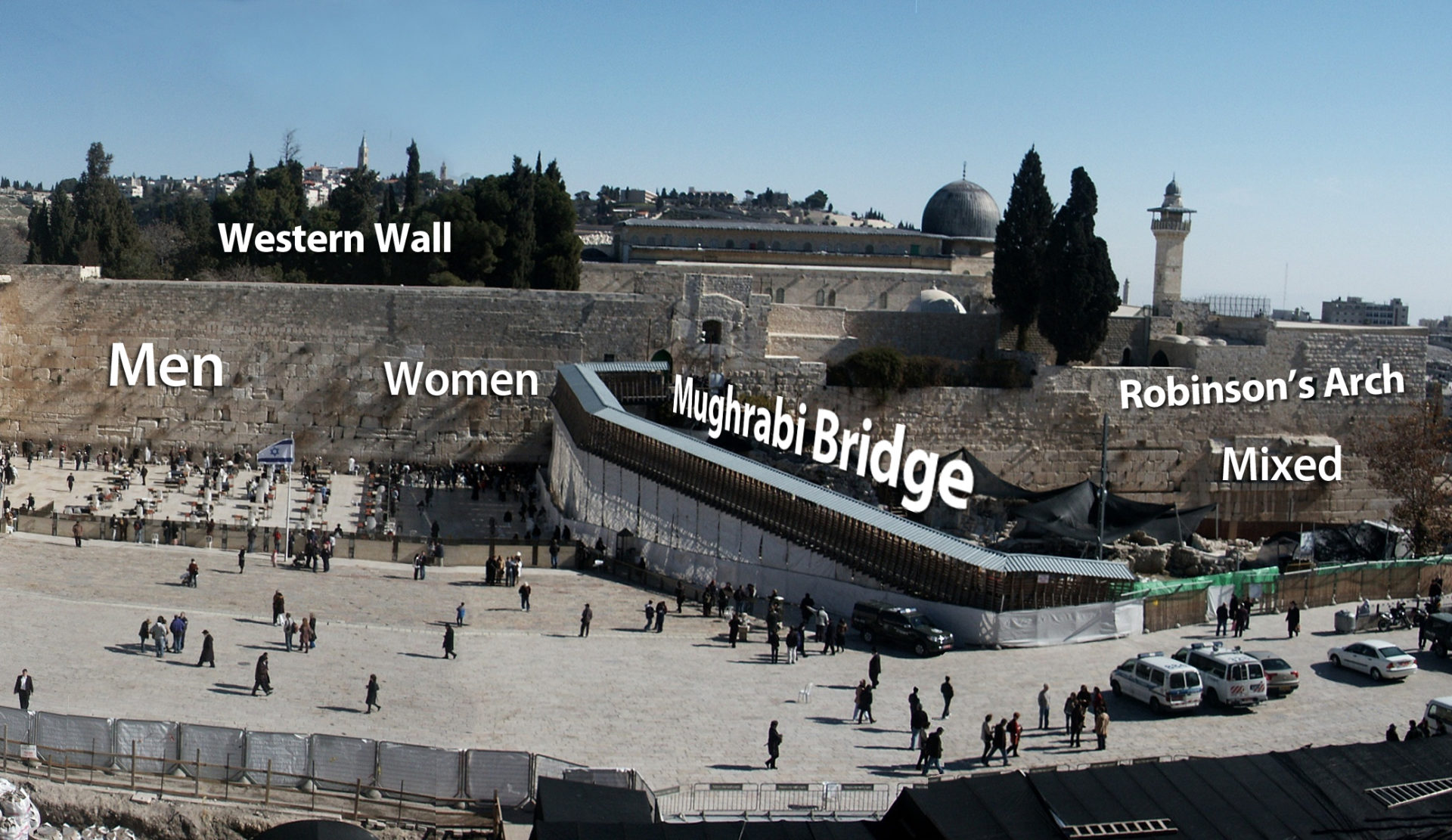
A decision by the Israeli government not to approve the construction of an egalitarian prayer area at the Kotel, the Western Wall of the Temple Compound in Jerusalem and Judaism's holiest site, has opened wounds between the Israeli government and the American Jewish community.  It is ironic that, only weeks after celebrating the 50th anniversary of the return of the Kotel to Jewish hands, this iconic landmark and holy site is giving rise to huge divisions between different groups of Jews.  How differently the Kotel is being viewed now, as opposed to 50 years ago when Jews around the world were rejoicing in unison at the prospects of being able to visit and pray at this site.

Things have clearly changed over the past 50 years that we are fighting amongst ourselves over this matter.  Fifty years ago,  Jews would have been happy simply to be able to visit and pray at the Kotel. It would not have mattered if this would have been by a group of men or women on their own, or by mixed groups and families.  After so many years of having been denied the right to visit the site of the Temple, the details of how prayers would be offered there were unimportant.

Fast-forward fifty years, and the Kotel Plaza has been developed to allow and encourage Jews to visit the site for historical and religious reasons.  It was developed according to the tenets of Jewish religious law as befits a site of prayer.  This means that men and women have been provided with separate prayer areas.  This separation is not a new or alien concept amongst Orthodox and traditional Jews.  It is something that is expected at holy sites and areas of prayer.  And while Orthodox or traditional strands of Judaism are dominant in Israel amongst those who wish to identify with the Jewish religion, the same is not true outside of Israel.  There, the Reform and Conservative strands of Judaism are more popular.  These strands follow a somewhat less stringent interpretation of the Orthodox Jewish laws, either because followers have studied the laws and rejected some of the stringencies arising from Rabbinical interpretations and pronouncements over the years, or because it is simply easier to follow.  In a world where the rate of assimilation amongst Jewish communities around the world is running at alarmingly high levels, any form of identification with Judaism can be considered to be positive.  It is for this reason that the Reform and Conservative communities, particularly those in the USA, have gathered enormous power as they manage to stem some of the massive flows of Jews away from the faith.

The battle lines between Orthodox and Reform/Conservative Jews have long been drawn.  The Orthodox communities have done all that they can to reject the dilutions that are inherent with the Reform/Conservative view on the Jewish world.  They have worked to discredit and delegitimise them, even accusing them of not being Jews.  The Reform and Conservative communities, particularly those in the US that command power and have access to large sums of money, have used this to fight back against the Orthodox world view.  The battle over the Kotel is simply an extension of this power struggle between the different groups.  The Reform/Conservative strand believes that their followers (and other non-religious people) would prefer to visit and pray at the Kotel in an area that is mixed with men and women - an egalitarian area.  This would also allow families to enjoy this experience together.  The Orthodox are absolutely opposed to this, claiming that the Kotel is a religious place of prayer that requires separation of the sexes according to the traditional Jewish Law.

The State of Israel has set out not to distinguish between different groups of Jews.  In fact, the Law of Return that grants immediate Israeli citizenship to Jews, has chosen to use Hitler's definition of Jews rather than going by Jewish religious law.  Hitler decided that any person who had one Jewish grandparent would be eligible to be treated inhumanely by his regime, and to be part of his plan of extermination.  The Israeli government decided that if a person was good enough to be exterminated by Hitler, they would be good enough to be granted immediate Israeli citizenship.  This means that some of those who have been granted immediate citizenship under this law, are not Jewish according to Jewish Law.  This demonstrates the extent to which the State of Israel has opened its arms to many different groups of Jews - and even to some non-Jews.  Under the circumstances, it seems as though the government would be sympathetic to the claims of the non-Orthodox groups at the Kotel.

Even though the government would probably wish to be more accommodating to the demands of the non-Orthodox lobby, and even previously agreed to their demands for an egalitarian prayer area at the Kotel, politics always seems to come first.  The current government coalition can only exist with the support of the ultra-Orthodox parties in the Knesset.  Upon hearing of the government's plan to accommodate an egalitarian prayer area at the Kotel, the ultra-Orthodox parties flexed their muscles and threatened to bring the government down if the plan was implemented.  Prime Minister Netanyahu went into survival mode, even at the expense of his relationship with US Jews, and acquiesced to the demands of his coalition partners.  At least for now.  American Jews responded in disgust by withdrawing their support for the Israeli government.

Does the Reform/Conservative lobby have a valid case in declaring open warfare on the Israeli government as a result of this decision?  The Israeli government has said that an egalitarian prayer area does already exist, but it is just not in the premier Kotel Plaza area.  The non-Orthodox lobby claims that this is not good enough, and effectively treats some Jews as second-class.  Their demand is to have the egalitarian area front and centre alongside the other prayer areas in the Kotel Plaza.  The battle is one of power and of wills. This is a battle between different groups of Jews, each of whom demands that their way is accepted, and with the Israeli government being called upon to act as referee.

Is the Kotel a Jewish national asset that should be required to accommodate all groups of Jews in a way that is to their liking?  Or is it an asset that belongs to the religious, as the holiest religious site in Judaism?  Does creating an egalitarian prayer area alongside the other areas serve to dilute its importance and religious status?  Is this issue important enough to be worth creating a rift amongst different groups of Jews?

I don't have answers to any of these questions.  And even if I did, I feel sure that the warring parties would not consider my point of view in formulating their reactions to the situation.  Of course, the Israeli government will always act in way that promotes its own best interests.  At the moment, that requires it to take the side of the ultra-Orthodox parties and freeze the egalitarian prayer area.

In my opinion, the situation requires tolerance and understanding by all parties.  It is natural to expect that the holiest site in Judaism should have some of the most stringent rules attached to it, and that Orthodox Jewish law should apply.  We live at a time, however, when Jews around the world should find reasons to unite, and not reasons to be in conflict with each other, especially over a site as central as the Kotel.  The ultra-Orthodox parties are not generally known for making efforts to unify different strands of Judaism, but it is never too late.  They should know that no man is in a position to judge another one, nor judge his interpretation of the religion.  So they should be taking the moral high ground on this matter in an attempt to accommodate the requests of the non-Orthodox groups.  Surely accommodating an egalitarian space could be acceptable, as long as they continue to have their separated areas?  The situation now requires unity and not conflict.  It is incumbent upon the parties to sit down, and find a compromise that will be acceptable to all.  Is this too much to expect?

Saturday, 7 May 2016

Remembrance Day Reflections

When lighting the candle or listening to the siren on the day that commemorates the six million who were killed, and the heroes who survived the greatest genocide known to mankind, I find myself reflecting on so many different thoughts.  We are afforded a few minutes to think about what was, what is and what could be.

Amongst other thoughts, today I was struck by some of the similarities between Pesach and remembering the Shoah.  Jewish texts and prayers are littered with references to the exodus from Egypt, and the obligation on the Jewish people to remember it.  It is found necessary to remind Jews to remember this through the generations, despite it being regarded as probably the greatest miracle ever to happen to the Jewish people.  Memories can apparently be short, even when it comes to recalling miracles.  This is also reflected in the central mitzvah of the Pesach Seder, to tell one's children of the miracle of the exodus from Egypt.  In fact, the Haggadah tells us that, in each generation, we should immerse ourselves into the exodus from Egypt so deeply, that we should imagine that we actually experienced it ourselves.

In many ways, this is exactly what Holocaust Remembrance Day in Israel is about.  It is about never forgetting.  It is about being immersed in the events that led to the annihilation of 6 million of our people.  It is about recognising the bravery of those who stood up to the murderers despite the odds.  It is about standing to support and strengthen the survivors.  It is about never forgetting how evil people can be, and how Jews can be hated for no apparent reason.  It is about celebrating the survival of our people, and celebrating he Jewish state.  And it is about ensuring that the next generations know all of this so they will never forget.  Most of all, it is about preserving the State of Israel which is the only way to ensure that this never happens again.

In the months and years following the genocide, people could not believe that such an event had been allowed to take place without the intervention of the international community.  And yet, more than 70 years later, it is easy to see how it could have happened.  The United Nations organisation that was set up in the aftermath of the Second World War and the Shoa to ensure that it does not happen again, is exactly the organisation that gives a platform to those who wish for it to happen again.  Many of the events that precipitated the murder of millions of our people, and the thoughts, sentiments, views and actions are dangerously repeating themselves in our day.  It has become politically correct, acceptable and even desirable to be anti-Semitic, dressed up as being anti-Zionist or anti-Israeli.  The BDS movement is at the forefront of what could be likened to the Nazi Party in Germany in the early 1930s.  While they stop short of calling for the annihilation of the Jews, they are actively working to indelibly damage the State of Israel.  They realise, as many of us do, that a world without Israel is a smokescreen for a world without Jews.

While we unbelievably continue to witness the hatred towards Israel and Jews that was such a hallmark of the lead-up to the Shoa, there are a few things that have changed since then.  With the access that we have to news and events around the world brought about by the Internet and social media, nobody will be able to say that they were not aware that this was happening.  Some are in denial about the true intentions of the Palestinians, of BDS and of other anti-Israel activists.  There are those, many of them Jews, who think that this is ok in our democratic world.  It is their view that Israel deserves to be criticised and castigated for actions to defend her existence and that of her citizens and Jews around the world.  But they will never be able to deny that these events took place.

Perhaps the most important difference between then and now, is the existence of the State of Israel.  It is not only the existence of the state, but also the existence of leadership which is prepared to take the difficult decisions required to ensure our continued survival.  When considering this, along with a population of young and old who are willing to give all that they have to defend our rightful existence in our homeland, I am convinced that even the most determined anti-Semite will have no prospect of repeating the horrendous events of the Shoa.  The State of Israel and the proud Jews who live there are our strength that is insurmountable to all those who wish harm upon the Jews.

It has been amazing to see the evolution of the nervous, fearful yellow star into the strong, proud and determined blue star.  The same star, but two different worlds.  Whereas the yellow star was worn with shame and trepidation, the blue star stands for democracy, innovation, pride, determination and an attitude that will do everything to ensure that we never again return to the yellow star.

We mourn those millions who were lost in the Shoa, but we bask in the glory of the State of Israel, the victory that this represents over those who wished to destroy us.  We will never forget, and we will never return to those days.  Never again.

Am Yisrael Chai.

Sunday, 20 May 2012

Keeping Jerusalem Unified

Today, Sunday 20th May, we celebrate 45 years since Jerusalem was reunified in the Six Day War according to the Hebrew calendar.  These have been 45 eventful but happy years, which have seen the holy city of Jerusalem quickly regain its central place in Israeli and Jewish life.  After 2,000 years of exile from the Land of Israel and the city of Jerusalem, and a further 19 years of being denied access to the holiest sites in Judaism, Jews around the world celebrated when the IDF paratroopers finally reached the Kotel and Motta Gur announced the famous words, "The Temple Mount is in our hands".  That moment is being savoured and celebrated today on Jerusalem Day.

The important place that Jerusalem occupies for Israelis and for Jewish people all around the world has strengthened over the past 45 years.  Once again, we have had the merit and the joy to be able to visit the holiest site in Judaism.  It is impossible to consider a possibility that Jerusalem would not remain unified in the future, and that Jews could be denied access to visit the holy sites in the way that we were forced to experience in the past.  This is almost certainly one of the reasons why discussions on the final status of Jerusalem in the peace talks with the Palestinians are so fraught.  It seems as though the Palestinians understand the strength of feeling that we have for Jerusalem, and continue to demand it for themselves.  This may enable them to extract major compromises in return for giving up on Jerusalem in the final agreement.

There can be no escape from the centrality of Jerusalem in Judaism.  Even those who wish to prevent Jews from having access to Jerusalem would struggle to the deny strong links that Jews and Judaism have to this holy city.  The holy nature of the city was arguably only established during the time of David and Solomon when the temple was built.  It is no mere coincidence, however, that the temple was built in this city and on Mount Moriah.  This is the site of the dream of Jacob's ladder, the site of the almost-sacrifice of Isaac and possibly even the site from which the which the world was created.  Whether or not one believes in these biblical links, it is simple to refer to Jewish texts that have been written and passed down over thousands of years, and which bear testimony to the close links that Jews have to the city.

Over the past 45 years, the city of Jerusalem has developed and grown in a way that makes it unrecognisable from the city that was reunified 45 years ago.  The Kotel (the Western Wall), the only remnant of the remains of the temple, was quickly transformed into an area that could be host to the many millions of visitors that wish to visit the heart of Judaism.  It is believed in Judaism that the divine presence emanates from Jerusalem.  In order, however, for the divine presence to be felt, it is required that there will be those to receive and bask in its glory.  The Kotel has truly fulfilled that purpose.  It plays host to state and military ceremonies of great importance and significance.  It also hosts all manner of religious worship, celebration and heartbreak.  The Kotel plaza is often filled with tens of thousands of people as they cram themselves in to take part in the merit that our generation enjoys to have free access to this place.  The surrounding parts of the Old City, and stretching out well beyond into the new city and further, have seen a renewal and redevelopment that has transformed the face of Jerusalem, without changing its character.  The modern Chords Bridge at the entrance to the city, numerous luxury hotels and the sight of the Jerusalem light rail show the face of a contemporary city keeping up with the times, while allowing residents and visitors to get close to its historical roots.

Over the years, conquerors of Jerusalem have denied access to other religions as a punishment, and as a sign of their supremacy over the city.  It is, after all, a city that is holy to all three monotheistic religions.  Contrary to this trend, it is interesting that Israel decided to allow all religions access to their holy sites in the city.  Rather than weaken Israel's grip on the city, I feel that it has served to strengthen Israel's position in Jerusalem.  I believe that most Israelis are proud that this is the case, as much as they are determined to ensure that Israel's rule over the city continues well into the future.

The truth is that it is difficult to try to predict what the future holds for the holy city.  There seems to be no real reason for the Palestinians to wish to rule over the city.  While it is a city that is holy to Muslims, it ranks only third in its holiness to the cities of Mecca and Medina.  Muslims have access to, and complete control over all Muslim holy sites in the city through the Waqf.  This stretches even to having control over the Temple Mount and the Al Aqsa mosque, despite this also being the site of the holy Jewish temple.  I imagine that the only benefit that can be gained from ruling over Jerusalem, or parts of the city, is that it may give them the right to deny access by others to these areas.  We can never risk this situation coming to fruition.

Despite the fact that a great deal of thought has been given to the possibility of creating Jerusalem into something of an international city that is owned by everyone, but nobody in particular, there is no real precedent for a successful implementation of such a model.  This gives rise to a great deal of scepticism, and suspicion as to what the true intentions of the Palestinians may be with regard to Jerusalem.

For now, the united city of Jerusalem is the capital of the State of Israel, and the centre of the Jewish world.  It also plays host to Muslims, Christians and members of other faiths that may wish to visit, live and study in the city.  There seems little wrong with this model, and no individual is denied any rights that he may wish to have.

It is my hope and prayer that Jerusalem will continue to play its role as a central part of so many faiths, and that all faiths will continue to have free access to all corners of this ancient and fascinating city.

If I forget thee, O Jerusalem, let my right hand forget her skill.
                                                                (Psalm 137)


Tuesday, 10 April 2012

The Powers of Deception over Pesach

The spring has come, and Pesach is suddenly upon us.  It is astonishing how easy it is to shift attention from all the issues relating to Israel's safety and security, to the seemingly mundane activities relating to preparation and separation for Pesach.

Until a short time ago, the newspapers and national agenda were filled with stories of Iran's nuclear program, of Grad missiles being fired from Gaza and about preparations being made for a possible war of great significance.  It is great that Pesach has come around to distract us from these matters of importance, which have a tendency to weigh heavily on the minds of many of Israel's citizens.  Somehow, the festival has managed to deceive us all into feeling and believing that the existential threat has somehow been relieved, even for a few short days.

The days have become warmer and the spring cleaning has been undertaken at a manic pace.  Furniture and household items have been put on the streets to make place for the new replacements in honour of Pesach.  Many of the discarded items seem hardly used, and many of them were snapped up by those not quite in a position to replace their items with new from the shop.  Adverts on the radio and TV all seem to have Pesach tunes as their theme, and gifts are being dragged around by hundreds of motorcycle couriers to business associates, family and friends. Charity organisations have been in top gear distributing thousands of food parcels to the needy, to ensure that everybody can make a basic Seder, and that everybody has what they need to observe the festival.  Supermarkets have covered their aisles to prevent people reaching those items that may contain any chametz (leaven), and they are giving away packs of matzah for little or no charge to those who spend more than a certain amount.  On the day before Pesach, the air was filled with the smoke of the burning of the last remnants of any chametz that people had collected from their homes.  This familiar smell announces in no uncertain terms that Pesach is upon us.

Pesach celebrates two of the greatest miracles in Jewish history - the exodus from Egypt and the crossing of the Red Sea.  We are told that the 7th day of Pesach is a holiday to mark day upon which Moses and the children of Israel cross the Red Sea safely ahead of the following Egyptian army.  Now, a few thousand years later, we are told that we are living an even greater miracle than that - the miracle of the State of Israel.  The Sinai Desert still represents a considerable challenge for the Jewish people.  Whereas then, it was all about how to cross this safely, now it is about how to prevent terrorists from using the cover of the desert to ship rockets and fire them towards Israel.  Then as now, astonishing events have taken place.  There is no plausible explanation as to how a nascent Israeli army succeeded in holding off the well-trained and well-equipped armies of multiple Arab countries during the War of Independence.  Some call it good fortune, and others call it a miracle sent from heaven. The reality of what happened, however, cannot be denied.  A succession of wars has been forced upon Israelis, and they have fought back in a bid to survive and to flourish.  Who would think that a nation decimated by the horrors of the Holocaust could rise to such heights?  Who would have guessed that Israel could be a technological and agricultural powerhouse in the region, and could make such huge contributions to the world in so many different ways?

Just as quickly as Pesach has pounced upon us, so it will be gone.  Soon afterwards, we will mark memorial days in quick succession to commemorate those who have fallen in the Holocaust and those who have fallen in wars and terror attacks in the modern State of Israel.  And then we will celebrate the biggest miracle of the Jewish people, the 64th anniversary of the founding of the State of Israel.

Even though the threat of a war with Iran, and the firing of Grad and Qassam rockets into civilian areas may have been forgotten for a short time, it is always lingering there somewhere in the background.  Pesach has allowed us to step into a mystical wonderland which is filled with fun and good things, but only until the next reality hits home.  We know that there are many out there who seek to destroy this dream, and to destroy the aspirations of the Jewish people to live in freedom to determine our own destiny.  Pesach teaches us that we were born to be a free nation, and the State of Israel provides exactly this for the Jewish people.  Being able to celebrate Pesach in Israel means marking some of the greatest miracles in Jewish history in the land that surely represents the greatest miracle we have experienced.  We will not allow anybody to take this away without a fight.  Our army is ready for this.

I often ask why I have merited the precious honour of being able to live in the Jewish homeland.  I think about how my grandparents and great-grandparents would have given almost anything to have this honour.  I think about what the victims of the Shoah would have given to know that a strong Jewish army exists to guard and protect the rights of Jews all around the world.  This is my reality, and it is one that I am enormously humbled to be able to partake in, and immensely proud to share.

In wishing all readers a wonderful Pesach, it is my wish that the story of Pesach will continue to inspire us to fight for our freedom and for our self-determination.  This will continue to drive the modern-day miracle.


Sunday, 11 March 2012

A Modern-Day Purim Story

Last week we celebrated the Jewish festival of Purim.  It is a classic Jewish festival which involves bad guys who wanted to murder the Jews.  Somehow, we managed to survive against the odds and a festival was created to celebrate this fact with the addition of delicious food.  As a child growing up, I remember thinking how unrealistic these stories sounded.  Could it really have been the case that the evil Haman was trying to influence the king of Persia to annihilate the Jews?  What reason could he have had for wishing to do this?  After all, most of the Jews that I knew were decent upstanding citizens and quite nice people as well.  So why would somebody have wanted to kill them?

For those of my parents' and grandparents' generation, this story would have been a very real one.  They were unfortunate enough to have witnessed the horrors of the Holocaust.  This was a repeat of the Purim story except, in this story, millions of innocent people were slaughtered.  Only now, 60 years later, can the State of Israel boast a population that equals the number that were murdered during the most barbaric human-cleansing exercise in history.  Despite the fact that the Jews have survived and made a strong comeback, we have not quite decided upon a festival with delicious food to celebrate Hitler's failure.  Perhaps we will have one in the future.  This should, however, not allow our eyes to be taken off the ball.  The Haggadah that we read on Pesach tells us that, "In each and every generation they rise up against us to destroy us. And The Holy One, blessed be He, rescues us from their hands."  We are also instructed to remember how Amalek attacked the Israelites soon after the crossing of the Red Sea following the exodus from Egypt.  Each year, we read the portion known as "Zachor" (remember) on the Shabbat preceding Purim to be reminded of the evil of Amalek, who is traditionally believed to be a descendant of the evil Haman from the Purim story.  The need to read this each year and remember, arises from the fact that we are required to be vigilant to prevent it from happening again.  Now, in 2012, there are strong indications that it is happening again.

The irony of the Purim story cannot be lost on us as we hurtle headlong into an inevitable conflict with Iran.  The Purim story took place in Persia, and we now return to the scene of the crime approximately 2,400 years later to confront Ahmadinejad, the modern-day Iranian Haman.  As far as I can make out, the Jews and Israel have caused no damage nor present any threat to Iran or Ahmadinejad.  Despite this fact, Ahmadinejad has made Israel-bashing the cornerstone of his foreign policy platform.  He has not missed an opportunity to threaten Israel or to predict her demise whenever he has had the ears and eyes of the world trained on him.  He has been good to his word in practice as well, channelling millions of dollars into terror organisations like Hezbollah and Hamas which have indiscriminately attacked Jewish and Israeli targets.  When adding his duplicitous dealings with the Iranian nuclear program, it is clear that this situation cannot be allowed to continue unchecked.  This is the reincarnation of Amalek, of Haman and of Hitler.  This is exactly the sort of person that we are warned against.

Experience that the Jewish people have accumulated over the years, shows that they cannot rely on others to do the right thing to protect them.  Whether it was the failure to bomb Auschwitz, or the criticism over the destruction of nuclear reactors in Iraq and Syria, the international community has shown itself unwilling or unable to take action at the required moment in order to prevent a disaster.  Viewing things with the benefit of hindsight is too late, and the lessons are somehow never learned.  The Jewish nation have been forced to ensure that they can take care of themselves.

Fortunately, one important thing has changed since the days of Haman and Hitler.  We now have a Jewish army.  This is probably the most substantial element of the equation in the current scenario with Ahmadinejad.  The fact that thousands of Iranians missiles are trained on Israel, and waiting for the first strike on Iran, does not intimidate the Israeli army.  This is simply another danger to be considered, alongside the others, when taking on the significant threat that Iran poses under Ahmadinejad's leadership.  The fight will be ugly and there will be casualties, but there is no choice for the Israeli army in the imperative to put a stop to this threat as soon as possible.

For parents like myself whose children are the soldiers who will be called upon to fight this fight, the prospects are chilling.  We would certainly prefer not to be in this situation, and we would not choose for our children to be placed in harm's way as they battle to protect Israel and the Jewish people.  Ultimately, however, we realise the importance of having an army like the IDF, and we are forced to stand helplessly by as our children willingly fulfil their obligation to protect their land and their people.  This is the only way that we can be assured that the likes of Haman, Hitler and Ahmadinejad will never be allowed to carry out their evil plans to destroy our state and our nation.  These soldiers, our children, are the heroes of this part of the story of survival.

As the situation escalates and the prospects of an armed conflict with Iran grow with each passing day, it is our prayer that our army and our children will succeed in doing their job safely and securely.  We pray that they will return to their families, sound in body and mind, having completed their task that they have been called upon to do.  We stand behind them, fearful for their well-being, but immensely proud of their sacrifice.  May Hashem protect them in all that they do.

Image by Deputado Bruno Covas

Monday, 27 February 2012

To Run Buses on Shabbat or Not?

The Tel Aviv City Council decided last week to recommend the operation of a bus services in the city on Shabbat.  The decision, which was passed by a majority of 13 to 7, threatens to change the "status quo" that has existed in the city and around the country since before the founding of the State of Israel nearly 64 years ago.  It was first Prime Minister David Ben-Gurion who agreed to implement public observance of Shabbat in Israel, a situation that has endured across the country except for Eilat and Haifa until this day.  This has meant that public buses have not operated on the streets of Tel Aviv between sunset on Friday until after sunset on Saturday, and on religious holidays.

Israel is one of the few countries in the world that has succeeded in maintaining a public day of rest.  These days, most countries operate shops, restaurants and other places of entertainment as well as public transportation seven days a week.  The fact that many parts of Israel still manage to observe Shabbat, creates a fairly unique atmosphere on the day of rest.  This is something that is noticed immediately by visitors to Israel from abroad who observe Shabbat, and who are not accustomed to see entire cities literally shut down for the day of rest.  There are even those who are not observant who like the different atmosphere that Shabbat observance brings to towns and cities across Israel.  Besides bringing a public face to the commandment not to work on the Sabbath day, this practice also means that employees working in these establishments will not be called upon to violate their weekend.  This must surely bring an advantage in a day and age when shift work is commonplace to feed our demands to have services on tap 24/7.  This culture comes at the expense of a stable family life for those workers who are called upon to work odd hours when their families wait for them at home.  In Israel, keeping Saturday special by not operating commercial activities has endured as a result of the "status quo", and due to the pressure exerted by the religious groups who are very vocal when it comes to violating Shabbat.

The fact that children attend school 6 days a week from Sunday to Friday in Israel means that families wishing to undertake family trips or other activities can only really do so on Shabbat.  This fact has caused many to oppose the "status quo", as this prevents many families from undertaking activities that they can only do on Shabbat.  This has further  fuelled the argument that commercial activities should be allowed, and even encouraged, on Shabbat.  Compromise solutions have been found in some towns and cities in order to satisfy all constituencies.  I am aware of some places where Shabbat commercial activities are permitted in areas which are slightly removed from the central areas of the city.  This means that those who observe Shabbat, will be able to experience the tranquillity of the Shabbat without interruption.  Those wishing to take advantage of Shabbat to shop or be entertained, can leave the city centre area and head to the outskirts where these activities are available.  This works well for those who have their own private transportation.  For those relying on public transport to seek out Shabbat activities, it is not quite so convenient due to the fact that regular public transportation does not run on Shabbat.

Those who oppose the implementation of full public transport services on Shabbat in Tel Aviv, point to the fact that the "monit sherut" (a type of minicab operating along established bus routes) offers an alternative service and for a similar price to buses.  It is argued that this is enough of a service for those requiring public transport, while not encroaching on the sanctity of the Shabbat in the city centre in the way that buses would do.

Tel Aviv, as Israel's main commercial city, enjoys a special status in Israeli society.  It is also held up as being a bastion of secular freedom in a country that many believe to be dominated by religious extremists.  Although only a minority of Israelis (42%) define themselves as secular, it is clear that Tel Aviv has a majority of secular citizens.  Tel Aviv is also Israel's capital for secular entertainment such as bars, clubs, restaurants and cinemas that remain open over Shabbat.  It comes as little surprise to some observers that the "status quo" is being challenged in Tel Aviv, and that it has taken so long for this challenge to be made.

Even though the Tel Aviv City Council still has a long way to go before it can implement its decision to operate public transport on Shabbat, it seems quite determined to do so.  The government ministry of transportation will need to agree to this, and there are indications that the ministry is not inclined to support a change to the "status quo".  In response, the city council has threatened to operate its own private transportation if the ministry is not agreeable to running the existing public bus companies on Shabbat.  Those Tel Aviv residents who sense a change is imminent, may be disappointed in the short-term as this decision is likely to take some time to implement.  If the city is successful in bringing buses onto the streets on Shabbat, this will surely indicate a turning point for Tel Aviv, and for Israeli society as a whole.

Image by yanec.

Monday, 26 December 2011

Gender Segregation Pushed Too Far

Image by www.mizozo.com
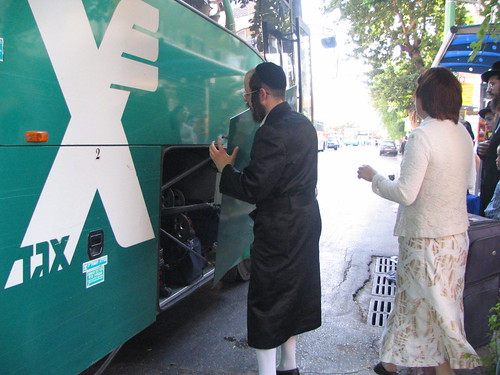
Despite many indications that Israel is a country that appears to promote gender equality more than most other countries around the world, there have been worrying signs of greater gender segregation creeping into some aspects of Israeli society recently.  Israel's Golda Meir was only the third female prime minister in the world, and Israeli women are required to serve in the Israeli army in the same way as their male counterparts.  These are all indications of Israel's progressive approach to women.  Yet this is the same country which closes off entire streets to the use of women, and requires them to sit at the back of the bus while their male counterparts sit at the front.

Ultra-Orthodox groups in Jerusalem and elsewhere around Israel, have been increasingly trying to enforce greater gender segregation.  There is also already fairly strict gender segregation enforced in ultra-Orthodox neighbourhoods such as Jerusalem's Mea Shearim.  This is tolerable inasmuch as those who are subject to the segregation, are those who subscribe to it.  For the people living in Mea Shearim, gender segregation is part of their belief system and lifestyle.  Women are raised with this from birth, attend separate schools and are readied to take on separate traditional roles in the home and society.  Visitors to Mea Shearim know that this is the way in which things work in this neighbourhood, and are invited to stay away if this is objectionable to them.

The problem arises when supporters of gender segregation allow this to creep out into the general public, thereby affecting those who do not subscribe to it.  This has already long been the case in Jerusalem, with advertisers refusing to show images of women on buses and billboards for fear of them being defaced by ultra-Orthodox protestors.  Despite a court order prohibiting gender segregation in specific streets, even in ultra-Orthodox neighbourhoods, residents of Mea Shearim set up separation barriers on Mea Shearim Street and Shivtei Yisrael Street during the recent Succot holiday.  The hard-line Toldot Aharon Hassidic sect were holding events relating to the holiday on locations in these streets, and were prohibiting women from approaching even near to these locations.

Two recent events have brought the gender segregation to a head, and have forced politicians and religious leaders to speak out on the issue.  The first event was a walkout of a military ceremony by religious soldiers when women soldiers began to sing at the ceremony.  The protestors subscribe to the so-called "kol isha" prohibition, which forbids males from hearing women sing.  The IDF's general staff has refused to back down on this issue.  The protesting soldiers were not given permission to leave the ceremony , and have been disciplined for their behaviour.  The military authorities have refused to heed calls to ban singing by women in future ceremonies.  This has brought the military into direct conflict with some ultra-Orthodox groups.

The second incident took place on a bus that was designated as a gender-separate service, something that has become more popular in Israel in recent years.  This means that women are required to sit at the back of the bus, while their male counterparts get to sit in the front.  Upon entering the bus, Tanya Rosenblit was requested by one of the religious males to sit in the ladies' section at the bank.  In a protest which was reminiscent of the actions by Rosa Parks in Montgomery, Alabama in the 1950s, Tanya refused to relocate to the back of the bus.  This sparked a stand-off in which the bus was halted and the police called.  In a statement after the incident, Rosenblit said that she had shown respect by dressing modestly because she knew she was going into a religious area.  She refused, however, to be humiliated by being forced to sit at the back of the bus.  She has taken on a somewhat heroic status in the eyes of many, by being prepared to stand up to the religious coercion, something that few women have been prepared to do.

Israeli Chief Rabbi, Yona Metzger, came out recently saying that religious people are entitled to live their lives as they see fit, but they have no right to impose their views on the general public and in public areas.  Prime Minister Netanyahu announced at the Sunday morning cabinet meeting that Israel is a liberal democracy, and that public spaces are made available to men and women to use equally in a safe and open way.  The police will arrest those who spit, raise their hand or harass others.  These statements will sadly have no bearing at all on those who perpetrate gender segregation.  They do not respect these leaders, nor take note of anything they say.  They subscribe only to the leadership of the rabbinical leaders of their sects, and will only be guided by their statements.

It is ironic that these events take place at the same time that it is announced that no fewer than 5 female pilots and navigators, the most ever, will graduate from this year's air force flight instruction course.  It is only 16 short years since Alice Miller succeeded in challenging the prohibition on women being admitted to the flight instruction course.  Since then, many women have graduated from this course to serve their country with great distinction.  This year, 5 more women will join their distinguished ranks.  This is closer to the Israel that most of us know, a country which does support the equality of women in our society and which does encourage women to play a full role.

Despite the insistence by religious groups to enforce greater gender segregation and become more extreme in their views and actions, it seems unlikely that the greater public and the politicians will tolerate this.  While this does not mean that religious groups will be forced to dilute their religious observance, it simply means that they will be forced to limit their extreme views to their own environments, while allowing others to live their lives without being dictated to.  Surely this is the correct answer.

Wednesday, 14 December 2011

How to Bring Israelis Home


The Jewish Agency recently took a decision to make a change to their usual activities to attract Jews to come and live in the Jewish homeland. Until now, the activities of the Jewish Agency have been focused towards attracting Jews who have lived their lives in the Jewish Diaspora, to come and make their homes in Israel.  They have concentrated on two main targets.  Firstly,  they have concentrated on Jewish communities at risk or in need, such as the Jews in Morocco, Yemen, Russia and Ethiopia who were shipped to Israel in large projects, and sometimes in some haste. The Jewish Agency has also focused on attracting the attention of Jews in communities which were not under threat, such as Jews in the USA, the UK, South Africa, Australia, South America and other locations. The tactics employed in these communities has largely targeted the youth and the young adults to experience the vibrancy that Israel offers people of this age, in the hope that parents and other family members will follow the youngsters to Israel.
The new campaign that the Jewish Agency has embarked upon recently is aimed at an entirely different community. This time, the Jewish Agency is trying to attract former Israelis to come back home. In some parts of the world, and particularly around the USA, fairly large groups of former-Israelis (or yordim as they are sometimes known) have established themselves. It is estimated that as many as half a million Israelis live in the USA, and that this number has grown by 30,000 in the past ten years alone.  Most yordim continue to have a close connection with Israel, and visit members of their family on a fairly frequent basis. Although many voice an intention to return to live in Israel at some point in the future, the numbers of yordim continues to grow.  The link to Israel for these people is stronger during times of security crisis. They obviously have a strong concern for individual friends and family who may be at risk during times of unrest, and those who are serving in the IDF during periods of war.  There is a concern, however, that their link to Israel and Judaism gets weaker the longer they live outside of Israel.

The Jewish Agency campaign to try to convince yardarm to return home, has caused a great deal of negative reaction in the USA where adverts have appeared on billboards in areas where large communities of Israelis reside.  This has been supported by online video adverts that have been launched. The campaign focuses largely on the fact that the intermarriage of children of yardarm may result in assimilation. One video advert shows Israel grandparents communicating with their grandchild, in the USA on Chanukah. The parents ask what holiday the child is celebrating, to which he answers “Christmas”. In another advert, a yored father is upset by the fact that his child is calling him “daddy” rather than “abba”. The message is clear. The longer these people stay in their current environments, the more assimilated they become.


The Jewish community in the USA has come out in strong objection to the advertising campaign.  The main reason for their objection is that the assimilation referred to in the adverts is not limited to Israelis who marry non-Jews.  It also  includes the situation where Israelis marry Diaspora Jews.  This is particularly reflected in advert which shows a young Israeli woman watching a Yom Hazikaron ceremony on-line, while her American husband is seeing asking her to go out to a party.  The insinuation that  American Jews are somehow disconnected, is seen as being a slap in the face of the Jewish community in the USA, and their attempts to maintain their Judaism and their links to Israel.  I can understand the insult felt by the USA Jewish communities.  Apparently the Israeli government has also understood this as they have pulled the campaign since the uproar flared up.

As much as the campaign is disparaging towards the American Jewish community, it also contains a great deal of truth.  There can be no doubt that assimilation has ravaged the world’s Jewish population in the period following the Shoah, particularly that in the USA.  Recent statistics suggest that 40-50% of American Jews marry non-Jews.  Of these, only 33%  provide their children with a Jewish upbringing.  This means that there is an increasing number of “Jewish” children who are not halachically Jewish due to their mothers not converting to Judaism.  There are also a large number of children who are simply lost to Judaism as a result of their Jewish parent marrying a non-Jew,  and the family not identifying with the Jewish community at all.  This trend will have an impact on the Israeli community in the USA as well, even those who have a strong national identification with the State of Israel.

Israel has one of the few Jewish communities in the world that are growing.  This is not only because of aliyah and population growth.  It is also because there is much less of a problem of assimilation in Israel.  It is sometimes amusing to note the effect of the Jewish and Israeli national holidays, even on the non-Jewish foreign workers in Israel.  It is simply impossible for a child in Israel, even those raised in homes that don’t have a strong sense of Jewish identity, to miss a Jewish festival or not to be familiar with its main aspects.  This must surely be a strong reason why it is right to do all that we can to attract Israelis back home, as much as we wish to attract others to make Israel their home.  While I have a great deal of respect for the efforts made by the Jews in the USA and elsewhere to identify with Judaism and Israel, I feel that the only way to assure ourselves of Jewish continuity is to have as many Jews in Israel as possible.


Sunday, 6 November 2011

A Spitting Shame

I was horrified to read the details of the trial of Johannes Martarsian, which took place in the Jerusalem Magistrates Court last week.  Martarsian, an Armenian priesthood student, was charged with assault after he punched an ultra-orthodox Jew in the face and made him bleed.  The incident took place in Jerusalem's old city after the ultra-Orthodox man spat at Martarsian.

Judge Dov Pollock annulled the indictment against Martarsian and wrote, "putting the defendant on trial for a single blow at a man who spat at his face, after suffering the degradation of being spat on for years while walking around in his church robes is a fundamental contravention of the principles of justice and decency."  Fortunately, in this case, the judge had the good sense not to waste any more taxpayer money on proceeding to a trial.  Throwing the case out of court was exactly the right response to such a disgraceful situation.

The trial has brought to the fore some of the bad behaviour which is prevalent amongst the ultra-Orthodox community.  It seems as though the spitting incident is not an isolated one.  Clergymen from the Armenian church who are based in Jerusalem report that they are frequently subject to being spat and cursed at by ultra-Orthodox Jews.  One Armenian priest said that he wonders to himself if he will be spat at each time he walks by an ultra-Orthodox Jew in the street.  For some priests, it is difficult to simply ignore the repeated incidents of bad behaviour that they are forced to endure.  Johannes Martarsian is an example of one who decided to respond rather than to simply turn the other cheek, despite the fact that Armenian priests are encouraged by their church not to respond to these incidents of gross provocation.

The ultra-Orthodox community in Jerusalem has an unfortunate reputation for bad behaviour in many different situations.  Women who venture into ultra-Orthodox neighbourhoods in Jerusalem like Mea Shearim, and who are not dressed according to the ultra-Orthodox conservative dress code, will already know that they also become spitting targets.  Equally, cars driving through religious neighbourhoods on Shabbat have been subject to stoning attacks.  This has given rise to the famous T-shirt that has been sold in Jerusalem and purchased by thousands of tourists stating, "I got stoned in Mea Shearim"!  Although these types of attacks are unacceptable, there may be some part of a reasonable person that could condone such behaviour where people enter religious neighbourhoods without respecting the norms of the people that live there.

The attacks on the priests seem of a completely different nature.  There is no disrespect of the ultra-Orthodox lifestyle involved, and no violation of the norms by which they live.  Jerusalem is a city which is open to all religions which wish to be present there.  Not only is this a policy which is rigorously adhered to by the Israeli government and the city of Jerusalem, it is also the source of a great deal of tourist Dollars into the city.  At times, it seems as though the ultra-Orthodox community are completely divorced from the society in which they live, and their actions cannot be tolerated by other reasonable people.  The truth is, that some of their actions are so intolerable, that even those who have grown up within their sects and have become used to their social norms, cannot accept the way in which some situations are dealt with.

The types of insults that these young men give by spitting at others created in G-d's image, have caused me to wonder how they can reconcile this behaviour with their religious beliefs.  The Jewish religion believes in 613 mitzvot (precepts) that observers are required to adhere to.  They are split into mitzvot concerning man's relationship with his G-d, and mitzvot concerning man's relationship with his fellow-man.  Neither group has precedence over the other - they are both equally important.  On many occasions such as stoning a car that is transgressing the Shabbat, the justification for the action taken by somebody against his fellow-man is to protect his relationship with his G-d.  In light of the fact that these mitzvot do not enjoy precedence, there is a view that says that the transgression against the fellow-man cannot be justified, even if it is an act to protect his relationship with his G-d.  The act of spitting at the priests, however, seems to serve no religious purpose at all and has no positive side to it.  Rather, it represents an act of unjustified discrimination.  So how much less can this be justified in religious terms?

What is even more unfortunate about this sad situation, is the fact that priests say that reports made about these incidents to the police fall on deaf ears.  Perhaps it is because the police feel that it is impossible to catch the perpetrators and bring them to justice, that no action is taken.  It is also fair to say that Jerusalem's police force has its hands full with high-level security threats which it is required to take care of on an ongoing basis.  Whatever the reason for the lack of action, it is sends an entirely wrong message about the acceptability of this behaviour.

The ultra-Orthodox community present themselves as representing all that is good when acting in strict observance of the Torah.  Too often, however, the pursuit of individual points of observance causes the individual to lose the wood for the trees.  There seems to be no broader perspective, or ability to see the bigger picture.  This is extremely damaging to the standing of the ultra-Orthodox community in the world in which they are forced to live.  The time has come for concerted action to be taken to change the bad behaviour.  The yeshivot (institutions of religious learning) need to be responsible for teaching their students about the unacceptability of spitting at others.  The police on the streets need to keep their eyes open for such incidents, and act upon them immediately. 

Jerusalem is a city that is open to people of all religions to visit and to live in.  While it serves as the capital of the Jewish State of Israel, the government has undertaken that the city will be open to all religions for tourism, learning and worship.  This means that it is not the private domain of ultra-Orthodox Jews, even though it is their religion's holiest city.  There should be no reason why priests who have come to Jerusalem for the purpose of furthering their religious studies and experiences, should be subject to any sort of bad behaviour by ultra-Orthodox Jews or anybody else.  The time has come to take action to stop this intolerance and insulting behaviour.

Sunday, 2 October 2011

New Year's Dreams

With the Jewish New Year occurring immediately after the UN General Assembly meeting in New York as it just did, it made me take stock of Israel's current situation compared to last year (which seems like only yesterday).  In particular, I thought about where we were in our attempts to make peace with our Palestinian neighbours at this time last year, and the year before that.  As is the custom at the time of the new year, I thought about the future and what could realistically be achieved over the course of the next year.

The truth is that the peacemaking efforts have remained stagnant for many years.  Israeli leaders have come and gone, and a Palestinian leader has gone and another one come.  We have tried peace conferences in Madrid, Oslo, Camp David, Wye Plantation, Ramallah and Jerusalem.  And yet, the obstacles have not moved even one iota.  We are suffering with precisely the same issues as we have suffered with over the years, some of which seem to be beyond solution.

I heard a good piece of advice from our local Rabbi over the new year period about how to set behaviour patterns for the forthcoming year.  He said that we should close our eyes, and dream of where we wish to be in a year's time from now.  We should think about the things that we would wish to achieve by then, and then think about the stage that precedes that achievement.  By continuing to think about the step which precedes each stage, we can finally return back to our present situation with a roadmap of how to reach our goal.  Although this sounds good in theory and a little more difficult to implement in practice, the concept is a good one.  It is important to close your eyes and dream a little, and to set objectives which can serve to guide you in your work and private life.

While thinking about all of this, I spent a few moments considering whether Mahmoud Abbas may have done some of his own dreaming for the Palestinian people which he leads.  Maybe the time of the Jewish New Year is not exactly when you would expect him to be considering this matter, but perhaps he would do so after Ramadan or on Ras as-Sana al-Hijreya, the Islamic New Year which falls at the end of November this year.  If he was to close his eyes and dream of what he would like to see for himself and his people at the same time next year, what would this be?  If we are to believe his public statements, this would be an independent Palestinian state.  Clearly there are details such as the borders and capital of this state, but the "big picture" dream, we are told, is the Palestinian state.  This is what he left us believing following his actions and speech at the United Nations.  If this is true, the answer is in his hands.  The Israeli government has agreed to it, and the sponsors in the form of the US and other members of the Quartet have also accepted this point.  All that is required for him to get there, is for him to make a few concessions and to compromise by dropping the detailed demands that he is making, in return for which the Palestinian state will be his.

The problem is that the details seem to be more important than the big picture objective.  He will not accept a Palestinian state unless its borders comply with specific conditions, or until Jerusalem is handed to him as its capital amongst some of his demands.  Although the Jewish people have prayed for more than 2,000 years for their return to Zion, to Jerusalem as the holiest city in the religion, the Jewish state existed for 19 years with Jewish access to only the western side of the city.  This meant that the holiest sites, including that upon which the holy temple once stood, were out of bounds to Jews.  This fact (and the small issue of being attacked on all sides by Arab countries in the region) did not deter the Jews from establishing Israel as the Jewish state.  The truth is that the objective of having an independent Jewish homeland was bigger than any of the details, no matter how important.  I do not get the same feeling that the Palestinians have the same objective.  Somehow, the details are playing a more important role than the headline objective.

My new hope is that his experiences at the UN a couple of weeks ago would somehow change Abbas's approach to the peace negotiations.  Maybe, by some miracle, Abbas may decide that he needs to acknowledge Israel's position as a Jewish country in order to make progress with his own objectives?  I am sure that he understands the need to make this concession, and how this may give him the state that he claims to yearn for.  His refusal to acknowledge this critical point is extremely concerning.  Is it possible that holding on to his position is more important than getting his independent state?

There is a real danger that the inhabitants of the Middle East have forgotten how to dream, and are forced to be reactive in confronting daily emergencies.  This would a great pity.  In the case of Mahmoud Abbas, it is not clear whether he has stopped dreaming, or whether the dreams that he is communicating to the outside world are not the same ones as the those that he is dreaming.  Under the current circumstances, his dreams will not be fulfilled, no matter what they are.  

My new year’s dream is that Gilad Shalit will be with us and his family, for him to celebrate the new year in freedom next year.  I also dream that Mahmoud Abbas may change his dreams to create the possibility for real peace, although this may be expecting too much.  It is my wish that you will all realise your dreams in the new year, and that our nation's dream of living in peace alongside our neighbours with mutual respect will be realised.  Shana Tova.

Saturday, 25 December 2010

The Strange Thing About Christmas in the Holy Land


Christmas is undoubtedly the biggest annual event in the world. Whether you are somebody who believes in the religious aspects of the festival, somebody who follows its traditions or somebody who does not believe at all, it is difficult to go through the December period completely unaware of Christmas.

Despite this fact, Christmas in the Holy Land is something of a non-event. This may be unsurprising as almost all of the citizens of Israel, Jews and Arabs, follow religions that do not believe in Jesus as the messiah, and do not celebrate Christmas. For those Christians who do celebrate the festival around the world, it is surprising that Christmas is hardly celebrated in the place where the story of Christmas actually began. Most Israelis have no idea of when Christmas occurs, or what it really means. In the years when the day falls on a weekday, it is a regular working day in Israel.

In recent years, Christmas has seen an influx of tourists to Israel. There are many pilgrims who wish to celebrate this special day by being in the places where Jesus actually spent his time, and where the best-known events of his life took place. Favourite spots include Nazareth, Jerusalem and Bethlehem. Bethlehem is under the control of the Palestinian Authority, and they ensure that the scene is properly set for the celebration of a midnight mass in Manger Square and in the Church of the Nativity in Bethlehem for the many thousands of pilgrims who attend. Large numbers celebrate Christmas at the holy sites in the city of Jerusalem including the Church of the Holy Sepulchre, or by visiting the stations of the cross along the Via Dolorosa. Even though it is more traditional to visit the Jerusalem holy sites around the Easter holiday, many pilgrims can nonetheless be found in Jerusalem over Christmas as well.

Israel's holy sites play host to pilgrims from the three monotheistic religions. Under the Israeli government's policy, worshippers of all three religions have free access to their sites to celebrate festivals and at other times during the year. Whether it be Christmas, Ramadan or Yom Kippur, the sites are available to those wishing to visit in celebration of their own religious festivals. The policy of freedom to worship and celebrate festivals in Israel is so closely adhered to, that Christian pilgrims from Gaza were given permission to make the short trip to the West Bank to be allowed to celebrate Christmas in Bethlehem. With the recent security threats which have continued to originate from the Gaza Strip, this step is not insignificant. Naturally, it is also not something that the Palestinians would be keen to publicise for fear that Israel may have the opportunity to score some PR points.

For pilgrims visiting Israel over the Christmas period, being at the holy sites at this special time of year is certainly an unforgettable experience. They may, however, be disappointed when visiting shops and other parts of the country due to the complete lack of anything to do with Christmas. There are no decorations, tinsel or mistletoe to be found anywhere. For the majority of Israelis after all, it is a regular day like any other. Christmas decorations are more likely to be found in Israel during the festival of Succot when tabernacles are built and decorated. It seems to have become popular to recycle unsold Christmas decorations from last season to decorate the temporary booths that are constructed for this festival.

As a Jew who does not participate in all that is associated with celebrating Christmas, I feel good in the fact that other religions have freedom to visit and worship in our country. As long as they have respect for us and our land while here, I have no problem in allowing them free access to visit and worship as they wish. Besides bringing valuable tourist dollars to our economy, it epitomises the statement in our Declaration of Independence allowing for freedom of religion. It feels particularly good in light of our ability to rise above the poor manner in which these religions have treated Jews over the ages.

Sunday, 19 December 2010

Playing Politics With the IDF Conversion Bill

With so many important matters confronting our government, I often feel really frustrated at the amount of time that seems to be wasted by politicians in playing needless political games. This is exactly the feeling that I have now watching the amount of time, effort and money that is being wasted in bringing the so-called IDF Conversion Bill through the Knesset.

The background to the story begins with what seems to be one of the great anomalies of the modern State of Israel. The Law of Return was enacted soon after the independence of Israel. This law is designed to give Jews an automatic right to take up citizenship in Israel without any need for a period of naturalisation. This was a particularly urgent need in the years following the Holocaust when so many Jews were displaced without being a citizen of any country, or who were citizens of countries that they were eager to escape from. The Law of Return grants the right to immediate citizenship of Israel to those who have one Jewish grandparent. The definition of those who have entitlement under the law, comes from the one that Hitler applied to those who he decided should be put to death under the "Final Solution". The definition is, however, at odds with the definition of a Jew under Jewish law. Under Jewish law (halacha), any person who has a Jewish mother is Jewish. This results in thousands of Israeli citizens, who have obtained citizenship under the Law of Return, who are not Jewish according to halacha.

This phenomenon particularly affects many of the immigrants who came from the countries of the former Soviet Union, and who increasingly found themselves hitting their heads against a bureaucratic brick wall as a result of their status as non-Jewish Israeli citizens. To them, it seems absurd that they are granted citizenship of a country, only to find that they are not treated as "full Jews" under the law. The great melting pot of Israeli society is the Israel Defence Force (IDF) and, as the IDF has seen more and more of these people coming through their ranks, they have decided to implement a program to allow those who wish to convert to Judaism during the course of their military training. Over the past eight to ten years, almost 5,000 soldiers have been converted to Judaism under the auspices of the IDF and its Chief Rabbi.

Recently, these conversions were brought into question by Israel's Chief Rabbinate, in its capacity as the national authority over all conversions to Judaism in Israel. This means that all those who were converted to Judaism during their military service, may find themselves being declared not "properly" Jewish if this is what the Chief Rabbinate decides. The status of 5,000 people is suddenly brought into question, and their lives thrown into turmoil. It seems that the reason for the Chief Rabbinate questioning the conversions has nothing to do with the process followed or the way in which the conversions were undertaken. We are told that they have found this all to be entirely kosher ! The reason for reopening these cases is seemingly all about power. The Chief Rabbinate needs to exercise the power which it has been granted on these issues, to ensure that the IDF Rabbinate does not exceed its own powers. The lives of the individuals concerned is nothing when compared to the necessity for these organisations to assert their power and authority.

The issue was brought to the Knesset when the Yisrael Beiteinu party,which has many of the IDF converts in its constituency of supporters, introduced a bill that will legally confirm these conversions and not allow them to be reopened by the Chief Rabbinate. Although I can fully associate with the party and its desire to represent the interests of its voters, the truth is that this issue should never need to be raised by the Knesset. This is an issue which can easily be sorted out between the Chief Rabbinate and the IDF, without Israel's legislature being forced to intervene. What makes things worse is the fact that the Shas party actually opposed the bill. The Shas opposition arises from the desire to strengthen Israel's Sephardi Chief Rabbi, who is also head of the conversion court. It seems as though the introduction of this bill is seen to be weakening his authority on this matter.

The Knesset battle is all about power. On the one hand, the converts and Yisrael Beiteinu are seeking to undermine the powers vested in the Chief Rabbinate, while Shas and its supporters are desperately working to strengthen them. Caught in the middle of this all is Prime Minister Netanyahu who has been forced to intervene, as the two parties opposing each other on the matter are both members of his governing coalition. A serious split on this seemingly insignificant issue could bring down the narrow coalition, and the government with it.

Irrespective of how the Knesset ultimately votes on this matter, it is shameful that precious government and parliament time needs to be devoted to this power struggle. While it may be true that the Chief Rabbinate formally has a power of veto on matters relating to conversions, there seems to be no logical reason why they could not come to an arrangement with the IDF to ease the path and future lives of the converts in question. Reopening conversions going back ten years seems to be a price that is too high to pay for the benefit of reinforcing the power of the Chief Rabbinate. The decision to do this has clearly been the wrong one. This is a classic case of power incorrectly exercised for personal gain.

For the record, the prime minister agreed not to enforce the coalition agreement (which binds members of government to vote in the way that the prime minister prescribes) for the purpose of voting on the IDF Conversion Bill, and allowed all members of the coalition to vote according to their conscience. The preliminary Knesset reading of the bill was passed by a large majority of 74 votes to 18. The significant issue of wasting valuable Knesset time has, however, not yet debated.

The largest issue at stake is the lives of 5,000 converts and their families. These are individuals who have come to Israel as new immigrants, and who have served the country with distinction by serving in the armed forces. This is the army that defends not only Israelis, but Jews around the world. It is right that those who have converted to Judaism according to the rules laid down, should be allowed to be secure in the knowledge that they are fully accepted within the Jewish fold. With so many Jews being lost to assimilation around the world, we can ill afford to disrespect and disregard those who choose to join the ranks, and who are prepared to put their lives on the line in the defence of the Jewish state. Jewish law requires us to respect converts to Judaism even more than those who were born Jewish. These converts deserve the greatest respect that we can give them.