Showing posts with label Jerusalem. Show all posts

Monday, 18 December 2017

How Important is Trump's Recognition of Jerusalem?

President Donald Trump's announcement to recognise Jerusalem as Israel's capital, and his decision to instruct the US embassy to be moved to Jerusalem, have dominated world headlines in recent weeks.  Many have analysed what lies behind his decision, and why he chose to take these steps now.  Amidst the speculation about these points, there appear to be no clear answers to these questions.

The reaction from around the world has been almost universally critically.  Except, of course, Israel's reaction where Prime Minister Netanyahu has lauded Trump's announcement as courageous, just and historic.  It is interesting to understand why western countries have been so opposed to this announcement, and why so many countries have responded in criticising Israel when Israel was not party to this action at all.  Not to speak of the anger shown by the Arab world with riots being held in many countries.  And the launching of missiles towards Israel in a way that one may have viewed Israel to be the offending party here.

Why has there been such a huge reaction to this announcement?  Previous American presidents, most notably Democratic Presidents Clinton and Obama, are on record stating the Jerusalem is the capital of Israel. The Jerusalem Embassy Act has been on the US statue books since 1995, and dictates that the US embassy should be moved to Jerusalem.  In reality, Trump has said and done nothing new.  He has simply followed in the footsteps of others before him by reiterating the obvious. 

The fact that Jerusalem is Israel's capital cannot be disputed.  The decision as to which city is the capital city of any country, is one that is taken by the country itself.  It is almost unheard of for any country's choice of a capital city not to be recognised or respected by members of the international community.  Israel declared Jerusalem to be her capital in 1948, a fact that was entrenched in the Basic Law in Israel in 1980 with the Jerusalem Law.  The Knesset sits in Jerusalem as do all government ministries.  Both the prime minister and the president have their offices and residences in Jerusalem, and foreign dignitaries are received in Jerusalem as the nation's capital.  Trump's announcement, or lack of announcement, makes no difference at all to the situation.  The fact that Jerusalem functions as the country's capital cannot be denied even by the most anti-Israeli person.

So why the furore over Trump's announcement?  It stems back to 1947 when the Arabs refused to accept the UN Partition Plan for Palestine that envisaged the sharing of Palestine, as it was, between Jewish and Arab states.  It also envisaged Jerusalem being a city under international control that would be shared between the Jews and the Arabs.  When the Arabs rejected this plan and grabbed whatever they could for themselves (including East Jerusalem), one would have thought that the UN plan was effectively rejected and binned.  Following a number of wars in the intervening period which saw the Arabs trying to grab more for themselves, but ultimately losing ground, the Arabs ironically still reject this plan as being not enough for them.  Perhaps this is because the Arabs continue to plot for the takeover of the entire city of Jerusalem, and the expulsion of the Jews from all parts of it.  In spite of all of the history, the international community has continued to pressurise Israel to honour the plan, even though it was formally rejected by the Arabs.  In this context, the international community refuses to recognise Jerusalem as Israel's capital, believing instead that the Arabs have some right to it.  They continue to demand a piece of Jerusalem for an Arab country, that seems unlikely to arise in the near future.  What has suddenly changed since 1947 when the Arabs rejected the plan to share Palestine and Jerusalem?  I don't think that anything has changed since then, and I suspect that the same plan would be rejected today by the Arabs as it was then.

For those who continue to insist that the Arabs have some rights to Jerusalem, Trump's announcement has been interpreted as reducing the possibility of this becoming reality.  They consider that Trump effectively took Jerusalem off the table from any peace talks that may take place.  If they were more honest, I believe that they would acknowledge the fact that the Arabs have no current plan or intention to sit down in peace talks anytime soon.  In my view, this means that Jerusalem was never really on the table at all.

Jerusalem has never been freer, than since the city was unified under Israeli rule in 1967.  All religions are free to worship at their holy sites, providing that they come with intention of behaving respectfully and peacefully.  While Jews were denied the right to visit the holiest site in Judaism when it was under Arab rule, Muslims have been assured the rights to their holy sites under Israeli rule.  The Israeli government has rebuilt the city of Jerusalem, improved its infrastructure and made it more desirable for all those who wish to live in and visit the city.  This should surely be something that influences the views of the international community regarding the most appropriate entity to rule over Jerusalem.  The argument that many of the citizens of Jerusalem, particularly in East Jerusalem, are Arabs who have no desire to be citizens of Israel is also used as reason why this area of the city should be ruled by a future Palestinian state.  It should be known that these residents were offered the right to Israeli citizenship, and have many rights as permanent residents of Jerusalem and Israel in spite of their rejection.  Just because entire neighbourhoods of Paris are dominated by Muslim residents, does not mean that these neighbourhoods should form part of an Arab state. Why is this different in Jerusalem?

The Trump announcement is not a trailblazer, and changes nothing in reality.  It is essentially an insignificant act for Israelis, Arabs and the international community.  Israelis may appreciate the statements of support for the Jewish right to Israel and Jerusalem, but are essentially indifferent to Trump's announcement.  They care little about what was said, and would have cared the same if it was not said.  Israelis are determined that the united city of Jerusalem be the capital of Israel, and nothing has changed.

There can be no doubt that the announcement by Trump has been seized upon by those who are determined to destroy Israel.  They have taken the opportunity to further their aim of ultimately ridding Jerusalem and Israel of Jews.  Trump's announcement is being used to justify this in a manner that is politically correct.  It seems entirely acceptable to launch rockets into Israel, to attack Israeli soldiers and to riot in Bangladesh in response to the Trump announcement.  The announcement itself was of no consequence, and nothing has changed.  Jerusalem will continue to be the capital of Israel whether the world accepts this or not.  Perhaps this is what Trump came to realise.

Thursday, 13 July 2017

The Unifying Wall That Divides

Image from tcjewfolk.com
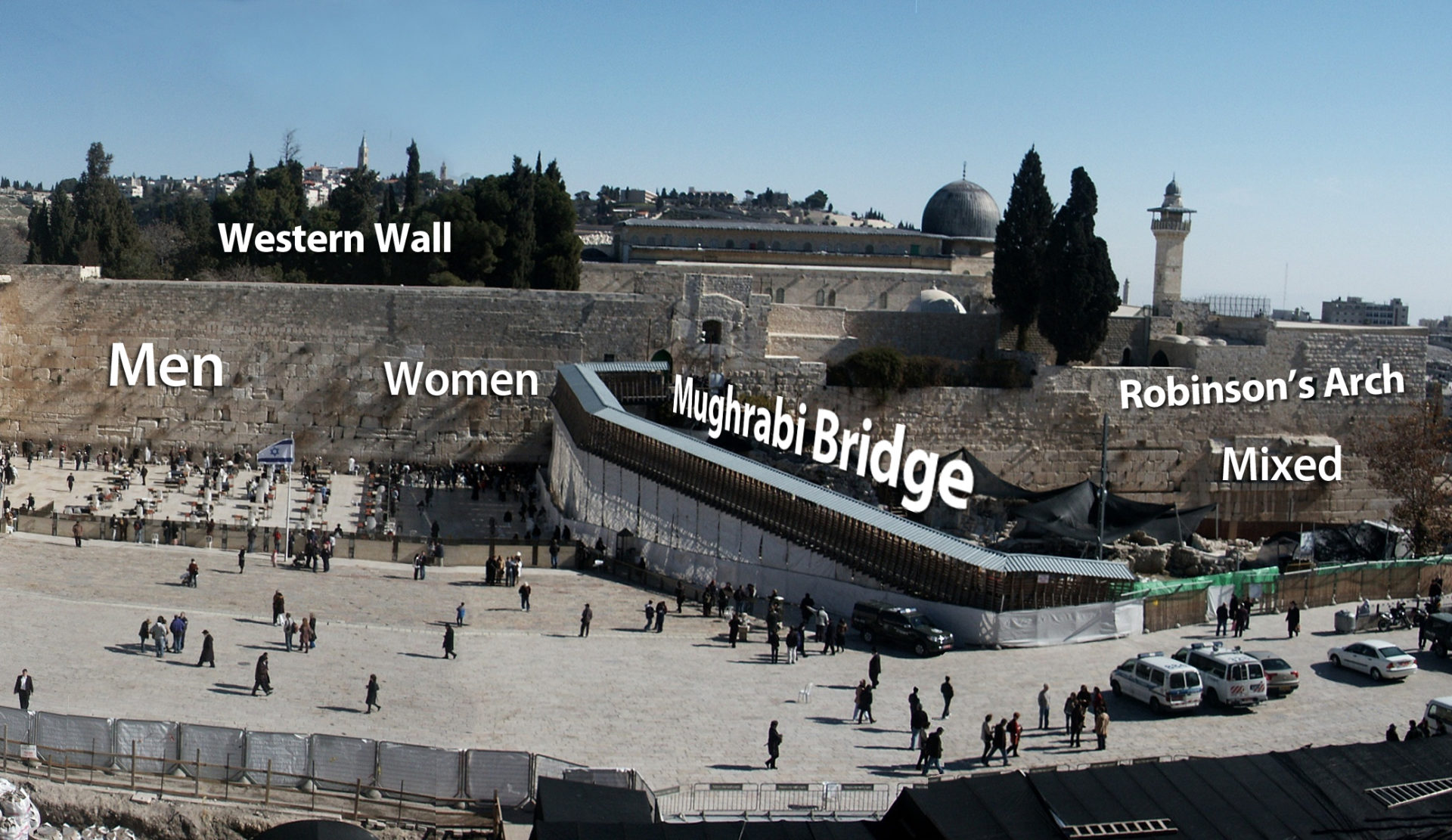
A decision by the Israeli government not to approve the construction of an egalitarian prayer area at the Kotel, the Western Wall of the Temple Compound in Jerusalem and Judaism's holiest site, has opened wounds between the Israeli government and the American Jewish community.  It is ironic that, only weeks after celebrating the 50th anniversary of the return of the Kotel to Jewish hands, this iconic landmark and holy site is giving rise to huge divisions between different groups of Jews.  How differently the Kotel is being viewed now, as opposed to 50 years ago when Jews around the world were rejoicing in unison at the prospects of being able to visit and pray at this site.

Things have clearly changed over the past 50 years that we are fighting amongst ourselves over this matter.  Fifty years ago,  Jews would have been happy simply to be able to visit and pray at the Kotel. It would not have mattered if this would have been by a group of men or women on their own, or by mixed groups and families.  After so many years of having been denied the right to visit the site of the Temple, the details of how prayers would be offered there were unimportant.

Fast-forward fifty years, and the Kotel Plaza has been developed to allow and encourage Jews to visit the site for historical and religious reasons.  It was developed according to the tenets of Jewish religious law as befits a site of prayer.  This means that men and women have been provided with separate prayer areas.  This separation is not a new or alien concept amongst Orthodox and traditional Jews.  It is something that is expected at holy sites and areas of prayer.  And while Orthodox or traditional strands of Judaism are dominant in Israel amongst those who wish to identify with the Jewish religion, the same is not true outside of Israel.  There, the Reform and Conservative strands of Judaism are more popular.  These strands follow a somewhat less stringent interpretation of the Orthodox Jewish laws, either because followers have studied the laws and rejected some of the stringencies arising from Rabbinical interpretations and pronouncements over the years, or because it is simply easier to follow.  In a world where the rate of assimilation amongst Jewish communities around the world is running at alarmingly high levels, any form of identification with Judaism can be considered to be positive.  It is for this reason that the Reform and Conservative communities, particularly those in the USA, have gathered enormous power as they manage to stem some of the massive flows of Jews away from the faith.

The battle lines between Orthodox and Reform/Conservative Jews have long been drawn.  The Orthodox communities have done all that they can to reject the dilutions that are inherent with the Reform/Conservative view on the Jewish world.  They have worked to discredit and delegitimise them, even accusing them of not being Jews.  The Reform and Conservative communities, particularly those in the US that command power and have access to large sums of money, have used this to fight back against the Orthodox world view.  The battle over the Kotel is simply an extension of this power struggle between the different groups.  The Reform/Conservative strand believes that their followers (and other non-religious people) would prefer to visit and pray at the Kotel in an area that is mixed with men and women - an egalitarian area.  This would also allow families to enjoy this experience together.  The Orthodox are absolutely opposed to this, claiming that the Kotel is a religious place of prayer that requires separation of the sexes according to the traditional Jewish Law.

The State of Israel has set out not to distinguish between different groups of Jews.  In fact, the Law of Return that grants immediate Israeli citizenship to Jews, has chosen to use Hitler's definition of Jews rather than going by Jewish religious law.  Hitler decided that any person who had one Jewish grandparent would be eligible to be treated inhumanely by his regime, and to be part of his plan of extermination.  The Israeli government decided that if a person was good enough to be exterminated by Hitler, they would be good enough to be granted immediate Israeli citizenship.  This means that some of those who have been granted immediate citizenship under this law, are not Jewish according to Jewish Law.  This demonstrates the extent to which the State of Israel has opened its arms to many different groups of Jews - and even to some non-Jews.  Under the circumstances, it seems as though the government would be sympathetic to the claims of the non-Orthodox groups at the Kotel.

Even though the government would probably wish to be more accommodating to the demands of the non-Orthodox lobby, and even previously agreed to their demands for an egalitarian prayer area at the Kotel, politics always seems to come first.  The current government coalition can only exist with the support of the ultra-Orthodox parties in the Knesset.  Upon hearing of the government's plan to accommodate an egalitarian prayer area at the Kotel, the ultra-Orthodox parties flexed their muscles and threatened to bring the government down if the plan was implemented.  Prime Minister Netanyahu went into survival mode, even at the expense of his relationship with US Jews, and acquiesced to the demands of his coalition partners.  At least for now.  American Jews responded in disgust by withdrawing their support for the Israeli government.

Does the Reform/Conservative lobby have a valid case in declaring open warfare on the Israeli government as a result of this decision?  The Israeli government has said that an egalitarian prayer area does already exist, but it is just not in the premier Kotel Plaza area.  The non-Orthodox lobby claims that this is not good enough, and effectively treats some Jews as second-class.  Their demand is to have the egalitarian area front and centre alongside the other prayer areas in the Kotel Plaza.  The battle is one of power and of wills. This is a battle between different groups of Jews, each of whom demands that their way is accepted, and with the Israeli government being called upon to act as referee.

Is the Kotel a Jewish national asset that should be required to accommodate all groups of Jews in a way that is to their liking?  Or is it an asset that belongs to the religious, as the holiest religious site in Judaism?  Does creating an egalitarian prayer area alongside the other areas serve to dilute its importance and religious status?  Is this issue important enough to be worth creating a rift amongst different groups of Jews?

I don't have answers to any of these questions.  And even if I did, I feel sure that the warring parties would not consider my point of view in formulating their reactions to the situation.  Of course, the Israeli government will always act in way that promotes its own best interests.  At the moment, that requires it to take the side of the ultra-Orthodox parties and freeze the egalitarian prayer area.

In my opinion, the situation requires tolerance and understanding by all parties.  It is natural to expect that the holiest site in Judaism should have some of the most stringent rules attached to it, and that Orthodox Jewish law should apply.  We live at a time, however, when Jews around the world should find reasons to unite, and not reasons to be in conflict with each other, especially over a site as central as the Kotel.  The ultra-Orthodox parties are not generally known for making efforts to unify different strands of Judaism, but it is never too late.  They should know that no man is in a position to judge another one, nor judge his interpretation of the religion.  So they should be taking the moral high ground on this matter in an attempt to accommodate the requests of the non-Orthodox groups.  Surely accommodating an egalitarian space could be acceptable, as long as they continue to have their separated areas?  The situation now requires unity and not conflict.  It is incumbent upon the parties to sit down, and find a compromise that will be acceptable to all.  Is this too much to expect?

Tuesday, 25 October 2016

The UNESCO Fiasco That Could Help Israel's Cause

The United Nations Educational, Scientific and Cultural Organisation (UNESCO) decided last week to pass a vote on the issue of the Old City of Jerusalem, and the Western Wall and Al Aqsa Mosque in particular.  This was not the first time that such a vote has been passed by UNESCO, and it is unlikely to be the last.  If it was not for the fact that the vote was passed by an organisation that has such broad international representation, and a remit that has an important role in the preservation and advancement of education, science and culture around the world, it would be laughable and difficult to take seriously.

The resolution runs into five pages of condemnations, disapprovals, regrets and deprecations about how Israel (referred to repeatedly in the document as the "occupying power") has violated the "historic status quo" under which the Waqf (referred to in the document as the Awqaf) governs the holy sites.  Israel is accused of using aggression and illegal measures against the Waqf and its personnel, civilians and religious figures, and of using force against and damaging the Al Aqsa Mosque, restricting access to the Temple Mount (not the words of the resolution) via the Mughrabi Gate and preventing the reconstruction of the Al Rahma Gate building.  And, for good measure, there are some condemnations thrown in about military confrontations in and around Gaza and excavations at the Tomb of the Patriarchs in Hebron and Rachel's Tomb in Bethlehem.  The resolution fails to make mention of any Jewish connection to Jerusalem, the Old City and the Temple Mount that is is the holiest site in Judaism.  Instead, it is mentioned purely in Islamic terms.  None of this comes as any surprise to anybody who has been following the votes by UN organisations over the past decade.  They have objectively been very biased against Israel at every level, including the General Assembly, Security Council and other related UN bodies.  Many words of condemnation of this UNESCO resolution have been written, and the Jewish people around the world have demonstrated their disapproval in many different ways.  The thousands who turned up the Western Wall for the Priestly Blessing during the festival of Succot was a sure sign of defiance against the resolution.

In a strange sort of way, I sense that reaction to this resolution may end up helping Israel's cause in the international community, and at UN-related bodies in particular.  Despite the outrage of this vote being passed by 24 votes to 6, with a massive 26 countries abstaining, there are a few positives to be taken from the vote.  While these positive points change nothing about this vote, they do send a message that things could be different in the future.  There are indications that this is the vote that may have broken the camel's back.

Even before the result of the vote was announced,  UNESCO's director-general Irina Bokova was forced to make a statement about how she believes that denying Judaism's connection to Jerusalem (along with the two other monotheistic faiths) harms UNESCO.  The head of UNESCO's executive board, Michael Worbs, said that he hoped that the resolution would not go to a vote.  Clearly, the executive team of UNESCO was embarrassed by the vote of the members of the organisation, and was happy to show this embarrassment in public.  Even the Secretary-General of the UN, who has not necessarily been a great friend to Israel or the Jews during his term, felt the need to speak out against the resolution.  This is a first.  But the positive signs run even deeper than that.

At a previous similar vote in April 2016, the number of countries that voted in favour of the anti-Israel resolution was 33.  Over the course of about 6 months, there were 9 fewer votes in support of a resolution that was substantively the same as the previous one.  This represents progress for Israel, albeit not quite a victory.  The Mexican government decided to fire its ambassador after he refused to obey their orders to support the resolution.  Despite this debacle, the Mexican government stood up after the vote to withdraw its support for the resolution.  The ambassador remained fired, but the u-turn was highly unexpected.

Brazil, which supported the original vote and then spoke out saying that support of the vote was a mistake, chose to support the second vote as well.  They then spoke out again saying that a future similar vote would not be supported by Brazil.  Brazil's actions, and contrary statements are impossible to understand.  It is unclear why the Brazilian government considered that, if the resolution is not worthy of support in the future, it should be worthy of support now.  Brazil's ambivalence, however, is noted with some satisfaction.  There are many theories circulating about why governments like Brazil would choose to support this resolution.  Especially those governments who seemingly do not have an entrenched interest in this matter.  Was money changing hands behind the scenes?  Were political favours being traded?  Are the pro-Palestinian voting trends so entrenched in the international community, that breaking them is almost impossible?  We will probably never know the answer to this question, although speculation is rife.  The thing that has become clear, is that even those countries who supported the vote feel some need to show regret in an attempt to make their public position a little more acceptable.

The resolution in its current wording, not only ignores the Jewish connection to Jerusalem and the Temple Mount, it ignores the Christian connection too.  The Christian countries which voted in favour of the resolution were effectively supporting this world view as well.  It is inconceivable that Christian countries would promote exclusive Muslim rights to the this holy city and its holy sites.  Perhaps their eagerness to condemn Israel caused them to lose sight of this?  It is no coincidence that it has only been under Israeli rule over Jerusalem that all three monotheistic religions have been allowed free access to their holy sites.  History has shown that Arab or Muslim rule over Jerusalem is tantamount to denying the rights of other religions to their holy sites.  How ironic it is that UNESCO has chosen to castigate Israel for its rule over Jerusalem, when this is the one period in Jerusalem's history that has ensured free access to all who come in peace and security to worship.

We can take some comfort from the fact that fewer countries supported the most recent resolution than the one before.  And also from the fact that some of the thinking personalities in leadership positions spoke out against the senselessness of the rhetoric.  I sense that the tide of opinion against Israel could be turning.  Whereas supporting anti-Israeli resolutions has always seemed easy to do by many in the international community, irrespective of how ridiculous the text was, it appears as though people are now thinking a little more before giving blind support against Israel.  That is an optimistic sign.  The battle is, however, far from won, and many more similar resolutions are expected in the future.  Perhaps members of the international community will see more and more what the truth of the anti-Israel campaign is truly about.

Israel could be standing on the threshhold of a new period in international politics and diplomacy.  A new secretary-general is due to take over leadership at the UN in 2017 that could signal a change in some attitudes.  If organisations like UNESCO are going to insist upon passing ridiculous resolutions like the one discussed above, it may also assist in bring the attention of the international community to the single-minded bias against Israel that exists in UN organisations.  The next organisation on the list would be the UNHRC, which has the dubious distinction of isolating Israel as the only country forced to appear as an item on the agenda of all its meetings to explain its actions.

Dreaming costs nothing.

Wednesday, 5 October 2016

Obama's Insult

Image courtesy Financial Times https://www.ft.com
US President Barack Obama was in attendance on Friday at the funeral of former Israeli president and prime minister Shimon Peres, and was invited to eulogise the last of Israel's founding fathers.  Obama's attendance and eulogy was evidence, if any was needed, of Peres's standing in the international community and the circles in which Peres has moved during more than six decades of international diplomacy.  In spite of Peres's persona as an international statesman, his funeral was an intensely personal event for Israel and for members of the Peres family.  This fact seems to have been lost on President Obama judging by the text of his eulogy.

It almost felt as though Obama was trying using his attendance at the funeral to compete with the last US president who attended the funeral of an Israeli statesman just over 20 years ago.  On that occasion, President Bill Clinton created the simple but iconic phrase, "shalom chaver"(goodbye friend), when eulogising late Prime Minister Yitzhak Rabin.  Obama's own attempt at creating an icon of a Hebrew phrase was not simple enough, and fell flat.  Obama's phrase, "toda raba chaver yakar" (thank you dear friend) seemed to be too much of a take on Clinton's original phrase, and seemed much less sincere than the words uttered by Clinton two decades ago.  Even Bill Clinton's own eulogy on Friday of Shimon Peres seemed more sincerely spoken than that of Obama.

Obama had lost his way in his speech, and in the hearts of Israelis, long before the "toda raba chaver yakar" was uttered.  In fact, he had already succeeded in putting a foot wrong in his remarks of welcome, long before reaching the main part of his speech.  As one would expect at such an occasion, President Obama acknowledged members of the Peres family in mourning, Israeli leaders and representatives and other world leaders in attendance at the funeral.  This is where things started to go wrong.  Out of all the foreign leaders, who attended the funeral, President Obama chose to mention only one by name in acknowledging his presence.  That was the name of Palestinian Authority President Abbas whose presence, he said, "was a sign of unfinished business"!

That one comment infuriated me, and many of my fellow Israelis.  Is this what Obama's attendance at the funeral was all about?  To promote his political agenda and highlight his political failings, at the state funeral of one of Israel's founding fathers?  And what did Obama hope to achieve by making this comment?  His ability to achieve anything in Middle East peace-making is long past, as he enters the "lame duck" period of his presidency.  So what positive could have come from this comment?  To me, his comments indicated a lack of respect to those whose hospitality he was enjoying.

Out of all the elected leaders who had accepted the invitation of the Peres family and the Israeli government to attend the funeral, why did Obama choose to single out the one leader who does not enjoy a democratic mandate from his people to rule?  And did he not understand that this was also the leader who has supported waves of terrorist attacks that have been undertaken against Israel and Israelis over the past few months and years?  Even though Abbas may not have personally ordered these terror attacks to take place in the way that his predecessor did, he has provided Palestinian Authority money to the families of terrorists who were killed during the course of their murderous activities.  And he has sent out messages of sympathy and made condolence visits to the families of these evil murderers.  In doing so, Abbas has made clear to his people that such activities are acceptable and desirable.  This, in turn, creates a new generation of terrorists.  So for him to be standing on the hallowed ground of Jerusalem's Mount Herzl at the funeral was already a huge concession in the view of many Israelis, perhaps an unjustified and undesirable concession.  But Obama succeeded in rubbing salt into the wounds by choosing to give credibility and international standing to a man who is most unworthy of this.

What was the unfinished business that Obama was referring to?  He would say that it is the unfinished business of making peace between Israelis and Palestinians.  But the Palestinians show little desire to finish this, and have taken no active and meaningful steps in this direction.  In Israel's view, the unfinished business is that of removing the objective to destroy Jews and the Jewish homeland from the charter of the PLO, and to openly and unequivocally recognise Israel's right to exist as a Jewish state.  Until that unfinished business is taken care of, and the support for terrorists is ended, there will be no further business.

There is no doubt that Obama was conscious that his comments would be controversial.  He is well aware of the position that Prime Minister Netanyahu has taken on the issue of the peace talks, and the stand taken by the Palestinians.  These remarks were made with full knowledge that they would cause a reaction, and that they would not be welcome.  This represents an insult to his hosts, and was inappropriate and uncalled for.

The actions by the US president seem consistent with his behaviour towards Israel over the last few years.  During the time of Obama's presidency, the Palestinian Authority has had its status at the United Nations upgraded, been accepted as a party to the International Criminal Court in The Hague and taken on a much higher standing in the international community.  All of this comes despite continuing to fund and encourage terror, and not being willing to recognise the democratic right of the State of Israel to exist as a Jewish state.  Instead of holding the Palestinians responsible for acts of terror and being prepared to criticise this publicly, the US president has continuously castigated Israel for constructing homes in Israeli-ruled territory.

Prime Minister Netanyahu acquiesced to the request by the Peres family to invite Mahmoud Abbas to the funeral, and to seat him in the front row.  His hands were tied in terms of agreeing to grant Abbas permission to enter Jerusalem for the funeral, even though he may have wished to act otherwise.  Obama should have considered this enough, instead of making a more public spectacle of an already uncomfortable situation.  Sometimes less is more, although Obama seemed insensitive to this during his eulogy.

It is somewhat ironic that Abbas's presence at the funeral was also castigated by his own electorate, many of whom considered Peres an enemy of the Palestinian cause.  With so many Palestinians and Israelis joining together in the dislike of Abbas's presence at the funeral, perhaps this should have been a clear enough message to Obama that raising this in public would serve to damage his objectives rather than progress them.  Perhaps this is a clear indication why American peace-making efforts, particularly those driven by Obama, have been so unsuccessful.

Sunday, 5 June 2016

Staying Unified

Picture from aicvideo
Today is the day in the Jewish calendar that Israelis (and others) celebrate the reunification of the holy city of Jerusalem 49 years ago.  Jerusalem Day is celebrated widely, and nowhere more enthusiastically than in the city itself.

Not only is Jerusalem one of the oldest cities in the world, it is undoubtedly the most controversial city in history.  According to Wikipedia, the city has been destroyed twice, besieged 23 times, attacked 52 times, and captured and recaptured 44 times.  And these numbers do not include internal strife, intifadas and terror attacks which persist in the city until today.  Although these events have taken place over approximately 5,000 years, it still seems a great deal for any city to endure, and there are many who wonder why it is that one city should be so sought after that people are prepared to go to such extraordinary lengths to secure control over the city.

For the Jewish people, the answer is quite clear.  The belief is that the creation of the world emanated from the Foundation Stone on Mount Moriah.  This is also the same place that Jacob was ordered to sacrifice Isaac (and then stopped from doing so), and also coincides with the location of of the famous dream of Jacob's ladder.  So it comes as no surprise that King David chose this place to erect his City of David in approximately 1,000 BCE, and that Solomon's Temple was built on Mount Moriah soon after this.  From the moment that Solomon's Temple stood at this site (and possibly even from long before), it took on the undisputed position as the holiest place on earth to all Jews.  The city of Jerusalem is mentioned by name more than 600 times in the Jewish biblical texts, and thousands more times by other names and references.  The centrality of this location and this city to Jews is without rival.  It is highly likely that this centrality is the reason why Jesus, a Jewish boy from Nazareth, found himself in Jerusalem where he was crucified.  This established Jerusalem as a holy city for his followers, later to be known as Christians.  The holiness of Jerusalem to the third monotheistic religion, Islam, stems from an event that took place more than 600 years later.  The Quran tells us that the Prophet Mohammad was taken by Buraq to visit the "furthest mosque" (believed to mean the Al Aqsa Mosque in Jerusalem), from where Mohammad was taken to heaven.  This reference is the sole claim that Muslims have to Jerusalem as a holy city (although still not quite as holy as Mecca and Medina), and Jerusalem is not mentioned by name once in the entire Quran.  The scene was set for conflict, disagreement, war, death and destruction surrounding the control of this city, holy to three religions.

Today we celebrate 49 years of freedom of the city of Jerusalem.  This freedom extends not only to Jews and Israelis who have administrative control over the city.  It extends to all from the three religions, and others, who come in peace to worship, learn the history and pay respects to the holy city.  But this was not always the case, and is never taken for granted in this conflict-filled city.  Even as recently as 50 years ago, Jews were prevented from entering the Old City of Jerusalem, and approaching the holy site of the Western Wall.  This fact alone is justification for Israel to continue to exert control over the city and its holy sites.

Over the past few years, Jerusalem has put on an annual festival of light as part of the Jerusalem Day festivities.  It is highly symbolic that the city, with such a dark history, has a festival of light to emphasize all that is positive about the city.  I had the good fortune to participate in the festival this year, and it is an experience that has left an impression that will remain with me for a long time to come.  Not only were each of the exhibits creative and interesting, the atmosphere that could be felt around all parts of the city was electrifying (no pun intended).  Thousands of people formed a human chain following the different coloured tracks around the streets of the Old City, and around the walls.  People were drawn to parts of the Old City that they had never visited, perhaps because they were afraid or perhaps just because they were off the beaten track and unfamiliar.  I could not help noticing that people came from all parts of the country, from all walks of life and from all ethnic backgrounds.  Muslims joined with Christians and Jews in celebrating the light of this intriguing city.  I silently wondered as I walked around the thronging alleyways whether the Muslims were not enjoying more freedom now since the Old City is in Jewish hands, than they did when it was ruled by Jordan.  It could only happen under Jewish leadership that the King of Jordan, the same Jordan that denied Jews the right to access its holiest site for 19 long years years, is now the head of the Waqf religious council that has jurisdiction over Muslim holy sites in the city of Jerusalem.

Despite the conflicts and violence that continue in Jerusalem at the current time, the city of Jerusalem has undergone probably one of its most dramatic reconstruction periods in its history over the past 49 years.  While the integrity and the character of the original city has been preserved, the construction of infrastructure and residential and commercial buildings has been astonishing.  The light rail trundles over ancient cobblestones, and modern buildings are built in the Jerusalem stone in keeping with the rest of the architecture of the city, blending in with the ancient walls of the Old City.

Jews have maintained a continuous presence in the Jewish Quarter of the Old City of Jerusalem since the 8th century BCE, with the exception of the period between 1948 and 1967 when Jordan brutally forced Jews out.  There were periods when being Jewish in the Jewish Quarter was not easy, but Jews were never willing to give up on this despite any hardship.  The same tenacious spirit is in evidence today.  Jews will not give up on the presence in the Jewish Quarter, and Jews will not give up on the united city of Jerusalem as the capital of Israel.

Each time I visit Jerusalem, I wonder what my grandparents and great-grandparents would feel if they saw the ease with which I am able to visit the holiest city in Judaism, and its holiest site, the Western Wall.  I wonder what they would think to see me driving freely around the streets, walking in the market and viewing the Knesset building.  We are indeed a privileged generation to have the immense good fortune to live at this time when we are able to do the things that our forefathers prayed fervently to have the right to do, and who died fighting to do.  When we say Lshana habaa B'Yerushalayim at the end of the Pesach seder, it is not a pipe dream.  It is something that is absolutely achievable.

If the history of Jerusalem is anything to go by, we will be forced to continue to fight to retain Jerusalem as our eternal capital.  It is a fight that most Israelis are prepared to undertake, and a fight that many have already died for.  But this makes us stronger rather than weaker, and our resolve to retain Jerusalem will never diminish.  For now, we bask in the glory of Jerusalem, and we rejoice in our ability to be free as Jews in our holy city.

Sunday, 12 May 2013

War Against Women of the Wall

The group known as "Women of the Wall" have elevated themselves onto the front pages of the Israeli press in recent times.  They have clashed with police in Jerusalem over their desire to have the right to pray at the Kotel, the Western Wall, in their own way and style.  For them, their way and style means wearing a talit (prayer shawls) and tefilin (phylacteries), and undertaking other prayer-related activities which are usually the preserve of males in Orthodox Judaism.  Their mission says, "........ our central mission is to achieve the social and legal recognition of our right, to wear prayer shawls, pray, and read from the Torah collectively and out loud at the Western Wall".  Why does this lead them to become criminals in the eyes of the Israeli justice system?

Some of these actions on the part of the Women of the Wall have attracted attention from Jerusalem police officers, and even led to some of the women being arrested.  The legal system has relied on the law in Israel that requires respect for "local custom" at the site, which in this case refers to the Kotel.  The police have been called to arrest Women of the Wall on the basis that their actions do not respect local custom.  Clearly, the "local custom" is determined by what the Orthodox establishment demand.  Such arrests have been made on more than one occasion.

While we understand that, in most Orthodox Jewish custom, women do not wear prayer shawls and do not read from the Torah in public, the question is whether there is any actual prohibition on women doing these things?  It seems as though the customs of women not undertaking these activities stems from the fact that, in Orthodox Jewish law, women are not obliged to fulfil them in the way that men are.  In the case of the talit and tefilin, these are precepts (mitzvot) that are time-bound.  This means that there are certain times that the mitzva should be undertaken, and other times when it should not.  As a general rule, such time-bound mitzvot are not required to be undertaken by women in terms of Talmudic law.  It is not exactly clear why this is this case, but there are views that it is because women have a higher spiritual wisdom (bina) than men, and this exempts them from time-bound mitzvot.  Others contend that it is a more pragmatic issue of women having so many other household chores to take care of, that they can be exempted from time-bound mitzvot.  Our Talmudic sages are divided as to whether women are prohibited from performing mitzvot from which they are exempt.  The Rambam, one of the most famous of the Talmudic sages seems to accept that there is no prohibition on women performing mitzvot that they are not obliged to perform, and chooses instead to discuss whether women should pronounce the blessing which states that they are obliged to perform the mitzva before actually performing it.  He is supported in this discourse by Rabbi Yosef Karo and others.  This seems to give sufficient doubt to indicate that women are not entirely without justification when choosing to perform such mitzvot, and there is a strong case which supports women being free to carry them out.

Jewish Agency Chairman Natan Sharansky was drafted in by the government to try to help the situation. The actions to prevent the Women of the Wall from expressing themselves during prayer have served to alienate many US Jews from Israel.  The US community, which is notoriously heterogeneous in its interpretation of Judaism and which values pluralism in Jewish thought and practice, has reacted extremely negatively to the standoff at the Kotel.  It was hoped that Sharansky will be able to use his balanced approach to suggest a compromise solution, and that he can use his links with the US Jewish community to heal the rift which has developed.  Sharansky recommended allowing the Women of the Wall to use a separate section of the wall, known as Robinson's Arch, to allow the Women of the Wall to express themselves and carry out their practices without others being offended.  While this was originally accepted as a possible compromise by the Women of the Wall, their position has hardened recently and they are now rejecting this solution.

The hardening of their position coincided with the ruling by an Israeli court a few weeks ago, which decided that these actions by the Women of the Wall do not actually constitute disrespect for local custom at the site.  This reinforces the lack of agreement by the Talmudic sages.  This court ruling means that their actions no longer constitute an offence for which women can be arrested.  The Women of the Wall were emboldened in their view that their actions are entirely acceptable, and decided that there is much less justification in accepting a compromise solution that means they are forced to pray hidden from general sight.

The influence of the ultra-Orthodox in Israel has been substantial over the past few years, particularly during the years that successive governments owed their continued existence to the support of the ultra-Orthodox parties in the Knesset.  The ultra-Orthodox influence has pervaded many aspects of Israeli society.  Numerous concessions have been granted to the ultra-Orthodox community to keep them supporting the government, the most famous of which is the exemption of young ultra-Orthodox boys and girls from serving in the IDF.  This has granted disproportionate power to ultra-Orthodox groups.  With the construction of Prime Minister Netanyahu's most recent government that excludes the ultra-Orthodox parties for the first time in many years, ultra-Orthodox power has been substantially reduced.  Many in Israel are happy about this, as the influence of the ultra-Orthodox has permeated the lives of so many individual Israelisl.  Perhaps the drama at the wall is an attempt for the ultra-Orthodox establishment to exert their power where they can.

Even though the ultra-Orthodox establishment has been given control over the Western Wall, and Chief Rabbi of the Wall Shmuel Rabinovitz has rabbinic jurisdiction over this site, it should be understood that the Western Wall is a public asset for Jews in Israel and around the world.  As such, decisions such as those affecting the Women of the Wall should not be taken lightly.  It is not as in an individual synagogue where congregants are free to move elsewhere in the event that they do not wish to accept the rules pertaining to the synagogue.  The Western Wall has no alternative in Judaism.  To the extent that there is even the slightest doubt about the interpretation of a particular element of Jewish law, as is the case here, the rabbi has a responsibility to consider the national and international ramifications of his decision.

I salute the Women of the Wall for standing by their convictions, and for being prepared to take on the ultra-Orthodox establishment.  This is not an easy decision, and life has been made extremely for them as a result.  Ultimately, I believe that they will prevail, and that they will be granted the right to pray as they wish.  In reality, anybody who does not like this is not obliged to be present at the Kotel when the women are there.  Until now, the Women of the Wall have conducted their prayers monthly on rosh chodesh at a time known in advance.  This allows plenty of alternative opportunities for those who wish to attend the wall, without being forced to endure anything that they do not wish to see.  This simply demands a little tolerance and understanding by all parties, something that is unfortunately in short supply in Israel, especially in the ultra-Orthodox establishment.

The time has come for the government to exercise its control over the Kotel, and ensure that all who wish to pray there are able to do so.  It is ironic that the IDF, without the support of the ultra-Orthodox youth, was responsible for liberating this holy site during the Six Day War, only for the site to then be turned over to the control of the ultra-Orthodox.  This is a national holy site, and all Jews should have the right to worship there.  Bravo Women of the Wall.

Sunday, 20 May 2012

Keeping Jerusalem Unified

Today, Sunday 20th May, we celebrate 45 years since Jerusalem was reunified in the Six Day War according to the Hebrew calendar.  These have been 45 eventful but happy years, which have seen the holy city of Jerusalem quickly regain its central place in Israeli and Jewish life.  After 2,000 years of exile from the Land of Israel and the city of Jerusalem, and a further 19 years of being denied access to the holiest sites in Judaism, Jews around the world celebrated when the IDF paratroopers finally reached the Kotel and Motta Gur announced the famous words, "The Temple Mount is in our hands".  That moment is being savoured and celebrated today on Jerusalem Day.

The important place that Jerusalem occupies for Israelis and for Jewish people all around the world has strengthened over the past 45 years.  Once again, we have had the merit and the joy to be able to visit the holiest site in Judaism.  It is impossible to consider a possibility that Jerusalem would not remain unified in the future, and that Jews could be denied access to visit the holy sites in the way that we were forced to experience in the past.  This is almost certainly one of the reasons why discussions on the final status of Jerusalem in the peace talks with the Palestinians are so fraught.  It seems as though the Palestinians understand the strength of feeling that we have for Jerusalem, and continue to demand it for themselves.  This may enable them to extract major compromises in return for giving up on Jerusalem in the final agreement.

There can be no escape from the centrality of Jerusalem in Judaism.  Even those who wish to prevent Jews from having access to Jerusalem would struggle to the deny strong links that Jews and Judaism have to this holy city.  The holy nature of the city was arguably only established during the time of David and Solomon when the temple was built.  It is no mere coincidence, however, that the temple was built in this city and on Mount Moriah.  This is the site of the dream of Jacob's ladder, the site of the almost-sacrifice of Isaac and possibly even the site from which the which the world was created.  Whether or not one believes in these biblical links, it is simple to refer to Jewish texts that have been written and passed down over thousands of years, and which bear testimony to the close links that Jews have to the city.

Over the past 45 years, the city of Jerusalem has developed and grown in a way that makes it unrecognisable from the city that was reunified 45 years ago.  The Kotel (the Western Wall), the only remnant of the remains of the temple, was quickly transformed into an area that could be host to the many millions of visitors that wish to visit the heart of Judaism.  It is believed in Judaism that the divine presence emanates from Jerusalem.  In order, however, for the divine presence to be felt, it is required that there will be those to receive and bask in its glory.  The Kotel has truly fulfilled that purpose.  It plays host to state and military ceremonies of great importance and significance.  It also hosts all manner of religious worship, celebration and heartbreak.  The Kotel plaza is often filled with tens of thousands of people as they cram themselves in to take part in the merit that our generation enjoys to have free access to this place.  The surrounding parts of the Old City, and stretching out well beyond into the new city and further, have seen a renewal and redevelopment that has transformed the face of Jerusalem, without changing its character.  The modern Chords Bridge at the entrance to the city, numerous luxury hotels and the sight of the Jerusalem light rail show the face of a contemporary city keeping up with the times, while allowing residents and visitors to get close to its historical roots.

Over the years, conquerors of Jerusalem have denied access to other religions as a punishment, and as a sign of their supremacy over the city.  It is, after all, a city that is holy to all three monotheistic religions.  Contrary to this trend, it is interesting that Israel decided to allow all religions access to their holy sites in the city.  Rather than weaken Israel's grip on the city, I feel that it has served to strengthen Israel's position in Jerusalem.  I believe that most Israelis are proud that this is the case, as much as they are determined to ensure that Israel's rule over the city continues well into the future.

The truth is that it is difficult to try to predict what the future holds for the holy city.  There seems to be no real reason for the Palestinians to wish to rule over the city.  While it is a city that is holy to Muslims, it ranks only third in its holiness to the cities of Mecca and Medina.  Muslims have access to, and complete control over all Muslim holy sites in the city through the Waqf.  This stretches even to having control over the Temple Mount and the Al Aqsa mosque, despite this also being the site of the holy Jewish temple.  I imagine that the only benefit that can be gained from ruling over Jerusalem, or parts of the city, is that it may give them the right to deny access by others to these areas.  We can never risk this situation coming to fruition.

Despite the fact that a great deal of thought has been given to the possibility of creating Jerusalem into something of an international city that is owned by everyone, but nobody in particular, there is no real precedent for a successful implementation of such a model.  This gives rise to a great deal of scepticism, and suspicion as to what the true intentions of the Palestinians may be with regard to Jerusalem.

For now, the united city of Jerusalem is the capital of the State of Israel, and the centre of the Jewish world.  It also plays host to Muslims, Christians and members of other faiths that may wish to visit, live and study in the city.  There seems little wrong with this model, and no individual is denied any rights that he may wish to have.

It is my hope and prayer that Jerusalem will continue to play its role as a central part of so many faiths, and that all faiths will continue to have free access to all corners of this ancient and fascinating city.

If I forget thee, O Jerusalem, let my right hand forget her skill.
                                                                (Psalm 137)


Sunday, 6 November 2011

A Spitting Shame

I was horrified to read the details of the trial of Johannes Martarsian, which took place in the Jerusalem Magistrates Court last week.  Martarsian, an Armenian priesthood student, was charged with assault after he punched an ultra-orthodox Jew in the face and made him bleed.  The incident took place in Jerusalem's old city after the ultra-Orthodox man spat at Martarsian.

Judge Dov Pollock annulled the indictment against Martarsian and wrote, "putting the defendant on trial for a single blow at a man who spat at his face, after suffering the degradation of being spat on for years while walking around in his church robes is a fundamental contravention of the principles of justice and decency."  Fortunately, in this case, the judge had the good sense not to waste any more taxpayer money on proceeding to a trial.  Throwing the case out of court was exactly the right response to such a disgraceful situation.

The trial has brought to the fore some of the bad behaviour which is prevalent amongst the ultra-Orthodox community.  It seems as though the spitting incident is not an isolated one.  Clergymen from the Armenian church who are based in Jerusalem report that they are frequently subject to being spat and cursed at by ultra-Orthodox Jews.  One Armenian priest said that he wonders to himself if he will be spat at each time he walks by an ultra-Orthodox Jew in the street.  For some priests, it is difficult to simply ignore the repeated incidents of bad behaviour that they are forced to endure.  Johannes Martarsian is an example of one who decided to respond rather than to simply turn the other cheek, despite the fact that Armenian priests are encouraged by their church not to respond to these incidents of gross provocation.

The ultra-Orthodox community in Jerusalem has an unfortunate reputation for bad behaviour in many different situations.  Women who venture into ultra-Orthodox neighbourhoods in Jerusalem like Mea Shearim, and who are not dressed according to the ultra-Orthodox conservative dress code, will already know that they also become spitting targets.  Equally, cars driving through religious neighbourhoods on Shabbat have been subject to stoning attacks.  This has given rise to the famous T-shirt that has been sold in Jerusalem and purchased by thousands of tourists stating, "I got stoned in Mea Shearim"!  Although these types of attacks are unacceptable, there may be some part of a reasonable person that could condone such behaviour where people enter religious neighbourhoods without respecting the norms of the people that live there.

The attacks on the priests seem of a completely different nature.  There is no disrespect of the ultra-Orthodox lifestyle involved, and no violation of the norms by which they live.  Jerusalem is a city which is open to all religions which wish to be present there.  Not only is this a policy which is rigorously adhered to by the Israeli government and the city of Jerusalem, it is also the source of a great deal of tourist Dollars into the city.  At times, it seems as though the ultra-Orthodox community are completely divorced from the society in which they live, and their actions cannot be tolerated by other reasonable people.  The truth is, that some of their actions are so intolerable, that even those who have grown up within their sects and have become used to their social norms, cannot accept the way in which some situations are dealt with.

The types of insults that these young men give by spitting at others created in G-d's image, have caused me to wonder how they can reconcile this behaviour with their religious beliefs.  The Jewish religion believes in 613 mitzvot (precepts) that observers are required to adhere to.  They are split into mitzvot concerning man's relationship with his G-d, and mitzvot concerning man's relationship with his fellow-man.  Neither group has precedence over the other - they are both equally important.  On many occasions such as stoning a car that is transgressing the Shabbat, the justification for the action taken by somebody against his fellow-man is to protect his relationship with his G-d.  In light of the fact that these mitzvot do not enjoy precedence, there is a view that says that the transgression against the fellow-man cannot be justified, even if it is an act to protect his relationship with his G-d.  The act of spitting at the priests, however, seems to serve no religious purpose at all and has no positive side to it.  Rather, it represents an act of unjustified discrimination.  So how much less can this be justified in religious terms?

What is even more unfortunate about this sad situation, is the fact that priests say that reports made about these incidents to the police fall on deaf ears.  Perhaps it is because the police feel that it is impossible to catch the perpetrators and bring them to justice, that no action is taken.  It is also fair to say that Jerusalem's police force has its hands full with high-level security threats which it is required to take care of on an ongoing basis.  Whatever the reason for the lack of action, it is sends an entirely wrong message about the acceptability of this behaviour.

The ultra-Orthodox community present themselves as representing all that is good when acting in strict observance of the Torah.  Too often, however, the pursuit of individual points of observance causes the individual to lose the wood for the trees.  There seems to be no broader perspective, or ability to see the bigger picture.  This is extremely damaging to the standing of the ultra-Orthodox community in the world in which they are forced to live.  The time has come for concerted action to be taken to change the bad behaviour.  The yeshivot (institutions of religious learning) need to be responsible for teaching their students about the unacceptability of spitting at others.  The police on the streets need to keep their eyes open for such incidents, and act upon them immediately. 

Jerusalem is a city that is open to people of all religions to visit and to live in.  While it serves as the capital of the Jewish State of Israel, the government has undertaken that the city will be open to all religions for tourism, learning and worship.  This means that it is not the private domain of ultra-Orthodox Jews, even though it is their religion's holiest city.  There should be no reason why priests who have come to Jerusalem for the purpose of furthering their religious studies and experiences, should be subject to any sort of bad behaviour by ultra-Orthodox Jews or anybody else.  The time has come to take action to stop this intolerance and insulting behaviour.

Monday, 11 October 2010

Jerusalem is Always Full of Surprises

I truly love visiting the Holy City of Jerusalem. There is no doubt that it has a certain spiritual atmosphere that I have not experienced in any other city in Israel, or elsewhere in the world. I am not sure to what extent this atmosphere is real, or created as a result of my expectation that I will feel it. The only thing that is important is that I feel it, and enjoy it very much. I usually try to make a point of setting aside at least one day each year to visit Jerusalem as a tourist. I like to travel around to the famous sites and vantage points and just experience the unusual things that can happen only in Jerusalem.

People in Jerusalem are totally different, and a good number seem crazy to me. Many of its residents have one religious leaning or another, and behave in ways which would not be acceptable or seen anywhere else. Where else in the world would it be completely normal for men to enter the bus at the front, with women getting on at the back. Although I find this odd, and even offensive, the residents in Jerusalem do it like it is the most normal thing in the world. This strange behaviour even seems to rub off onto the tourists who visit the city. Jews, who would not be seen dead wearing a kippa (skullcap) in public in their home towns, are all of a sudden enjoying wearing it in Jerusalem. There are those who experience Jerusalem Syndrome and other strange psychological occurrences, apparently all unique to this much fought-over city, which is holy to the three monotheistic religions, and the capital of the State of Israel.

On Friday, I had the good fortune to have an excuse to pay Jerusalem a fleeting visit. The occasion of a visit by friends to Israel from abroad took me to the City of Zion. I was, however, wholly unprepared for I what I was to witness. After entering the city from the north, and then heading eastward towards French Hill, I made a stop on Mount Scopus. In my quest to get from there to the area of the Germany Colony, I managed to take a wrong turning and momentarily lose my way. As a result, I was forced to drive unexpectedly through Wadi El Joz, an Arab neighbourhood of East Jerusalem. I had driven down these roads on a number of previous occasions, and had no hesitation about following this route to my destination. Even though the character of this neighbourhood is clearly different from that found in the neighbourhoods of the western parts of the city, or even the area within the walled Old City of Jerusalem, there seemed to be no logical reason not to travel this way.

This all changed when I suddenly observed three or four young Arab children, perhaps ten or eleven years of age, hurling rocks at passing cars. I was travelling up the hill past them, and they seemed only to be throwing rocks at the cars travelling down the hill. I could not quite figure out why they were throwing rocks at some cars, but not others. Perhaps they thought that they could identify Arab cars and spare them a pelting. Whatever it was, my shock turned to real anxiety when I was detained behind a bus and a long queue of cars heading up the hill. My car was brought to a halt directly opposite these children while I waited for the traffic to proceed. For some reason, they chose not to direct their attack at my car, and my anxiety became relief when the traffic proceeded, and I left the location of the random violence in my rear-view mirror.

After returning home later in the day, I read of the incident involving settler leader David Be'eri, who was filmed driving into a group of Arab children who were pelting his car with stones in the Silwan neighbourhood of East Jerusalem. This was not far from where I experienced my incident. Be'eri claims to have acted in self defence as he felt his life was in danger. There are many questions to be asked about this incident, especially how come an Associated Press film crew just "happened" to be on hand to film the incident, and then post the film clip on the Internet. Although I don't subscribe to Be'eri's right-wing brand of politics, I honestly understand what he means when he says that he felt threatened. I felt the same fear, and I did not even have a stone thrown in my direction.

This incident, although fairly minor in the overall scheme of Middle East politics, made me wonder a great deal about what is acceptable, and what is not. There can be no doubt that the extremism that people demonstrate in Jerusalem is a cause for many of its problems. When can it be OK for children as young as ten years old, to be stoning cars of innocent passers-by? What do we expect of these children when they eventually grow to twenty and thirty years old? Is this fight really about the Holy City of Jerusalem, or is it about the fact that possession is nine tenths of the law, and it is worth taking any actions to retain the possession? It left me feeling less optimistic and less spiritually cleansed by being in Jerusalem.

Later in the afternoon, while enjoying a late lunch in Emek Refaim Street with our friends, the first rain of the season arrived. These were the first drops of rain seen in Jerusalem for at least 5 months, and almost seemed to try to wash away the negative memory that still lingered in my mind following the earlier incident. As exciting and welcome as the few drops of rain were, they could not eradicate the picture imprinted in my mind of the young children seemingly randomly throwing rocks at passing cars.

This was certainly not the Jerusalem that Jews pray about in their daily prayers. Nor is it the Jerusalem which is holy to Islam and Christianity. This is the Jerusalem of violence, extremism, political brinkmanship and film cameras. Although I loved Jerusalem more before this act of random violence on Friday, nothing will stop me from cherishing it as the holiest place in the Jewish religion, and as the undivided and eternal capital of the State of Israel.

Tuesday, 11 May 2010

Celebrating Jerusalem

Wednesday this week sees the minor holiday of Yom Yerushalayim (Jerusalem Day). It is not a holiday that is widely celebrated, and there will be many Jewish communities around the world that may not even be aware of the holiday. In Israel, and particularly in the capital city, the day will be celebrated as one of the happiest days of the year. This is the day which, in 2010, marks 43 years since the holy city of Jerusalem was reunified and installed as the undivided capital of Israel and the Jewish people.

The pictures that are synonymous with the famous victory achieved by the Israeli forces in the Six Day War show celebrations and tears at the Western Wall when it was restored to Israeli control. The feeling of being so near to the holiest site in Judaism, and being prevented from approaching it during the years of Jordanian rule over East Jerusalem, proved to be very difficult for Jews. The ability to touch the wall after the victory in 1967, the same wall that formed part of the outer borders of Herod’s Temple, was unsurprisingly the focal point of the celebration. This place and this city has been the object of Jewish prayers and yearning for almost 2,000 years during the period of exile. Finally returning it to Jewish hands brought about scenes of jubilation and unbridled joy.

During the nearly 20 years of Arab rule over East Jerusalem and the Temple Mount, no access to the holiest Jewish site was allowed to Jews. During the same period, there was no attempt to declare this the capital of any Palestinian State or the capital of any other country. The claims that Jerusalem be the capital of a country other than the Jewish State were only initiated well after East Jerusalem was returned to Jewish hands, and the united city of Jerusalem proclaimed as the eternal capital of Israel. When the opportunity was presented to proclaim Jerusalem as the capital of an Arab country, there was no interest in doing so. It is, therefore, hardly surprising that there is a great deal of scepticism around the claims by the Palestinians that Jerusalem be the capital of a Palestinian state.

When considering that Muslims have been allowed access to their holy sites in Jerusalem under Israeli rule and the Waqf council headed by the King of Jordan has jurisdiction over Muslim holy sites, there seems to be little reason for Palestinians to claim Jerusalem as their capital city. Despite this fact, the Palestinians have made the issue of Jerusalem one of the cornerstones of their claims against Israel. The now on-again proximity talks with US mediation will focus on 5 core issues, which include the claim by the Palestinians to have East Jerusalem as the capital of a Palestinian state.

The extent to which the claim to Jerusalem is really so important is brought into question by the actions of Yasser Arafat at the Camp David summit with Prime Minister Ehud Barak in 2000, under the mediation of US President Bill Clinton. At that famous meeting, Arafat rejected the generous proposals made by Barak to him. These proposals, which would most likely have been rejected by the Israeli electorate had they had the chance to vote on them, were still not enough for Arafat. Is the claim to Jerusalem to be regarded as a genuine desire to have the holy city as a Palestinian capital, or is it simply part of the strategy to expel the Jews from Jerusalem and Israel? I am forced to believe the latter.

During the course of the current round of proximity talks, it is my hope that prime minister Netanyahu will not be fooled by the tactics employed by the Palestinians. Despite my scepticism regarding the true intentions of the Palestinians, I am a supporter of the two-state solution which allows for the establishment of a Palestinian state for the Palestinian people. This does not, however include gifting any part of Jerusalem to this Palestinian state. The prime minister does not have a remit from his electorate to give any part of Jerusalem to the Palestinians. Jerusalem was annexed soon after the 1967 war (as opposed to the West Bank which remains under military rule) in order to send a clear message that an undivided Jerusalem will always be the capital of the Jewish state. This message needs to be resent loudly and clearly. The Palestinian headquarters are currently established in Ramallah, and there seems to be no conceivable reason why this should not continue to serve as a capital of a Palestinian state in the future.

This week on Yom Yerushalayim, not only will we be celebrating events of the past, we will also be considering what the future holds for the holy city. One thing is for sure, the right of Jews to visit the holiest site in Judaism can never be compromised. This is a minimum. The truth is that giving any part of Jerusalem will not be acceptable. My prayer is that we can reach an agreement with the Palestinians to allow them to establish a state without having to cede any part of Jerusalem to this state. I also pray that this state will agree to live alongside Israel in peace and mutual respect. Is this too much to expect?

Saturday, 13 March 2010

Yerushalyim Shel Zahav (Jerusalem of Gold)

Over the course of the nearly 12 years that I have been living in Israel, and before that during numerous visits to Israel, I have had the privilege of visiting the holy city of Jerusalem many times. I spent a number of years working in the city, and commuted each day to my office there. Although I long ago decided that I would not like to live in the city, it definitely holds a mysteriousness for me and has a unique atmosphere that I feel a strong connection with. Despite this fact, I have never taken the chance to be in Jerusalem over Shabbat. So, when I was recently invited to spend last Shabbat in Jerusalem, I grabbed the opportunity with both hands. I am so pleased that I did so.

One of the things that I love about living in Israel is the real and noticeable difference between Shabbat and other days of the week. It is not only the fact that most businesses and all schools are closed, it is the fact that the whole atmosphere is completely different. My most favourite time of the week is on Friday afternoon when the shops begin to close for Shabbat, and the air is filled with the delicious smells of chicken soup and cholent (a traditional Shabbat dish prepared and cooked before Shabbat, but eaten on Saturday for lunch). Daily life in Israel is so hectic and people are always rushing and scurrying about to try to pack as much as possible into the limited hours that the week offers. When things begin to relax on a Friday afternoon and everybody slows down a little, it really feels like a different world.

Last week, we decided to spend an hour or two in the ultra-Orthodox Jerusalem neighbourhood of Mea Shearim on Friday afternoon as people were running their last-minute errands before the shops finally took a welcome break. Here, it seems the weekday intensity is heightened quite substantially, especially on a Friday. It was tiring just to watch people as they rushed about their business trying to beat the weary shopkeepers who, themselves, were rushing to close their stores to finish their pre-Shabbat preparations. A walk through the new city of Jerusalem after this revealed that most people had already gone home, and the Ben-Yehuda pedestrian mall that forms the main focus for the new city's commercial area was practically deserted.

We decided to welcome Shabbat at the Western Wall. As the only remaining structure which formed part of the second Temple, there is no holier site in the Jewish world. We approached the Western Wall from the Jaffa gate and crossed through the Armenian Quarter and Jewish Quarter of the Old City of Jerusalem. We were accompanied by numerous others like ourselves who were wishing to celebrate the holiest day of the week at the holiest location. All were in their finest Shabbat clothes - the ultra-Orthodox had donned their traditional smart robes, streimels and hats in honour of this holy day. The air was electric, but this was nothing in comparison to what was happening at the Western Wall itself.

Thousands had gathered at the Kotel in groups and in singles to experience the magic of Shabbat. Some were gathered in their regular prayer groups as they are privileged to do each week. They were obvious by the fact that they had an established location at the wall that they occupied, and looked like a permanent structure. There were groups, Israelis and foreigners, who were obviously there on a one-time basis and who praying fervently, hardly able to believe the wonderful location to be celebrating their prayers. There was a group of IDF soldiers in a prayer group, and who broke out into a dance during the course of their prayers. Excited onlookers joined the dance and their prayers. There were others like myself who strolled around looking for a group to attach themselves to in order to pray. Because of the wide variety of styles of prayer, I tried a few groups before finding the one that suited my style best. At various times, singing could be heard from across the Kotel plaza of groups welcoming the Shabbat bride. Each group was singing a different tune, but each more fervently than the next.

After I completed my prayers, I wandered around amongst the groups praying there just to listen in to the style of prayer and tunes they were singing. It was difficult for me to tear myself away from this wonderful, happy, holy place. Everybody was so happy. There was so much dancing, singing and joy . I just wanted the scene to last forever.

Eventually, the hunger took over and I was forced to pull myself away to return for our Shabbat meal. As I walked away and back through the Old City, the fact that many Arab merchants still had their shops and stalls open did not detract from the wonderful atmosphere that prevailed.

Now, more than a week later, the effect of the scene at the Kotel on Friday night has still not worn off. In fact, it is a feeling that could live with me forever. Any visit to Jerusalem feels special for me. Going to the Kotel, in particular, always feels like an enormous privilege. This is especially true when considering the amount of history that has taken place at this holy site. The Friday night scene was, for me, one of the greatest highlights I have experienced.

Perhaps we make up a feeling of holiness when in Jerusalem because of our knowledge of the history attached to the city. I feel, however, that it has a holiness of its own. Something that cannot be made up, but has to be experienced in person to really be felt. The Jewish people have had a connection of holiness to this city and this location for over 2,000 years. During this time, many of my ancestors could only pray about the possibility of being there as part of a far-flung unrealistic dream. Living in Israel, I am truly privileged to live this out on behalf of those of my forefathers who were not able to do so. But mainly, I did it for the joy and honour that I felt for myself.

"If I forget thee, O Jerusalem, let my right hand wither,
let my tongue cleave to my palate if I do not remember you,
if I do not set Jerusalem above my highest joy."
(Psalms 137, 5-7)