Showing posts with label Ultra Orthodox. Show all posts

Wednesday, 8 April 2020

A New Modern-Day Plague

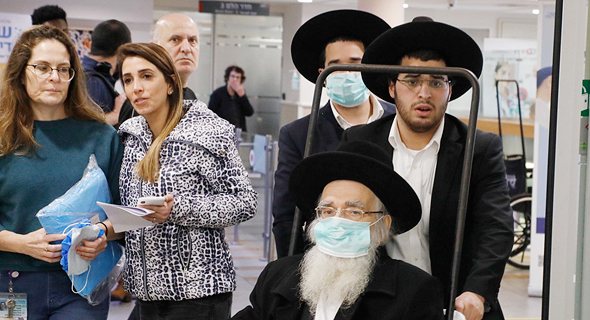
Image from calcalist.co.il
We are entering the Pesach (Passover) holiday in the midst of the greatest health challenge that the world has had to confront in living memory.  The Coronavirus epidemic has changed the world that we know in so many different ways.  It is almost difficult to see how things can ever go back to the way that they were a few months ago.

In Israel, in spite of having gone into lock-down at a relatively early stage of the outbreak of the virus, we are now having to deal with an infection rate in some ultra-Orthodox areas which is threatening to infect as many as one third of the citizens living there.  The government has already placed the city of Bnei Brak into a quasi-military rule in attempt to stem the further spread of the infection, and other neighbourhoods and towns are set to follow suit.  Much has been written about how it has transpired that the ultra-Orthodox neighbourhoods in Israel, and indeed in other parts of the world, have become disproportionately infected by the Coronavirus.  Most of the theories range from the fact that this element of the population is disconnected from much of what surrounds them, including news media and online information.  These theories also discuss the fact that instructions are only respected when they come from the community's Rabbis, rather than from secular or governmental authorities.  And the fact that the Rabbis are generally reluctant to quickly assimilate the assessment of the civilian authorities, when they prefer to allow their religious-based responses to take effect.  In this case, the Rabbis ruled to keep schools, yeshivas and places of learning open when the government ordered them closed.  The Rabbis insisted upon praying in the presence of a minyan (a quorum of ten men) when the laws of social distancing implemented by the government prevented this.  Additionally, functions to celebrate weddings and other family events were ruled to continue when the civilian authorities decided that these presented a risk to life and limb.  One of the most recognised leaders of the ultra-Orthodox community in Israel, 92 year-old Rabbi Chaim Kanievsky, was found to be praying with a minyan at his home as recently as last week in spite of having finally publicly ordered his followers not to do so.

As a result of these actions and inactions, Israel heads into the Pesach holiday period with great uncertainty.  It seems as though the huge number of people who were recently diagnosed as suffering from the Coronavirus from the ultra-Orthodox community have set us on an irreversable track to a medical catastrophe that will result in tens, possibly hundreds of deaths from the virus in the coming weeks.  It is ironic that this is set to coincide with the first few weeks of the counting of the Omer (the 7 week period that links Pesach to Shavuot) during which it is traditional to observe rituals of mourning.  The reason for the observation of these mourning rituals is because of the events that took place in the first century AD when 24,000 students of Rabbi Akiva died in a plague.  It is believed that they stopped dying on Lag B'Omer, the 33rd day of the Omer.  In a strange but very sad and unfortunate déjà vus, we are on a path to relive this to some degree, although hopefully not nearly to the same extent.  The reason that is commonly given and widely believed for the death of Rabbi Akiva's students is lashon hara, the speaking of negative things behind people's backs, whether true or not.  Lashon hara is one of the reasons being used as a way to explain why the world is having to endure the effects of the Coronavirus.

There can be little doubt that lashon hara is prevalent in all communities, is undesirable and is a problem in our society.  It is a problem that has been in evidence over the centuries, and seems very difficult to control or reduce.  It has been used to explain the occurrence of many disasters in Jewish history over the centuries, including the destruction of the Temples.  To me, on this occasion, it seems too easy to use this as an excuse for the current pandemic that we are suffering, and to explain the deaths of those who are suffering from it.  It is simply not acceptable to explain this as being because of lashon hara, and not to take a deep introspective view about the community's general lack of adherance to the orders of the civilian authorities.

There can be little doubt that the leaders of the community chose not to take note of the deliberate and highly-justified restrictions that were quickly imposed on our society to retard the spread of the virus.  They decided, in direct contradiction, to command their followers to continue to behave as before.  Word went out to keep shuls operating when others in Israel were closed, to keep schools open when others in the country were closed, and to keep operating as usual without consideration of the instructions by which everybody else was living.  This indicates that the leadership knew exactly what the civilian authorities were ordering, and they took their own independent decision to ignore these orders.  The Israeli minister of health, himself a follower and Rabbi from an ultra-Orthodox sect, should have brought the government's message to the ultra-Orthodox leadership and ensured that they followed the instructions in the same way as all other citizens in the country were required to do.  Instead, he stands accused of ignoring these instructions himself, and attending public events at a time when this was expressly forbidden by the government that he is a minister of.  The fact that he is also now inflicted by the virus cannot necessarily be inferred from this, but it is certainly shameful that he did not take heed of his own government's instructions.  More than that, the fact that he did not take it upon himself to bring this critical message to all leaders within the ultra-Orthodox community will surely hang as a black cloud over his head when the final death toll is tallied.  This is equally true of all senior leaders within the ultra-Orthodox community, who simply chose to ignore and contradict the expert opinions that are unanimous in their views that staying home saves lives.

When the dust settles on this set of tragic events and things revert back to some semblance of what we knew before, it is my sincere hope that lessons will be learned.  It is difficult for me to believe that the ultra-Orthodox community will not be affected by what is happening in their neighbourhoods now, and the disastrous mistake in ignoring civilian warnings and instructions.  The tension between them and the democratically-elected government in Israel has been one of the enduring stories of the State of Israel from its founding moments, and the current evens have the possibility of changing all of that.  In spite of the tolerance that has been shown to the ultra-Orthodox community by successive Israeli governments, including exemption from military service, government funding in a significantly disproportionate manner, incorporation of ultra-Orthodox parties in government coalitions and many other leniencies and concessions shown over the years, the ultra-Orthodox community has incessantly battled against governments and civilian authorities.  There are many within the ultra-Orthodox community who do not recognise the existence of the State of Israel and its government, while still being willing to accept social benefits from the state.  The sight of members of the ultra-Orthodox community screaming insults at Israeli police and accusing them of being Nazis, while police were instructing them to maintain social distancing in order to protect their own lives, is part of this tense and unacceptable relationship.  If the events surrounding the Coronavirus cannot change that, it seems that nothing will.  It is my hope that one of the most important outcomes of the virus and its effects, is a change in the relationship between government and ultra-Orthodox.  And a general change in the relationship between the ultra-Orthodox and other sectors of the population.  There is enough space for all of us to live with mutual respect.  Are my dreams unrealistic?  I hope not.

 The leaders of the ultra-Orthodox community have been exposed and shown up during the course of this pandemic.  Their refusal to take heed of the advice of scientists and civilian authorities has cost some of them their lives, and has cost the lives of many of their followers.  It raises a real question regarding the direction in which their leadership is taking their community.  Their advice on many real-world issues must surely now be in doubt.  I hope that the new generation of leaders that rise up following this episode will never forget the failures of their predecessors, and will find a way to do things differently going forward.

Chag sameach.


Monday, 15 January 2018

Israel and Shabbat

The Knesset passed into law last week, the controversial so-called "Shabbat law", also labelled by some as the "minimarket law".  This new law requires local municipalities to first get the approval of interior minister before allowing stores in their municipal area to open on Shabbat.  Given the fact that the current interior minister is Shas leader Arye Deri, the immediate expectation is that such approval would generally be withheld, forcing stores across the country to be closed on Shabbat.  And furthermore, the extent to which stores are allowed to be open on Shabbat or not, will seem to depend upon who occupies the seat of the interior minister at any moment in time.

The issue of Shabbat in the Jewish state is a complex one.  The religious community will always wish to see the Shabbat respected to the fullest as set out by Jewish law.  This dictates, amongst other things, that stores will be closed from sundown on Friday until sundown on Saturday each week, and similarly on religious holidays.  Aside from the issue of violating Jewish law by opening stores on the holy Shabbat, the religious community also argues that the opening of stores on Shabbat forces people to work there on Shabbat.  These workers, they believe, would be better off spending Shabbat at home with their families resting, rather than being forced to work.  On the other hand, there is a substantial secular community living in Israel which prefers to have greater choice as to when they shop for their groceries and other items.  Many of them work long hours during the week, and find it impossible, difficult or inconvenient to do their shopping after work during the week.  For them, shopping on Shabbat is preferable.  Why should they not have the right to choose for themselves when the best shopping time is for them?  What about those people whose work during the week does not afford them enough to make a living, and who welcome the additional work hours at double time that the law allows on Shabbat?

Does Israel, as a democratic Jewish state, have the right to impose Jewish law on its citizens?  Does it really want to impose Jewish law?  How important is the observance of the Shabbat to the Jewish nature of Israel?  Israel's Jews are a mixed bunch.  Some are observant, and some are not.  Most of them are fiercely proud to be Jewish and to live in the Jewish state, and each expresses their Jewish identity in a different way.  The statistics show that between 20% and 30% of the Jews in Israel consider themselves to be ultra-Orthodox or Orthodox.  On the other end of the spectrum, around 40% of Jewish Israelis consider themselves to be secular.  So the balance of power rests with those who consider themselves to be traditional.  From this, we can see that there is no obvious single view that emerges concerning the importance of Shabbat observance.  This was reflected in the law that was in force until now, that allowed each municipality to choose for itself what its policy regarding store-opening on Shabbat would be.  This was also borne out in the High Court decision that confirmed this method of deciding.  Each municipality can decide, according to the demographics of its local area, whether stores will be open on Shabbat or not.  Some decide yes, others decide no.  Some have a mixed policy of forcing stores in certain areas to close, while allowing stores in other areas to be open.  One thing that remains certain is that there will also be those who disagree with whatever happens in their local vicinity.  There is no possible way of satisfying all the people in any particular locality.

The authorities have previously intervened in some ways in order to impose some element of Shabbat observance in Israel.  El Al, Israel's national airline does not fly on Shabbat or on Jewish holidays.  Banks, supermarkets and many other facilities are prohibited from opening on Shabbat.  All hotels in Israel that wish to be certified by the Ministry of Tourism, are forced to serve food that is kosher.  This requires a certain level of observance of Shabbat.  Much of Israel's public transport does not operate on Shabbat.  It seems to me, however, that this has extended a little too far with the government passing the recent Shabbat law.

It seems that Interior Minister Arye Deri also feels the same.  Despite his personal views that Shabbat should be observed, he has pledged not to exercise the power that the new law gives him to enforce Shabbat observance.  Instead, he has indicated that he will allow each municipality to decide for themselves as they have done before.  This view does not, however, remove the possibility that a future interior minister may exercise his power under the law in one direction or the other.  For this reason, the law seems to me to be a step too far.

Unfortunately and unsurprisingly, the law has become mixed up in Israeli party politics.  Essentially, the enactment of this law has served to give Health Minister Yossi Litzman a path back to his ministerial position, after resigning from the government over his opposition to work being undertaken on Israeli railway infrastructure on Shabbat.  Now that the new Shabbat law is on the statute books, he can prove to his party and electorate that he has forced a change to the government policy on Shabbat, and is justified in returning to the government.  The illusion seems to hide the reality in this case.

The often remembered Ahad Ha'am quote says, "More than the Jews have kept the Shabbat, the Shabbat has kept the Jews".  There is no doubt that Shabbat observance has been a central tenet around which Jews have focused during the thousands of years of exile, and which has helped to maintain some element of identity and unity.  It is interesting that, during the years of exile, Shabbat was observed out of free will, and not out of being forced on anybody.  It seems to me that it is desirable to continue the observance out of free will, now that we have a Jewish state that enables this more than at any time during Jewish history.  Forcing it on anybody seems counterproductive. 

The real question is whether Shabbat observance and the traditional Shabbat atmosphere in Israel can survive the law, or whether the law will potentially force people away from it.  I have no doubt that free will is much stronger than laws that are imposed.  The Shabbat is no exception.

Thursday, 13 July 2017

The Unifying Wall That Divides

Image from tcjewfolk.com
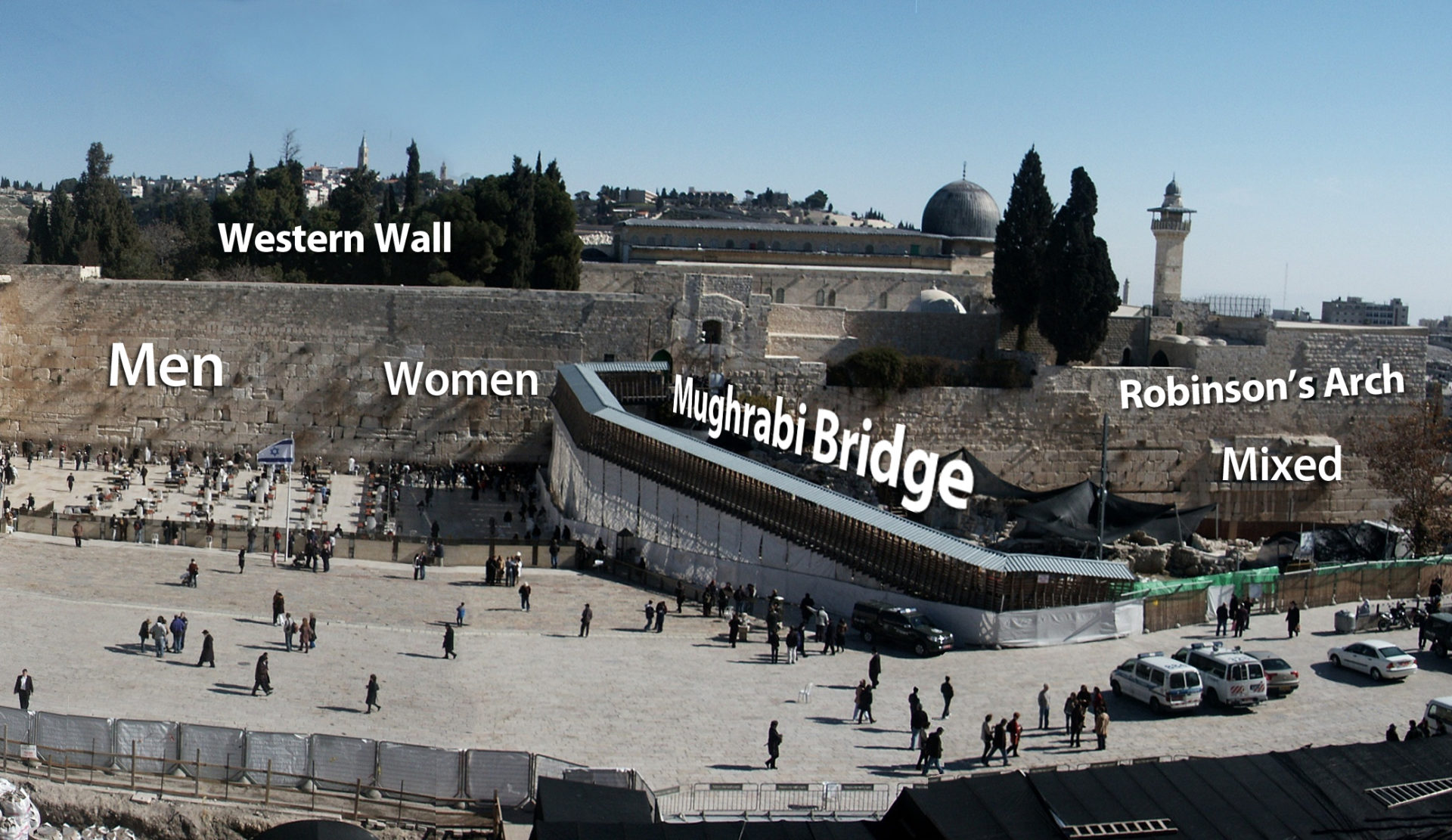
A decision by the Israeli government not to approve the construction of an egalitarian prayer area at the Kotel, the Western Wall of the Temple Compound in Jerusalem and Judaism's holiest site, has opened wounds between the Israeli government and the American Jewish community.  It is ironic that, only weeks after celebrating the 50th anniversary of the return of the Kotel to Jewish hands, this iconic landmark and holy site is giving rise to huge divisions between different groups of Jews.  How differently the Kotel is being viewed now, as opposed to 50 years ago when Jews around the world were rejoicing in unison at the prospects of being able to visit and pray at this site.

Things have clearly changed over the past 50 years that we are fighting amongst ourselves over this matter.  Fifty years ago,  Jews would have been happy simply to be able to visit and pray at the Kotel. It would not have mattered if this would have been by a group of men or women on their own, or by mixed groups and families.  After so many years of having been denied the right to visit the site of the Temple, the details of how prayers would be offered there were unimportant.

Fast-forward fifty years, and the Kotel Plaza has been developed to allow and encourage Jews to visit the site for historical and religious reasons.  It was developed according to the tenets of Jewish religious law as befits a site of prayer.  This means that men and women have been provided with separate prayer areas.  This separation is not a new or alien concept amongst Orthodox and traditional Jews.  It is something that is expected at holy sites and areas of prayer.  And while Orthodox or traditional strands of Judaism are dominant in Israel amongst those who wish to identify with the Jewish religion, the same is not true outside of Israel.  There, the Reform and Conservative strands of Judaism are more popular.  These strands follow a somewhat less stringent interpretation of the Orthodox Jewish laws, either because followers have studied the laws and rejected some of the stringencies arising from Rabbinical interpretations and pronouncements over the years, or because it is simply easier to follow.  In a world where the rate of assimilation amongst Jewish communities around the world is running at alarmingly high levels, any form of identification with Judaism can be considered to be positive.  It is for this reason that the Reform and Conservative communities, particularly those in the USA, have gathered enormous power as they manage to stem some of the massive flows of Jews away from the faith.

The battle lines between Orthodox and Reform/Conservative Jews have long been drawn.  The Orthodox communities have done all that they can to reject the dilutions that are inherent with the Reform/Conservative view on the Jewish world.  They have worked to discredit and delegitimise them, even accusing them of not being Jews.  The Reform and Conservative communities, particularly those in the US that command power and have access to large sums of money, have used this to fight back against the Orthodox world view.  The battle over the Kotel is simply an extension of this power struggle between the different groups.  The Reform/Conservative strand believes that their followers (and other non-religious people) would prefer to visit and pray at the Kotel in an area that is mixed with men and women - an egalitarian area.  This would also allow families to enjoy this experience together.  The Orthodox are absolutely opposed to this, claiming that the Kotel is a religious place of prayer that requires separation of the sexes according to the traditional Jewish Law.

The State of Israel has set out not to distinguish between different groups of Jews.  In fact, the Law of Return that grants immediate Israeli citizenship to Jews, has chosen to use Hitler's definition of Jews rather than going by Jewish religious law.  Hitler decided that any person who had one Jewish grandparent would be eligible to be treated inhumanely by his regime, and to be part of his plan of extermination.  The Israeli government decided that if a person was good enough to be exterminated by Hitler, they would be good enough to be granted immediate Israeli citizenship.  This means that some of those who have been granted immediate citizenship under this law, are not Jewish according to Jewish Law.  This demonstrates the extent to which the State of Israel has opened its arms to many different groups of Jews - and even to some non-Jews.  Under the circumstances, it seems as though the government would be sympathetic to the claims of the non-Orthodox groups at the Kotel.

Even though the government would probably wish to be more accommodating to the demands of the non-Orthodox lobby, and even previously agreed to their demands for an egalitarian prayer area at the Kotel, politics always seems to come first.  The current government coalition can only exist with the support of the ultra-Orthodox parties in the Knesset.  Upon hearing of the government's plan to accommodate an egalitarian prayer area at the Kotel, the ultra-Orthodox parties flexed their muscles and threatened to bring the government down if the plan was implemented.  Prime Minister Netanyahu went into survival mode, even at the expense of his relationship with US Jews, and acquiesced to the demands of his coalition partners.  At least for now.  American Jews responded in disgust by withdrawing their support for the Israeli government.

Does the Reform/Conservative lobby have a valid case in declaring open warfare on the Israeli government as a result of this decision?  The Israeli government has said that an egalitarian prayer area does already exist, but it is just not in the premier Kotel Plaza area.  The non-Orthodox lobby claims that this is not good enough, and effectively treats some Jews as second-class.  Their demand is to have the egalitarian area front and centre alongside the other prayer areas in the Kotel Plaza.  The battle is one of power and of wills. This is a battle between different groups of Jews, each of whom demands that their way is accepted, and with the Israeli government being called upon to act as referee.

Is the Kotel a Jewish national asset that should be required to accommodate all groups of Jews in a way that is to their liking?  Or is it an asset that belongs to the religious, as the holiest religious site in Judaism?  Does creating an egalitarian prayer area alongside the other areas serve to dilute its importance and religious status?  Is this issue important enough to be worth creating a rift amongst different groups of Jews?

I don't have answers to any of these questions.  And even if I did, I feel sure that the warring parties would not consider my point of view in formulating their reactions to the situation.  Of course, the Israeli government will always act in way that promotes its own best interests.  At the moment, that requires it to take the side of the ultra-Orthodox parties and freeze the egalitarian prayer area.

In my opinion, the situation requires tolerance and understanding by all parties.  It is natural to expect that the holiest site in Judaism should have some of the most stringent rules attached to it, and that Orthodox Jewish law should apply.  We live at a time, however, when Jews around the world should find reasons to unite, and not reasons to be in conflict with each other, especially over a site as central as the Kotel.  The ultra-Orthodox parties are not generally known for making efforts to unify different strands of Judaism, but it is never too late.  They should know that no man is in a position to judge another one, nor judge his interpretation of the religion.  So they should be taking the moral high ground on this matter in an attempt to accommodate the requests of the non-Orthodox groups.  Surely accommodating an egalitarian space could be acceptable, as long as they continue to have their separated areas?  The situation now requires unity and not conflict.  It is incumbent upon the parties to sit down, and find a compromise that will be acceptable to all.  Is this too much to expect?

Sunday, 10 May 2015

Converting the Missionaries

It may come as a surprise to some that missionary groups are alive and very active in Israel.  Groups like the Jehovah's Witnesses have been operating in Israel for some time, as they have operated all around the world for many years.  It is their belief that they should make every effort to convert as many people to their way of thinking as possible.  And their reason for being in Israel is entirely understandable.  When seeking out potential converts, it is known that the Jehovah's Witnesses consider the conversion of Jews is of much greater value than converting anyone else.  Now that Israel houses the largest community of Jews in the world, Israel is an obvious target for them.

The issue has become very public over the past few weeks, with the Jehovah's Witnesses trying to hire a hall in the city of Ra'anana for their meeting.  Some have labelled the meeting as an annual conference or convention, and others have described it as a baptism for some of their recent converts.  The Municipality of Ra'anana initially declined the request for a municipal hall to be hired to them, and then acceded to their request.  Their agreement to rent out the hall was challenged in a district court by those opposed to the municipality allowing such a group to hold a meeting in its hall.  The court decided that Israeli democracy is the primary issue at stake here, and that the Jehovah's Witnesses are as entitled as anybody else to rent a municipal facility, and have their right to freedom of speech, religion and expression.  An appeal lodged with the Supreme Court of Israel upheld this decision, and the event was allowed to go ahead.

Many hundreds of Orthodox Jews turned out to protest against the event, and held prayers outside the hall in which the meeting took place.  There were even sporadic outbreaks of violence against the Jehovah's Witnesses and their supporters when they arrived at the hall.  While such an event being held in the midst of a Jewish city certainly represents a provocation to those living within the proximity of the event and in the city of Ra'anana, the Supreme Court of Israel has made its decision regarding the important issue of democracy and how this ought to be applied in our country.  It is, of course, the democratic right of all those who oppose this, to voice their opposition.  This should, however, be undertaken within the confines of what the law allows.  If that was not enough, members of the religious community in the city have turned on each other to make scapegoats out of those who are held responsible for allowing such an event to take place.

For me, the question was not about the work that the Jehovah's Witnesses are doing to try to convert Jews to their belief system, or about the municipality for allowing their meeting to take place here.  They are fully within their rights to do this, even though many are affronted by their efforts.  The greater question is why so many Jews feel that they are forced to find their spiritual fulfilment with the Jehovah's Witnesses.  Nobody observed any Jews being forced against their will to convert to the Jehovah's Witness belief system.  This indicates that these Jews are doing so out of their own choice.  It also indicates that they have rejected the possibility of finding their spiritual home within Judaism.  Instead of protesting against the work that the Jehovah's Witnesses are doing to convert Jews, the religious community should be asking themselves why Orthodox Judaism does not provide this home to its own people?

It seemed to me not to be coincidental that these events took place in the same week as the United Torah Judaism Party signed a coalition with the Likud to enter the new government.  This coalition agreement is sprinkled with concessions that the new government will make to give religious Jews certain rights that other citizens of Israel do not have.  There are also agreements that will ensure that government funding is allocated to religious groups and institutions at the expense of others.  When considering that Israel is currently experience a period of austerity when the government does not have funding available for additional requirements, and when considering the relatively small amount that Haredi Jews contribute to government coffers, this agreement is highly controversial amongst many Israelis.  To make matters worse, the agreement requires the reversal of legislation that was recently passed in the Knesset in an attempt to bring the treatment of ultra-Orthodox Israelis in line with everybody else.  It seems little wonder that there is such a large stigma attached to the notion of secular Israelis reconnecting with their religious roots when seeking spiritual fulfilment.  The behaviour of those who are the public face of these religious roots is so unattractive and opposite to anything that good, law-abiding people consider to be acceptable, that they would not wish to be associated with anything that these people represent.

It would appear as though the success of the Jehovah's Witnesses in Israel has little to do with the authorities permitting them to operate here, or decisions made by the Supreme Court.  If there was no public need or desire to listen to the alternatives that they offer, they would have left these shores a long time ago.  The fact that they continue to be successful in Israel says more about the religious alternatives that Judaism offers, than it says about those public officials who allow them to hold meetings in our municipal facilities.

Judaism certainly offers attractive alternatives to those who wish to seek it out.  In order to attract people to seek this out, people need to be attracted to those who practise this Judaism as much as they are attracted to the Judaism itself.  It is extremely unfortunate that the lie of the religious land in Israel favours the ultra-Orthodox community at the expense of the secular and modern Orthodox Jews.  And as much as Jewry offers many different strands for those who are interested to choose from, the headlines that are attracted by the negative activities of the ultra-Orthodox serve to drown out the good aspects that Judaism can offer.  The storm created by the Jehovah's Witness event is an easy scapegoat for the failure of Judaism to make itself attractive to its own people.  This is a classic case of throwing the baby out with the bathwater.

  of proselytising has raised its head again in Israel following attempts by a group known as

Sunday, 12 May 2013

War Against Women of the Wall

The group known as "Women of the Wall" have elevated themselves onto the front pages of the Israeli press in recent times.  They have clashed with police in Jerusalem over their desire to have the right to pray at the Kotel, the Western Wall, in their own way and style.  For them, their way and style means wearing a talit (prayer shawls) and tefilin (phylacteries), and undertaking other prayer-related activities which are usually the preserve of males in Orthodox Judaism.  Their mission says, "........ our central mission is to achieve the social and legal recognition of our right, to wear prayer shawls, pray, and read from the Torah collectively and out loud at the Western Wall".  Why does this lead them to become criminals in the eyes of the Israeli justice system?

Some of these actions on the part of the Women of the Wall have attracted attention from Jerusalem police officers, and even led to some of the women being arrested.  The legal system has relied on the law in Israel that requires respect for "local custom" at the site, which in this case refers to the Kotel.  The police have been called to arrest Women of the Wall on the basis that their actions do not respect local custom.  Clearly, the "local custom" is determined by what the Orthodox establishment demand.  Such arrests have been made on more than one occasion.

While we understand that, in most Orthodox Jewish custom, women do not wear prayer shawls and do not read from the Torah in public, the question is whether there is any actual prohibition on women doing these things?  It seems as though the customs of women not undertaking these activities stems from the fact that, in Orthodox Jewish law, women are not obliged to fulfil them in the way that men are.  In the case of the talit and tefilin, these are precepts (mitzvot) that are time-bound.  This means that there are certain times that the mitzva should be undertaken, and other times when it should not.  As a general rule, such time-bound mitzvot are not required to be undertaken by women in terms of Talmudic law.  It is not exactly clear why this is this case, but there are views that it is because women have a higher spiritual wisdom (bina) than men, and this exempts them from time-bound mitzvot.  Others contend that it is a more pragmatic issue of women having so many other household chores to take care of, that they can be exempted from time-bound mitzvot.  Our Talmudic sages are divided as to whether women are prohibited from performing mitzvot from which they are exempt.  The Rambam, one of the most famous of the Talmudic sages seems to accept that there is no prohibition on women performing mitzvot that they are not obliged to perform, and chooses instead to discuss whether women should pronounce the blessing which states that they are obliged to perform the mitzva before actually performing it.  He is supported in this discourse by Rabbi Yosef Karo and others.  This seems to give sufficient doubt to indicate that women are not entirely without justification when choosing to perform such mitzvot, and there is a strong case which supports women being free to carry them out.

Jewish Agency Chairman Natan Sharansky was drafted in by the government to try to help the situation. The actions to prevent the Women of the Wall from expressing themselves during prayer have served to alienate many US Jews from Israel.  The US community, which is notoriously heterogeneous in its interpretation of Judaism and which values pluralism in Jewish thought and practice, has reacted extremely negatively to the standoff at the Kotel.  It was hoped that Sharansky will be able to use his balanced approach to suggest a compromise solution, and that he can use his links with the US Jewish community to heal the rift which has developed.  Sharansky recommended allowing the Women of the Wall to use a separate section of the wall, known as Robinson's Arch, to allow the Women of the Wall to express themselves and carry out their practices without others being offended.  While this was originally accepted as a possible compromise by the Women of the Wall, their position has hardened recently and they are now rejecting this solution.

The hardening of their position coincided with the ruling by an Israeli court a few weeks ago, which decided that these actions by the Women of the Wall do not actually constitute disrespect for local custom at the site.  This reinforces the lack of agreement by the Talmudic sages.  This court ruling means that their actions no longer constitute an offence for which women can be arrested.  The Women of the Wall were emboldened in their view that their actions are entirely acceptable, and decided that there is much less justification in accepting a compromise solution that means they are forced to pray hidden from general sight.

The influence of the ultra-Orthodox in Israel has been substantial over the past few years, particularly during the years that successive governments owed their continued existence to the support of the ultra-Orthodox parties in the Knesset.  The ultra-Orthodox influence has pervaded many aspects of Israeli society.  Numerous concessions have been granted to the ultra-Orthodox community to keep them supporting the government, the most famous of which is the exemption of young ultra-Orthodox boys and girls from serving in the IDF.  This has granted disproportionate power to ultra-Orthodox groups.  With the construction of Prime Minister Netanyahu's most recent government that excludes the ultra-Orthodox parties for the first time in many years, ultra-Orthodox power has been substantially reduced.  Many in Israel are happy about this, as the influence of the ultra-Orthodox has permeated the lives of so many individual Israelisl.  Perhaps the drama at the wall is an attempt for the ultra-Orthodox establishment to exert their power where they can.

Even though the ultra-Orthodox establishment has been given control over the Western Wall, and Chief Rabbi of the Wall Shmuel Rabinovitz has rabbinic jurisdiction over this site, it should be understood that the Western Wall is a public asset for Jews in Israel and around the world.  As such, decisions such as those affecting the Women of the Wall should not be taken lightly.  It is not as in an individual synagogue where congregants are free to move elsewhere in the event that they do not wish to accept the rules pertaining to the synagogue.  The Western Wall has no alternative in Judaism.  To the extent that there is even the slightest doubt about the interpretation of a particular element of Jewish law, as is the case here, the rabbi has a responsibility to consider the national and international ramifications of his decision.

I salute the Women of the Wall for standing by their convictions, and for being prepared to take on the ultra-Orthodox establishment.  This is not an easy decision, and life has been made extremely for them as a result.  Ultimately, I believe that they will prevail, and that they will be granted the right to pray as they wish.  In reality, anybody who does not like this is not obliged to be present at the Kotel when the women are there.  Until now, the Women of the Wall have conducted their prayers monthly on rosh chodesh at a time known in advance.  This allows plenty of alternative opportunities for those who wish to attend the wall, without being forced to endure anything that they do not wish to see.  This simply demands a little tolerance and understanding by all parties, something that is unfortunately in short supply in Israel, especially in the ultra-Orthodox establishment.

The time has come for the government to exercise its control over the Kotel, and ensure that all who wish to pray there are able to do so.  It is ironic that the IDF, without the support of the ultra-Orthodox youth, was responsible for liberating this holy site during the Six Day War, only for the site to then be turned over to the control of the ultra-Orthodox.  This is a national holy site, and all Jews should have the right to worship there.  Bravo Women of the Wall.

Sunday, 6 November 2011

A Spitting Shame

I was horrified to read the details of the trial of Johannes Martarsian, which took place in the Jerusalem Magistrates Court last week.  Martarsian, an Armenian priesthood student, was charged with assault after he punched an ultra-orthodox Jew in the face and made him bleed.  The incident took place in Jerusalem's old city after the ultra-Orthodox man spat at Martarsian.

Judge Dov Pollock annulled the indictment against Martarsian and wrote, "putting the defendant on trial for a single blow at a man who spat at his face, after suffering the degradation of being spat on for years while walking around in his church robes is a fundamental contravention of the principles of justice and decency."  Fortunately, in this case, the judge had the good sense not to waste any more taxpayer money on proceeding to a trial.  Throwing the case out of court was exactly the right response to such a disgraceful situation.

The trial has brought to the fore some of the bad behaviour which is prevalent amongst the ultra-Orthodox community.  It seems as though the spitting incident is not an isolated one.  Clergymen from the Armenian church who are based in Jerusalem report that they are frequently subject to being spat and cursed at by ultra-Orthodox Jews.  One Armenian priest said that he wonders to himself if he will be spat at each time he walks by an ultra-Orthodox Jew in the street.  For some priests, it is difficult to simply ignore the repeated incidents of bad behaviour that they are forced to endure.  Johannes Martarsian is an example of one who decided to respond rather than to simply turn the other cheek, despite the fact that Armenian priests are encouraged by their church not to respond to these incidents of gross provocation.

The ultra-Orthodox community in Jerusalem has an unfortunate reputation for bad behaviour in many different situations.  Women who venture into ultra-Orthodox neighbourhoods in Jerusalem like Mea Shearim, and who are not dressed according to the ultra-Orthodox conservative dress code, will already know that they also become spitting targets.  Equally, cars driving through religious neighbourhoods on Shabbat have been subject to stoning attacks.  This has given rise to the famous T-shirt that has been sold in Jerusalem and purchased by thousands of tourists stating, "I got stoned in Mea Shearim"!  Although these types of attacks are unacceptable, there may be some part of a reasonable person that could condone such behaviour where people enter religious neighbourhoods without respecting the norms of the people that live there.

The attacks on the priests seem of a completely different nature.  There is no disrespect of the ultra-Orthodox lifestyle involved, and no violation of the norms by which they live.  Jerusalem is a city which is open to all religions which wish to be present there.  Not only is this a policy which is rigorously adhered to by the Israeli government and the city of Jerusalem, it is also the source of a great deal of tourist Dollars into the city.  At times, it seems as though the ultra-Orthodox community are completely divorced from the society in which they live, and their actions cannot be tolerated by other reasonable people.  The truth is, that some of their actions are so intolerable, that even those who have grown up within their sects and have become used to their social norms, cannot accept the way in which some situations are dealt with.

The types of insults that these young men give by spitting at others created in G-d's image, have caused me to wonder how they can reconcile this behaviour with their religious beliefs.  The Jewish religion believes in 613 mitzvot (precepts) that observers are required to adhere to.  They are split into mitzvot concerning man's relationship with his G-d, and mitzvot concerning man's relationship with his fellow-man.  Neither group has precedence over the other - they are both equally important.  On many occasions such as stoning a car that is transgressing the Shabbat, the justification for the action taken by somebody against his fellow-man is to protect his relationship with his G-d.  In light of the fact that these mitzvot do not enjoy precedence, there is a view that says that the transgression against the fellow-man cannot be justified, even if it is an act to protect his relationship with his G-d.  The act of spitting at the priests, however, seems to serve no religious purpose at all and has no positive side to it.  Rather, it represents an act of unjustified discrimination.  So how much less can this be justified in religious terms?

What is even more unfortunate about this sad situation, is the fact that priests say that reports made about these incidents to the police fall on deaf ears.  Perhaps it is because the police feel that it is impossible to catch the perpetrators and bring them to justice, that no action is taken.  It is also fair to say that Jerusalem's police force has its hands full with high-level security threats which it is required to take care of on an ongoing basis.  Whatever the reason for the lack of action, it is sends an entirely wrong message about the acceptability of this behaviour.

The ultra-Orthodox community present themselves as representing all that is good when acting in strict observance of the Torah.  Too often, however, the pursuit of individual points of observance causes the individual to lose the wood for the trees.  There seems to be no broader perspective, or ability to see the bigger picture.  This is extremely damaging to the standing of the ultra-Orthodox community in the world in which they are forced to live.  The time has come for concerted action to be taken to change the bad behaviour.  The yeshivot (institutions of religious learning) need to be responsible for teaching their students about the unacceptability of spitting at others.  The police on the streets need to keep their eyes open for such incidents, and act upon them immediately. 

Jerusalem is a city that is open to people of all religions to visit and to live in.  While it serves as the capital of the Jewish State of Israel, the government has undertaken that the city will be open to all religions for tourism, learning and worship.  This means that it is not the private domain of ultra-Orthodox Jews, even though it is their religion's holiest city.  There should be no reason why priests who have come to Jerusalem for the purpose of furthering their religious studies and experiences, should be subject to any sort of bad behaviour by ultra-Orthodox Jews or anybody else.  The time has come to take action to stop this intolerance and insulting behaviour.

Sunday, 28 November 2010

Shas Shows its True Face

Two interviews published in local newspapers with ultra-orthodox Shas member of Knesset Chaim Amsellem have served to publicly expose some of the inner workings and beliefs of the Shas parliamentary party in a way not previously seen. Although operating within a democratic environment, the religious parties in the Knesset have a distinctly undemocratic way of working, and this has been challenged in the open by Rabbi Amsellem.

Israel's proportional representation system requires each party contesting Knesset seats to submit its list of prospective members of Knesset prior to any general election. The way in which the order of the names on the list is determined varies from one party to another. In the case of the non-religious parties, democratic primaries are held in which party members vote for those who wish to be placed on the list. The position the list of each prospective member of Knesset is determined by the results of the party vote. In the case of the ultra-orthodox Haredi parties, and the Shas party in particular, the list is drawn up by the "Council of Torah Sages". In the case of Shas, this is a council headed by the party's spiritual leader Rabbi Ovadia Yosef, and includes rabbis and "wise men" who are members of Yosef's inner circle. Their decision is final and no appeals against it are offered. This council represents the final word on all major issues concerning the party, including decisions about participation in a coalition and policy on many important issues. It is remarkably undemocratic in its workings considering the democratic environment in which it operates.

The rebel Shas member of Knesset came out criticising some of the policies followed by Shas in a newspaper interview conducted a few weeks ago. In his interview published in Israel's Ma'ariv newspaper, he condemned strictures against conversion, growing joblessness and army evasion among yeshiva students and an absence of non-religious education for children. These criticisms amount to an attack on the very foundations and beliefs of the ultra-orthodox world. Their type of Jew is one who will study religious texts as a vocation in order to promote the religion in the most literal sense. This means that there is no need for secular education at schools - there will be no use for subjects that are not focused on the religion in their ideal world. In addition, young men and women are encouraged not to enlist for the army, but rather to attend yeshiva where they will further their religious education. This also sets the pattern for their future lives as young men are encouraged to remain for the rest of their days in this religious framework at yeshivas studying the religious texts. They are able to gain exemption from the army via a special deal struck between the state and the religious institutions many years ago. They are able to continue studying at yeshivas thanks to stipends granted to them out of government money, to allow them to continue their religious learning indefinitely.

Amsellem has recognised the effect on Israeli society of following this policy, which has resulted in a dramatic growth in the number of yeshiva students in Israel. Limiting the education at primary and secondary school level ill-prepares young people for the challenges of daily life, irrespective of the vocation chosen. The policy also reduces the number of young men and women enlisting in the army. In its current situation of being constantly under threat of attack, Israel needs all the soldiers it can get. Once these young men and women get married and begin to raise children, there is an increasingly unmanageable burden on the state arising from the responsibility to fund their stipends without receiving any contribution in return from employment.

To add insult to injury, it turns out that many of the young yeshiva students are not suited to religious study and have no desire to pursue it. There seems to be no exception for these young people, and they are forced to toe the line and be squeezed into the religious framework despite the obvious problem that they have no place there. The ultra-orthodox system does not make allowances for these young people to find alternative vocations and paths for development, where they may seek a more appropriate way for them to make their contribution to society. Chaim Amsellem was speaking out not only against the sausage machine system and uniform path expected from all Haredi young people, he was also speaking out in favour of directing these people towards a life that will allow them to have a useful place in society. This does not mean that they will be forced to leave the religious fold. On the contrary, their religious convictions may be strengthened by virtue of the useful contribution that they can make and the happier place they can have in society.

Unfortunately, the Shas leadership does not view things in the same way as Rabbi Amsellem. They were particularly unhappy about the manner in which he expressed his views, and the Council of Sages decided to expel him from his Knesset seat and from the party. By choosing him to be one of their members of Knesset, they expect him to toe the line. Failure to do so gives them the right to remove him from the list, and they did not hesitate to take action. Amsellem, however, took his rebellion against the party hierarchy to the next stage and has refused to relinquish his seat. Together with this, he issued his harshest criticism of the Council of Torah Sages yet. He expressed the view that each Knesset member should have the right to speak his or her mind, and that the upper echelon of spiritual leadership should be sticking to its role in the religious world and should not be meddling in politics. He accused the party's leadership of trying him in a "kangaroo court" where he had no opportunity to present his own views or defend his position.

Support for Rabbi Amsellem's position has not only come from the secular world. It seems that there is an increasingly large constituency of Shas supporters who agree with his view, but may be afraid to express it. Amsellem has now given these people a voice to express their opinions and frustrations. While many of them may not be minded to challenge the revered position of the Council of Torah Sages, they would be delighted to be given an opportunity to find a vocation that can give them a useful position in society that can bring greater value to themselves,their families and the State of Israel.

In dealing with Amsellem's revolt in this way, the Shas party hierarchy has shown its true colours. While working for the benefit of its own constituency and special interest group, the Shas party frequently works against the better interests of the State of Israel and her people. A country of little more than 6 million people cannot afford to carry passengers who do not serve to defend the national security of the country, nor contribute anything to her economy while all the time sucking on the state coffers. It is my hope that Rabbi Amsellem can succeed, not only in hanging onto his Knesset seat, but also in mobilising similar thinking people within his community to change the face of Shas and other ultra-orthodox parties alike.