Showing posts with label Temple Mount. Show all posts

Thursday, 13 July 2017

The Unifying Wall That Divides

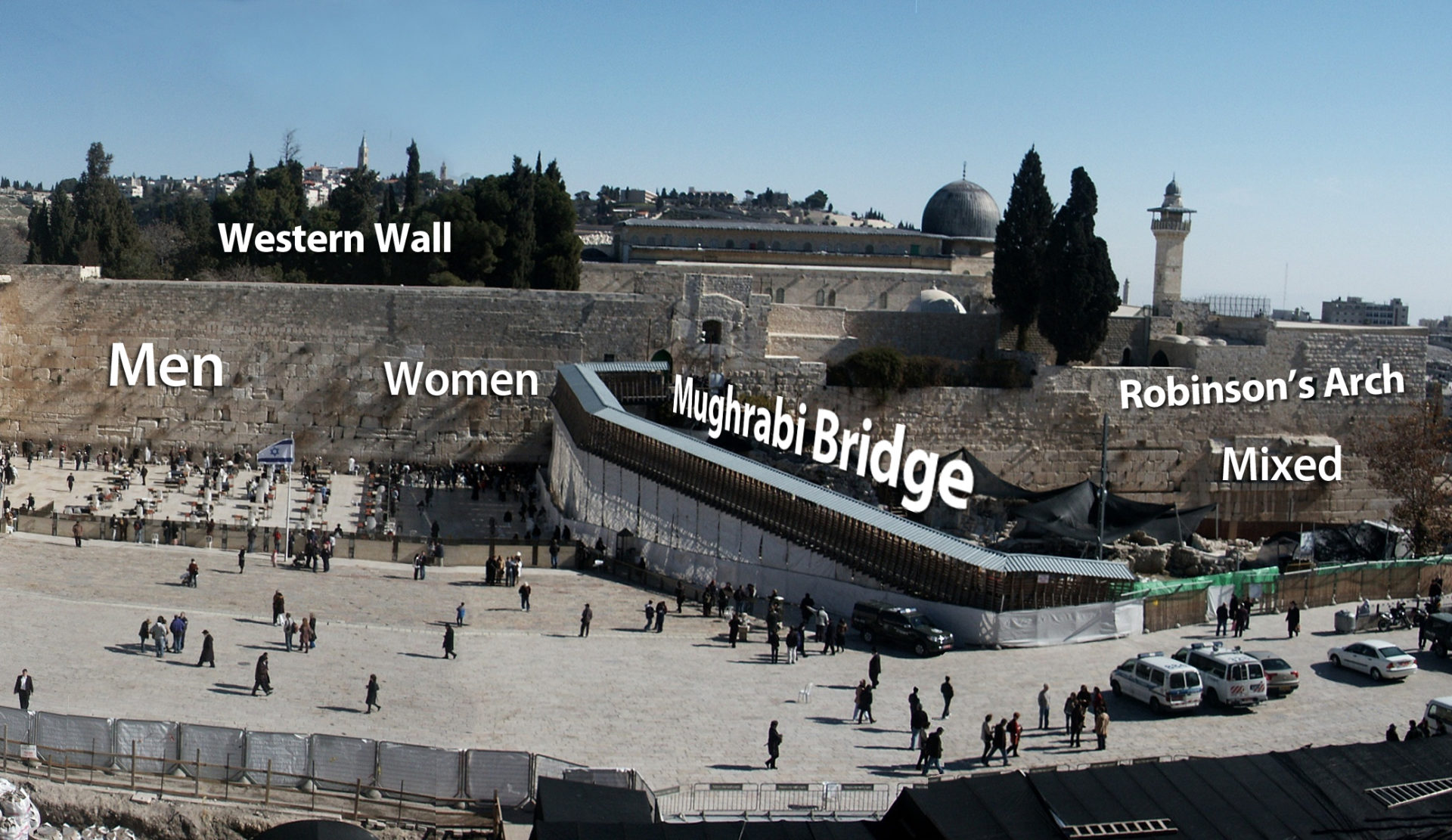
Image from tcjewfolk.com
A decision by the Israeli government not to approve the construction of an egalitarian prayer area at the Kotel, the Western Wall of the Temple Compound in Jerusalem and Judaism's holiest site, has opened wounds between the Israeli government and the American Jewish community.  It is ironic that, only weeks after celebrating the 50th anniversary of the return of the Kotel to Jewish hands, this iconic landmark and holy site is giving rise to huge divisions between different groups of Jews.  How differently the Kotel is being viewed now, as opposed to 50 years ago when Jews around the world were rejoicing in unison at the prospects of being able to visit and pray at this site.

Things have clearly changed over the past 50 years that we are fighting amongst ourselves over this matter.  Fifty years ago,  Jews would have been happy simply to be able to visit and pray at the Kotel. It would not have mattered if this would have been by a group of men or women on their own, or by mixed groups and families.  After so many years of having been denied the right to visit the site of the Temple, the details of how prayers would be offered there were unimportant.

Fast-forward fifty years, and the Kotel Plaza has been developed to allow and encourage Jews to visit the site for historical and religious reasons.  It was developed according to the tenets of Jewish religious law as befits a site of prayer.  This means that men and women have been provided with separate prayer areas.  This separation is not a new or alien concept amongst Orthodox and traditional Jews.  It is something that is expected at holy sites and areas of prayer.  And while Orthodox or traditional strands of Judaism are dominant in Israel amongst those who wish to identify with the Jewish religion, the same is not true outside of Israel.  There, the Reform and Conservative strands of Judaism are more popular.  These strands follow a somewhat less stringent interpretation of the Orthodox Jewish laws, either because followers have studied the laws and rejected some of the stringencies arising from Rabbinical interpretations and pronouncements over the years, or because it is simply easier to follow.  In a world where the rate of assimilation amongst Jewish communities around the world is running at alarmingly high levels, any form of identification with Judaism can be considered to be positive.  It is for this reason that the Reform and Conservative communities, particularly those in the USA, have gathered enormous power as they manage to stem some of the massive flows of Jews away from the faith.

The battle lines between Orthodox and Reform/Conservative Jews have long been drawn.  The Orthodox communities have done all that they can to reject the dilutions that are inherent with the Reform/Conservative view on the Jewish world.  They have worked to discredit and delegitimise them, even accusing them of not being Jews.  The Reform and Conservative communities, particularly those in the US that command power and have access to large sums of money, have used this to fight back against the Orthodox world view.  The battle over the Kotel is simply an extension of this power struggle between the different groups.  The Reform/Conservative strand believes that their followers (and other non-religious people) would prefer to visit and pray at the Kotel in an area that is mixed with men and women - an egalitarian area.  This would also allow families to enjoy this experience together.  The Orthodox are absolutely opposed to this, claiming that the Kotel is a religious place of prayer that requires separation of the sexes according to the traditional Jewish Law.

The State of Israel has set out not to distinguish between different groups of Jews.  In fact, the Law of Return that grants immediate Israeli citizenship to Jews, has chosen to use Hitler's definition of Jews rather than going by Jewish religious law.  Hitler decided that any person who had one Jewish grandparent would be eligible to be treated inhumanely by his regime, and to be part of his plan of extermination.  The Israeli government decided that if a person was good enough to be exterminated by Hitler, they would be good enough to be granted immediate Israeli citizenship.  This means that some of those who have been granted immediate citizenship under this law, are not Jewish according to Jewish Law.  This demonstrates the extent to which the State of Israel has opened its arms to many different groups of Jews - and even to some non-Jews.  Under the circumstances, it seems as though the government would be sympathetic to the claims of the non-Orthodox groups at the Kotel.

Even though the government would probably wish to be more accommodating to the demands of the non-Orthodox lobby, and even previously agreed to their demands for an egalitarian prayer area at the Kotel, politics always seems to come first.  The current government coalition can only exist with the support of the ultra-Orthodox parties in the Knesset.  Upon hearing of the government's plan to accommodate an egalitarian prayer area at the Kotel, the ultra-Orthodox parties flexed their muscles and threatened to bring the government down if the plan was implemented.  Prime Minister Netanyahu went into survival mode, even at the expense of his relationship with US Jews, and acquiesced to the demands of his coalition partners.  At least for now.  American Jews responded in disgust by withdrawing their support for the Israeli government.

Does the Reform/Conservative lobby have a valid case in declaring open warfare on the Israeli government as a result of this decision?  The Israeli government has said that an egalitarian prayer area does already exist, but it is just not in the premier Kotel Plaza area.  The non-Orthodox lobby claims that this is not good enough, and effectively treats some Jews as second-class.  Their demand is to have the egalitarian area front and centre alongside the other prayer areas in the Kotel Plaza.  The battle is one of power and of wills. This is a battle between different groups of Jews, each of whom demands that their way is accepted, and with the Israeli government being called upon to act as referee.

Is the Kotel a Jewish national asset that should be required to accommodate all groups of Jews in a way that is to their liking?  Or is it an asset that belongs to the religious, as the holiest religious site in Judaism?  Does creating an egalitarian prayer area alongside the other areas serve to dilute its importance and religious status?  Is this issue important enough to be worth creating a rift amongst different groups of Jews?

I don't have answers to any of these questions.  And even if I did, I feel sure that the warring parties would not consider my point of view in formulating their reactions to the situation.  Of course, the Israeli government will always act in way that promotes its own best interests.  At the moment, that requires it to take the side of the ultra-Orthodox parties and freeze the egalitarian prayer area.

In my opinion, the situation requires tolerance and understanding by all parties.  It is natural to expect that the holiest site in Judaism should have some of the most stringent rules attached to it, and that Orthodox Jewish law should apply.  We live at a time, however, when Jews around the world should find reasons to unite, and not reasons to be in conflict with each other, especially over a site as central as the Kotel.  The ultra-Orthodox parties are not generally known for making efforts to unify different strands of Judaism, but it is never too late.  They should know that no man is in a position to judge another one, nor judge his interpretation of the religion.  So they should be taking the moral high ground on this matter in an attempt to accommodate the requests of the non-Orthodox groups.  Surely accommodating an egalitarian space could be acceptable, as long as they continue to have their separated areas?  The situation now requires unity and not conflict.  It is incumbent upon the parties to sit down, and find a compromise that will be acceptable to all.  Is this too much to expect?

Tuesday, 25 October 2016

The UNESCO Fiasco That Could Help Israel's Cause

The United Nations Educational, Scientific and Cultural Organisation (UNESCO) decided last week to pass a vote on the issue of the Old City of Jerusalem, and the Western Wall and Al Aqsa Mosque in particular.  This was not the first time that such a vote has been passed by UNESCO, and it is unlikely to be the last.  If it was not for the fact that the vote was passed by an organisation that has such broad international representation, and a remit that has an important role in the preservation and advancement of education, science and culture around the world, it would be laughable and difficult to take seriously.

The resolution runs into five pages of condemnations, disapprovals, regrets and deprecations about how Israel (referred to repeatedly in the document as the "occupying power") has violated the "historic status quo" under which the Waqf (referred to in the document as the Awqaf) governs the holy sites.  Israel is accused of using aggression and illegal measures against the Waqf and its personnel, civilians and religious figures, and of using force against and damaging the Al Aqsa Mosque, restricting access to the Temple Mount (not the words of the resolution) via the Mughrabi Gate and preventing the reconstruction of the Al Rahma Gate building.  And, for good measure, there are some condemnations thrown in about military confrontations in and around Gaza and excavations at the Tomb of the Patriarchs in Hebron and Rachel's Tomb in Bethlehem.  The resolution fails to make mention of any Jewish connection to Jerusalem, the Old City and the Temple Mount that is is the holiest site in Judaism.  Instead, it is mentioned purely in Islamic terms.  None of this comes as any surprise to anybody who has been following the votes by UN organisations over the past decade.  They have objectively been very biased against Israel at every level, including the General Assembly, Security Council and other related UN bodies.  Many words of condemnation of this UNESCO resolution have been written, and the Jewish people around the world have demonstrated their disapproval in many different ways.  The thousands who turned up the Western Wall for the Priestly Blessing during the festival of Succot was a sure sign of defiance against the resolution.

In a strange sort of way, I sense that reaction to this resolution may end up helping Israel's cause in the international community, and at UN-related bodies in particular.  Despite the outrage of this vote being passed by 24 votes to 6, with a massive 26 countries abstaining, there are a few positives to be taken from the vote.  While these positive points change nothing about this vote, they do send a message that things could be different in the future.  There are indications that this is the vote that may have broken the camel's back.

Even before the result of the vote was announced,  UNESCO's director-general Irina Bokova was forced to make a statement about how she believes that denying Judaism's connection to Jerusalem (along with the two other monotheistic faiths) harms UNESCO.  The head of UNESCO's executive board, Michael Worbs, said that he hoped that the resolution would not go to a vote.  Clearly, the executive team of UNESCO was embarrassed by the vote of the members of the organisation, and was happy to show this embarrassment in public.  Even the Secretary-General of the UN, who has not necessarily been a great friend to Israel or the Jews during his term, felt the need to speak out against the resolution.  This is a first.  But the positive signs run even deeper than that.

At a previous similar vote in April 2016, the number of countries that voted in favour of the anti-Israel resolution was 33.  Over the course of about 6 months, there were 9 fewer votes in support of a resolution that was substantively the same as the previous one.  This represents progress for Israel, albeit not quite a victory.  The Mexican government decided to fire its ambassador after he refused to obey their orders to support the resolution.  Despite this debacle, the Mexican government stood up after the vote to withdraw its support for the resolution.  The ambassador remained fired, but the u-turn was highly unexpected.

Brazil, which supported the original vote and then spoke out saying that support of the vote was a mistake, chose to support the second vote as well.  They then spoke out again saying that a future similar vote would not be supported by Brazil.  Brazil's actions, and contrary statements are impossible to understand.  It is unclear why the Brazilian government considered that, if the resolution is not worthy of support in the future, it should be worthy of support now.  Brazil's ambivalence, however, is noted with some satisfaction.  There are many theories circulating about why governments like Brazil would choose to support this resolution.  Especially those governments who seemingly do not have an entrenched interest in this matter.  Was money changing hands behind the scenes?  Were political favours being traded?  Are the pro-Palestinian voting trends so entrenched in the international community, that breaking them is almost impossible?  We will probably never know the answer to this question, although speculation is rife.  The thing that has become clear, is that even those countries who supported the vote feel some need to show regret in an attempt to make their public position a little more acceptable.

The resolution in its current wording, not only ignores the Jewish connection to Jerusalem and the Temple Mount, it ignores the Christian connection too.  The Christian countries which voted in favour of the resolution were effectively supporting this world view as well.  It is inconceivable that Christian countries would promote exclusive Muslim rights to the this holy city and its holy sites.  Perhaps their eagerness to condemn Israel caused them to lose sight of this?  It is no coincidence that it has only been under Israeli rule over Jerusalem that all three monotheistic religions have been allowed free access to their holy sites.  History has shown that Arab or Muslim rule over Jerusalem is tantamount to denying the rights of other religions to their holy sites.  How ironic it is that UNESCO has chosen to castigate Israel for its rule over Jerusalem, when this is the one period in Jerusalem's history that has ensured free access to all who come in peace and security to worship.

We can take some comfort from the fact that fewer countries supported the most recent resolution than the one before.  And also from the fact that some of the thinking personalities in leadership positions spoke out against the senselessness of the rhetoric.  I sense that the tide of opinion against Israel could be turning.  Whereas supporting anti-Israeli resolutions has always seemed easy to do by many in the international community, irrespective of how ridiculous the text was, it appears as though people are now thinking a little more before giving blind support against Israel.  That is an optimistic sign.  The battle is, however, far from won, and many more similar resolutions are expected in the future.  Perhaps members of the international community will see more and more what the truth of the anti-Israel campaign is truly about.

Israel could be standing on the threshhold of a new period in international politics and diplomacy.  A new secretary-general is due to take over leadership at the UN in 2017 that could signal a change in some attitudes.  If organisations like UNESCO are going to insist upon passing ridiculous resolutions like the one discussed above, it may also assist in bring the attention of the international community to the single-minded bias against Israel that exists in UN organisations.  The next organisation on the list would be the UNHRC, which has the dubious distinction of isolating Israel as the only country forced to appear as an item on the agenda of all its meetings to explain its actions.

Dreaming costs nothing.