Showing posts with label Netanyahu. Show all posts

Tuesday, 14 April 2020

Leading By Personal Example

Attribution:  United States Department of State
 The problems that we have had in holding Israel's leaders to personal accountability is not new.  The notion that politicians are above the law and not subject to the same rules as everybody else is unfortunately one that pervades Israel's political system.  This has reached the highest echelons in the hierarchy with a former president and a former prime minister having already served jail time for criminal offences committed.  The current list of charges levelled against Prime Minister Netanyahu do not help in any way to restore our faith in politicians and their behaviour.

Against this backdrop, little should surprise me in the way of politicians and leaders misbehaving.  And yet, some things over the past few weeks have surprised me into giving this matter some further thought.  My disgust has finally reached levels that have compelled me to air my thoughts in public.
Attribution: Kobi Gideon / GPO Israel

I was absolutely horrified at the inaction of the ultra-Orthodox leadership on the issue of the Coronavirus, both in Israel and around the world.  While doctors, scientists and international leaders were pronouncing the necessity of social distancing as a way to avoid the spread of the virus and to save lives, the leaders of the ultra-Orthodox community were imploring their followers to continue life as usual.  Their communities were advised to continue to attend wedding parties, brit celebrations, attend shiurim and study classes and to pray in a minyan, a quorum of at least ten men.  This extended even to Israel's Minister of Health, Yaakov Litzman, himself a follower of the ultra-Orthodox Ger Hasidic dynasty.  Soon after appearing live on the news laying down legal restrictions on the number of people allowed to gather in any place, he was attending wedding functions that hosted many more than the permitted maximum that he had earlier been responsible for imposing upon the nation.

By the same token, Rabbi Chaim Kanievsky, one of the senior leaders of the Israeli Haredi community, refused to consider the pleas of the civilian authorities for social distancing.  Instead, he instructed his followers to continue to pray in a minyan.  A number of weeks after the social distancing rules had been implemented in Israel, he was finally convinced to instruct his followers not to pray in a minyan.  In spite of this,  he was seen praying in a minyan himself at his home in Bnei Brak not long after that.  These life-threatening actions not only violated laws of the land that he lives in, they also directly contradicted his own instructions.  Perhaps, more tellingly, the act of endangering humans and taking action that could threaten human life goes against the highest-ranking principle in the religion of preserving human life at any price.

Prime Minster Netanyahu appeared on prime time TV on two separate occasions to prepare Israelis for the Pesach (Passover) holiday.  He told the nation that the government had taken decisions that would not allow Pesach to be Purim.  It was believed that Purim parties were attended by many carriers or sufferers of the Coronavirus, perhaps unknowingly, and were a source of many secondary infections.  The Pesach Seder is usually a time when friends and family gather together to celebrate the start of the holiday.  But not this year, said the prime minister.  "A small Seder is a healthy Seder", were his words on TV to convince people that they would be allowed only to celebrate the Seder at their registered place of residence and in the attendance of their nuclear family.  A full lock-down and curfew was imposed on the whole country to prevent anybody from venturing more than 100 metres from their residence on Seder night.  Police were deployed across the country to enforce the lock-down in the most determined manner possible.  Apparently, that applied to everybody except for members of the families of the prime minister himself and the president of Israel, who both hosted family members who were not part of their immediate household for Seder night.  Yisrael Beiteinu leader Avigdor Lieberman was also apparently exempt from the restrictions after it was alleged that he hosted members of his family at his Seder who do not live in his household.


Health Minister Yaakov Litzman was forced to pay the price for his indiscretion having contracted the Coronavirus and passed it onto his wife.  He also succeeded in sending many members of the Ministry of Health into self-isolation to prevent them from the possibility of passing his virus onto other unsuspecting and innocent people.  Just at a time when the Ministry of Health needs all of its team at their healthiest, most available and strongest to fight the greatest health crisis in living memory.  And, while we wish the Netanyahu, Rivlin and Lieberman families good health in spite of their indiscretions, their actions are clearly unforgivable under the circumstances that we find ourselves.  Gushing apologies and excuses were naturally forthcoming, but this falls well short of the behaviour that we expect from our leaders.  We particularly expect more from those who stand in front of the TV cameras advising what people will be forced to do, at risk of fines or even prison sentences, then go about doing exactly the opposite themselves.  Leaders in earlier times were forced to resign and vacate their office for infringements far less serious than these.  I do miss the days of leaders who are held accountable and responsible for their words and actions.

This sorry episode demonstrates a two-tier system that spells future disaster for any country.  If the leaders are unable to adhere to the rules, how can they expect other citizens to do so?  The simple answer is that they cannot.  The leaders set the tone for how others will behave.  Actions speak louder than words, and it is impossible to expect that ordinary citizens will not follow suit in their actions too.  This ultimately creates an environment where the unacceptable will become acceptable by virtue of common infringement of the laws.  Time has come for a return to leaders who not only set the rules, but adhere to them as well.  If not, our society will unavoidably fall into decline.

Tuesday, 23 July 2019

Netanyahu Breaks the Record

Over the weekend, Prime Minister Netanyahu officially became Israel's longest-serving prime minister since the state was created in 1948.  And he could not have reached this historical milestone under stranger circumstances.

Netanyahu has achieved this notable record while currently governing the country without a mandate.  In spite of having been democratically elected to continue to rule the country in the elections in 2015, the most recent round of elections earlier this year did not produce any winners who could secure a mandate to rule.  A such, Netanyahu has remained in office as a caretaker prime minister until the next round of elections take place in September.  Without the support of the majority as required by our democracy.  And it is in this role as caretaker prime minister that he has overtaken David Ben Gurion's previous record of having ruled over Israel for 13 years and 127 days, in spite of the heavy cloud that hangs over his head.  He also holds the record as the prime minister to have the longest uninterrupted term as prime minister (10 years and 110 days and counting).

There can be no doubt or argument that Netanyahu has devoted much of his life in the service of the State of Israel.  Nor can there be any doubt about some of his significant achievements during this period.  Credit needs to be given for this.  As can be anticipated with any leader and public official, he has had his notable failures too.  And, as much as he would like to achieve the legacy of having been the protector of Israel during his term in office, it seems that he is likely to be remembered for the scandal that currently surrounds him, irrespective of how it ultimately turns out.  This is a real pity for the longest-serving prime minister in Israel's history.

Along with this record, come many unwelcome and undesirable effects of the length of time that Netanyahu has been in office.  "Power tends to corrupt, and absolute power corrupts absolutely. Great men are almost always bad men."  This quotation by Lord Acton from 1887 seems as relevant now as it was then, and can easily be applied to Netanyahu in recent years.  He has behaved in a manner that indicates his sense of invincibility, that has only been strengthened by success that he has enjoyed at the polls.  The people gave him the power, but it seems as though this has been taken for granted as a result of it lasting for too long.  The feeling that he will have enough public support to rule irrespective of how he behaves, has led him to really test this out with behaviour by him and members of his family that is way beyond what could reasonably be tolerated from an elected leader.  It is no coincidence that other democracies, such as the USA, put a limit on how long the elected leader is allowed to be in office for.  I believe that such a limit is healthy and much-needed in Israel.

In addition to the promotion of unlawful behaviour, the lack of limit on time in office promotes another unwelcome consequence.  This is the lack of incentive to groom new young leaders to assume the senior positions.  In Netanyahu's case, he has done everything in his power to ensure that there are no pretenders to the throne who could possibly cause a threat to his continued rule.  He has no interest at all to ensure that a new generation of leaders is prepared to take over from him when he finally leaves office.  There is a huge chasm in his party and in the country at the moment between the current prime minister and those who may take over from him.  This is surely undesirable and unhealthy.

As a result of his extended term in office and the anti feeling that this has generated against Netanyahu, the upcoming election will ignore the main issues of the day that face Israel.  Instead of focusing on security, economy, education or health care, the election will be all about how to keep Netanyahu in office or, more likely, how to remove him.  The country is currently divided into three camps; those who support Netanyahu at any price, those who would vote for Mickey Mouse if he was a candidate only to remove Netanyahu, and those who feel forced to vote for Netanyahu simply because there is no alternative credible candidate.  This is surely not what our democracy is about.

Now that the record has been achieved and past, and Prime Minister Netanyahu has become Israel's longest- ruling prime minister, the time has come to change the laws to prevent anybody else from surpassing this record.  Democracy is not only about holding elections, it is also about ensuring that the best quality candidates are encouraged to come forward and have an equal chance of being elected on merit.  Our democracy is sorely missing this right now.

Wednesday, 7 March 2018

Corruption and Israeli Democracy

Accusations of corruption and behaviour unbefitting of a person acting in a position of trust as a minister or prime minister of the country have been circulating around Prime Minister Netanyahu for some time.  The stories and accusations are not new.  Things did, however, take a different turn over the past couple of weeks.  The recommendation by the police to the attorney-general that the prime minister should be indicted on charges of corruption, bribery and breach of trust in two of the cases has put a different complexity on this sorry case.  This, added to a new story and set of accusations coming out of the woodwork with a former close associate of the prime minister turning state witness, has served to tighten the squeeze on Netanyahu and those around him.  The accusations made by the new state witness, Shlomo Filber, sound almost inconceivable.  If only a small proportion of the accusations are proven to be true, it would make place Netanyahu in an untenable position regarding his ability to continue to serve as prime minister.

For now, however, that is all that they are.  Accusations.  The stories sound like they could come from a far-flung land where there is no consideration for rule of law or fiduciary responsibility towards those who elected the prime minister into office.  Many of them are corroborated by people who are seemingly unrelated to each other, and are reported to have been repeated in different situations involving different people and issues.  In the way that they have been presented, the stories sound almost like they could be true.  Any objective person with a high level ability to assess fact from fiction could easily be convinced that the accusations are all based on truth.  And yet, we still do not know.   We do not know because the stories have yet to be verified by an objective court of law that was set up for the purpose of evaluating the credibility and truth of such accusations.  All we know is that certain people, not an insignificant number of people, have the incentive to publicly tell stories of bribery, corruption and betrayal about the prime minister and his associates, while others have the incentive to defend them.  That is as much as we know.  Nothing more.  So how can it be that a democracy allows public officials to be charged, vilified and castigated in public like this, when no formal charges have been laid, and when there is no attempt to bring them before a duly constituted court of law?

Don't get me wrong.  I have listened to and read about the accusations of bad behaviour on the part of the prime minister, his wife, members of his family and others in his close circle.  It seems inconceivable to me that such stories could be made up by people, purely for the intention of weakening or unseating the prime minister.  It seems unbelievable that seemingly similar patterns of behaviour could be concocted by so many different people from different spheres of life and with different interests.  It seems to me that, where there is smoke, there is fire.  And I am a great believer in elected officials being held accountable for all their actions, good and bad.  I am also a great believer in the basic democratic tenet that everybody is innocent until proven guilty by a duly established court of law to examine the particular issues.  If the accusations are so convincing, and if the police have recommended on the basis of evidence in their possession that there is a case to answer, why is the case not being answered?

I am not sure of the answer to this question, but I remain convinced of a few other important aspects of our democracy.  I believe that the trial by public opinion is wrong, and wholly undemocratic.  It is my view that all the investigations that are being conducted into the prime minister's behaviour, should have taken place behind closed doors.  Until the moment that the attorney-general is ready to formally lay legal charges to be answered in a court of law, I think that the details of all that we have been bombarded with, should have been kept away from the public eye.  Instead, we have experienced a trial by public kangaroo court, and directed by the press.  All of the protagonists in this sordid affair, including those who have been accused, the accusers, those involved around the edges, the press and the general public seem to have some axe to grind on the issue of the prime minister and his family.  It is difficult to work out who we should believe, as more and more unbelievable stories surface daily.  The country seems to be split almost down the middle between those who support the prime minister and wish to see him stay in office, as opposed to those who wish to see him unseated, jailed and consigned to political purgatory.

In addition to holding our public officials up to the light and expecting them to be fully accountable to the voting public for their actions in office, our democracy should also protect them against unreasonable and frivolous claims that could damage them and our democracy.  Prime Minister Netanyahu has effectively been rendered incapable of carrying out his highly important prime ministerial duties, as he is spending most of his time these days bring questioned, defending his character against the accusations, and trying to influence the public about the nature of these accusations.  Who is running our country and keeping it secure while he is worrying about the next story that accuses him of inappropriate behaviour?  If the attorney-general considers the police investigation to have produced a case for the prime minister to answer in court, Netanyahu should resign his position and answer the accusations against him.  If it turns out that the court does not find the accusations against him worthy of a guilty verdict, he should be able to return to the prime minister's office to resume his duties.

Israeli democracy should not tolerate corruption of public officials under any circumstances.  It should also protect them while in office against any attempts to disturb their ability to carry out their jobs.  The democratic process should determine that, at a certain point, elected officials should be relieved of their duties to allow them to answer properly-constituted charges that have sufficient basis to believe that they have a reasonable possibility of being upheld by a court.  Until that moment, they should be allowed to get on with their job.

In my opinion, democracy goes both ways.  At the moment, we are suffering the worst of all situations that a democracy gives us.  The people of Israel deserve more, and it has come time to examine our system to ensure that democracy for us protects both the state and the individuals, rather than the unsavoury and undesirable position that our country current finds itself in.

Thursday, 13 July 2017

The Unifying Wall That Divides

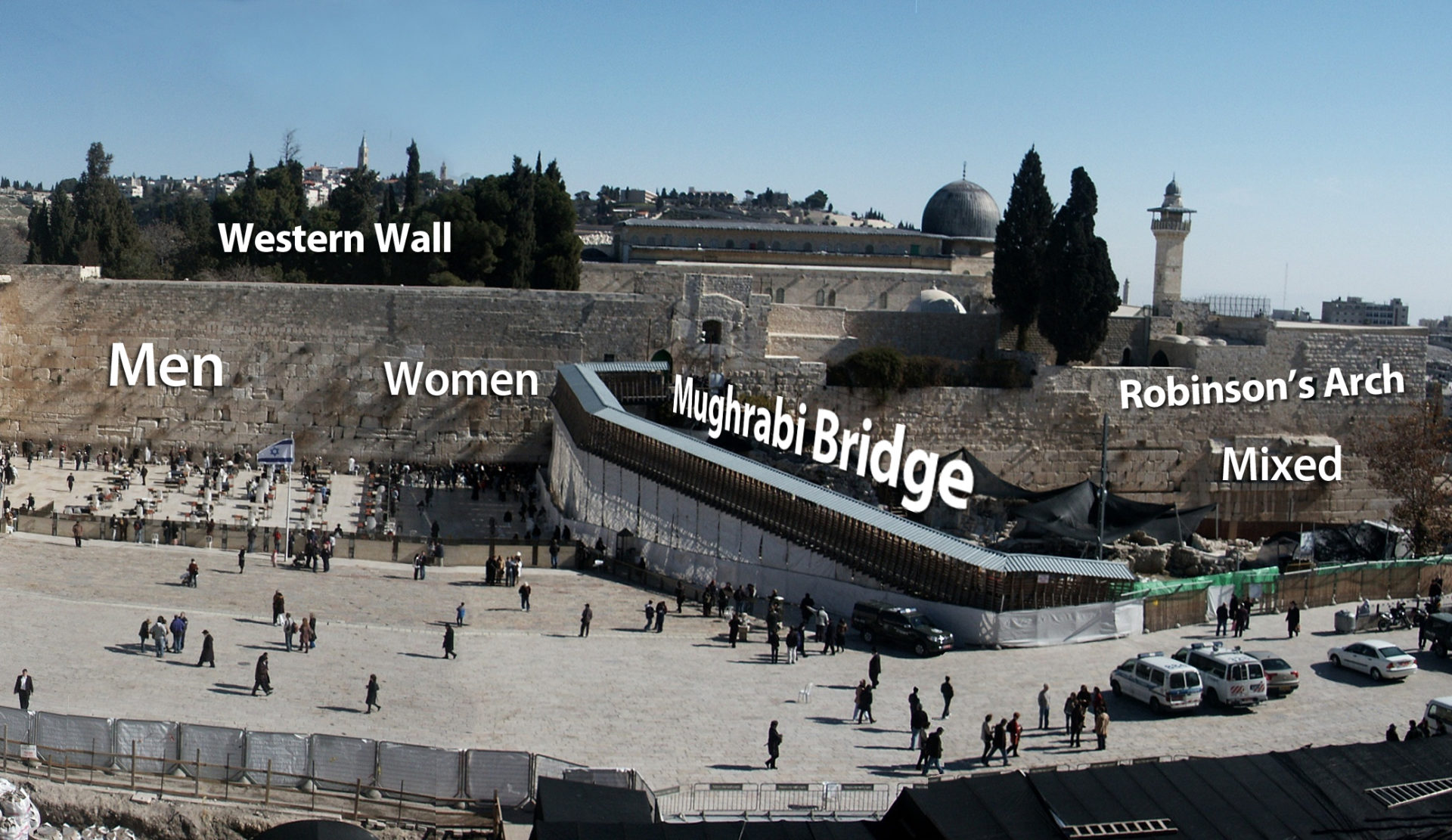
Image from tcjewfolk.com
A decision by the Israeli government not to approve the construction of an egalitarian prayer area at the Kotel, the Western Wall of the Temple Compound in Jerusalem and Judaism's holiest site, has opened wounds between the Israeli government and the American Jewish community.  It is ironic that, only weeks after celebrating the 50th anniversary of the return of the Kotel to Jewish hands, this iconic landmark and holy site is giving rise to huge divisions between different groups of Jews.  How differently the Kotel is being viewed now, as opposed to 50 years ago when Jews around the world were rejoicing in unison at the prospects of being able to visit and pray at this site.

Things have clearly changed over the past 50 years that we are fighting amongst ourselves over this matter.  Fifty years ago,  Jews would have been happy simply to be able to visit and pray at the Kotel. It would not have mattered if this would have been by a group of men or women on their own, or by mixed groups and families.  After so many years of having been denied the right to visit the site of the Temple, the details of how prayers would be offered there were unimportant.

Fast-forward fifty years, and the Kotel Plaza has been developed to allow and encourage Jews to visit the site for historical and religious reasons.  It was developed according to the tenets of Jewish religious law as befits a site of prayer.  This means that men and women have been provided with separate prayer areas.  This separation is not a new or alien concept amongst Orthodox and traditional Jews.  It is something that is expected at holy sites and areas of prayer.  And while Orthodox or traditional strands of Judaism are dominant in Israel amongst those who wish to identify with the Jewish religion, the same is not true outside of Israel.  There, the Reform and Conservative strands of Judaism are more popular.  These strands follow a somewhat less stringent interpretation of the Orthodox Jewish laws, either because followers have studied the laws and rejected some of the stringencies arising from Rabbinical interpretations and pronouncements over the years, or because it is simply easier to follow.  In a world where the rate of assimilation amongst Jewish communities around the world is running at alarmingly high levels, any form of identification with Judaism can be considered to be positive.  It is for this reason that the Reform and Conservative communities, particularly those in the USA, have gathered enormous power as they manage to stem some of the massive flows of Jews away from the faith.

The battle lines between Orthodox and Reform/Conservative Jews have long been drawn.  The Orthodox communities have done all that they can to reject the dilutions that are inherent with the Reform/Conservative view on the Jewish world.  They have worked to discredit and delegitimise them, even accusing them of not being Jews.  The Reform and Conservative communities, particularly those in the US that command power and have access to large sums of money, have used this to fight back against the Orthodox world view.  The battle over the Kotel is simply an extension of this power struggle between the different groups.  The Reform/Conservative strand believes that their followers (and other non-religious people) would prefer to visit and pray at the Kotel in an area that is mixed with men and women - an egalitarian area.  This would also allow families to enjoy this experience together.  The Orthodox are absolutely opposed to this, claiming that the Kotel is a religious place of prayer that requires separation of the sexes according to the traditional Jewish Law.

The State of Israel has set out not to distinguish between different groups of Jews.  In fact, the Law of Return that grants immediate Israeli citizenship to Jews, has chosen to use Hitler's definition of Jews rather than going by Jewish religious law.  Hitler decided that any person who had one Jewish grandparent would be eligible to be treated inhumanely by his regime, and to be part of his plan of extermination.  The Israeli government decided that if a person was good enough to be exterminated by Hitler, they would be good enough to be granted immediate Israeli citizenship.  This means that some of those who have been granted immediate citizenship under this law, are not Jewish according to Jewish Law.  This demonstrates the extent to which the State of Israel has opened its arms to many different groups of Jews - and even to some non-Jews.  Under the circumstances, it seems as though the government would be sympathetic to the claims of the non-Orthodox groups at the Kotel.

Even though the government would probably wish to be more accommodating to the demands of the non-Orthodox lobby, and even previously agreed to their demands for an egalitarian prayer area at the Kotel, politics always seems to come first.  The current government coalition can only exist with the support of the ultra-Orthodox parties in the Knesset.  Upon hearing of the government's plan to accommodate an egalitarian prayer area at the Kotel, the ultra-Orthodox parties flexed their muscles and threatened to bring the government down if the plan was implemented.  Prime Minister Netanyahu went into survival mode, even at the expense of his relationship with US Jews, and acquiesced to the demands of his coalition partners.  At least for now.  American Jews responded in disgust by withdrawing their support for the Israeli government.

Does the Reform/Conservative lobby have a valid case in declaring open warfare on the Israeli government as a result of this decision?  The Israeli government has said that an egalitarian prayer area does already exist, but it is just not in the premier Kotel Plaza area.  The non-Orthodox lobby claims that this is not good enough, and effectively treats some Jews as second-class.  Their demand is to have the egalitarian area front and centre alongside the other prayer areas in the Kotel Plaza.  The battle is one of power and of wills. This is a battle between different groups of Jews, each of whom demands that their way is accepted, and with the Israeli government being called upon to act as referee.

Is the Kotel a Jewish national asset that should be required to accommodate all groups of Jews in a way that is to their liking?  Or is it an asset that belongs to the religious, as the holiest religious site in Judaism?  Does creating an egalitarian prayer area alongside the other areas serve to dilute its importance and religious status?  Is this issue important enough to be worth creating a rift amongst different groups of Jews?

I don't have answers to any of these questions.  And even if I did, I feel sure that the warring parties would not consider my point of view in formulating their reactions to the situation.  Of course, the Israeli government will always act in way that promotes its own best interests.  At the moment, that requires it to take the side of the ultra-Orthodox parties and freeze the egalitarian prayer area.

In my opinion, the situation requires tolerance and understanding by all parties.  It is natural to expect that the holiest site in Judaism should have some of the most stringent rules attached to it, and that Orthodox Jewish law should apply.  We live at a time, however, when Jews around the world should find reasons to unite, and not reasons to be in conflict with each other, especially over a site as central as the Kotel.  The ultra-Orthodox parties are not generally known for making efforts to unify different strands of Judaism, but it is never too late.  They should know that no man is in a position to judge another one, nor judge his interpretation of the religion.  So they should be taking the moral high ground on this matter in an attempt to accommodate the requests of the non-Orthodox groups.  Surely accommodating an egalitarian space could be acceptable, as long as they continue to have their separated areas?  The situation now requires unity and not conflict.  It is incumbent upon the parties to sit down, and find a compromise that will be acceptable to all.  Is this too much to expect?

Friday, 2 June 2017

Trump - Saviour or Poison Chalice

The visit to Israel by US President Donald Trump has come and gone, and the analysts will undoubtedly still spend some time considering their verdicts dissecting each aspect of the visit.  At first glance, the visit appears to have been filled with symbolism but short on substance.  Following a turbulent first few months in office for the US president, there are many who wonder whether his support for Israel is welcome, or whether it is turning out to be more of a poison chalice than a helping hand.

Trump has been openly and publicly supportive of Israel's position, even from before he was elected.  His high profile campaign promise to move the US embassy from Tel Aviv to Jerusalem has been the subject of much debate and controversy.  When his victory in the presidential election was revealed, the Israeli government (and many other Israelis) welcomed his election with the hope and expectation that this would change the anti-Israel bias within the US government and elsewhere that was such a feature of the Obama administration.  And changes have certainly been felt since his election.

The current atmosphere at the United Nations is entirely different from the one that ruled during 2016 and before.  Part of this change can be attributed to new UN Secretary General António Guterres, who is much less inclined to entertain the constant barrage of anti-Israel sentiment that prevailed under Ban Ki Moon.  Much of the change is, however, thanks to new US ambassador to the UN Nikki Haley and the change in policy that she represents.  She has imposed the Trump administration's support for Israel at the UN in the strongest possible terms.  The days of raising frivolous anti-Israel resolutions at the UN Security Council are over for now.  The international community has understood that these will be vetoed by the US, and that there is little point in raising them under the current administration.  Haley has been vociferous in her condemnation of the constant attempts to paint Israel in a negative light.  There can be little doubt that the changes at the UN have a great deal to do with the new man in the White House.

President Trump's visit to Israel was highly symbolic.  He made Israel one of the stops on his maiden foreign tour since becoming president.  He visited the Western Wall in Jerusalem during his visit, becoming the first US president to make this visit while in office.  He emphasized to Palestinian Authority President Mahmoud Abbas that funding terror is not acceptable.  He reinforced the support that Israel will always enjoy from his administration.  In spite of this, he stayed clear of the key substantive issues confronting Israel and the region now.  He did not raise the move of the US embassy to Jerusalem.  No mention was made of the constant accusations against Israel regarding construction in Judea and Samaria.  Nothing was said about Palestinian claims to Jerusalem, or accusations regarding Israel's claims to Jerusalem as its capital.  His outward shows of support were all seized upon, recognised and appreciated by the majority of Israelis.  The lack of meaningful progress in getting Israelis and Palestinians to sit down around the peace table is what the international community has seized upon.

The issue that Israel needs to consider is Trump's overall standing within the USA and further afield.  It was clear before he arrived in Israel that Trump has many enemies at home, and that they are determined to keep him on the back foot by levelling all types of accusations against him.  Trump's own conduct in defending these accusations has certainly not helped his cause.  And Israel was dragged into the crossfire when Trump was accused of sharing secret intelligence received from Israel with Russia.  If true, this would be a serious violation of trust, and norms associated  with the sharing of intelligence information.

Distrust for Trump appears to be spreading rapidly within the international community as well.  Trump's recent appearances at the G7 and NATO meetings did not show him to be in accord with any of the other western leaders.  On the contrary, there are indications that Trump is being sidelined from the key international organisations.

Winston Churchill famously said, “Diplomacy is the art of telling people to go to hell in such a way that they ask for directions.”  This is an art that Trump has clearly not yet mastered.  Even though Trump frequently says things that many people are thinking, he has not yet discovered how to say it in a way that does not create enemies.  While Israel has no particular issue with Trump's popularity (or lack of it) in the international community, there is a danger that Israel will be tarred with the same negative brush if she is seen to be too closely associated with Trump.

There is no doubt that Israel has already gained a great deal from the change of administration in the White House.  Trump's influence over US domestic and international policy towards Israel, and his influence over proceedings at the UN cannot be under-estimated.  Israel will certainly wish to see more of that in the future.  There is a danger, however, that the association with Trump could prove to be negative in Israel's relationships with other countries around the world.  If Trump continues to completely ignore the accepted rules of international engagement while representing his contrary views, he will quickly became a pariah in the international community.  And, even if Israel wishes to stay close to Trump to benefit from his supportive views and actions, the association with him may proved negative. 

The prime minister and the Israeli government has a tough job to navigate a careful path to take advantage of the emerging situation, without losing too much in the process.  Will Trump prove to be the good things for Israel that were predicted, or a poison chalice?  Only time will tell.

Sunday, 25 December 2016

Obama's Final Act of Betrayal

Image courtesy of www.politico.com
After weeks of speculation as to how the US will vote at the UN Security Council when presented with the resolution condemning Israel's policy regarding the so-called "settlements", we now have a clear and unequivocal answer.  In the vote held on Friday, Barack Obama instructed his ambassador to the UN to abstain from the vote at the Security Council.  This action allowed the motion to be carried, with 14 countries voting in favour and 1 country (the USA) abstaining.  Had Obama decided to vote against the resolution, it would not have been carried despite the majority voting in favour.  Because the USA has a veto right at the UN Security Council, it had the power to defeat the motion on its own.  This veto right was not exercised on Friday.

The decision by the USA delegation to abstain from Friday's vote flies in the face of USA policy at the UN Security Council in recent years on the subject of resolutions condemning Israel.  In the words of outgoing UN Secretary-General Ban Ki Moon, Israel has been the victim of a disproportionate number of resolutions condemning her actions at the hands of various UN organisations.  One could interpret this to mean that Israel has been unfairly targeted by the UN, and unjustifiably singled out for constant criticism and condemnation.  The USA has somewhat redressed this imbalance by exercising its right of veto at the Security Council over the years, and has ensured that the unfair condemnations of Israel are not allowed to stand, at least in that forum.  The most recent example of this was in 2011, when the Obama administration vetoed a resolution that condemned Israel's settlement activity.  The resolution on that occasion was remarkably similar to the one passed by the Security Council on Friday by virtue of the US abstention.  So what has changed in 5 short years, that justified the US turning its back on Israel at this time?

In 2011, there was a great deal more at stake for President Obama.  He had been in office for approximately 3 years, and was already eyeing his re-election with the hope of returning to the White House for 4 more years.  His decision to veto the resolution on that occasion was all about serving his interest at that time, rather than showing what he genuinely felt and believed.  Fast-forward 5 years, and Obama has no political capital to win or lose from the Security Council vote.  He will vacate the Oval Office in less than a month, and this vote has no bearing on his future whatsoever.  The only reason that he would vote in one direction or another, is to reflect his genuine view on the matter.  This view is shown loudly and clearly in a resolution that is one-sided and false in its depiction of the reality.  This is the legacy that Obama and Kerry are leaving on their peace-making efforts over the years, that were presented as being fair and even-handed.

This act puts an entire 8 year presidency into context.  There were many conspiracy theories about what Obama's true position on Israel was.  Was he influenced by the fact that he comes from Muslim heritage?  Was he genuinely sympathetic to Israel's struggle for survival?  Did he understand that the obstacles to peace are numerous, and not only the fault of one party or the other?  He tried to cloud the answers to these questions, and presented himself as a friend of Israel throughout his term in office.  This single act at the end of his presidency, however, has clarified all that has gone before.    While Israel would never wish to oppose the possibility of reaching a genuine agreement with the Palestinians, it has always been important to Israel that any agreement be reached on the basis of mutual respect and recognition between the parties.  This respect and recognition has been sorely missing from the Palestinian side.

The only real purpose that this resolution serves, is to continue to perpetrate the view that Israel is solely to blame for the lack of progress towards peace.  And Israel's policy on settlements is an easy scapegoat to use to illustrate why Israel should be blamed.  If it was true that the settlements are the main obstacle to peace, why was peace not achieved in the period from 1948 to 1967, when there were no settlements to blame.  Not only was peace not achieved, the Arabs were hell-bent on destroying Israel at any and every opportunity.  But now, the settlements are being presented as the only reason for the lack of a peace agreement.  Where is the criticism of the fact that the Palestinians refuse to recognise Israel as a Jewish state, that has a right to live in peace and security?  Or of the fact that the PLO charter continues to call for the destruction of the State of Israel?  Or the continuous terror attacks that Israelis are forced to endure?  These were conveniently ommitted from the UN Security Council resolution, and this emphasizes how one-sided how this resolution really is.

If the resolution served to somehow move the peace process forward or to make a positive contribution the situation, I would be able to understand Obama's decision to allow it to stand on the record.  Unfortunately, this is not the case.  Instead, it is a pointless finger-pointing exercise that makes little contribution to the creation of a positive environment for peace-making.  And now, it is clearer as to who is pointing at whom.  Obama, your true colours have been revealed.  Shame on you.

Wednesday, 5 October 2016

Obama's Insult

Image courtesy Financial Times https://www.ft.com
US President Barack Obama was in attendance on Friday at the funeral of former Israeli president and prime minister Shimon Peres, and was invited to eulogise the last of Israel's founding fathers.  Obama's attendance and eulogy was evidence, if any was needed, of Peres's standing in the international community and the circles in which Peres has moved during more than six decades of international diplomacy.  In spite of Peres's persona as an international statesman, his funeral was an intensely personal event for Israel and for members of the Peres family.  This fact seems to have been lost on President Obama judging by the text of his eulogy.

It almost felt as though Obama was trying using his attendance at the funeral to compete with the last US president who attended the funeral of an Israeli statesman just over 20 years ago.  On that occasion, President Bill Clinton created the simple but iconic phrase, "shalom chaver"(goodbye friend), when eulogising late Prime Minister Yitzhak Rabin.  Obama's own attempt at creating an icon of a Hebrew phrase was not simple enough, and fell flat.  Obama's phrase, "toda raba chaver yakar" (thank you dear friend) seemed to be too much of a take on Clinton's original phrase, and seemed much less sincere than the words uttered by Clinton two decades ago.  Even Bill Clinton's own eulogy on Friday of Shimon Peres seemed more sincerely spoken than that of Obama.

Obama had lost his way in his speech, and in the hearts of Israelis, long before the "toda raba chaver yakar" was uttered.  In fact, he had already succeeded in putting a foot wrong in his remarks of welcome, long before reaching the main part of his speech.  As one would expect at such an occasion, President Obama acknowledged members of the Peres family in mourning, Israeli leaders and representatives and other world leaders in attendance at the funeral.  This is where things started to go wrong.  Out of all the foreign leaders, who attended the funeral, President Obama chose to mention only one by name in acknowledging his presence.  That was the name of Palestinian Authority President Abbas whose presence, he said, "was a sign of unfinished business"!

That one comment infuriated me, and many of my fellow Israelis.  Is this what Obama's attendance at the funeral was all about?  To promote his political agenda and highlight his political failings, at the state funeral of one of Israel's founding fathers?  And what did Obama hope to achieve by making this comment?  His ability to achieve anything in Middle East peace-making is long past, as he enters the "lame duck" period of his presidency.  So what positive could have come from this comment?  To me, his comments indicated a lack of respect to those whose hospitality he was enjoying.

Out of all the elected leaders who had accepted the invitation of the Peres family and the Israeli government to attend the funeral, why did Obama choose to single out the one leader who does not enjoy a democratic mandate from his people to rule?  And did he not understand that this was also the leader who has supported waves of terrorist attacks that have been undertaken against Israel and Israelis over the past few months and years?  Even though Abbas may not have personally ordered these terror attacks to take place in the way that his predecessor did, he has provided Palestinian Authority money to the families of terrorists who were killed during the course of their murderous activities.  And he has sent out messages of sympathy and made condolence visits to the families of these evil murderers.  In doing so, Abbas has made clear to his people that such activities are acceptable and desirable.  This, in turn, creates a new generation of terrorists.  So for him to be standing on the hallowed ground of Jerusalem's Mount Herzl at the funeral was already a huge concession in the view of many Israelis, perhaps an unjustified and undesirable concession.  But Obama succeeded in rubbing salt into the wounds by choosing to give credibility and international standing to a man who is most unworthy of this.

What was the unfinished business that Obama was referring to?  He would say that it is the unfinished business of making peace between Israelis and Palestinians.  But the Palestinians show little desire to finish this, and have taken no active and meaningful steps in this direction.  In Israel's view, the unfinished business is that of removing the objective to destroy Jews and the Jewish homeland from the charter of the PLO, and to openly and unequivocally recognise Israel's right to exist as a Jewish state.  Until that unfinished business is taken care of, and the support for terrorists is ended, there will be no further business.

There is no doubt that Obama was conscious that his comments would be controversial.  He is well aware of the position that Prime Minister Netanyahu has taken on the issue of the peace talks, and the stand taken by the Palestinians.  These remarks were made with full knowledge that they would cause a reaction, and that they would not be welcome.  This represents an insult to his hosts, and was inappropriate and uncalled for.

The actions by the US president seem consistent with his behaviour towards Israel over the last few years.  During the time of Obama's presidency, the Palestinian Authority has had its status at the United Nations upgraded, been accepted as a party to the International Criminal Court in The Hague and taken on a much higher standing in the international community.  All of this comes despite continuing to fund and encourage terror, and not being willing to recognise the democratic right of the State of Israel to exist as a Jewish state.  Instead of holding the Palestinians responsible for acts of terror and being prepared to criticise this publicly, the US president has continuously castigated Israel for constructing homes in Israeli-ruled territory.

Prime Minister Netanyahu acquiesced to the request by the Peres family to invite Mahmoud Abbas to the funeral, and to seat him in the front row.  His hands were tied in terms of agreeing to grant Abbas permission to enter Jerusalem for the funeral, even though he may have wished to act otherwise.  Obama should have considered this enough, instead of making a more public spectacle of an already uncomfortable situation.  Sometimes less is more, although Obama seemed insensitive to this during his eulogy.

It is somewhat ironic that Abbas's presence at the funeral was also castigated by his own electorate, many of whom considered Peres an enemy of the Palestinian cause.  With so many Palestinians and Israelis joining together in the dislike of Abbas's presence at the funeral, perhaps this should have been a clear enough message to Obama that raising this in public would serve to damage his objectives rather than progress them.  Perhaps this is a clear indication why American peace-making efforts, particularly those driven by Obama, have been so unsuccessful.

Saturday, 30 July 2016

The Legacy of Entebbe Lives On

Forty years have passed since the rescue of Jewish hostages was carried out by IDF soldiers at Uganda's Entebbe airport.  A number of events were held recently to mark the occasion, and to remember all that happened in the hijacking of the Air France plane, the separation of the Jewish hostages from the others and the ultimate rescue of the hostages in an astonishing operation by IDF troops.  With a heavy heart, the victims of this hijacking and rescue operation were also remembered and commemorated.  In total, 4 of the hostages were killed as well as the IDF commander of the operation, Lt. Col. Yonni Netanyahu.  Prime Minister Benjamin Netanyahu chose this opportunity to visit Entebbe for the first time, to personally witness the place where his older brother was killed.

Operation Thunderbolt  was renamed Operation Yonatan to commemorate its fallen commander.  With the luxury of hindsight to look back on this operation, the legacy that Operation Yonatan has left for Israel and its security establishment can be assessed.  This rescue mission was undoubtedly one of the most daring and audacious missions of its type during its day, and even since then.  It has been the subject of numerous books, movies and military case studies, such has been the level of interest into the operation.  Besides the audacity and sheer chutzpa involved in pulling off this operation, the tiny details that were taken into consideration and the very short period of time within which all the preparations were made, have served to elevate the mission to legendary status.

The ramifications of this operation in Israel, and in the Jewish world in general, have been profound.  The operation has elevated Israel's secret service, the Mossad, to be afforded greater respect and recognition by lay people and peers in a way that other secret service organisations do not enjoy.  Because much of the work undertaken by secret service organisations, particularly the Mossad, is secret by its nature and is seldom made public, it is difficult to measure the effectiveness and the successes of the organisation.  Operation Yonatan was a visible sign of success, not only for the IDF, but indeed for the Israeli secret service.  It was, after all, the Mossad who were responsible for much of the intelligence-gathering, and who were integrally involved in every step of the operation.  It was one of the few visible successes that the Mossad would be happy to be publicly associated with, and which served to demonstrate its amazing capabilities.  This operation (along with a few others), has given the Mossad the status of a legend in the secret service world.  Israel's enemies know that they should be on their guard to expect the unexpected.  They have learned from this that very little is beyond the Mossad's capabilities.  Not only does the Mossad have the ability to carry out these types of operations, it also has the audacity and fearlessness to do so.  That legend continues to the current day.  Frequently, when crazy and improbable "accidents" occur that impair the work being done by Israel's enemies, the Mossad is the first organisation suspected of involvement.  Despite the automatic suspicion of the Mossad and the close monitoring of its operations, it is extremely seldom that hard evidence can be brought to confirm involvement of Mossad agents in an operation.  Rather than causing the Mossad to operate with impunity or carelessness, it gives the Mossad the impetus to carry out more and greater operations in the protection of the State of Israel and Jews around the world.

The fact that Operation Yonatan rescued both Israeli and non-Israeli Jews has also left its mark.  There is no other country around the world, whose secret service operates to protect the citizens of countries that are not its own.  And yet, this is the hallmark of the Mossad, as borne out by Operation Yonatan, when it comes to the protection of Jews who are not citizens of Israel.  The reason that the hostages were separated in Entebbe as they were, had nothing to do with them being citizens of Israel.  Instead, they were separated on the basis of whether they were Jewish or not.  Exactly as was the case during the Shoah.  Clearly, the Israelis were automatically included in the group of Jews, but they were not alone.  When Operation Yonatan was carried out, it was carried out in the name of all the Jews in the group, whether they were Israeli or not.  This was further evidence from the government of Israel, and from the instruments of the government, that the country stands ready to help Jews from all corners of the earth.  This was cemented into law when the Law of Return was enacted to allow Jews to claim immediate citizenship of the State of Israel, and has been demonstrated in numerous rescue missions of Jews when they were considered to be in danger.  Operation Yonatan was another significant sign of this commitment.

Little has changed over the past 40 years in terms of the threat that confronts Jews, no matter where they happen to be in the world.  We have seen Jews establish a level of comfort in their host countries, only to come under threat again.  The latest wave of violence in Europe, and in France in particular, has certainly been directed against Jews.  It is with pride and confidence that the State of Israel reaches out to these Jews to offer them protection in their homes, but also to offer them a home with greater protection.  And we have seen these Jews take up on this in their droves.  This is, amongst other things, the legend of Operation Yonatan.  Wherever Jews are in the world, the Jewish state will protect them.

Perhaps the greatest legacy left by Operation Yonatan comes in a much more personal form.  The death of Yonni Netanyahu left a scar on his family, and left a profound mark on a 27 year-old MIT student.  This student was Benjamin Netanyahu, younger brother of Yonni.  In his own words, the death of his older brother, "changed my life and steered it to its current course".  It is tough to judge to what extent the death of Yonni really spurred Benjamin to achieve what he has achieved over the years.  It is possible that he would have risen to be prime minister of Israel and one of the most influential leaders on earth, even without the push that he received from Yonni's death.  But we know about what he has managed to do in rising to be one of the best known and most influential people, and the influence that he has exerted over the years.  And we know that much of this has been with Yonni in mind.  The visit to Entebbe by the prime minister was not only in his capacity as prime minister, but was intensely personal as he mourned at the location where  his older brother and hero met his death.  One could not help wondering what Yonni would be thinking as he looked down on the scene from his seat in heaven.

As we look at the events at Entebbe with the benefit of 40 years of hindsight, the legacy is probably stronger now than it was in the euphoric days that followed the operation.  The strong message sent out by the Israeli government regarding its commitment to protect Jews around the world, and the message sent out by the IDF and the Mossad regarding their ability to do so, are louder and clearer than before.  And the personal impact left on one young student who went on to be one of the world's most recognisable personalities is unquestionable.  If the same set of circumstances presented themselves again, I have no doubt that the response would be no different.  This ultimately proves the greatness of the operation.

Saturday, 17 October 2015

Palestinian Actions Speaking as Loudly as Words

Israeli Prime Minister Benjamin Netanyahu  delivered  another triumphant speech at the United Nations General Assembly meeting.  He seems to be at his best when standing at the UN podium and presenting Israel's case to the world.  His speech came only a day after the one delivered by Palestinian Authority President Mahmoud Abbas, and it was noticeable how Netanyahu's speech contained much optimism in stark contrast to Abbas's words.  Since these speeches were delivered, a number of innocent Israelis have been murdered and many more injured in Palestinian terror attacks in the city of Jerusalem, in the West Bank and elsewhere in Israel.  It frequently seems as though nobody in the UN General Assembly is really listening to the speeches, as most people come there with their positions firmly entrenched.  The speeches are heard by audiences outside of the General Assembly chamber in New York, particularly by the electorate of the leader concerned.  Abbas's speech appears to have been very much directed at the Palestinian people.  There also seems to be a strong link between the tone of the messages delivered, and the actions that have taken place on the ground in Israel since the speech.

Those close to Abbas had warned for many months prior to this UN General Assembly meeting, that Abbas's speech was going to contain a "bombshell".  This expectation was set, not only amongst the international community, but also amongst the Palestinians who are looking to Abbas for leadership.  There was speculation about what it could be.  Most of the ideas that were put forward as possibilities were along a negative theme.  Some thought that Abbas would resign or dismantle the Palestinian Authority.  Those people who were hoping for something positive that could somehow contribute to the situation in the Middle East, and possibly move the peace process forward, were drowned out.  After the speech, the so-called "bombshell" was described by one Israeli newspaper as more of a stink bomb than a bombshell.  There was nothing dramatic that one could point to in his speech that could be termed a "bombshell".  Perhaps, more importantly, there was certainly no hint of anything positive to give one a feeling that a way forward can be found.  Instead, there was evidence of frustration that the Palestinian issue has been replaced on the front pages of the international press by the ISIS threat and by the Syrian refugee crisis.  There was an appeal for governments around the world not to forget that they should continue to pursue foreign policies that criticise Israel's behaviour and actions, while heaping sympathy on the Palestinian "victims" in the conflict.  The message, however, was received loudly by the Palestinian people, while not registering any response on the agendas of foreign governments.  The clear message sent by Abbas and received by the Palestinians, was one of hopelessness and lack of optimism for the future.

It should, therefore, come as no surprise that the Palestinians have heard the message from the UN, and have embarked upon a spree of terror attacks across Israel that have killed and injured innocent people.  In the process, children have been orphaned, parents have lost children, and wives have lost their husbands.  Even though the wave of violence has been blamed by Palestinian leaders on events that have recently taken place on the Temple Mount in Jerusalem, the violence cannot be attributed to these events in any way.  The events on the Temple Mount are simply part of this violence that we have seen elsewhere, rather than a cause of it.  The cause of the violence can be traced back to the words in the UN General Assembly Hall that reflect the general message that has been in evidence for the Palestinians for some time.  A lack of hope and optimism, and a feeling that there is little to lose, can cause people to behave in extreme and sometimes illogical ways.  This is clearly the case with Palestinian people right now.  It is too simplistic to explain the current events as simply arising spontaneously out of a lack of hope.

It is frequently the case that the actions of the government serve to give their people the optimism that drives them to feel motivated or not.  Actions by a national government can easily trigger a positive feeling and spirit amongst its populace, and equally cause it to dry up as a result of actions that drain their mood.  This can sometimes be triggered by relatively mall things that are of greater concern to people. It seems to me that the spirit of the Palestinian people has been drained by the negative actions of Mahmoud Abbas.  How can a nation feel motivated when your leader stands up in front of the international community and expresses views that are completely devoid of any optimism for the future?

The Palestinian Authority is not only guilty of milking their people of any optimism to the point that they have effectively given cause to this cycle of violence, they are also guilty of inciting them to continue this violence.  The word "intifada" has been mentioned many times in relation to this cycle of violence.  For those of us who lived through the previous 2 intifadas, this cycle of violence looks remarkably like an intifada.  We are told, however, that this is not an intifada.  The most commonly quoted reason is that the previous 2 intifadas were actively supported by the Palestinian Authority, with weapons, money and specific instructions being given by the authority.  On this occasion, according to what we are being told, the authority is not actively supporting the violence.  It is noticeable, however, that they are also not speaking out against this violence in any way.  This can surely be considered and interpreted to be support.  Those who are not speaking out against this wave of violence, are clearly seen to support it.  In my view, and according to the official definition, this is an intifada.

The involvement of the Palestinian Authority in previous intifadas was described as a "guiding hand" behind the scenes.  The Israeli government is telling us that, on this occasion, there is no guiding hand.  Having said that, there are some hallmarks of the current wave of violence that seem to be part of an orchestrated strategy.  The fact that the weapons of choice being used in the current round of attacks are stones that are being thrown, and knives being used for stabbing attacks, is different from intifadas in the past.  And it is also noticeable that many of those involved in attacks in the current wave of violence are youths and minors.  This certainly tells a better story for putting on social media.  Minors are clearly problematic from a prosecution perspective under Israel law, when the perpetrators are arrested.  They cannot be treated in the same way as adults are treated under the law, and this may be one of the reasons why this strategy is being employed.  As much as we are being told that the violent attacks are spontaneous actions by individuals on the ground, it seems that the attacks are coordinated and part of a strategy.

A recent development in the wave of violence, is the involvement of Israeli Arabs.   Some of the attacks carried out in Jerusalem, have been undertaken by Arabs who are citizens of Israel.  Over the past few days, protests have been seen in Israeli Arab cities up and down Israel.  These are protests in support of the wave of violence directed against Jewish Israelis.  The involvement of Israeli Arabs is a dangerous development, and creates a dilemma for the Israeli government.  The interior minister has threatened to withdraw Israeli citizenship from any Israeli found to be involved in the violence.  Even this is more of a knee-jerk response, and not necessarily a longer-term solution.

The responsibility for this wave of violence falls directly on the Palestinian Authority.  And this is not only because of their responses (or lack of responses) over the past few weeks.  This responsibility goes back many years during the time that they have educated their children for conflict and violence against Israel and Jews.  Such education takes a long time to undo, perhaps even a number of generations.  Of course, this is not aided by staying silent when their people carry out heinous attacks on innocent people, and by blaming Israel for a change in status on the Temple Mount.  This is an outrageous accusation, that is simply designed to get support from fellow Muslims around the world, and to return the Palestinian issue back to the front pages of the newspapers.

Despite the fact that the support and the "guiding hand" of the Palestinian Authority is different from what it has been in the past, this is an intifada in definition and action.  The authority has adopted a policy of maintaining a feeling of hopelessness amongst its people, in order to build hatred and despondency that is being channelled against Israel and Israelis.  It continues to educate its children for hatred, war and conflict rather than education for peace and coexistence.  The speeches at the United Nations showed clearly that Israel stands for all that is positive and optimistic, while the Palestinian Authority stands for the opposite.  Until this is rectified, there can never be peaceful coexistence in this land.

Friday, 29 May 2015

Starting on the Wrong Foot

The entire process that led to the forming of Israel's 34th government in 68 years of independence was filled with drama and unexpected events.

Opinion polls in the weeks leading up to the election predicted that the two largest parties, the Likud and the Zionist Union (formed out of a pact between the Labour and Hatnua parties), would be fighting each other off to form the new government.  The feeling was that one or two seats would separate the parties.  Even the election's exit polls did not predict the extent to which voters ultimately favoured the Likud over Zionist Union.  When the election result was announced showing that the Likud won 6 seats more than the Zionist Union, it took everybody in the country by surprise.  Even the members of the Likud were shocked at the size of the victory, especially in view of the earlier predictions.

The pendulum of expectation swung in the opposite direction.  All of a sudden, there was the expectation that Prime Minister Netanyahu would form a broad-based, strong, right-wing coalition government in double quick time.  As it turned out, the formation of the government took way longer than expected, is the narrowest possible government and is not nearly as strong as people thought and hoped it would be.   With these fluctations came swings in the public's expectation about how long this government can reasonably survive, and whether it has the ability to govern and make the changes that are so needed in Israeli society.

If the lead-up to the new government contained its fair share of surprises, the process of forming the government has also been less than inspiring.  The prime minister has been forced to compromise on many fundamental ideas that his electorate stand opposed to, in the interests of attracting coalition partners into the government.  For example, he has been forced to go back on legislation, that was put in place during the previous government, to force ultra-Orthodox yeshivah boys to undertake military or national service like all others of their age.  He has also been forced to redirect huge sums of money to the ultra-Orthodox sector, at a time when the Israeli government has implemented large budget cuts as part of an austerity plan.  Many Likud voters are horrified at these and other concessions.

One of the persistent rumours that refuses to go away concerns the reported approach that Prime Minister Netanyahu made to Labour leader Isaac Herzog to join the coalition.  The prime minister is reported to have approached Herzog on condition that he agrees to abandon his pact with Tzipi Livni, and bring only the Labour faction into the new government while leaving Livni and her Hatnua members out of the coalition.  Herzog refused, thereby turning down the opportunity to be part of a national unity government, and provide Israel with a much more stable coalition.  Has he spited the people of Israel by preferring to see Prime Minister Netanyahu fail in his endeavours?  There are many who believe that he has chosen the egotistical path, rather than setting his ego aside in the interests of serving the Israeli electorate.

The make-up of the new cabinet is also not a huge source of inspiration.  For starters, there are a total of 21 ministers in the new government, surpassing the 18 ministers that were recently legislated as being the maximum allowed in any government.  Netanyahu was forced to pass an amendment law through the Knesset to allow him to appoint 21 ministers to have sufficient jobs to dish out to all coalition partners.  The important job of foreign minister has been left vacant and has been assumed by the prime minister.  He has also retained the communications ministry, ministry of health and ministry of regional cooperation for himself.  It seems as though Netanyahu may be reserving these in case he is able to convince Lieberman or others to join the coalition in the future.

Aryeh Deri, head of Shas, is the new economics minister.  He has recently served a jail sentence and now come out of an exclusion period, during which he could not serve in a public position, as a result of having been found guilty of taking bribes while a government minister.  Yoav Galant is the minister of construction.  This is highly controversial seeing as Galant was prevented from taking up his appointment as the IDF Chief of General Staff due to irregularities found in the construction of his personal residence on public property.  Miri Regev is the new minster for culture and sport, despite having made it quite clear that she really wanted to have the welfare portfolio.  Habayit Hayehudi's Ayelet Shaked is probably the most surprising and high profile appointment to the new government, having been appointed as the minister of justice.  In this position, she has a huge influence over the appointment of judges to the supreme court, as well as many other aspects of Israel's judicial policy and justice system.  She has also secured herself a seat in the security cabinet, the narrow inner cabinet that is responsible for formulating and implementing Israel's security, defense and foreign policy on a daily basis.  At 39 years-old, she is considered an extremely young appointment to a critical position, despite clearly being very capable.  It is reported that Likud old-timer Benny Begin only knew of his appointment to the cabinet, as minister without portfolio, at the moment that it was announced in the Knesset.

The Knesset session to present the new government was held on Thursday 14 May.  The session epitomised a circus more than a meeting of Israel's legislature.  At first, Arab members of Knesset created an intentional and sustained disruption during the prime minister's address, that resulted in  a number of them being evicted from the chamber.  A few other Arab members decided to leave of their own accord in sympathy, although they did return during the address by the leader of the opposition.  Miri Regev was also issued a warning for heckling and disruptive behaviour, although managed to survive without being ejected.  Leader of the opposition, Isaac Herzog, delivered a stinging rebuke and criticism of the prime minister and his new government.  He was heckled by members from the religious parties, who were also issued with warnings.  While the job of the official opposition (and its leader) is to ensure that the government is held to account, there are times when it is appropriate for the opposition to support the government and to show some unity in helping with its efforts.  There are many who feel that this occasion was the perfect opportunity to show some unity and support.

The inconspicuous start to the new government continued further with a reshuffle coming less than 10 days into the life of the new government.  Likud number 2, Gilad Erdan, decided that he would be better off working within the new government rather than from the back benches.  While his disagreement with Prime Minister Netanyahu has not been resolved, Erdan finally agreed to accept the ministries of public security, strategic affairs and public diplomacy.  Despite him trying to put a spin on why he changed his mind to justify his actions, it is clear to all that this is a big U-turn on Erdan's party.  Netanyahu was happy to reshuffle his new government in order to accommodate Erdan.  Benny Begin, who was asked to resign his position as minister without portfolio to accommodate Erdan joining the cabinet, was not happy to comply with the request.

Despite the problematic manner in which the government has finally come into office, it does not detract from the fact that new government has a lot of important work to do.  Israel is under much pressure on the international diplomatic front to move forward to a peace agreeement with the Palestinians.  It also has to maintain firm security against those who are determined to destroy her and her people while also addressing the social and welfare needs for the weakest members of society in a tough economic climate.  All of this needs to achieved in a climate of lower levels of government spending to manage the economy responsibly.  Israel needs a firm, stable and decisive government that can make the difficult decisions that confront it.  Even though the manner in which the new government has started out life does not seem to bode well for the future, we all hope that we will be confounded by the extent to which the government is able to achieve great things.  We wish them much success.

Monday, 20 April 2015

Iran and Obama


What is it that is driving US President Barack Obama to seemingly single-mindedly pursue an agreement with Iran?  From the outset, he has appeared determined to reach this agreement, almost at any price.  This is despite strong opposition and warnings from the US's key allies in the Middle East, Israel and Saudi Arabia.  Although the agreement that is being sought with Iran comes under the auspices of the United Notions and the European Union together with a group of countries that includes Germany, France, the United Kingdom, China and Russia, there is no doubt that it is the US and Obama that are making all the running in trying to achieve this agreement.  On the face of it, there seems no obvious reason why Obama would wish to do this.  In the absence of clear publicly-visible reasons to reach such an understanding with Iran, the situation inevitably gives rise to conspiracy theories about what may be happening behind the scenes, that is driving Obama to act in the way that he is.

The US broke off diplomatic relations with Iran in 1980, soon after the Shah was deposed and around the time of the Iran hostage crisis.  The US gave strong support to Iraq during the Iran-Iraq war, even if this meant providing support to former Iraqi President Saddam Hussein during the 1980s.  All of this was done in the interests of opposing Iran.  The current threat that the Iranian regime represents in the world order is clearly not new to the US administration.  The question remains as to what has happened over the past few years that gives the urgency for Obama to reach this agreement with Iran, where his predecessors followed policies towards Iran that were exactly the opposite?

Some have put forward the theory that Obama is pursuing a policy of engagement with Iran.  The theory on engagement says that it is better to have a relationship with Iran to allow visibility and supervision of its nuclear program, rather than allow it to proceed with its nuclear activities in an unsupervised and secretive way.  There are certainly cases where a policy of engagement has proven itself to be successful, and reach positive results.  There are also glaring examples of the failure of engagement, where even more damage was done as a result of the belief that all parties are pursuing a common objective.  Possibly the most obvious failure of engagement was when British Prime Minister Neville Chamberlain pursued his policy of appeasement in relation to the Nazi regime during the late 1930s.  His triumphant declaration of securing "peace for our time" after concluding the Munich Pact in 1938 could not have been a greater misjudgement of the facts.  The Second World War broke out less than a year later.  A policy of engagement has a place, but only under very specific circumstances and conditions.  The moment there is any doubt about what may be driving the other party to wish to pursue engagement, it is a policy that can do much more harm than good.  This certainly seems to be the case with Iran.

Iran has two clear objectives from the talks with the P5+1 group.  The first and primary objective is to lift the crippling sanctions that have been applied to it over the past few years by western countries.  There can be no doubt that these sanctions have had a devastating effect on Iran's economy.  Iran has a heavy burden in funding daily economic activities, funding its nuclear development and also funding a large number of proxies conducting terror activities around the world.  This is tough for any economy, and even more so for an economy where its primary economic activity is suffering severe constraints due to international sanctions.  Iran's second clear objective is to gain an international stamp of approval for its nuclear activities.  These activities have been conducted in secrecy until now, despite the international community being aware of the fact that this has been pursued behind closed doors.  The opportunity has now been offered for Iran to get international approval for its nuclear development program, and Iran would certainly wish to accept this chance with both hands.

By giving such great compromises to Iran, President Obama is allowing a golden opportunity to slip through his hands and is breaking the cardinal rules of international diplomacy.  The fact that Iran has been brought to its knees by the effects of the sanctions, should present the chance that Obama needs to force Iran to kill off its nuclear program once and for all.  The "concessions" that Obama triumphantly announced that he had received from Iran sounded more like Chamberlain's misguided announcement of "peace for our time".  After Iran admitted to having lied about the fact that its nuclear facilities were not being used to produce a nuclear weapon, Obama still felt comfortable about accepting Iranian promises about how it would conduct its nuclear activities going forward.  Why do Iran's past lies not count for anything when moving into this brave new world?  Why would anybody believe that Iran has suddenly decided to reveal all details of its nuclear program moving forward, when it has never done so in the past?   As president of the Supreme National Security Council for 16 years, Iran's President Rouhani frequently boasted of how he succeeded in using talks with western countries to buy time to advance Iran's nuclear program.  It seems as though nothing much has changed.  According to some interpretations of the framework agreement reached in Lausanne, Iran will be formally free to pursue a nuclear weapon as soon as 10 years from now.  It is a frightening thought that Obama has officially signed this off.

In his announcement of the successful conclusion of the framework deal, Obama clearly showed the weakness of the agreement and the betrayal of his Middle Eastern allies.  He acknowledged that Iran is engaged in sponsoring terror activities and groups around the world.  The fact that Iran continues to publicly call into question Israel's right to exist and advocates her annihilation is undisputed.  The terror activities and ongoing threatening behaviour is all being funded out of Iran's economy.  Despite Obama trying his best to separate between Iran the terrorist and Iran the nuclear power, and to emphasise that the new deal does not change the US policy towards Iran's terror activities, it doesn't require an advanced knowledge of politics and diplomacy to understand that all of these things are linked and intertwined.  Lifting sanctions against Iran will immediately channel more money into terror activities, and channel money into building further nuclear activities and nuclear weapons away from the prying eyes of the international community.  Despite Israel's constant requests, there was no requirement on Iran to cease its anti-Semitic and discriminatory activities against the state of Israel.  In agreeing to lift restrictions on Iran while refusing to demand that Iran stop its activities of terror around the world and stop its discrimination against Israel, Obama has effectively becomes a party to them.  Not only has he let down Israel, Saudi Arabia, Iraq and other countries in the Middle East who are threatened by Iran on a daily basis, he has placed the entire free world at risk.

The question still remains as to why Obama would find it fit to pursue this policy, that has so much risk attached to it?  Does he honestly believe that the greater visibility that he believes he has achieved will really place a limit on Iran's nuclear activity?  I would like to think that the president of the US is smarter than being duped into such a misconception.  Perhaps it has to do with the need to show some success in an otherwise dismal record in the pursuit of its policies in the Middle East, or to have a legacy of some sort before leaving office.  This legacy promises to dog him to his dying day and beyond, in the same way that appeasement continues to cloud the legacy that Chamberlain left.

It took less than two weeks for the effects of the Lausanne agreement with Iran to be felt.  Russia, one of the P5+1 countries, announced that it would be selling its sophisticated S-300 anti-missile system to Iran.  This is a sale that has been on hold for many years, delayed as a result of the sanctions regime against Iran.  Now that the US and the P5+1 group have found it acceptable to reach a formal international agreement with Iran, it opens the floodgates for international trade with Iran to resume, even before sanctions have been lifted.  Iran is already benefiting from the policy of engagement, even before it has lifted a finger to implement any of the terms that it has undertaken to implement under the terms of the agreement.

Iran is unashamed in its sponsor of terror and pursuit of conflict, death and destruction against Sunni Muslims, Jews and western countries.  Any person or country that enters into an agreement with Iran effectively becomes part of these activities.  Obama has entered into the agreement with Iran in full knowledge of this situation.  History will judge him accordingly.

Saturday, 28 March 2015

The People of Israel Have Spoken

The ballots have been counted in Israel's election 2015, and people have recovered from the surprise of a result which has deviated substantially from the opinion polls and exit polls.  I believe that the surprise comes, not from the result itself, but because of the extent to which people's expectations were inaccurately set by the polls in the media.  The people of Israel have spoken, and they have spoken loud and clear.
 
It is possible to draw a number of conclusions from the comprehensive and unexpected manner in which Prime Minister Netanyahu and his Likud party have been returned to power.

1.  Security issues are at the top of the national agenda.
Prime Minister Netanyahu's election platform was based upon security issues, and the nature of the threat that exists against the State of Israel.  Some have called it scare-mongering people to believe that Israel is under an existential threat, in order to convince people to vote for him.  He even appeared in front of the American Congress during the latter stages of the election campaign,  in an attempt to reinforce this point for the Israeli public, the American public and the world at large.  With the strength of anti-Israel feeling evident within the international community, within the United Nations and evident from individuals around the world, it hardly comes as a surprise that the Israeli people believe him when he is says that Israel is under threat.  And when considering the rhetoric coming from countries like Iran and countries along Israel's borders, it is easy to understand why this feeling is so great.  When adding the growing levels of anti-Semitism, much of it dressed up as anti-Israel views, I don't believe that this threat arises from paranoia.  It is true to say that Israel is not on the verge of being wiped out, as was the case a few times in the past.  The Israeli army is certainly strong enough to stand up to any physical threat to our country.  This does not, however, diminish the threat and the desires of Israel's enemies to destroy her.  The majority of the Israeli electorate believe that Israel is under a substantial international threat, and have good reason to believe this.

2.  Peace with the Palestinians is not a priority.
It is noticeable that the issue of peace with the Palestinians played no role in the election campaigns of any of the parties.  The left-wing parties did not seek election on the strength of promises to bring compromises in the interests of reaching peace with the Palestinians, and the right-wing parties did not seek election on the basis that they would not be prepared to enter into peace with the Palestinians.  It would appear as though the Israeli public has understood that peace is unattainable with people who are not prepared to recognise that Israel is a Jewish country.  This is despite the fact that it is a most basic Israeli aspiration to seek a just and equitable peace.  The realisation that the Palestinians are not willing or ready to agree upon the compromises that are necessary to reach a peace, has not been easy to understand.  It is tough to accept that the Palestinian leadership has no intention of entering into a peace agreement at all.  It is unfortunate that the international community continues to try to squeeze a square peg into a round hole, and to insist that now is the time to force the parties to negotiate to reach a peace agreement.  It is even more unfortunate that the international community places the blame on Israel for the lack of progress towards peace.

3.  Tzipi Livni is unelectable.
Isaac Herzog sought out Tzipi Livni to join him at the head of the Zionist Union list.  The combined list was regarded as greater than the sum of its component parts, and this was borne out by the election result.  It seems unlikely that Labour and Hatnua could have secured 24 seats if they had run as separate lists.  When agreeing to form the Zionist Union list, Herzog and Livni also agreed to rotate the position of prime minister between the two of them in the event that their list should win the election.  There were many in the Labour Party and across the country who wondered why Herzog had agreed to conceed such a strong position to Livni, when her power to bring support to the Zionist Union was questionable.  Only one day before the election, Tzipi Livni announced that she was giving up on her right to be prime minister in the rotation agreement.  This was widely interpreted as the Zionist Union acknowledging that more people would be inclined to vote for them if they knew that Livni would not be prime minister.  The act was also seen as an immense act of weakness on the part of the tough lady.  It was also the final word in confirming that Tzipi Livni is unelectable as prime minister.  She lost credibility while she migrated from the Likud, across Kadima and Hatnua to ultimately team up with Labour at the opposite end of the political spectrum.  She was unable to form a government in 2009, despite her Kadima party won the highest number of seats in the general election.  This act of her giving up her right to be prime minister is the final nail in her prime ministerial ambitions.  It also opens a broad debate about whether Isaac Herzog is electable as prime minster.

4.  Toughness by Israel's leaders on the international stage is desirable and respected.
Prime Minister Netanyahu has always been a master at presenting Israel's case on the international stage, and showing toughness and being unashamed and uncompromising in doing so.  He is the new type of Jew that Jabotinsky could only dream of during the years of the pogroms in Eastern Europe.  Despite the fact that a number of generations have come and gone since Jabotinsky's time when he dreamed of this Jew, it seems as though Israelis continue to like, respect and desire this quality that Netanyahu possesses.  At a time when attacks on Israel in the international community  are at an unprecedented high and when anti-Semitism around the world is rising to levels that are unknown since the Shoah, there is something appealing to Israeli eyes and ears in a leader who is prepared to confront and beat these attacks by facing them head-on.  The sight of him addressing the US Congress just before the election will have confirmed Netanyahu's ability and willingness to do this for any Israeli who doubted it.

5.  Bias in the media counts for nothing.
There can be no doubt that the Israeli media waged a campaign against Prime Minister Netanyahu in order to remove him from the prime minister's residence.  He tried calling out the Yediot Haachronot and its online version Ynet during the course of the election campaign, by accusing the editor Noni Moses of publishing untruths in an attempt to discredit him.  Israel's media, and its lack of independence and editorial integrity, has come under scrutiny in recent months.  It is not only the anti-Netanyahu camp that stands accused, but equally Sheldon Adelson's Yisrael Hayom, and its unashamed support for Netanyahu.  The Israeli people have shown that, despite the vicious and overwhelming anti-Netanyahu sentiments published in many Israel printed and online newspapers, they have been able to make up their minds independently about who they wish to lead the country over the next 4 years.  Even the opinion polls, that did not even get close to the election result at any point, could not influence the electorate.  Since the election result has been made known, the anti-Netanyahu lobby has not given up and continues to castigate Israelis for making the wrong choice in the election.  They make an even greater laughing stock of themselves by doing this.

6.  Even Obama cannot unseat Netanyahu.
US President Barack Obama refused to meet with Prime Minister Netanyahu during his recent trip to address the US Congress in Washington.  The reason given for him not meeting with Netanyahu was that he did not wish to influence Israel's election result in any way.  When looking at Obama's actions in the period leading up to the election, and particularly his response to the election result, it seems that nothing could be further from the truth.  There is no secret that Obama has no time or patience for Prime Minister Netanyahu.  There is no secret that Obama would have been much happier if somebody else, anybody, would have been elected as the prime minister in the election.  There were strong rumours that Obama was somehow behind funding the V15 group that rose up in Israel prior to the election in attempt to unseat Netanyahu almost at any price.  The slogan of this group, and also much of the rhetoric behind the Zionist Union's election campaign, was anti-Netanyahu.  They were encouraging people to vote against Netanyahu, as opposed to enticing people to make a positive choice and to vote for something that they do want.  My interpretation of Obama's decision not to meet Netanyahu prior to the election, was a real attempt to influence people to vote against him, and not to stay neutral as he was trying to get us to believe.  Perhaps he was concerned that a meeting may have helped to convince people to vote for a man that he would like to see consigned to the dustbin of history.  The Israeli people have shown that even the most powerful politician in the world cannot influence their choice.  This is not a happy moment for Obama, and his concerted campaign against Netanyahu and Israel since the election has demonstrated that he is a very sore loser.   It seems inconceivable that US foreign policy in the Middle East can suddenly change as a result of an election result and a few statements from Netanyahu.  Obama's message that "this is not personal" has shown to be completely false.  Ultimately, the vote of the Israeli people is stronger, even than Obama.

Israelis are notoriously independent in their views and actions, and have a reputation for being steadfast and stubborn.  This has come through very loudly in the 2015 election.  And all of this with a turnout of voters in excess of 70%, the highest number since 1999.  Even the number of Arab voters was more than 60%, the highest number in history.  Despite numerous attempts to influence against the re-election of Prime Minister Netanyahu, he has returned to power with a stronger mandate than before.  He is on the verge of becoming Israel's longest-serving prime minister in history.  Israel is held up as the only real democracy in the Middle East, and the democratic process has spoken.  The time has come for those who preferred a different result, and who would have liked to see Herzog as prime minster, to rally around and accept the result that Israeli democracy has selected.  Continuing to fight against it does not serve a purpose.  This is not to say that those who justifiably oppose Netanyahu's policies should be silent and not express their views.  There is, however, a democratic way of doing this.  This does not include intervention from the US president, or unjustified attacks from the media.  Democracy is alive and well in Israel, and the people have spoken.