Showing posts with label Western Wall. Show all posts

Thursday, 13 July 2017

The Unifying Wall That Divides

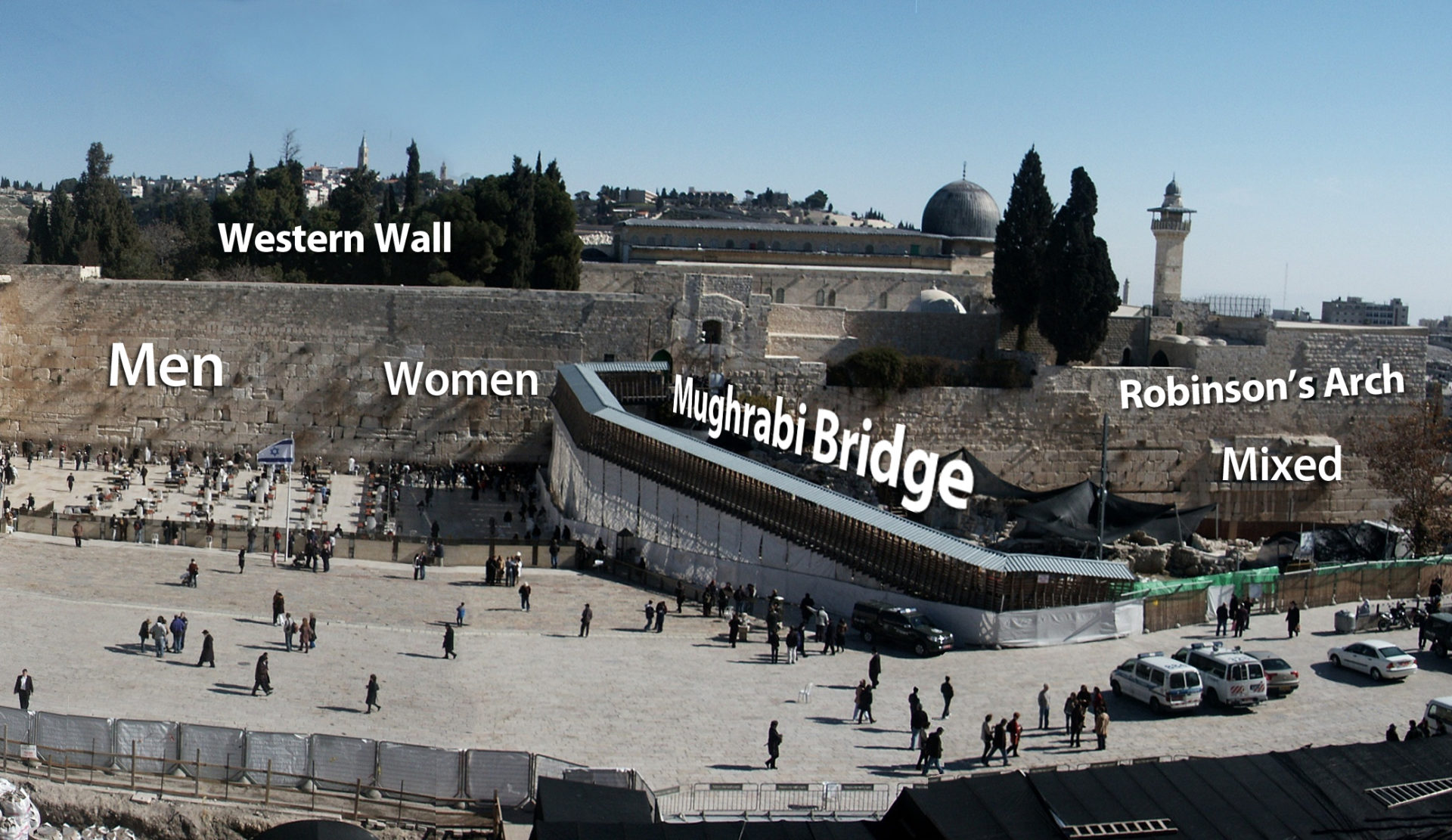
Image from tcjewfolk.com
A decision by the Israeli government not to approve the construction of an egalitarian prayer area at the Kotel, the Western Wall of the Temple Compound in Jerusalem and Judaism's holiest site, has opened wounds between the Israeli government and the American Jewish community.  It is ironic that, only weeks after celebrating the 50th anniversary of the return of the Kotel to Jewish hands, this iconic landmark and holy site is giving rise to huge divisions between different groups of Jews.  How differently the Kotel is being viewed now, as opposed to 50 years ago when Jews around the world were rejoicing in unison at the prospects of being able to visit and pray at this site.

Things have clearly changed over the past 50 years that we are fighting amongst ourselves over this matter.  Fifty years ago,  Jews would have been happy simply to be able to visit and pray at the Kotel. It would not have mattered if this would have been by a group of men or women on their own, or by mixed groups and families.  After so many years of having been denied the right to visit the site of the Temple, the details of how prayers would be offered there were unimportant.

Fast-forward fifty years, and the Kotel Plaza has been developed to allow and encourage Jews to visit the site for historical and religious reasons.  It was developed according to the tenets of Jewish religious law as befits a site of prayer.  This means that men and women have been provided with separate prayer areas.  This separation is not a new or alien concept amongst Orthodox and traditional Jews.  It is something that is expected at holy sites and areas of prayer.  And while Orthodox or traditional strands of Judaism are dominant in Israel amongst those who wish to identify with the Jewish religion, the same is not true outside of Israel.  There, the Reform and Conservative strands of Judaism are more popular.  These strands follow a somewhat less stringent interpretation of the Orthodox Jewish laws, either because followers have studied the laws and rejected some of the stringencies arising from Rabbinical interpretations and pronouncements over the years, or because it is simply easier to follow.  In a world where the rate of assimilation amongst Jewish communities around the world is running at alarmingly high levels, any form of identification with Judaism can be considered to be positive.  It is for this reason that the Reform and Conservative communities, particularly those in the USA, have gathered enormous power as they manage to stem some of the massive flows of Jews away from the faith.

The battle lines between Orthodox and Reform/Conservative Jews have long been drawn.  The Orthodox communities have done all that they can to reject the dilutions that are inherent with the Reform/Conservative view on the Jewish world.  They have worked to discredit and delegitimise them, even accusing them of not being Jews.  The Reform and Conservative communities, particularly those in the US that command power and have access to large sums of money, have used this to fight back against the Orthodox world view.  The battle over the Kotel is simply an extension of this power struggle between the different groups.  The Reform/Conservative strand believes that their followers (and other non-religious people) would prefer to visit and pray at the Kotel in an area that is mixed with men and women - an egalitarian area.  This would also allow families to enjoy this experience together.  The Orthodox are absolutely opposed to this, claiming that the Kotel is a religious place of prayer that requires separation of the sexes according to the traditional Jewish Law.

The State of Israel has set out not to distinguish between different groups of Jews.  In fact, the Law of Return that grants immediate Israeli citizenship to Jews, has chosen to use Hitler's definition of Jews rather than going by Jewish religious law.  Hitler decided that any person who had one Jewish grandparent would be eligible to be treated inhumanely by his regime, and to be part of his plan of extermination.  The Israeli government decided that if a person was good enough to be exterminated by Hitler, they would be good enough to be granted immediate Israeli citizenship.  This means that some of those who have been granted immediate citizenship under this law, are not Jewish according to Jewish Law.  This demonstrates the extent to which the State of Israel has opened its arms to many different groups of Jews - and even to some non-Jews.  Under the circumstances, it seems as though the government would be sympathetic to the claims of the non-Orthodox groups at the Kotel.

Even though the government would probably wish to be more accommodating to the demands of the non-Orthodox lobby, and even previously agreed to their demands for an egalitarian prayer area at the Kotel, politics always seems to come first.  The current government coalition can only exist with the support of the ultra-Orthodox parties in the Knesset.  Upon hearing of the government's plan to accommodate an egalitarian prayer area at the Kotel, the ultra-Orthodox parties flexed their muscles and threatened to bring the government down if the plan was implemented.  Prime Minister Netanyahu went into survival mode, even at the expense of his relationship with US Jews, and acquiesced to the demands of his coalition partners.  At least for now.  American Jews responded in disgust by withdrawing their support for the Israeli government.

Does the Reform/Conservative lobby have a valid case in declaring open warfare on the Israeli government as a result of this decision?  The Israeli government has said that an egalitarian prayer area does already exist, but it is just not in the premier Kotel Plaza area.  The non-Orthodox lobby claims that this is not good enough, and effectively treats some Jews as second-class.  Their demand is to have the egalitarian area front and centre alongside the other prayer areas in the Kotel Plaza.  The battle is one of power and of wills. This is a battle between different groups of Jews, each of whom demands that their way is accepted, and with the Israeli government being called upon to act as referee.

Is the Kotel a Jewish national asset that should be required to accommodate all groups of Jews in a way that is to their liking?  Or is it an asset that belongs to the religious, as the holiest religious site in Judaism?  Does creating an egalitarian prayer area alongside the other areas serve to dilute its importance and religious status?  Is this issue important enough to be worth creating a rift amongst different groups of Jews?

I don't have answers to any of these questions.  And even if I did, I feel sure that the warring parties would not consider my point of view in formulating their reactions to the situation.  Of course, the Israeli government will always act in way that promotes its own best interests.  At the moment, that requires it to take the side of the ultra-Orthodox parties and freeze the egalitarian prayer area.

In my opinion, the situation requires tolerance and understanding by all parties.  It is natural to expect that the holiest site in Judaism should have some of the most stringent rules attached to it, and that Orthodox Jewish law should apply.  We live at a time, however, when Jews around the world should find reasons to unite, and not reasons to be in conflict with each other, especially over a site as central as the Kotel.  The ultra-Orthodox parties are not generally known for making efforts to unify different strands of Judaism, but it is never too late.  They should know that no man is in a position to judge another one, nor judge his interpretation of the religion.  So they should be taking the moral high ground on this matter in an attempt to accommodate the requests of the non-Orthodox groups.  Surely accommodating an egalitarian space could be acceptable, as long as they continue to have their separated areas?  The situation now requires unity and not conflict.  It is incumbent upon the parties to sit down, and find a compromise that will be acceptable to all.  Is this too much to expect?

Sunday, 5 June 2016

Staying Unified

Picture from aicvideo
Today is the day in the Jewish calendar that Israelis (and others) celebrate the reunification of the holy city of Jerusalem 49 years ago.  Jerusalem Day is celebrated widely, and nowhere more enthusiastically than in the city itself.

Not only is Jerusalem one of the oldest cities in the world, it is undoubtedly the most controversial city in history.  According to Wikipedia, the city has been destroyed twice, besieged 23 times, attacked 52 times, and captured and recaptured 44 times.  And these numbers do not include internal strife, intifadas and terror attacks which persist in the city until today.  Although these events have taken place over approximately 5,000 years, it still seems a great deal for any city to endure, and there are many who wonder why it is that one city should be so sought after that people are prepared to go to such extraordinary lengths to secure control over the city.

For the Jewish people, the answer is quite clear.  The belief is that the creation of the world emanated from the Foundation Stone on Mount Moriah.  This is also the same place that Jacob was ordered to sacrifice Isaac (and then stopped from doing so), and also coincides with the location of of the famous dream of Jacob's ladder.  So it comes as no surprise that King David chose this place to erect his City of David in approximately 1,000 BCE, and that Solomon's Temple was built on Mount Moriah soon after this.  From the moment that Solomon's Temple stood at this site (and possibly even from long before), it took on the undisputed position as the holiest place on earth to all Jews.  The city of Jerusalem is mentioned by name more than 600 times in the Jewish biblical texts, and thousands more times by other names and references.  The centrality of this location and this city to Jews is without rival.  It is highly likely that this centrality is the reason why Jesus, a Jewish boy from Nazareth, found himself in Jerusalem where he was crucified.  This established Jerusalem as a holy city for his followers, later to be known as Christians.  The holiness of Jerusalem to the third monotheistic religion, Islam, stems from an event that took place more than 600 years later.  The Quran tells us that the Prophet Mohammad was taken by Buraq to visit the "furthest mosque" (believed to mean the Al Aqsa Mosque in Jerusalem), from where Mohammad was taken to heaven.  This reference is the sole claim that Muslims have to Jerusalem as a holy city (although still not quite as holy as Mecca and Medina), and Jerusalem is not mentioned by name once in the entire Quran.  The scene was set for conflict, disagreement, war, death and destruction surrounding the control of this city, holy to three religions.

Today we celebrate 49 years of freedom of the city of Jerusalem.  This freedom extends not only to Jews and Israelis who have administrative control over the city.  It extends to all from the three religions, and others, who come in peace to worship, learn the history and pay respects to the holy city.  But this was not always the case, and is never taken for granted in this conflict-filled city.  Even as recently as 50 years ago, Jews were prevented from entering the Old City of Jerusalem, and approaching the holy site of the Western Wall.  This fact alone is justification for Israel to continue to exert control over the city and its holy sites.

Over the past few years, Jerusalem has put on an annual festival of light as part of the Jerusalem Day festivities.  It is highly symbolic that the city, with such a dark history, has a festival of light to emphasize all that is positive about the city.  I had the good fortune to participate in the festival this year, and it is an experience that has left an impression that will remain with me for a long time to come.  Not only were each of the exhibits creative and interesting, the atmosphere that could be felt around all parts of the city was electrifying (no pun intended).  Thousands of people formed a human chain following the different coloured tracks around the streets of the Old City, and around the walls.  People were drawn to parts of the Old City that they had never visited, perhaps because they were afraid or perhaps just because they were off the beaten track and unfamiliar.  I could not help noticing that people came from all parts of the country, from all walks of life and from all ethnic backgrounds.  Muslims joined with Christians and Jews in celebrating the light of this intriguing city.  I silently wondered as I walked around the thronging alleyways whether the Muslims were not enjoying more freedom now since the Old City is in Jewish hands, than they did when it was ruled by Jordan.  It could only happen under Jewish leadership that the King of Jordan, the same Jordan that denied Jews the right to access its holiest site for 19 long years years, is now the head of the Waqf religious council that has jurisdiction over Muslim holy sites in the city of Jerusalem.

Despite the conflicts and violence that continue in Jerusalem at the current time, the city of Jerusalem has undergone probably one of its most dramatic reconstruction periods in its history over the past 49 years.  While the integrity and the character of the original city has been preserved, the construction of infrastructure and residential and commercial buildings has been astonishing.  The light rail trundles over ancient cobblestones, and modern buildings are built in the Jerusalem stone in keeping with the rest of the architecture of the city, blending in with the ancient walls of the Old City.

Jews have maintained a continuous presence in the Jewish Quarter of the Old City of Jerusalem since the 8th century BCE, with the exception of the period between 1948 and 1967 when Jordan brutally forced Jews out.  There were periods when being Jewish in the Jewish Quarter was not easy, but Jews were never willing to give up on this despite any hardship.  The same tenacious spirit is in evidence today.  Jews will not give up on the presence in the Jewish Quarter, and Jews will not give up on the united city of Jerusalem as the capital of Israel.

Each time I visit Jerusalem, I wonder what my grandparents and great-grandparents would feel if they saw the ease with which I am able to visit the holiest city in Judaism, and its holiest site, the Western Wall.  I wonder what they would think to see me driving freely around the streets, walking in the market and viewing the Knesset building.  We are indeed a privileged generation to have the immense good fortune to live at this time when we are able to do the things that our forefathers prayed fervently to have the right to do, and who died fighting to do.  When we say Lshana habaa B'Yerushalayim at the end of the Pesach seder, it is not a pipe dream.  It is something that is absolutely achievable.

If the history of Jerusalem is anything to go by, we will be forced to continue to fight to retain Jerusalem as our eternal capital.  It is a fight that most Israelis are prepared to undertake, and a fight that many have already died for.  But this makes us stronger rather than weaker, and our resolve to retain Jerusalem will never diminish.  For now, we bask in the glory of Jerusalem, and we rejoice in our ability to be free as Jews in our holy city.

Sunday, 12 May 2013

War Against Women of the Wall

The group known as "Women of the Wall" have elevated themselves onto the front pages of the Israeli press in recent times.  They have clashed with police in Jerusalem over their desire to have the right to pray at the Kotel, the Western Wall, in their own way and style.  For them, their way and style means wearing a talit (prayer shawls) and tefilin (phylacteries), and undertaking other prayer-related activities which are usually the preserve of males in Orthodox Judaism.  Their mission says, "........ our central mission is to achieve the social and legal recognition of our right, to wear prayer shawls, pray, and read from the Torah collectively and out loud at the Western Wall".  Why does this lead them to become criminals in the eyes of the Israeli justice system?

Some of these actions on the part of the Women of the Wall have attracted attention from Jerusalem police officers, and even led to some of the women being arrested.  The legal system has relied on the law in Israel that requires respect for "local custom" at the site, which in this case refers to the Kotel.  The police have been called to arrest Women of the Wall on the basis that their actions do not respect local custom.  Clearly, the "local custom" is determined by what the Orthodox establishment demand.  Such arrests have been made on more than one occasion.

While we understand that, in most Orthodox Jewish custom, women do not wear prayer shawls and do not read from the Torah in public, the question is whether there is any actual prohibition on women doing these things?  It seems as though the customs of women not undertaking these activities stems from the fact that, in Orthodox Jewish law, women are not obliged to fulfil them in the way that men are.  In the case of the talit and tefilin, these are precepts (mitzvot) that are time-bound.  This means that there are certain times that the mitzva should be undertaken, and other times when it should not.  As a general rule, such time-bound mitzvot are not required to be undertaken by women in terms of Talmudic law.  It is not exactly clear why this is this case, but there are views that it is because women have a higher spiritual wisdom (bina) than men, and this exempts them from time-bound mitzvot.  Others contend that it is a more pragmatic issue of women having so many other household chores to take care of, that they can be exempted from time-bound mitzvot.  Our Talmudic sages are divided as to whether women are prohibited from performing mitzvot from which they are exempt.  The Rambam, one of the most famous of the Talmudic sages seems to accept that there is no prohibition on women performing mitzvot that they are not obliged to perform, and chooses instead to discuss whether women should pronounce the blessing which states that they are obliged to perform the mitzva before actually performing it.  He is supported in this discourse by Rabbi Yosef Karo and others.  This seems to give sufficient doubt to indicate that women are not entirely without justification when choosing to perform such mitzvot, and there is a strong case which supports women being free to carry them out.

Jewish Agency Chairman Natan Sharansky was drafted in by the government to try to help the situation. The actions to prevent the Women of the Wall from expressing themselves during prayer have served to alienate many US Jews from Israel.  The US community, which is notoriously heterogeneous in its interpretation of Judaism and which values pluralism in Jewish thought and practice, has reacted extremely negatively to the standoff at the Kotel.  It was hoped that Sharansky will be able to use his balanced approach to suggest a compromise solution, and that he can use his links with the US Jewish community to heal the rift which has developed.  Sharansky recommended allowing the Women of the Wall to use a separate section of the wall, known as Robinson's Arch, to allow the Women of the Wall to express themselves and carry out their practices without others being offended.  While this was originally accepted as a possible compromise by the Women of the Wall, their position has hardened recently and they are now rejecting this solution.

The hardening of their position coincided with the ruling by an Israeli court a few weeks ago, which decided that these actions by the Women of the Wall do not actually constitute disrespect for local custom at the site.  This reinforces the lack of agreement by the Talmudic sages.  This court ruling means that their actions no longer constitute an offence for which women can be arrested.  The Women of the Wall were emboldened in their view that their actions are entirely acceptable, and decided that there is much less justification in accepting a compromise solution that means they are forced to pray hidden from general sight.

The influence of the ultra-Orthodox in Israel has been substantial over the past few years, particularly during the years that successive governments owed their continued existence to the support of the ultra-Orthodox parties in the Knesset.  The ultra-Orthodox influence has pervaded many aspects of Israeli society.  Numerous concessions have been granted to the ultra-Orthodox community to keep them supporting the government, the most famous of which is the exemption of young ultra-Orthodox boys and girls from serving in the IDF.  This has granted disproportionate power to ultra-Orthodox groups.  With the construction of Prime Minister Netanyahu's most recent government that excludes the ultra-Orthodox parties for the first time in many years, ultra-Orthodox power has been substantially reduced.  Many in Israel are happy about this, as the influence of the ultra-Orthodox has permeated the lives of so many individual Israelisl.  Perhaps the drama at the wall is an attempt for the ultra-Orthodox establishment to exert their power where they can.

Even though the ultra-Orthodox establishment has been given control over the Western Wall, and Chief Rabbi of the Wall Shmuel Rabinovitz has rabbinic jurisdiction over this site, it should be understood that the Western Wall is a public asset for Jews in Israel and around the world.  As such, decisions such as those affecting the Women of the Wall should not be taken lightly.  It is not as in an individual synagogue where congregants are free to move elsewhere in the event that they do not wish to accept the rules pertaining to the synagogue.  The Western Wall has no alternative in Judaism.  To the extent that there is even the slightest doubt about the interpretation of a particular element of Jewish law, as is the case here, the rabbi has a responsibility to consider the national and international ramifications of his decision.

I salute the Women of the Wall for standing by their convictions, and for being prepared to take on the ultra-Orthodox establishment.  This is not an easy decision, and life has been made extremely for them as a result.  Ultimately, I believe that they will prevail, and that they will be granted the right to pray as they wish.  In reality, anybody who does not like this is not obliged to be present at the Kotel when the women are there.  Until now, the Women of the Wall have conducted their prayers monthly on rosh chodesh at a time known in advance.  This allows plenty of alternative opportunities for those who wish to attend the wall, without being forced to endure anything that they do not wish to see.  This simply demands a little tolerance and understanding by all parties, something that is unfortunately in short supply in Israel, especially in the ultra-Orthodox establishment.

The time has come for the government to exercise its control over the Kotel, and ensure that all who wish to pray there are able to do so.  It is ironic that the IDF, without the support of the ultra-Orthodox youth, was responsible for liberating this holy site during the Six Day War, only for the site to then be turned over to the control of the ultra-Orthodox.  This is a national holy site, and all Jews should have the right to worship there.  Bravo Women of the Wall.