Former government minister Tzachi Hanegbi has been quoted as telling a
closed meeting of Likud activists that the next fifty days are the most
fateful in Israel’s history. Hanegbi is not a member of the government
or even of the Knesset, having recently been convicted of moral
turpitude in relation to previous ministerial posts held. He has also
flip-flopped between political parties when he decided to join Ariel
Sharon’s Kadima party, then return to the Likud. Hanegbi is, however,
known to be a close confidante of Prime Minister Netanyahu. Under the
circumstances, his statements are being closely analysed for hidden
significance.
The fact that his statements were clearly not intended for outside
consumption has added even greater weight to them. Now that the words
have been recorded and smuggled to the outside world, the press is
taking the opportunity to speculate as to precisely what they mean. In
his statement, Hanegbi compared the next fifty days to a dozen or so
days during the Yom Kippur War which he considers to be equally as
fateful, and upon which the balance of Israel’s fate hung. He referred
to the fact that allowing Iran to have nuclear weapons has a price tag.
Hanegbi made a request of the Likud faithful to support Prime Minister
Binyamin Netanyahu, and to “allow him quiet” and “strengthen his
legitimacy” so that he can take the necessary decisions calmly.
The seriousness of the situation with Iran has been evident and
obvious to many within Israel and outside for some time. It is the
first time, however, that somebody who is believed to be close to the
inner core of government has indicated a timetable of any type on this
matter. The reference to the next 50 days seems to tie in quite closely
with speculation that has been previously heard, suggesting that the
window of opportunity to carry out a strike against Iran is limited
until the US presidential elections are held in November. After the
election takes place, there are strong reasons why Israel will not be
able to expect support for an attack on Iran, irrespective of whether
Obama is reelected or Romney is successful. It is not clear when the
window of opportunity may reopen after the election, but it is assumed
that it will take a good few months. By then, the situation in Iran may
be beyond the point of no return.
For some time now, Prime Minister Netanyahu has expressed his
frustration over the lack of international support to deal with the Iran
nuclear program. Despite the fact that Iran has consistently failed to
provide adequate responses to the international community in relation
to its nuclear program, the world (led by President Barack Obama) seems
content to provide it with the time it needs, while ostensibly waiting
for the sanctions to take effect. This is valuable time that is being
wasted, and which Iran is taking maximum advantage of to get its nuclear
bomb beyond the point where action can still be taken to destroy it. I
hope that the world will not look back in the future, and regret not
having used these days more productively.
Many ask why it is that Israel does not act unilaterally against
Iran, in the same way as the action was taken against Syria and Iraq?
It is my guess that we can never fully understand the differences in the
circumstances that exist now with Iran, when compared to those that
existed in Iraq and Syria. For one, the Iranians are lying in wait
ready and have hundreds, if not thousands, of missiles waiting to be
fired towards Israel. That seems to be a very powerful reason to change
the tactics used. The prime minister has responsibility for the safety
of his citizens, both now and in the future. As opposed to the
situation that existed previously, the Iranian issue is far too public
and high-profile to allow the IDF to carry out stealth missions without
any consequences. The world’s media is lying in wait for the first
Israeli aircraft to take off from their hangars towards Iran. Any
attack of this type will probably be broadcast live on Al Jazeera and
CNN.
When Tzachi Hanegbi spoke about 50 fateful days, I think he referred
as much to the consequences of inaction, as to the consequences of any
action. If the prime minister has decided that it is too risky to send
the forces in unilaterally, the question is what has he decided to do
instead. Clearly, doing nothing is not an option. We are now relying
on the creativity of the Israeli mind to find ways to get the Iranian
nuclear bomb without the need to send in the troops. Let us hope that
this is already in train.
With the onset of the Jewish New Year, we sincerely hope and pray
that 5773 will bring a final answer to this issue. We hope that, by the
time we reach 5774, the issue of the Iranian nuclear bomb will be
behind us once and for all. We pray for the health and safety of all of
our brave soldiers who give their time, energy and their souls in
protecting Israel and the Jewish people. May we find that elusive
missing piece of the puzzle that will lead our country towards peaceful
coexistence, and prosperity for all her people.
Wishing you and your family, and all the people of Israel, a happy, healthy and prosperous new year.
Sunday, 16 September 2012
Friday, 7 September 2012
Four More Years?
As the conventions for the nomination of presidential candidates
swing into action, Israeli TV is bombarded with images of American
politics at its peak. It is understandable that Israelis are taking a
keen interest in the developments across the Atlantic. Not only are
Israelis generally very well tuned-in to world politics and current
affairs, the USA elections hold more than just a passing interest for
even the most disinterested Israeli.
The outcome of the American election, and the policies that will accompany the victorious administration, rank among the most important items of interest on the Israeli political calendar. It is only marginally less important to the Israeli electorate than the outcome of an Israeli domestic election. Despite the fact that the close ties between Israel and the USA are widely known and understood around the world, it is probably difficult for those not living in Israel to comprehend the full extent of this relationship. The outcome of the US election could substantially change the nature of the relationship.
The most obvious and public element of this relationship is in the military sphere. America provides substantial financial help to Israel’s military effort, much of it in the form of loan guarantees. This is money that is critical to allow Israel to continue to defend her borders. The money is spent on funding the activities of the army, as well as developing and acquiring arms, weapons and military equipment. Access to American military hardware is also of vital importance to Israel. Without this, there are some who believe that Israel’s very existence may be endangered. Public statements of support and operational support from the USA for Israel’s military activities are also an important part of the relationship. Although Israel has gone it alone without the USA in the past, and may do so in the future, it is always much easier when the USA is in agreement. This has never been more clearly in evidence than with the current deliberations over what to do with Iran’s nuclear program. There is a view that Israel may have acted against the Iranians some time ago if the USA was fully on board.
The US economy is intertwined with that of Israel in many different ways. Israeli companies are selling substantial volumes of goods and services into the US market. Many Israeli companies are listed on the America’s NASDAQ stock exchange. A great deal of American money is invested in Israeli start-up companies, and helps to keep Israeli charities and other institutions alive. There is no doubt that if America sneezes, Israel catches a cold.
The above are only a few examples out of many that demonstrate how closely the two countries are connected. And while these examples send a message that the USA is in the supporting role to help Israel, this is not always true. Having an ally like an Israel, which is the only true democracy in the Middle East, is of essential importance to America and its security needs. Israel’s technology and military developments as well as its security intelligence act as a source supplying valuable goods and information to the US security establishment. There can be no doubt that this is a two-way relationship, and that each country is dependent upon the other in different ways.
There were those who predicted from the outset of his presidency, that Barack Obama would not be a good friend to Israel. How can Israel trust an American president with “Hussein” in his name? Even his Democratic predecessor, Bill Clinton, found it sufficiently important to pay visits to Israel during his time in office, something that Obama has yet to do. He has preferred to manage things remotely and intermittently in an inconsistent and disinterested manner. He has been happy to allow rockets to keep falling from Gaza while encouraging Israel to take “confidence-building” unilateral steps to appease the Palestinians. He is happy to tolerate calls by Iranian leadership for the destruction of the State of Israel at every public opportunity, and to witness the construction of a deadly nuclear program before his very eyes. Most problematic of all are his public announcements that he would not support Israeli military action to counter this menacing situation. These are worrying signs and worrying times. It is not concerning because Israel is unable to act without America in support. It is worrying because inaction on the part of the free world further emboldens the tyrants, and sends a strong message to them about what can and will be tolerated.
It is unsurprising, therefore, that many Israelis are rooting for Romney. If the circumstances were different, they would like to support Obama. He embodies the story of many Jewish families, and of the State of Israel itself. He is proof that immigrant parents and an underprivileged upbringing need not impede the drive to reach the very top. Perhaps this is what drove so many US Jews and Israelis to support him at the last election. While this is a nice story, the issue of Israel’s survival remains uppermost and much more important. It is for this reason that Israel will be saying that four years has been more than enough.
Wednesday, 5 September 2012
South Africa Turning the Screws on Israel
South Africa's relationship with Israel has been a tenuous one to say the least, since the birth of the "new South Africa" and the ascent of the ANC to government in 1994. This is hardly surprising, when considering the relationship between Israel and the ANC prior to 1994. The military links beween Israel and the apartheid Nationalist government in South Africa did nothing to help the ANC feel positive towards Israel. In their years in exile during the apartheid years, the ANC found a great deal of common ground with Yasser Arafat's PLO. The two organisations cooperated and supported each other substantially during this period. These links have not been broken since the ANC has come to power and the Palestinian Authority has been established. All of this means that the relations between an ANC-led South African government and Israel will be cordial at best, and are unlikely ever to be warm or friendly.
The involvement of a number of South African Jews in the ANC's "struggle" never really helped to endear the organisation towards the Jewish community. The fact that many of these Jews were and are virulently anti-Israeli has helped to engender a general feeling of contempt by the ANC organisation towards Israel. The only saving grace in the ANC- Israel relationship has been the influence of Jews in big business in South Africa. The Jewish community in South Africa, including the big names in the economy, have generally been strong Zionists. The ANC has been smart enough to realise this, and has been forced to tread a careful path in displaying its contempt for Israel for fear of alienating these individuals and businesses, and the economic clout that they come with. As Black Empowerment has worked to reduce this influence in favour of the new class of blacks who are seizing control of the economy for themselves, so the ANC has been allowed the freedom to turn the screws more tightly on Israel in the knowledge that this will not necessarily have the same economic consequences as it may have had previously.
Even though the ANC government's formal policy towards Israel appears unchanged, its actions display clearly that its position is tightening. In the first instance, the SA government continues to support Iran at every opportunity. This is despite the fact that Iranian leader Ahmadinejad has called for the destruction of the State of Israel at every possible opportunity, and the development of Iran's nuclear capability is clearly aimed at creating a threat against Israel. While many countries have unfortunately chosen not to take a position against Iran, they are at least thoughtful enough not to support Iran. The fact that the South African government has come out in support of Iran places it in a different category as far as I am concerned. Former US President George Bush said "you are either with us, or you are against us". Where Iran is concerned, South Africa is clearly against Israel.
The unfortunate episode of the labelling of goods from West Bank settlements, and the fact that South African government has decided that these goods should be differently labelled certainly sets South Africa aside from the rest of the world. South Africa is the only country that has taken this outrageous step, and this is a sign of grave hostility. The areas of Judea and Samaria were captured in a war, in a similar way to many other areas around the world. The war was not one of aggression by Israel, but rather a defensive move to ensure that enemies of the type of Iran's Ahmadinejad did not succeed in their quest to wipe Israel off the map. All fair and square, and in accordance with international law. Is the South African government objecting to the fact that Israel has decided not to hand this area on a golden platter to those who would use it to attack Israel? Does the South African government believe that those who are living in the settlements and producing the goods that are separately labelled, are not Israelis? This is a step that is unprecedented, and entirely unwarranted. Other than taking a hostile stance against Israel, this action is unlikely to have any impact on Israel or its economy. The point seems to be a simple statement of hostility.
This action is supported by the ridiculous statement by a minister in the South African government, that South Africans should not visit Israel. Although the statement made by Deputy Foreign Minister Ebrahim Ebrahim seems to be directly at odds with the formal policy of the government, nobody has responded to slap him down. By implication, this suggests that the members of the government are not in disagreement with his statement. An attempt by Mr Ebrahim to promote his own anti-Semitic agenda has served to expose the entire South African government as sympathisers-in-kind.
While the Israeli government has made some strong statements in response to the anti-Israel vitriol coming out of South Africa, accusing the South African government of implementing a form of boycott against Israel, the Israeli government is unlikely to take stronger action against South Africa. This is because of the sizable Jewish community that remains firmly ensconced in South Africa. Whereas the Israeli government may, under different circumstances, have taken firmer diplomatic action in response to such provocation on the part of any government, the South African government will be allowed to escape with less than what it deserves. The Israeli government would prefer this scenario rather than putting the South African Jewish community at any risk. The truth is that the current situation serves to place the community under increased threat by virtue of the clear anti-Israel and anti-Semitic sentiments coming out of the national government. This should surely serve as a wake-up sign to the community that the situation is changing for the worse.
As the influence of the white and the Jewish community is weakened in the South African economy, the government will have view itself as having greater flexibility to operate against Jews and against Israel in the future. It is difficult for me to see that the influence of the evangelical Christians in South Africa, who are important supporters both of the ANC and of Israel, will sufficiently sway the government such that it will take a less negative view of Israel.
In reality, there was never an expectation that the ANC government would be great supporters of the Jewish community and of Israel. They were happy to act out the charade while it was in the best interests of the local economy. Now that the economic interests are not the same as they once were, the charade is likely to be abandoned with it. While I would be happy to proved wrong on this point, it seems to me that the situation can only get worse and not better.
Tuesday, 28 August 2012
Non-Aligned, But Extremely Maligned
Iran is playing host to the meeting of the Non-Aligned Movement (NAM) during the course of this week. The meeting sees 120 developing nations of the world attend, with special attendance by the UN Secretary-General, Ban Ki Moon. Although the original intention of the NAM was to provide a home for countries who were not formally aligned with or against any major power bloc, it has always represented something of a political hot potato. This is because its membership includes the so-called "axis of evil" countries, and many other pariah states of the world. The NAM has, perhaps unwittingly, acted as a club for countries that are persona non grata in the developed world. The best example is the the host of the 16th meeting of the NAM this week, Iran.
Since the NAM was established in 1961, a great deal has changed in the make-up of the world's power blocs. Despite this fact, it seems as though many of the original members of the NAM remain members to this day. The changes in the political power blocs have not succeeded in changing the countries that are aligned with them. The term "non-aligned", while accurately reflecting the fact that the member countries are not part of any major international power bloc, conceals the fact that many of the member states are aligned with each other in different ways. It seems as though being non-aligned is not sufficiently compelling to link the NAM countries. Even these countries need a common cause to create a more substantial link between themselves. Iran has succeeded in creating a common issue for the NAM countries to rally around, and this is the issue of hating Israel and bringing into question her right to continue to exist.
Iran's policy of publicly humiliating and deligitimising Israel is already not a new phenomenon. Iranian President Ahmadinejad has been allowed to get away with behaving like a thug on this issue for many years. He has stood at international gatherings at every opportunity, and ranted against Israel's right to existence amongst the family of nations. The international community has silently sat back and watched the spectacle without taking action. This has even been the case when Ahmadinejad has had the audacity to stand up at the United Nations General Assembly, the place that is supposed to protect the rights of nations to exist in peace and harmony, and spew vitriol about the destruction of Israel. Once again, the UN stands accused of failing to protect the basic rights of member nations by allowing UN Secretary-General Ban Kim Moon to travel to Tehran to attend the NAM. In so doing, he has legimitised the attendance of all the other countries at the meeting, all of whom will be subject to tirades promoting the destruction of the State of Israel in the usual Iranian way.
Surely, this enough to convince the world of Iran's ban intentions regarding its nuclear program? The evidence that Iran intends to construct a nuclear weapon is irrefutable. The subject of Iran's wrath and aggression is equally irrefutable. The fact that the world allows Iran to threaten Israel in every public forum in the most unashamed manner, is now supported by the world's unwillingness to take tougher action against the nuclear program. Instead, the world has decided to hide behind the sanctions to defer action on this matter. It has been clear for some time that the sanctions will neither prevent the countries of the world from buying oil from Iran, nor prevent Iran from continuing to build a nuclear bomb. Once again, it seems as though it will be left to Israel to take on the world's responsibility in acting against a tyrant. It is true that Israel is at the front of the line of countries at risk by Iran's aggression, but it is also true that Israel is not the only country at risk. It is clear that any action by Iran to construct a nuclear weapon will place all of the western world, and beyond, in the firing line. Perhaps the threat to these countries is not sufficiently pressing now to force them into action. As has been the case a few times in the past, it will be Israeli soldiers whose lives will be risked to clean up the mess that others are not prepared to take care of.
Israel has acted in the past without the blessing of its allies to take care of problems. Twice before, Israeli aircraft have destroyed nuclear reactors under construction. It was notable that the US government opposed Israeli action against both the Iraqi reactor and the Syrian one under construction. We now know that Israeli action saved some extremely nasty situations from arising, and history books could have looked extremely different had the timely and brave action not been taken in the nick of time. Fortunately, all Israeli soldiers and equipment was returned to base safely on both previous occasions. Where Iran is concerned, the operation looks to be infinitely more complicated and risky. This is partially because the world has failed to take timely action to destroy the threat at a much earlier stage. Any operation that Israel will mount against Iran is likely to be extremely risky, and will almost certainly result in Israeli loss of life.
In the interests of international diplomacy and world peace, the UN Secretary-General will appear alongside the world's thugs including Ahmadinejad, Zimbabwe's President Mugabe and others. Instead of protecting the interests and the freedom of the democratic world, he has chosen to legitimise the unacceptable behaviour of those countries who present the greatest threat to world peace.
The NAM conference has given Ahmadinejad the perfect opportunity to stand up in front of the non-aligned, and malign them against Israel and the west. In a few weeks' time, we will expect to see another of his tirades at the UN General Assembly in New York. All of the actions that turn a blind eye to Ahmadinejad's bad behaviour, simply empower him even further. He understands that the world does not set any limits in terms of acceptable behaviour, and will exploit this to the maximum extent possible. As before, it will be left to Israel to draw the line and to take the required action. It is my hope and prayer that our soldiers and our civilians will not be endangered in the process.
Thursday, 23 August 2012
A Damaging Debate
The debate about whether Israel should or should not attack Iran's nuclear facilities has broken out into the public arena in the strangest possible way. Over last weekend, the press reported a disagreement between the prime minister and the president over whether attacking Iran at this time is the correct course of action.
Indications are that Prime Minister Netanyahu is one of two lone voices calling for Israel to take military action to stop Iran building a nuclear bomb. Ironically, his only supporter is Defense Minister Ehud Barak. This is ironic due to the completely opposite ends of the political spectrum that these two politicians come from. At the moment, however, they are bedfellows in calling for the IDF to act in the near future to strike at Iran's nuclear facilities. President Shimon Peres is advocating a completely different approach. He would prefer to allow America to take the lead, and is currently trusting President Barack Obama's approach in waiting to see whether the sanctions will bring the desired result. Ultimately, Peres is opposed to Israel acting unilaterally against Iran. Peres, always a dove in his approach over many years, was also opposed to the strike that Israel carried out on the Iraqi nuclear reactor in1981. We know how crucial that operation ultimately proved to be.
Peres is not alone in Israel in his opposition to an attack on Iran. From recent press reports, it is understood that the military leadership in the IDF is also opposed to such an attack. This does not mean that they are not prepared to carry out such an attack, or that they would not do so if the government decided that this is the correct approach. It is just that military leaders, in their individual and professional capacities, believe that this would not be the best approach. In addition to this, it is reported from surveys undertaken, that most Israelis also do not support military action. The Israeli public seems concerned about the safety of the home front in the event of an attack on Iran. It is well understood that Iran will almost certainly take retaliatory action in the event that there are strikes on her nuclear facilities. This puts the Israeli public at risk, as Iran's Shihab missiles are armed and ready to fire towards Israeli territory. Clearly, this nervousness is influencing the view of the general public such that they are opposed to attacking Iran, even if this is by a slim majority. Some Israelis feel so strongly that we should not be attacking Iran, that an online petition has been launched imploring Israeli air force pilots to reject orders to strike Iran if called upon to do so. While the prospect of Israel's pilots not carrying out orders is something we could not contemplate, I guess that it does show the strength of the feelings.
The fact that this entire debate is being conducted via the press and in the public, is not positive. While democratic principles are important in our society, and especially maintaining the right to freedom of speech, I believe that certain discussions are much better held out of the public domain. This particularly refers to matters of national security, which this clearly is. It may be true that President Peres should not be interfering in government business, and that he has previously made incorrect calls on whether the IDF should attack targets or not. I feel, however, that these points should be made directly to him rather via articles in the weekend newspapers. My choosing to use the media to canvass internal support for their respective positions, the prime minister and the president may have forgotten that our enemies (including Iran) have intelligence officers who are scrutinising every article that is published. What sort of message are we sending to them? I believe that sending a message which shows a lack of unity in our government potentially weakens our situation in the eyes of the Iranians. If we cannot even agree on the fundamental issue of whether we should be taking military action to protect Israeli sovereignty for ourselves and future generations, how are we expected to agree on more substantial matters? Iran has reacted as we would expect, by making fun of our internal squabble, and by continuing at full steam to develop a nuclear weapon.
It is a good thing that we have an environment which supports internal debates and disagreements, and that we have the freedom to be able to express ourselves openly in the national media. Better decisions are often made when there is a minority that disagrees, and that is strong enough to bring the majority to consider their view before the final decision is made. Where issues relating to how we deal with Iran are concerned, the debate should be held in the well-secured hallowed halls of government and the IDF, and not in the press. Although we are very used to playing out party political agreements in the media, there are times when this approach is not appropriate. This is clearly one of those times, and the national security of the country must surely take preference over all other matters.
Sunday, 12 August 2012
The Second Time Around Simply Doubles the Pride
It seems like only yesterday that we were on our way to the IDF recruitment base to deliver our elder son to begin his military service. Ten months have since passed, and he has thankfully found his path in the military jungle. He continues to seek out ways to make his service as meaningful and effective as possible, in order to allow the State of Israel to get the best out of him that he can offer. I now find myself back in a similar situation, and on my way to deliver my younger son for the start of his military service.
The fact that I now have a slightly better understanding of the military, does not make the second time around any easier. I feel the same fears, concerns and trepidations now that I felt on the first occasion. I am still worried for his well-being, and concerned that he will find his way to ensure that he can make his contribution to his country and to his people in the best possible way. The thing that has changed on this second occasion, is the level of pride that I feel. This has now been doubled.
I feel immense pride in my sons for the way in which they have approached their military obligation. They have understood the importance of every Israeli boy and girl being recruited to defend their country and their people. Together with their friends, these young men have decided that they will fulfil the obligation to serve their country, and have decided to do it willingly and to the best of their ability. Thousands of young men and women will be joining the military over the course of the next few weeks, and will give their time and energy to ensure the well-being of the State of Israel. All of these young people have witnessed the threats that the State of Israel has been forced to live under in recent times, and understand the importance of having a strong army to counter these threats. Many of them have visited concentration camps such as Auschwitz, that bear testament to the consequences of not having a strong Jewish army to defend our people. They have resolved not to allow these events to repeat themselves while we have the ability to defend ourselves with a strong army.
Israelis and Jews around the world are indeed fortunate to have a young generation of the type that Israel has. These young people are not only seeking ways to fulfil their obligation in a minimalist way. They are happy to volunteer to be members of elite units, and to take on the toughest and most dangerous of jobs in maintaining freedom for Israelis and Jews. These jobs require training that is extremely demanding, and frequently put our young men and women in harm's way. This does not deter them from agreeing to these conditions, and even frequently signing up to serve for more time than the law requires if this is what it takes.
For you, my son, today is a day that will change your life. The time that lies ahead of you will ask the most difficult questions of your physical and mental strength. I know that you are up to the task, and I have every confidence in you. I know that you and your friends will do a great job in defending our land and our people. You understand the consequences are of not having our own army, and you will keep this in the back of your mind when you are having hard days. All I can offer is to be there for you in every way I can. I will be available to you at all times of the day and night, and I will be ready to do anything and everything in order to give you the support that you need. We will eagerly await every moment that you will be allowed to spend time with us at home.
I wish you a successful period of service that will contribute to your personal growth, and that will give you a sense that you have made your contribution to your country and your people. May Hashem protect you in all that you do, wherever you are. You are true heroes for Israelis and for Jews around the world.
Even though the level of my anxiety is doubled today with the start of your service, my pride is equally doubled. Go well, and return home safely.
Tuesday, 7 August 2012
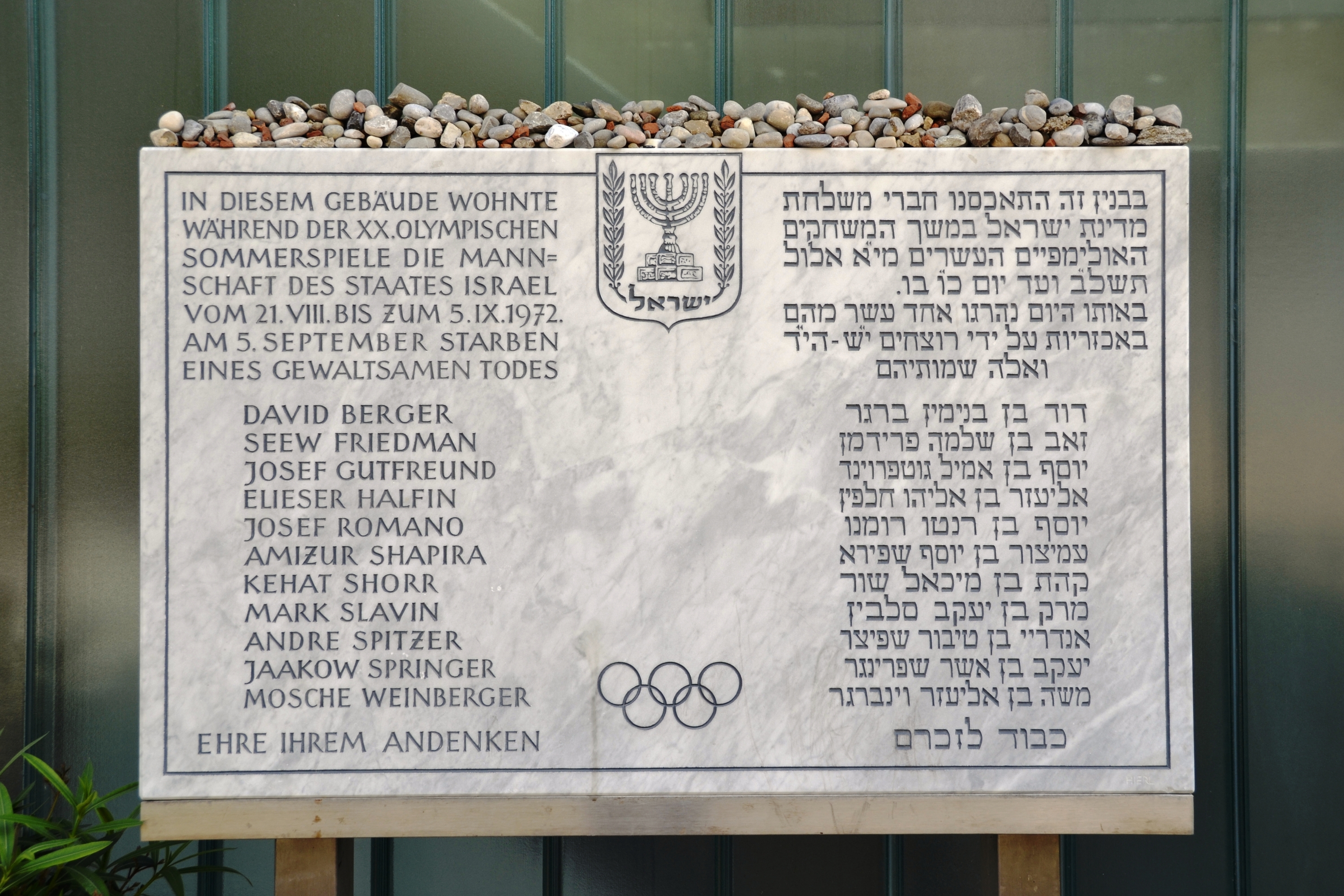
Remembering the Munich 11
The start of the 2012 London Olympic Games has arrived with great excitement and expectation for thousands of athletes and coaches, and for millions of viewers around the world. For some, however, the Olympic Games represents negative feelings and bad memories. Chief amongst those are the families of the 11 Israelis who were killed 40 years ago at the Munich. For these people, the Olympic Games will always represent a reminder of the cruel way in which innocent lives were cut short in their prime.
With the passing of 40 years since those tragic events, has come a concerted effort by the bereaved families of the athletes and coaching staff to hold a formal commemoration at the London Olympic Games in memory of the victims. These efforts have been formally supported by millions around the world, including a number of national governments. Special resolutions and requests to hold a minute's silence at the London opening ceremony were adopted by governments in Australia, Canada and the USA amongst others. It is astonishing that the International Olympic Committee (IOC) and the London Organising Committee of the Olympic Games have opposed these efforts, and decided against holding a minute's silence in memory of the murdered athletes and coaches as well as the German police officer who was also killed by the terrorists.
This decision is almost tantamount to the IOC denying the link between the cruel loss of life, and the Olympic movement. There can be no denying that the athletes and coaches were in Munich, in the Olympic village, only for the purpose of competing in the games. They were kidnapped and killed on the watch of the IOC and the organising committee of the Munich Games. Nothing would be more appropriate, than for a minute's silence to be held at the biggest event of the games, which is undoubtedly the opening ceremony. This would allow the IOC to acknowledge the tragedy that was allowed to take place when the IOC was on duty, and also to memorialise the names of the innocent victims in the tragedy. The act of opposing a formal memorial at the opening ceremony is a way of denying responsibility for the event, and also serves to reduce the significance of this tragedy.
In response to the decision by the London organisers not to hold a formal memorial ceremony, chairman of the Palestinian Olympic Committee Jibril Rajoub has written to the IOC President to thank him. He wrote, "Sport is a bridge for love, unification and for spreading peace among the nations. It must not be a cause for divisiveness and for the spreading of racism'". Perhaps Mr Rajoub conveniently forgot that it was terrorists linked to his own organisation who carried out the heinous crime, murdering 11 innocent sportsmen and a police officer in cold blood. It is clear that Mr Rajoub didn't wish to miss an opportunity to make a fool of himself in writing such a ridiculous letter. It is fair to say, however, that the IOC invited such a response by behaving in a way that can be interpreted as denying the importance of such a commemoration.
Various commemorations which have been held on the fringe of the games, one at the Olympic village and one hosted by the Israeli ambassador to the UK, do not go far enough to formally respect the memories of innocent people who should have been protected by the IOC and games organisers. They were let down by these people who allowed them to be kidnapped from the campus of the games. The only crime that they committed which resulted in them being given the death sentence, was that they were Jews and Israelis. Surely, the least that the IOC can do is to allow their memories to be formally commemorated?
The English Football Association has provided a great example for the IOC in the way that the Hillsborough disaster, and the 96 Liverpool fans killed in 1989, continue to be commemorated. A minute's silence is held at every football ground across the country on the date that is the anniversary of this tragedy. This includes grounds which have nothing to do with either of the teams in the game on the day, or the ground where the game was held. It is a true mark of respect when even those unrelated to the event are able to stand silent for a minute in memory of the victims. It remains unclear to me why this was not possible at the opening ceremony.
While the memories of those who were killed will never be forgotten by their families and the people of Israel, the time has come for the IOC to memorialise the names as well. A minute's silence at the opening ceremony is the respectable and respectful way to do this.
Until such time as the victims get the public recognition that they deserve, we can each play our part in ensuring that their memories are not forgotten. The Chief Rabbi of the United Hebrew Congregations of the Commonwealth has written a prayer to commemorate the victims. This can be found using the following link. Please do read it, and encourage those around you to do the same.
May the memories of the 11 be for a blessing for their families, and for all Israeli sportsmen and women.
Subscribe to:
Posts (Atom)