Monday, 1 May 2017

Damned If You Do, and Damned If You Don't

Much has been written and discussed about Marwan Barghouti's article in The New York Times, trying to explain why prisoners in Israeli jails have embarked on a hunger strike.  Most of the comments have surrounded the factual inaccuracies in Barghouti's statements and accusations against Israel.  Or they have questioned why The New York Times had the audacity to allow such subversive trash to be published at all.  My question is a different one.  I ask whether it is right that Israel should allow its prisoners (whether they are criminal or political prisoners) the freedom that it does, and that allows people like Barghouti to make such ludicrous claims in public?

It is somewhat ironic that Barghouti accuses Israel of operating an "inhumane system" in its attempt "to break the spirit of prisoners" and of "grave breaches of the Geneva Conventions against the Palestinian people", while still having the freedom to publish these accusations in The New York Times.  Surely this is a contradiction in terms?  If Israel was so intent on breaching the Geneva Convention, it would surely do more to ensure that prisoners do not have access to publish their articles in international publications.  Or at least opppose violations more vehemently than it has.  It is common knowledge that prisoners in many systems, even in countries that pride themselves on their democracy, are not allowed access to go unpunished when they publish their complaints and accusations in public.  And yet, Israel has hardly responded to Barghouti's article to punish him.

In many countries around the world, even in democratic countries, prisoners have significant restrictions placed on them.  This is even more true of those convicted of terror-related crimes, or who are considered the most dangerous after committing very extreme crimes.  In some cases, these restrictions can result in the opposite outcome of the one that the authorities hope to achieve.  In the case of Nelson Mandela who spent 27 years as a political prisoner in South Africa, his popularity grew substantially while he was in prison and isolated from the outside world.  He had no access to the media, and his likeness was not allowed to be published at all by the press.  Despite this, the campaign for his release only grew more over time.  The same was true of Prisoner of Zion Natan Sharansky when he was imprisoned in the Soviet Union.  Despite these examples, the act of isolating prisoners seems, in the most part, to keep them out of the public view.  This raises the question as to whether a stronger reaction to Marghouti would not be in Israel's best interests?

In spite of accusations of Israel acting in a racist way towards Arabs, and even being called an "Apartheid country", Israel values its democracy and freedom of speech almost above everything else.  And while security considerations are always of paramount importance in every situation, the notion of preserving democracy and freedom has a very high priority.  The Jewish people have suffered so much discriminatory behaviour over the generations that it would be anathema to have a Jewish country that does not embody democracy and freedom in every respect.  Even if it means being tolerant of those who seek Israel's destruction.

It seems as though the furore over the article has died down, and the hunger strike in the prisons has been abandoned by large numbers of prisoners.  It is ironic that some of the most important facts about the treatment of prisoners in Israeli jails seem to have been kept low-key in the whole uproar.  The system of housing prisoners in jails is well demonstrated in the list of the improvements that the prisoners are striking for.  These include;
- increasing family visits from the current 45 minutes a time, to 90 minutes a time
- increasing the frequency of family visits from once a month to twice a month
- allowing the prisoners an increased selection of TV channels in the prisons
- allowing the prisoners greater education facilities.
Comparing this to the way in which Israeli prisoners have been held by Arab states over the years seems a joke.  And yet, The New York Times sees it fit to cover this matter.  This hardly points to the systematic violations of the Geneva Convention that Barghouti accuses of.

With the story having almost burnt itself out, perhaps it was the right decision by the Israeli government not to respond more actively to the article that was published.  In Israel's case, the criticism seems to come whether she has done something, and equally when she has not.  Ultimately, we need to feel good with ourselves that we are doing what allows us to feel good when we look at ourselves in the mirror.  I believe that this is what has been achieved in this case.

Saturday, 15 April 2017

Action At Last

The decision by US President Donald Trump to launch an attack in Syria following the recent chemical weapons attack has been widely welcomed by Israelis.  It is also a welcome change from the policy that was pursued by the US during the presidency of Barack Obama.  Finally, the free world has a leader who is prepared to take action rather than utter words.

Last Friday, President Trump really showed what he is made of.  Following the horrendous chemical weapons attack that was carried out earlier last week by the forces of Syrian President Bashar al-Assad against his own people, Trump took a few days to consider the situation and gather the required evidence before striking in retaliation.  The retaliation was not against a violation of any US interest in particular.  The retaliation was rather against the violation of innocent women and children, and against the unacceptable use of chemical weapons.

Over the past few years, the world became used to the Obama style of doing things.  Obama threatened, but never made good on his threats.  So, it comes as no surprise that Assad gambled on the US not responding to this chemical attack.  After all, previous chemical attacks went unanswered.  In fact, it was the deal that was struck during Obama's presidency in 2013, that enabled this chemical attack.  When Obama discovered the extent of the stockpile of Syria's chemical weapons, he decided to cut Assad some slack and allow him a way to diplomatically and elegantly dispose of them.  The deal struck with Syria by negotiation between the USA and Russia involved the dismantling of no fewer than 12 chemical weapons productions facilities, numerous storage locations, a research and development facility and the destruction of thousands of tons of chemical agents.

But, under the noses of the international supervisors, and with the tacit knowledge of Obama and other members of the international community, Assad succeeded in retaining some of these chemical weapons for himself.  It was one of the worst-kept secrets in the Middle East.  The Israeli intelligence community believed that the Assad government retained a "residual" chemical stockpile of somewhere between several hundred kilograms to several tons of chemical weapons, about 1% of its original stockpile.  Obama's reaction was fairly predictable.  He turned a blind eye.  Last week's Sarin attack by Assad is the public evidence of Obama's failed policy.

In taking action in the way that he did, Trump sent out a number of very important messages.  The first was a very clear message to Assad and his army.  This US president will not tolerate bully-boy tactics being employed against innocent women and children, even if he is still in the honeymoon period of his presidency.  And he will not tolerate the use of illegal chemical weapons, even if his predecessor was prepared to turn a blind eye to this.

The second message was sent to Russian President Vladimir Putin.  He has been Assad's patron for a number of years.  Initially, this support was in the form of supplying weapons and vetoing resolutions against Assad at the UN Security Council.  While this support has continued, it has also escalated to include Russian boots on the ground in Syria and Russian warplanes in Syrian air space.  Even though Trump was determined to forge a closer link with Putin when he first entered office, the message to Putin is that everything has changed.  Even Russian support, and the possibility of damaging US relations with Russia will not prevent Trump from taking action against Assad.

The third message was sent to other rogue nations of the world, including Iran and North Korea.  In a similar way to how the deal with Syria was struck, Obama also struck a deal with Iran.  This deal involved nuclear weapons rather than Syria's chemical weapons.  The stakes were much higher, but the lack of backbone on Obama's part was exactly the same.  He decided to strike the deal with Iran despite the obvious signs that Iran was pulling the wool over the eyes of the countries signing the deal.  Despite Obama's attempts to placate Israel and other detractors of the agreement, its blaring shortcomings were obvious to anybody with a mediocre understanding of the situation.  Trump, however, sends a completely different message.  He has started his time in office by questioning the logic of the deal with Iran.  And the attack against the Syrian forces sends an even stronger message that Trump will not tolerate any deception or aggression on the part of Iran, and also North Korea.

For the Israeli government, the intervention is welcome.  Israel is typically a country for whom actions speak louder than words, even if the actions are frequently very quietly done.  It is inconceivable that the Jewish state could idly watch from the sidelines when chemicals are being used to kill innocent women and children.  The memory of the world standing idly by and watching during the Holocaust is still too fresh in our minds.  It is a great dilemma about how to respond to a situation like the chemical attack in Syria.  On the one hand, Israel would wish to respond with force to the use of chemical weapons.  Doing so would, however, seemingly play into Syria's hands, and immediately embroil Israel in the war in Syria.  Given the history of the two countries and the way in which friendships line up, this could potentially involve Iran, Syria and the USA very quickly indeed.  This would escalate to a regional conflict, and perhaps even result in a conflict that goes beyond the regional borders.

Trump's strong message shows decisive leadership, and finally a willingness to confront rogue states head-on.  This is welcome.  While debates and condemnations at the UN and other forums may have their place, action on the ground sends a much stronger and more serious message.   And his action also saved Israel from, once again, having to respond in a way that will not result in a war involving multiple countries.

We watch with bated breath to see how things develop with Iran.

Wednesday, 15 March 2017

Israel Apartheid Week - A Contradiction in Terms

Source; Haaretz
Every year, many universities around the world hold an event on their campuses know as "Israel Apartheid Week".  The event is justified by the fact that it brings the so-called discriminatory behaviour of Israel to the attention of the general public to allow people to know "what is really happening in Israel and the Palestinian Territories".  There could be no greater contradiction in terms than this.

I am trying to work out why the focus is on Israel's reportedly discriminatory behaviour in particular?  Why Israel, as opposed to discrimination by the Turks against the Kurds, or discrimination by the Chinese against the Nepalese, or by the Russians against the Ukrainians in Crimea and other former Soviet countries, or the discrimination in many African countries, or discrimination by many Muslim countries against their minorities and foreign workers, and even their own citizens?  There are surely so many countries on the list of those behaving badly, that universities could mark some country's discriminatory behaviour every week of the year.  While one form of discrimination does not justify another, the question is why Israel is singled out for an apartheid week of its own?  Surely this is discriminatory in itself?  It brings into question the real motivations of those who are the main instigators behind this highly questionable event, and how come it has gained so much traction around the world that it is repeated on an annual basis?

The first question that arises, is whether Israel really behaves in the discriminatory manner that is alleged by so many in the international community?  Given the level of threat and violence that is a constant in and around Israel, it is easy to conclude that Israel discriminates against Arabs.  News broadcasts frequently show IDF soldiers in action against those who are presented as innocent civilians.  Israeli is constantly engaged in one military operation or another.  This supports the easy conclusion about Israel being discriminatory against Arabs.  This conclusion, however, would be misguided.  Instead, it would be more accurate to say that Israel discriminates against the threat of terror and violence that she has to deal with.  And judging Israel's actions using a standard for a western country, that is not subject to the same risks and terror attacks, is not an even playing field.  It would be interesting to see how other peace-seeking countries would respond to the set of circumstances that Israel finds herself in.  I suspect that Israel's so-called "discrimination" would be seen in an entirely different light.  Using the term "apartheid" to describe Israel is simply an emotive term trying to play on the ultimate success of the anti-Apartheid movement in South Africa.  There is no link between what is happening in Israel today, and Apartheid South Africa.

Many people try to put constant attacks on Israel in the international community simply down to Israel-hating and Jew-hating.  It is easy to say that these are anti-Semitic activities dressed up with a political justification, and leave it at that.  And, even though much of that is probably true, I don't feel satisfied with leaving the explanation there.  It is important for me to put this into greater context.  I wish to understand where this comes from, and why it is rearing its head at this time and in this way.

The anti-Israel activities that have become common around the world, and which are epitomised in Israel Apartheid Week, bear resemblance to the wave of anti-Semitism that was in evidence in the years leading up to the Second World War.  We know that anti-Semitism is an age-old phenomenon that has no real explanation or justification.  We know that it has been allowed to rise and fall, largely by the general tolerance and acceptance of the general community.  It increased in its intensity when leaders in the international community have encouraged it, or tolerated it.  Hitler's Germany is the best example when the state encouraged anti-Semitism on an industrial scale at the highest levels.  The man in the street needed little further encouragement, and the results are one of the most shameful periods in history.  It is my contention that the constant criticism of Israel at the highest echelons of the international community, is effectively encouraging the man in the street to believe that his hatred towards Israel and Jews is justified and consistent with public opinion.  It is inconceivable that Israel justifies being the one country in the world with more negative resolutions against her at the UN Security Council, or having a permanent agenda item to answer to at the UN Human Rights Council.  These unjustified actions are encouraging anti-Semitism on the streets of Europe, the USA and around the world.

We have just celebrated the Jewish festival of Purim, that marks victory over unjustified anti-Semitism in Persia more than 2,000 years ago.  It seems that little has changed since then.  Not in the modern-day Persian country of Iran, and not elsewhere around the world.  People are taking their cue from international leaders who find it acceptable to spew venom against Israel at every chance.  And to turn international institutions, particularly those connected to the UN, into tools of anti-Semitism and anti-Israel sentiment.  This provides the green light for people around the world to feel that it is politically correct and acceptable to focus their hatred towards Israel.  This is clearly a form of anti-Semitism, in the same way as much of the anti-Israel activity is simply anti-Semitism dressed up to look politically acceptable.

Surely the time has come for international leaders to show true leadership and stop the discrimination once and for all.

Wednesday, 1 February 2017

Making Use of the Trump Card

Donald Trump has finally taken office as the 45th president of the United States and, along with it, many expectations from different quarters regarding the numerous outspoken promises made during his campaign for election.  One of the more controversial campaign promises made, was to move the US embassy in Israel from Tel Aviv to Jerusalem.  This point has been the subject of much focus, and some question marks over whether Trump will ultimately see this promise through.

Since first hearing of this promise by Trump, I have tried to work out what would have driven him to decide to make this undertaking.  It seems fairly clear to me that Trump decided to make this promise of his own volition, and not as a result of a particular request by any party.  So, what would have given Trump the reason to decide to make this matter a central part of his foreign policy in relation to the Middle East?  Did he think that this would be a statement against the Arab world?  Or a statement in support of Israel?  I feel quite sure that the Israeli government would not have requested such an action of Trump.  So Trump's motives seem strange in light of these facts.

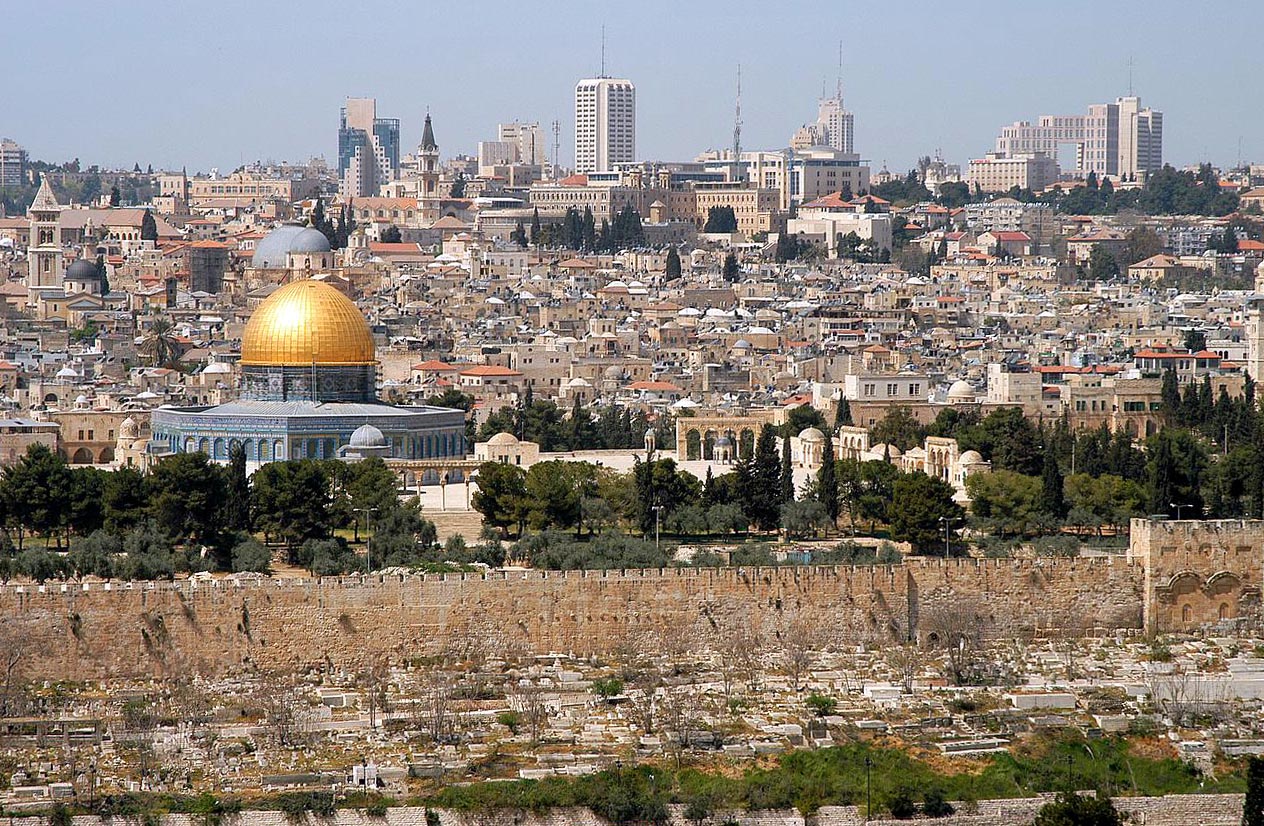
The location of international embassies in Tel Aviv instead of Jerusalem goes back to the time of the creation of the State of Israel in 1948.  It is accepted and usual for countries to locate their  embassy in the capital city of the host country.  In Israel's case, foreign governments decided not to locate their embassies in Israel's chosen capital, Jerusalem, in order not to contravene the spirit of UN General Assembly Resolution 181 on the partition of Palestine that was passed in November 1947.  This resolution called for the city of Jerusalem to be a "corpus separatum", a separate body from the Jewish and Arab states that the resolution also called for the establishment of.  History shows that the Jews accepted the resolution and went on to build the Jewish state as envisaged by the resolution, while the Arabs did not.  Instead, they attacked the Jewish state in attempt to take it for themselves to control the entire area, a battle that rages until this day.  In spite of all of this, the international community has been insistent to maintain the independent status of Jerusalem, and not show favour towards one part nor the other in their claims over the holy city.  It is for this reason that Jerusalem has not be recognised as the capital city of Israel, for fear of stepping on Arab toes.  This is the situation that has persisted until the current day.

Israel would clearly wish for the embassies to be moved to Jerusalem, and for the international community to recognise the holy city as the capital of the Jewish state.  So Trump's initiative is not entirely unwelcome.  The real question is whether this is what Israel would wish to see Trump using his energy to do as a first gesture of his support for the Jewish state?  I believe that there are currently larger and probably more important fish to fry, and that Trump's assistance could give would be more helpful in other areas.  Examples of this include the issue of Iran, that remains a major thorn in Israel's side.  It is not so much the direct threat that Iran presents to Israel, even though this is a huge issue, it is more about the massive funding that is being channelled by Iran to other terror groups.  All of which are trying to destroy Israel in any way possible.  The deal that was struck between Iran and the P5+1 countries has delivered economic benefits to Iran which have served to increase the flow of funds to these terror groups.  It would be very desirable for Trump to somehow help to turn this clock back.   Trump could also help to redress the imbalance that has existed in the international community against Israel for too long now.  There is no doubt that Trump can also help to isolate terror groups that have been operating against Israel and against Jews.  It is my view that some of these issues are more pressing than moving the embassy to Jerusalem.

Trump's assistance to Israel, even if it is genuine and well-meant, will have its limits.  He has many pressing US domestic issues to deal with, along with foreign policy issues affecting US allies and enemies alike. The amount of time and energy that he will have to devote to Israeli issues will be limited, and it would make sense for Prime Minister Netanyahu to prioritise the help that he needs from Trump very carefully in order to make it really count.  I believe that the location of the embassy in Jerusalem is a lower priority issue.  While I don't think that Netanyahu should forget this idea completely, it may be advisable to freeze it and put it on the back-burner for now.

Netanyahu and Trump are diarised to meet on 15 February in Washington.  Netanyahu will be drawing up his agenda very carefully to get the maximum benefit from this meeting.  It is arguably more difficult for Netanyahu to fix his agenda for the meeting with Trump, than it was to arrange the agenda for meetings with less supportive presidents such as Obama.  It is a little like a kid in a candy store trying to decide which he should leave behind.  The choices are difficult.

With the Trump presidency having started with such positive support for Israel, there is a great danger that Israeli expectations may be heightened to the point of ultimate disappointment.  Only time will tell.

Sunday, 25 December 2016

Obama's Final Act of Betrayal

Image courtesy of www.politico.com
After weeks of speculation as to how the US will vote at the UN Security Council when presented with the resolution condemning Israel's policy regarding the so-called "settlements", we now have a clear and unequivocal answer.  In the vote held on Friday, Barack Obama instructed his ambassador to the UN to abstain from the vote at the Security Council.  This action allowed the motion to be carried, with 14 countries voting in favour and 1 country (the USA) abstaining.  Had Obama decided to vote against the resolution, it would not have been carried despite the majority voting in favour.  Because the USA has a veto right at the UN Security Council, it had the power to defeat the motion on its own.  This veto right was not exercised on Friday.

The decision by the USA delegation to abstain from Friday's vote flies in the face of USA policy at the UN Security Council in recent years on the subject of resolutions condemning Israel.  In the words of outgoing UN Secretary-General Ban Ki Moon, Israel has been the victim of a disproportionate number of resolutions condemning her actions at the hands of various UN organisations.  One could interpret this to mean that Israel has been unfairly targeted by the UN, and unjustifiably singled out for constant criticism and condemnation.  The USA has somewhat redressed this imbalance by exercising its right of veto at the Security Council over the years, and has ensured that the unfair condemnations of Israel are not allowed to stand, at least in that forum.  The most recent example of this was in 2011, when the Obama administration vetoed a resolution that condemned Israel's settlement activity.  The resolution on that occasion was remarkably similar to the one passed by the Security Council on Friday by virtue of the US abstention.  So what has changed in 5 short years, that justified the US turning its back on Israel at this time?

In 2011, there was a great deal more at stake for President Obama.  He had been in office for approximately 3 years, and was already eyeing his re-election with the hope of returning to the White House for 4 more years.  His decision to veto the resolution on that occasion was all about serving his interest at that time, rather than showing what he genuinely felt and believed.  Fast-forward 5 years, and Obama has no political capital to win or lose from the Security Council vote.  He will vacate the Oval Office in less than a month, and this vote has no bearing on his future whatsoever.  The only reason that he would vote in one direction or another, is to reflect his genuine view on the matter.  This view is shown loudly and clearly in a resolution that is one-sided and false in its depiction of the reality.  This is the legacy that Obama and Kerry are leaving on their peace-making efforts over the years, that were presented as being fair and even-handed.

This act puts an entire 8 year presidency into context.  There were many conspiracy theories about what Obama's true position on Israel was.  Was he influenced by the fact that he comes from Muslim heritage?  Was he genuinely sympathetic to Israel's struggle for survival?  Did he understand that the obstacles to peace are numerous, and not only the fault of one party or the other?  He tried to cloud the answers to these questions, and presented himself as a friend of Israel throughout his term in office.  This single act at the end of his presidency, however, has clarified all that has gone before.    While Israel would never wish to oppose the possibility of reaching a genuine agreement with the Palestinians, it has always been important to Israel that any agreement be reached on the basis of mutual respect and recognition between the parties.  This respect and recognition has been sorely missing from the Palestinian side.

The only real purpose that this resolution serves, is to continue to perpetrate the view that Israel is solely to blame for the lack of progress towards peace.  And Israel's policy on settlements is an easy scapegoat to use to illustrate why Israel should be blamed.  If it was true that the settlements are the main obstacle to peace, why was peace not achieved in the period from 1948 to 1967, when there were no settlements to blame.  Not only was peace not achieved, the Arabs were hell-bent on destroying Israel at any and every opportunity.  But now, the settlements are being presented as the only reason for the lack of a peace agreement.  Where is the criticism of the fact that the Palestinians refuse to recognise Israel as a Jewish state, that has a right to live in peace and security?  Or of the fact that the PLO charter continues to call for the destruction of the State of Israel?  Or the continuous terror attacks that Israelis are forced to endure?  These were conveniently ommitted from the UN Security Council resolution, and this emphasizes how one-sided how this resolution really is.

If the resolution served to somehow move the peace process forward or to make a positive contribution the situation, I would be able to understand Obama's decision to allow it to stand on the record.  Unfortunately, this is not the case.  Instead, it is a pointless finger-pointing exercise that makes little contribution to the creation of a positive environment for peace-making.  And now, it is clearer as to who is pointing at whom.  Obama, your true colours have been revealed.  Shame on you.

Saturday, 10 December 2016

The Real Obstacle to Peace

If one believes all that is written in the international media about the current state of the Middle East conflict, it would be easy to reach the conclusion that there is only one obstacle to peace - Israel's policy on the so-called settlements.  According to these accounts, if Israel agreed to uproot its citizens who are living in the disputed areas of Judea and Samaria,  peace would magically break out in the Middle East.  Nothing could be further from the truth.  And the fact that outgoing US Secretary of State John Kerry (amongst others) constantly uses the line that the Israeli policy on settlements is the obstacle to peace, is a shameful inaccurate depiction of the situation.

Before suggesting what I think the real obstacle to peace is, it is worth understanding the true legal standing of this disputed land.  Until 1948, the land in Judea and Samaria was under a British mandate in terms of the San Remo conference of 1920.  In 1947, the United Nations adopted a resolution to support the establishment of an Arab state and a Jewish state in the land under British mandate, then known as Palestine.  The Arab world rejected this idea, chiefly because they objected to the establishment of a Jewish state.  Ultimately, the Jewish state was established, and the Arab world declared war on it.  In the aftermath of this war, the area of Judea and Samara came under the rulership of the Jordanian government.  It remained like this for 19 years.  During the course of the Six Day War in 1967, Israel captured this land and put it under Israeli military rule.  This situation continued until 1982, when a semi-civil authority was appointed to oversee rulership of this area under the auspices of the Israeli ministry of defence.  This is the situation until the present day.  What is clear from history, is that Arabs were handed the opportunity to rule over this land on a golden platter in the UN partition plan for Palestine in 1947.  It was rejected by them.  Had it not been rejected, we would not still be arguing over ownership issues today.  In addition, had the Arab world not plotted to try to wipe Israel off the map in 1967, the land would probably still be under Jordanian control.  So now, that Israel has responded to protect the existence of the Israeli state, the complaints are too little, too late.

There is no doubt in my mind that the Arab world is using all at its disposal to bring Israel's name into disrepute in the international community, and to take advantage of the easiest argument to convince others that Israel is the evil ogre in the story.  This, it seems, is the argument of Israel's settlement policy which, according to the current rhetoric, is designed to scupper the prospects of peace ever being established in the region.  Memories are, however, short.  It is already long forgotten that it was the Arabs who rejected the opportunity of two states for two peoples in 1947, and it seems strange that questions are not being asked about why that was.

In my view, the real obstacle to peace is the same one that existed in 1947 when the Arab world rejected the UN partition plan, and the same obstacle that existed for many years before that.  The obstacle is the existence of the Jews, and now, the existence of the Jewish state.  Until this "problem" is resolved, there will never be peace in the Middle East.  And, judging by some of the things that are happening in Syria, there is unlikely to be peace in the Middle East even if the Arab world would succeed in removing Israel.  All actions that are undertaken by the Arabs in the context of "peace" discussions, are done with the intention of weakening Israel's position to the point of destroying her.  This is clearly evidenced by the response to Israel's unilateral withdrawal from Gaza.  Until that moment, Israel's rulership over Gaza was held up as an obstacle to peace.  Since Israel withdrew from Gaza, the area has become less peaceful than it was before.  Now it is being used as a springboard to launch further attacks into Israel.  As far as progress towards peace is concerned, nothing was achieved by withdrawing from Gaza.  So why should we believe that withdrawal from settlements in Judea and Samaria will be any different?  The truth is that most Israelis do not believe this, even though the desire by Israelis to achieve peace remains as strong as ever.

Over the years, Israel has made numerous unilateral gestures in an attempt to further the prospects for peace.  Terrorists have been released from prison, money has been paid to the Palestinian Authority, borders have been opened and concessions granted, all in the interests of showing goodwill and positive intention to reach a peace agreement.  In return, Israelis have been killed in terror attacks and Israel has had to fight numerous wars and protect her citizens from ongoing missile attacks.  No meaningful progress has been made towards achieving a peace, or towards peaceful co-existence.  It seems no wonder that the Israeli government is hesitant to make further concessions.  They seem to achieve nothing other than further weakening Israel's ability to protect her right to peaceful existence.

The time has come for the world to stop allowing the Arabs to hide behind the rhetoric that Israel's settlement policy is the obstacle to peace.  More than that, the time has come for the international community to stop repeating and validating this ridiculous position.  I feel sure that, if somebody could give a cast iron guarantee that reversing the settlement policy would allow peace to be reached, Israel would agree to it almost immediately.  It is clear to all concerned, however, even to most of those repeating this line in the international community, that Israel's settlement policy is only being used as an excuse to justify why there is no peace.  It is far from the obstacle that, if overcome, would allow peace to be achieved.

The peace agenda contains numerous points that require resolution before a peace can be achieved.  These include land borders, the rights of Palestinian refugees, the status of Jerusalem, the arming of a future Palestinian state and many others.  In my view,  however, there is only one point that is of any real significance in this discussion, and this is the recognition by the Arab world of Israel's right to exist as a Jewish state.  Until this is resolved, there is nothing further to talk about.

Monday, 14 November 2016

Does Israel Really Care That Trump Was Elected?

The US presidential election is thankfully finally over.  The American people have spoken, and Donald Trump will be the next US president.  Now it is time for the Democrats in the US to accept the result and the way in which US democracy works, and to get on with living the next four years as positively as possible.

Many around the world have taken an interest in the election.  Some people have been involved in this almost to the extent that they are involved in their own local elections.  Such is the extent of the global influence exerted by the US and its leader.  Israel has been no exception, with media continually carrying the latest US election stories and Israelis following the stories very closely.  In Israel's case, it is understandable that individual Israelis have an interest in the outcome of the election.  The US is Israel's most important international ally, which is helpful for a country that continues to fight an international battle against those who call for her destruction.  There are many Israelis who believe that the views of the US president could be a great influence on  the safety and the security of the State of Israel.  But how much of a difference does it really make to Israel as to who is sitting in the Oval Office?  Is it possible that Trump could be so much better for Israel's interests than Hillary would have been?  Would Hillary really have been such a disaster for Israel's interests if she had been elected, as many Israelis believe?

Because it is true that Republican presidents have historically been more understanding of Israel's security challenges over the years and have been more supportive of Israel's position, many Israelis assume that a Republican president will automatically be better for Israel than a president representing the Democrat party.  There is certainly some justification to that point of view.  But I am not convinced that one president can really be so much better for the interests of the State of Israel than another.  While I feel that Trump may be a more understanding president for Israel, I am tempering my expectations about how the extent to which he will really be able to help Israel's cause.  In the same way, I am not convinced that Hillary would have been so terrible for Israel, in the way that some of her detractors like to present.

There is no doubt that Donald Trump made some remarks during his election campaign that were pleasing to the ears of many Israelis.  His desire to move the US embassy to Jerusalem would finally bring some international recognition of Israel's rights to Jerusalem as her capital.  His desire to build a wall along the US border with Mexico shows some understanding of Israel's construction of a safety wall in some parts of the country to reduce terrorist attacks.  His comments about keeping tighter controls over Iran have come in contrast to US policy pursued to date, and stand out in criticism of Iran's antagonistic position towards Israel.  But these, and other positive comments, were all simply electioneering rhetoric.  I am sure that Trump understood that many Jews in the US were Hillary supporters, and he wanted to find a way to convince at least some of them to vote for him.  US policy on Israel is a sure-fire way to get US Jews to think twice about who they wish to support in the election, and it is quite conceivable that Trump was using this lever to try to win support.  It is not obvious that any of these desires will come to fruition during his term as president, despite the best will in the world.  Making small things happen takes a huge effort, even if you are president of the US.  There is a constant battle against interest groups and bureaucracy, and President Trump will have his work cut out to make things happen.  We can expect that he will give up on pushing through legislation that he has no particular interest to pursue, especially if the headwinds are strong.  I suspect that the move of the US embassy from Tel Aviv to Jerusalem falls into this category.

The Obama presidency is regarded by many Israelis to have been one of the toughest for Israel.  President Obama and Prime Minister Netanyahu did not get along on a personal level, and this relationship characterised the period during which Obama was in office.  The agreement with Iran, which worked against Israel's national interest, is surely a result of his personal lobbying.  Despite this, many positive things were achieved for Israel during Obama's presidency.  The only veto cast by the US at the UN Security Council during Obama's presidency was on a resolution condemning Israel.  The US opposed attempts by the Palestinian Authority to gain membership of international organisations, even during the Obama presidency.  The US supplied Israel with sorely-needed weapons during Operation Protective Edge, and the defence loan guarantee agreement, providing millions of dollars of military aid to Israel, was renewed.  Despite Obama and his criticisms of Israel, Israel somehow succeeded in doing all that was required to protect her national security and to enjoy eight years of growth and relative prosperity.

This all indicates that the presidency, and the relationship between the two countries, is larger than one individual.  It all about national interests and priorities, and these do not change substantially when a new president takes office.  Israel will continue to be the only democracy in the Middle East and, therefore, of major importance to the US's national interests in a highly volatile part of the world.  And the US will continue to be a source of huge support to Israel's economic and defence needs.  Sometimes the relationship will be slightly closer, and at other times less so.  But it will always be important, at least for the foreseeable future.  This is in spite of anybody who may be resident in the White House.  What Israel really cares about is that the US continues to occupy its position of dominance in the international community.

I am sure that President Trump and Prime Minister Netanyahu will have a closer relationship than the one that existed between Obama and Netanyahu.  This will be good news.  I am sure that Israel will find an ear that is prepared to listen when talking to the Trump administration, so that is also good news.  I am equally sure that Trump will not have a free hand to carry out all of his election promises, so expectations should be tempered.  Overall, indications are good, but we should be cautious to judge things only by results.  Predicting how things will be ahead of time is dangerous. 

If the Obama presidency was bad for Israel, and Israel survived it relatively unscathed, it is fair to assume that Israel can survive almost any president and situation.  I think that Hillary would probably have been better than Obama for Israel, and it may be the case that Trump will be better than both of them.  But Israel will survive and prosper irrespective of who rules the Oval Office.  Israel is simply too important of an ally to the US for any US president to neglect the US relationship with Israel.

It is my hope that Trump will live up to the expectations of those who believe that he will do well for the US and for Israel.  And I hope that all his detractors will be pleasantly surprised as time goes by.  Mainly, I hope that he will maintain the US's position on the global stage.  We will only really be able to judge this in four years time.