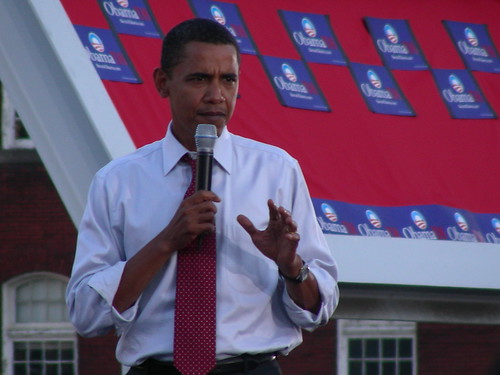
While half of America celebrates the results of the presidential election, many Israelis will be feeling quite depressed about the results. It would be safe to say that most of Israel was rooting for Romney (or whoever would have opposed Barack Obama). In four short years, Obama succeeded in alienating much of the Israeli public, and there is a fairly flat feeling about the prospect of Obama continuing similar Middle East policies over the next four years.
Of course, it is true that Israelis have very different interests than Americans have when viewing the presidential election. Americans are justifiably mostly concerned about economic issues, and about domestic issues such as universal health care. These are issues which are of much less interest to the average Israeli, even though the man on the street in Tel Aviv or Jerusalem still cares a great deal about who will govern from the White House. The reason for this is quite simple. The White House has historically had a substantial impact on events in the Middle East in the past, and this is likely to continue for the foreseeable future. People are clearly hoping that this influence will be exerted to help the security of the Jewish people in Israel, and also to advance the cause of peace in the Middle East. The experience of how this influence has been exerted over the past four years does not engender any feeling of confidence that the current status quo is likely to change, or that the current situation will move in a positive direction over the next four years. Even though life for Jews in Israel has been far worse in the past, people continue to live in hope that it will be a lot better with the help and influence of the White House in the future.
When Barack Obama came to power four years ago, there was a great deal of scepticism in Israel about how a president with such close family links to Islam, could be good for the Jews in Israel. The euphoria and excitement that swept through the USA, however, convinced many to give Obama the benefit of the doubt and the chance to prove himself one way or the other. Now, four years later, many believe that he has proved himself, and that their initial scepticism was fully justified. In President Obama's first presidential visit to the Middle East, he made a point of stopping in Egypt to lay out his policy for the region. Since then, he has not stepped foot in Israel nor shown himself to be particularly engaged in Middle Eastern issues. He has waged a battle against policies that Prime Minister Netanyahu has pursued to secure the safety of Israel as a Jewish state, and has allowed Iran to reach the verge of producing a nuclear weapon by not being prepared to support the required military action to remove this threat. Even though not all Israelis are supporters of Netanyahu and his policies, Obama's opposition to these policies have been viewed as unhelpful to Israel's cause and her security. Obama has not been sufficiently willing to speak out against the continued missile fire under which so many communities in the south of Israel have been forced to live under, and to make clear to the perpetrators of these attacks how unacceptable this situation is.
Obama's predecessor, George W. Bush was the one who coined the phrase "if they are not with us, they are against us", in the context of the war on terror following the 9/11 attacks. Israel has been fighting a war on terror for much longer than this, and understands very well the fact that there can be no "abstentions" in this important issue. Those who do not strongly support the fight and help to take steps to assist in eradicating terror, effectively enable it by their lack of action. Those who do not actively work to eradicate the nuclear threat from Iran, are those who enable it. Responsibility for this extremely worrying situation will fall to all of those who were happy to be spectators while it was clear that a nuclear weapon was being constructed by a rogue regime with full knowledge and in full sight of the world. The UN was set up in the wake of the Second World War with a brief of preventing conflicts and avoid future wars. This type of activity is surely exactly what the UN has been set up to act against. Even though the clear understanding is that Iran's nuclear program has the worst of intentions, it is being allowed by the world, and by Barack Obama in particular, to proceed almost unimpeded.
With this background, it is hardly surprising that Obama doesn't have a place in the hearts of many Israelis. There are those who claim that the Obama administration has done more than any other US administration to provide arms and funding for weapons to Israel. It is also clear that a strong US economy is good for Israel's economy in many respects. So, action taken by Obama to strengthen the US economy is good and extremely important for Israel's continued well-being. But these are indirect, and often invisible to the Israeli eye. The most public and obvious matters, being the Iran nuclear issue and the continued conflict with the Palestinians, particularly Hamas in Gaza, are always going to be the issues that grab the headlines. These are also the things that will capture the attention of the Israeli public, and by which Obama's success and failure with regard to his policy on Israel will be measured.
What remains unclear, is the extent to which the personal lack of agreement between Netanyahu and Obama may affect Obama's Israel policy. Netanyahu is reported to have got on the wrong side of Obama on more than one previous occasion, and was extremely clear in his support for Romney in the presidential election campaign. Indications from the White House are, that this will not influence Obama's attitude towards Israel, but this remains to be seen. Despite the lurch towards democracy by some Middle Eastern countries as a result of the Arab Spring, Israel is still the only truly democratic country in the Middle East that the US can truly rely upon as an ally. Their partnership in the war on terror is also a critical for both the US and Israel.
Perhaps its a good thing that Israelis have a very low expectation of the support that Israel will get from the new Obama administration. At least, this means that the chances for disappointment are much lower than was the case four years ago when he took office for the first time. Of course, we would all like to be pleasantly surprised, but there is no expectation that this will be the case. The real fear is that we will wake up one day during the course of the next few years, and find that Iran has a nuclear bomb. This will change the shape of the Middle East, and of the world. It is our hope that Obama will at least take action to prevent this nightmare becoming reality. Even though Israel is known for acting independently where required, and
is not bound to US agreement or support on these matters in any way,
the problem is a global one and not one which is only a threat to
Israel. While Israel is clearly one of the main targets of the Iranian
aggression, this issue should not be left entirely to Israel to take
care of. The US and other countries around the world have a clear share
of responsibility. The time to act is now.
Showing posts with label Arab Spring. Show all posts
Sunday, 11 November 2012
Monday, 16 April 2012
Sometimes, It's Better the Devil You Know .....
The civil war in Syria is already a year old. The "Arab Spring" started in 2011, and we are already in the Spring of 2012. If we believe those in the know, the Syrian civil war could last for another 6 to 12 months before any sort of final solution is reached. For Israel, it is critical to try to predict what the final solution could look like, in order to make relevant security arrangements for the new reality that she will inevitably have to face.
The security situation with Syria has experienced its ups and downs over the past 64 years. Israel has been at war with Syria 3 times since 1948, and has also been involved in numerous border incidents and skirmishes over the years. Despite the fact that Israel has not had an official war with Syria since 1973, Syria has continued to represent a significant threat to Israel. This threat has come, not only from the border that Israel shares with Syria, but also from the huge financial, military and political support that Syria has provided to terrorist organisations which are working to destroy the State of Israel by any means. Despite these constant threats, it would be fair to say that the border with Syria has been relatively stable and quiet since the guns went silent after the Yom Kippur War in 1973. The fact that Israel has never been on the losing side of a war with Syria may have something to do with this, and Israel has certainly benefited from this relative calm. A new reality in Syria could potentially be much worse than this.
It is believed that the minority Alawite regime of Bashar al-Assad (and similarly that of his father Hafez al-Assad before him) has given a great deal of thought to the possibility that the majority may rise up against its minority tribe. The Sunni Muslims are the great majority of the Syrian population comprising nearly 75% of the population, and the Alawites are a minority tribe falling under the umbrella of the arch-rival Shia group. For the ruling family, this has always represented a significant threat to their rule, and to their general safety. This threat was regarded as so significant, that detailed contingency plans were drawn up for the moment when Assad and his Alawite followers may be driven from power in Damascus. These contingency plans are now the focus of attention, as it seems as if the moment for them to be activated is nearing. It is rumoured that the plans involve the Alawites setting up some sort of independent homeland in the area of their stronghold in the Alawite Mountains, near to the Syrian towns of Homs and Tartous. It is further rumoured that this new homeland would immediately seek international allies and recognition. As ironic as it seems, Israel is one of the countries that have been identified for possible friendship with the Alawite nation when all of this transpires. Suddenly, the new Alawite homeland and the State of Israel will have a common enemy in the form of Sunni-ruled Syria. Such a relationship would, however, be complicated by the natural grouping of the Alawites alongside Iran, a fellow Shia majority country.
When contemplating the possibility of the above events taking place, it is clear that leaving Syria to the Sunnis following the flight of the Alawites to the mountains represents a huge threat to Israel. Any situation that does not involve a formal handover of power in a controlled and organised fashion is a major threat on Israel's border. This is particularly true when considering the quantity of arms and ammunition that Syria possesses. It is also very likely that a Sunni-controlled Syria will forge much closer links with their Sunni compatriots in Hamas. This is a further threat that Israel is forced to give serious thought to. Shia-controlled Hezbollah may find themselves side-lined in this shift of power, but that organisation will continue to enjoy strong support and backing from their fellow Shias in Iran.
The possible new look in Syria set out above represents a major threat to the balance of power and stability in the Middle East. Despite the fact that the Arab-Israeli conflict has continued unabated for more than 65 years, there has been an element of stability within the regional conflict. The relative quiet along the Syrian border has been part of that relative stability. Perhaps it is for this reason that the Israeli government has not been vociferous in speaking out on the events taking place in Syria. It may be that the Israeli government has no real interest to see the end of Assad's regime too quickly. Sometimes, its better the devil you know ................
Monday, 30 January 2012
Going Through the Motions
The most recent round of peace talks held between the Israelis and the Palestinians has been declared a failure by the Palestinians, Even though the talks were held at a low level, involving only negotiating representatives from each side, there always somehow seems a little more hope when a dialogue is taking place. In hindsight, it seems quite clear that there was never really any prospect that this round of talks would go anywhere. For the Palestinians, it was always a case of simply going through the motions to get safely to the next trigger point.
Following the unsuccessful attempts by the Palestinians to gain recognition from the UN Security Council and General Assembly in the summer of 2011, the Palestinians had promised the Quartet that they would give another round of talks a chance until the 26th January 2012. Having promised this, the Palestinians had no way of escaping from the commitment. Despite the fact that a total of 5 meetings were held in the current round between the parties in a very short period of time, all of which took place under the sponsorship of the Jordanian government in Amman, it became clear very early in the process that there was little intent on the part of the Palestinians to make this round work. Having seemingly exhausted its alternatives by making little progress at the UN, however, the question arises as to why the Palestinians were trying to torpedo these talks? With few alternatives to allow them to make progress towards their objective, it would appear that talks seem to be the best alternative for Mahmoud Abbas and the Fatah-controlled Palestinian Authority.
In order to better understand why the Palestinians sabotaged the latest talks, it is important to the sub-plots that are going on behind the scenes, and which are having more of an influence on the actions by President Abbas and chief negotiator Saeb Erekat. The first issue to address concerns the PA's alternatives at the UN. Even though the UN Security Council and General Assembly seemingly had little interest in promoting the cause of the Palestinians at their meetings last year, the UN is quite a disparate organisation with many different tentacles that are often disconnected from each other. This was demonstrated when, soon after the failure at the General Assembly, the Palestinians did manage to win support for full membership to the UN cultural organisation UNESCO in October 2011. Although this was a poor consolation prize for main objective, it did demonstrate to the Palestinians that they could use a slower and indirect approach in order to work their way into the UN organisation. This includes the possibility of making use of the UN-sponsored International Court of Justice to charge Israelis with crimes against humanity arising from events in the recent Gaza War, Operation Cast Lead. The Palestinians have repeatedly threatened to make use of this avenue in their battle against Israel. Even if charges that they may bring through this court are ultimately dismissed, such actions could tie individual Israelis and the Israeli government up in legal proceedings for many years. By bringing the latest round of peace talks with Israel to an end, the prospect of stepping up actions through these UN organisations is placed firmly back on the table, and exactly where the Palestinians wish it to be.
The second sub-plot concerns the evolution of the relationship between Fatah and Hamas. The Palestinian Authority is controlled by Fatah, and with Mahmoud Abbas already serving his 8th year of a 4-year term, there is a great deal of pressure for elections to be held. Fatah is clearly reluctant to call elections when there is a real prospect of them being routed, even in their perceived stronghold of the West Bank. Many of these issues were taken care of, when a deal was signed between Hamas and Fatah to create a unity government for the Palestinian Authority. This deal is a typical attempt to extend the longevity of politicians on both sides of the divide, by denying the electorate the right to express its will through the ballot box. With Hamas being absolutely opposed to holding any negotiations with Israel at all, the establishment of the unity government was put on hold while the latest talks were held. Now, with the talks dead and buried, the blockage has been removed. For Fatah, entering into a closer relationship with Hamas may allow it to share in some of the popular support that Hamas continues to enjoy following recent prisoner exchange deal. It may also extend the political lives of some of the bigger names.
A further sub-plot in play concerns the ongoing events in the Arab World, and the events which have resulted from the "Arab Spring". Mahmoud Abbas has announced that he will be taking the issue of the failed talks with the Israelis to the Arab League, to get direction as to what should happen next. With the Arab League occupied with events in Syria, Abbas may have a created a smokescreen under which to operate. Interestingly, the effects of the Arab Spring also seem to have created something of a split within Hamas, which may yet have an impact on the Palestinian Authority via the inclusion of Hamas in the unity government activities. The leadership that was formerly based in Damascus (reports suggest that Khaled Meshal and his team have fled the Syrian capital) feel that non-violent protest against Israel may be effective as a "Palestinian Spring", after having seen the impact of the popular uprising in Syria and Egypt first-hand. The Gaza leadership is quite clear that it has no intention of adopting a new non-violent approach against Israel, and this issue may yet cause further internal conflict within the Palestinian camp.
The way in which the Palestinians went through the motions in the recent peace talks seemed a little more transparent than usual. Despite the fact that the talks were primarily addressing the issues of borders and security, an Israeli official was prevented from fully presenting Israel's position on borders to the Amman meeting. An Israeli document setting out 21 points of principles needed to reach a peace agreement was not considered, and was then dismissed as being "just an outline". These attempts to dismiss Israel's honest efforts in the talks seem clearly designed to sabotage the talks. In the press, Israel's border proposals have been labelled as "preventing a Palestinian state from being established", and have been blamed for the breakdown of the talks.
In spite of the obvious reasons for the breakdown, the stale mate somehow seems still to have produced a slight edge for the Palestinian side. The breakdown of the talks has been presented by the international community by saying that the Palestinians have at least fulfilled their commitment to continue to try until the pre-agreed date of 26th January. Having tried and failed, all bets are off the table, but the rewards due to the Palestinians are triggered. European foreign policy chief Catherine Ashton even had the audacity to call upon Israel to deliver "confidence-building concessions" to encourage the talks to continue. We have already learned that this means delivering confidence to the international community, and concessions to the Palestinians. The Palestinian side seems not to be expected to deliver confidence nor the concessions. The international community would be better off understanding that any such concessions on Israel's part, would amount to rewards to the Palestinians for bad behaviour.
It seems clear to me that a lasting peace will only be possible via a negotiated settlement. This was also recognised by Fatah strongman Marwan Barghouti, who remains in an Israeli jail serving five life sentences for murder of Israeli citizens. He made a rare court appearance during the last week, and managed to send out a message indicating that he believes in a negotiated settlement based on the 1967 borders. The precise terms of the negotiated settlement remain a large outstanding issue, but it is interesting that the person believed to be the instigator of both the first and second intifadas is talking about a negotiated settlement at all. The problem right now, is that there appear to be few Palestinians who believe that this is the correct route to take, and who are prepared to make the painful concessions necessary to bring this to reality. Until this happens, the Palestinians will be going through the motions, and the cycle of violence will continue.
Monday, 2 January 2012
The Best and Worst of 2011
As we welcome 2012, it gives the opportunity to reflect on the best
and worst parts of 2011. In Israel, 2011 was an eventful year, including a number of interesting and challenging events. For some, it was a year that they would prefer to forget. Despite many negative aspects to the year, I think
that Israelis will regard 2011 as having been a year that was more
positive than negative. Here are the main reasons why I think that this
was the case.
The best story coming out of 2011 was the release of captured Israeli soldier, Gilad Shalit. It is not only the fact that Gilad was returned safely to the arms of his family that makes this story good. The fact that the Israeli government was finally able to agree and execute this deal sends some amazingly strong and positive statements to all Israelis. For me, this is a classic story where the right thing finally triumphed. Like all good stories, this has a negative side to it as well. I really cannot blame all of those who opposed the deal due to the "price" that had to be paid in terms of the number of Palestinian prisoners who were released, even those who have murdered Israelis. I also know how paranoid the Israel Defense Force (IDF) is about the possibility of soldiers being kidnapped in the future, and the measures that have been put in place to try to avoid this at any price. I feel that working to avoid future kidnappings is a better reaction than leaving Gilad in captivity under the conditions that he was held. This was, by far, the highlight of the year in my view.
Another good story of 2011 was that of the social protests. Hundreds of thousands of people took to the streets to demonstrate against lack of social justice, and of the dramatic increases in the cost of living without commensurate increases in earnings. This was a great story for a number of reasons. It was good to see the Israeli public having the time and energy to devote to social issues, and behaving in a manner that most "normal" countries behave. In the 63 years since Israel's independence, most of the time has been spent worrying about an existential threat. Wars have been fought, terror attacks overcome and many people have been left dead and injured. This allows little time or energy to give even a fleeting thought to daily social issues. The fact that hundreds of thousands of Israelis were able to come out into the street to protest social issues gives some indication that the existential threat is not quite at the same level as it has been in the past. It also shows what Israelis really care about, and shows the real democracy that exists in Israel. On all of these levels, the protests were extremely encouraging. These good points, however, should not cause us to lose sight of the core issue of these protests - the economic inequality and hardships that many people are suffering. Unfortunately, the government has not responded sufficiently to the message of the protest marches, and this issue is likely to plague us for some time yet.
A further good story for 2011 was the extent to which the economy succeeded in holding up during the year. Even though this seems to be at odds with the message brought by the social protest movement, more Israelis were in employment during 2011 than at any other time in Israel's history. In addition, while economies around the world were floundering and suffering all types of economic problems, Israel somehow managed to keep its economy on track. This does not mean that the year translated into a boom year for Israel. It does, however, continue the theme of displaying a real underlying strength to Israel's economy that was shown during 2008 when the credit crunch hit many economies so hard. Once again in 2011, Israel's economy has performed admirably. Along with the good things, come some very difficult questions. Why are so many Israelis struggling financially when the economy is at almost full employment? This is clearly something that needs to be addressed as part of the social equality agenda.
The major regional story this year was the unfolding of the Arab Spring in countries in the Middle East and North Africa. The way in which the Arab Spring has swept through the region could never have been predicted. Even though this is great news for democracy in the Middle East, it has created an instability that is proving to be negative for Israel, and many countries in the western world. While the free world has an obligation to support the move towards democracy in principle, there is a real problem about whether these countries are really ready to embrace democracy. In many respects, stability in the Arab world is more important than democracy. As things seem at the moment, the two don't seem to be able to live side by side. The change of regime in Egypt is particularly concerning, with the increasing popularity of the Muslim Brotherhood. The protest movement in Syria also promises some dramatic changes to regional politics, and they are not necessarily all going to be positive.
The second major regional story surrounds Iran's development of nuclear weapons. 2011 can be characterised as a year of confirmation and inaction where this is concerned. The international community were presented with irrefutable evidence of Iran's development of nuclear missiles. Even the International Atomic Energy Agency were forced to accept that Israel's representations about Iran's nuclear program have been correct all along. Having had this fact confirmed, the best that the international community could muster up, were a few ineffectual sanctions. It has become clear that Iran is not only setting out to threaten Israel. The events over the past few days in the Straits of Hormuz are a clear challenge to the US. The military exercise on this occasion closed the straights for only a short period of time. The next time could be for longer, precipitating a potential military conflict with the USA.
Despite the fact that 2011 was a hugely eventful year, it seems only to have set the scene for what awaits us in 2012. Israel's social justice movement is likely to be more vociferous, particularly if the economy suffers more than it did in 2011. The government will need to be prepared to commit to spend more money on social issues, and to see these promises through. This is an issue that is no less imporant than Israel's security challenges.
The Arab Spring will come to a head in Syria. It seems as though the Sunni Muslims, who represent over 70% of the population, are likely to gain the ascendancy after having been ruled by the minority Alawites for many years. The Spring could yet spread to other countries in the region, and this could present a greater threat to Israel as more of her neighbours became destabilised by these events.
I expect that 2012 will also see the Iranian nuclear issue come to a head, as Iran continues to intimidate and provoke Israel, the USA and other western countries. All of this adds up to 2012 looking to be a tough year.
In between the pessimistic expectations are a few rays of light. Even though I expect a great deal of instability during 2012, it is my hope that this will then bring a period of greater stability as is often the case. I also hope that the unfolding Arab Spring can create a new, more compromising, reality with the Palestinians to allow moves towards a genuine peace based on mutual recognition and respect.
It is my hope and prayer that 2012 holds only great things for all of you. Happy new year!!
Sunday, 4 December 2011
Egypt's Elections Produce a Surprise Package
The Arab Spring uprisings began exactly 1 year ago this month. The demonstrations against the government of President Zine El Abidine Ben Ali in Tunisia began in December 2010, and resulted in him being removed from power 1 month later. The Spring subsequently spread to many other countries in the Middle East, and has been encouraged by enthusiastic support from the western countries. Ironically, the one voice of hesitation against the uprisings came from Israel. At the time, it was difficult for many to understand why Netanyahu did not support the Spring whole-heartedly. Now, a year later, his reasons are starting to become apparent.
Netanyahu's concern about the uprisings were most obvious when the demonstrations reached Egypt, and thousands of Egyptians gathered in Tahrir Square demanding the head of President Hosni Mubarak. It was clear that Mubarak had ruled with an iron fist in the 30 years that he had presided over Egypt. He was never elected in a free democratic election, and he never repealed the emergency laws under which his government and his security apparatus were entitled to do almost as they wished, and which they used to maximum effect. Most citizens around the world who have lived in a democratic system (as well as many who have not) felt some level of empathy with Egyptians as they demanded, and finally got, the resignation of their president. Netanyahu's voice was a lone one during that time, and it seemed strange to many that the leader of a free and democratic country would express concern about the democratisation of another country. There were silent whispers about whether the relationship between Mubarak and Netanyahu held more than what was publicly known. There were mutterings about whether the gas deal that was struck between Egypt and Israel, and which Mubarak's family are reputed to have personally profited from, possibly held personal profits for Israel's leaders too. All the while, Netanyahu was heard to speak out in understated tones about his concerns for the Arab Spring.
Fast forward 11 months since the day that it was announced that Mubarak had resigned from power, and how different the situation looks. Egypt has undergone its first round of voting in its nascent democratic process, and things are looking distinctly worrying for Israel and the west. Voting for the lower house of Egypt's parliament has revealed that Islamic extremist groups are likely to rule in the new Egypt. The Muslim Brotherhood, which was held responsible for the assassination of former Egyptian President Anwar Sadat and which remained a banned organisation throughout the 30 years of Mubarak's rule, has emerged as the strongest party in the elections. There are those who believe that this support comes as a result of euphoria over the unbanning of the Muslim Brotherhood, not unlike the euphoria which saw the ANC sweep to power in South Africa after it was unbanned. There are those, however, who believe that this reflects a trend towards Islamic fundamentalism that can be seen in many countries around the world. This is borne out by the meteoric rise of the Salafist Al-Nour party which received the second highest number of votes in the first round. The Salafists advocate greater Islamic fundamentalism than the Muslim Brotherhood, and wish to apply Islamic Sharia law to Egypt. They make the Muslim Brotherhood look like amateur fundamentalists.
The fact that the Muslim Brotherhood had strong showings in the elections in Tunisia and Morocco, is not nearly as concerning as the indications of the trend in Egypt. Besides the fact that Egypt has a direct land border with Israel, Egypt also enjoys a strategic position both geographically and politically in the current fragile state of international diplomacy. Is the election result in Egypt showing that some countries are not yet ready to cope with western-style democracy, as so many people claim? Or is the truth that Hosni Mubarak's iron fist also worked to protect the west against the scourge of Islamic fundamentalism? Netanyahu seems to have been one of the only western leaders who understood this at a stage that it was still early enough to do something. Unfortunately, his was very much a lone voice, and he had no prospect of stemming the tide towards the overthrow of Mubarak.
The Israeli establishment understood as soon as Mubarak left power that Israel's relationship with Egypt has changed forever. There are some doubts as to whether the peace treaty signed between late Prime Minister Menachem Begin and late President Anwar Sadat will be respected by the new regime. Even if it is, a new era has dawned for Israel and Egypt. This will also manifest itself in Israel's relationship with the Palestinians. The Muslim Brotherhood is a close ally of Hamas. Whereas President Mubarak worked hard with the Israelis to try to prevent Hamas from acquiring weapons into the Gaza Strip, the Muslim Brotherhood is likely to do the exact opposite. This promises greater and more sophisticated attacks coming from Gaza, spelling real danger for southern Israel, and for the safety and security of the State of Israel as a whole.
It will be interesting to watch what sort of political system will manifest itself in post-Gaddafi Libya. In this case, western countries were actively involved in overthrowing Gaddafi by supplying NATO air power to assist rebel forces against him. Now, they will be forced to stand back to allow a new democratic government to replace the old dictatorship. But who will be the new elected leaders of Libya, and could it be that the west may yet come to regret this too? Sometimes, you need to be careful what you wish for.
Monday, 21 November 2011
Assad Keeps Fighting, But Cannot Survive
The uprising in Syria has continued unabated for the past 8 months. Despite the fact that thousands of people have already been killed in the process, the uprising shows no signs of being quelled by the strong-arm tactics adopted by President Bashar al-Assad. Despite Assad fighting the civilian uprising using all military options available to him, he cannot survive this challenge to his leadership. In the interests of preventing further loss of life, Bashar should accept the inevitable as soon as possible and leave office.
The Syrian uprising has progressed in a substantially different way to the uprisings that took place in Tunisia, Egypt, Yemen and Libya. The biggest difference in Syria is the fact that the regime has managed to survive for as long as 8 months, despite constant protests by the opposition and Syrian civilians over this time. We all know that the long-ruling and well-established governments of Gadaffi, Mubarak and others were unable to survive the attacks that they came under for more than a few months. So what is it about Assad and Syria that has allowed him to survive for this period of time, despite having already killed more than 3,000 civilians (according to the UN) in his attempt to put down the uprising?
Despite the fact that the uprisings in other countries in the region proved to be the catalyst for the demonstrations in Syria, Assad has benefited from the fact other countries have been suffering unrest. This has diverted the attention of the world and the international media elsewhere, while he tries to take care of his own back yard. So far, he has managed to escape the fates that Mubarak and Gadaffi suffered when the world's leaders and media were focused on the events in these countries. While there have been a few reports and international condemnation of events in Syria, these have not been anywhere as directed as those that were directed at Mubarak and Gadaffi before the demise of these two leaders. In Assad's case, there are indications that this is about to change over the coming weeks and months now that Syria has been brought into target by the international community.
In the case particularly of Libya, oil had much to do with the decision by NATO to take an active part in Libya's uprising. There can be no doubt that Gadaffi would probably still have been in power, if it was not for the role played by NATO war planes. Even though oil exploration and export is an important part of the Syrian economy accounting for as much as 25% of the government's income, Syrian oil only makes up about 0.5% of the world's oil production. As such, the world has not looked upon Syria with the same concern for its stability as it did when chaos ensued in Libya. It also means that NATO has no interest in getting involved in Syria. It enjoys little strategic relevance to the world, either in terms of its location or in terms of its production of oil. The only possible point of strategic relevance relating to Syria is its ongoing dispute with Israel over the Golan Heights. It is clear that the world would wish for this issue to be resolved in order to reduce the threat of a war between Syria and Israel which would, undoubtedly, drag other countries in the region into conflict.
Perhaps the most important reason why the world has not come down more harshly on Syria until now, relates to its connections with Iran. Despite not sharing a common border, Syria and Iran have forged extremely close links over the past few years. Ahmadinejad's Iran has proved to be the "catching net" for those countries seeking international links, but which have been rejected by countries in the west. As one of the world's major sponsors of terror, Iran has cast its influence far and wide. It has also stood up to huge criticism by the international community over its nuclear program, thereby showing itself as a leader of the renegade countries which oppose the influence of the USA and other western powers. In this respect, Iran has shown itself to be quite an attractive ally for Turkey, Syria and other countries that are struggling to gain acceptance into international circles. The world has realised that any action against Syria, effectively equates to action against Iran.
On the basis of the close links between Syria and Iran, it is difficult to separate action against Iran's nuclear program from action against Syria's extreme crackdown against protestors. There is a view that says that the world, by escalating Iran on its nuclear program, is trying to divert Ahmadinejad's attention away from Syria in order to allow the world to take a separate position on this. There seems to be an attempt to divide and rule. The Arab League has taken a bold and significant stand against Syria over the past week, by suspending it from the organisation, and threatening to take further diplomatic actions against Syria if Assad does not pull his military forces out of civilian areas and halt the violence. Although there is no love lost between the Arab League and Iran, the Arab League has taken its time in adopting this stand against Syria in view of the fact that it clearly represents taking a stand against Iran at the same time.
Despite Assad's closeness with Ahmadinejad, he will not be able to survive this uprising against his leadership. He is destined to go the same route as Gadaffi, Mubarak and other casualties of the Arab Spring. The question is whether he has learned any lessons from those that have fallen before him. By hanging on to power longer than he should have, Gadaffi issued a death sentence for himself. When his demise came, the hatred against him was such that he was never going to survive being captured by the opposition forces. If Assad is sensible, he still has the opportunity to remove himself from power, thereby saving his life and that of his young family. Continuing to direct his military forces to kill more civilians will make this outcome less likely, and will endanger his life further at that moment when he is driven from power.
Israel is watching carefully to see where events in Syria will lead. The fall of Assad's regime will surely weaken Ahmadinejad's influence in the region. Equally, any action taken against Iran's nuclear program will weaken Syria. Assad has warned that any action taken by the international community against Syria will cause an earthquake in the region. He knows that this is likely to drag Iran into a broader war in the Middle East, and the international community knows this too.
Ahmadinejad, it seems, is the big winner in all of this. Leaders like Assad are running to him like little puppies in order to gain his acceptance and support. He is standing up to the international community with his continued defiance of their calls against his nuclear program, and by continuing to fund international terrorism. His name is on everyone's lips in the international press, and at organisations like the UN and the IAEA. He is the modern-day version of Stalin that all seem to fear. Even Ahmadinejad, however, cannot save Assad's head. Assad will need to decide whether he is prepared to jump, or whether he is waiting to be pushed. The latter option will not be without its consequences for him and his family. Either way, Assad's eventual downfall can only be good for the region and the world by weakening Iran's influence.
Labels:
Ahmadinejad,
Arab Spring,
Arab World,
Assad,
Demonstration,
Gaddafi,
Iran,
Mubarak,
NATO,
Protest,
Syria,
Terrorism
Subscribe to:
Posts (Atom)