Tuesday, 27 January 2015

Freedom of Speech?

Disagreements between Jews are not new.  This is largely driven by the fact that many Jews are highly opinionated, and are not shy to share their opinions with all who care to listen.  Major disagreements have even taken place in Torah study over the years, the most famous of which is the disagreement between the Houses of Hillel and Shamai more than 2,000 years ago.  Any good Torah scholar knows how to answer a question when presented with two possible alternative solutions.  The answer is usually "machloket" or "disagreement", indicating that learned scholars have issued strong support for both possible solutions to the question.  In the modern State of Israel, it is common for people to refer to the fact that there are frequently three (or more) views and opinions expressed when two people get together to discuss matters.  While this can frequently indicate a healthy ability to see many different sides to the same issue, there are times when these disagreements can be undesirable and even destructive.

In recent weeks, we have seen disagreements arise amongst Israelis, which are less desirable in their nature.  One example of such a disagreement is the criticism that has been expressed for Prime Minister Netanyahu's recent visit to Paris to join the protest, following the terror attacks by the Muslim extremists.  Some Israelis, including senior politicians, have chosen to criticise every aspect of Netanyahu's visit to Paris, calling it a ploy designed to gain him personal support ahead of the upcoming general election.  He has been castigated for going to Paris at all, given the short notice and the huge cost of mounting the required security operation that travels with the prime minister at all times.  There was much written about the French government not really wanting him to be there, and being forced to ensure that Palestinian Authority President Mahmoud Abbas was also in the front row of the march in order to create political balance.  Some found it distasteful that Netanyahu supposedly pushed his way to the front row of the protest march.  He was accused of forcing his way onto the bus that was used to transport French President François Hollande to the march.  There were others who found his style of waving to the crowds during the march shameful.  Many newspaper columns were taken up explaining why the whole episode brought shame to Netanyahu and to Israel.

Last week, an attack was carried out in southern Syria that killed a number of Hezbollah operatives, and a few Iranian senior military men who were with them.  Although refusing to give any official response to the story, Israel has been accused of carrying out the attack.  This has given rise to all manner of response from Israelis.  Some have accused Netanyahu of using this military strike for election gain.  Others have accused Netanyahu and Israel of being too militaristic and too aggressive, while hiding behind the guise of looking after its security needs.  They argue that Mugniyeh and his compatriots who were killed did not represent a "ticking bomb" (the term used for somebody who is on the verge of carrying out an immediate attack on Israel) and should, therefore, not have been attacked by the IDF.  They further argue that the death of the Iranians (which some unnamed official sources claim was unintended) brings further unwanted tension to the already-tense relationship between Israel and Iran.

The most recent furore created by Netanyahu, is the announcement of a visit to the USA planned for the beginning of March, less than two weeks before the Israeli general election.  He has been invited to address a joint session of Congress, now dominated by the Republicans.  It is expected that Netanyahu will speak out strongly against reaching any deal with Iran, and will warn again of the threat presented by a nuclear Iran.  The White House has moved quickly to issue a statement saying that neither President Obama nor Secretary of State Kerry will meet with Netanyahu during this visit.  While the statement gives the explanation that the president has a policy of not meeting with political leaders so soon before a general election, we all know that there is a great deal of antagonism in the relationship between Obama and Netanyahu.  The fact that Netanyahu is in the USA at the invitation of Obama's rival party will not help the situation.  Israeli politicians and journalists alike have jumped up to accuse Netanyahu of endangering the sensitive relationship that Israel has with the USA by accepting the Republican invitation.  Perhaps they would care to consider the possibility that a Republican may occupy the White House after the upcoming presidential election at the end of 2016?

In a country that values free speech for people who sometimes hold more than one opinion on a subject, there is a valid question as to whether these criticisms cross the boundary where free speech becomes libellous or contrary to the best interests of the country.  While democracy in Israel is of paramount importance, including the right to think and speak your mind, there are times when this democratic right is used in a misdirected and unacceptable way.  People who take advantage of freedom of speech simply to cause damage or to attack individuals should be denied this valuable right.  Our democracy should not tolerate those who abuse their democratic rights.

How should we regard the actions of 43 reserve soldiers from an elite intelligence unit who decided to speak out against the intelligence work conducted by their unit?  Not only did they speak out against this work in the form of a strongly-worded letter to Prime Minister Netanyahu, they also disobeyed orders and the law of the land by refusing undertake their reserve duty.  Is this an exercise of their democratic rights, or did they cross the red line in terms of what is democratically acceptable?  They have all been dismissed from their military positions, probably the outcome that they were hoping for despite the fact that it is regarded as a punishment.  The case does, however, bring into sharp focus the issue of the right to free speech, and where the line should be drawn.  In the case of these soldiers, an existing process is made available for all soldiers to express their views and voice their objections.  The manner used by these soldiers was clearly designed to damage the State of Israel, and could threaten her security.  This cannot be tolerated.

There is clearly a very thin line between being allowed to exercise democratic rights and freedom of speech, as opposed to abusing this right in order to cause harm.  Anybody exercising their freedom to say what they wish, also has the obligation to do this responsibly.  This obligation, it seems, is frequently ignored in the interests of brazenly saying whatever is on the heart.  Democracy can be a dangerous tool when put in the wrong hands, or in the hands of those who do not exercise it responsibly.  Those who overstep the line should be dealt with decisively, particularly those who choose to threaten the security of the state and her citizens.

Ultimately, a democratic country like Israel should be able to withstand abuse of these democratic rights, and should have a process of dealing with the culprits accordingly.  Denying people their democratic rights is not a solution to the problem.   It is also important to provide better education regarding the obligations that flow from a democracy.  It is hoped that such education will bring a balanced assessment of the appropriate moments to say what you are thinking and feeling, and the best moments to keep quiet.  The democracy should never tolerate people who hide behind the right to free speech, with the intention of causing harm.

Sunday, 18 January 2015

Je Suis Israel?

The huge outpouring of sympathy and shock over the past week following the terror attacks in France is entirely understandable.  The French people have not experienced an attack on their republic in this way, probably since the storming of the Bastille in 1789.  The reason why this represents a threat that is different from the various wars that the French have fought on their home territory over the years, is because this attack comes from within France, and not from outside of her borders.  The sight of native French speakers explaining that they follow the doctrines of Al Qaeda, Islamic State and other extremist Muslim groups has dismayed the average Frenchman, and even many within the huge French Muslim community.

The French (and the international community) came out in an immediate response to show their support for the Charlie Hebdo publication, which is also an expression of their support for freedom as demonstrated by a free press.   One could almost hear the cries of Liberté, Égalité, Fraternité.  Millions of Frenchmen made their statement in the presence of leaders from the international community in opposition to the attack on their freedom, and protested against Islamic extremism that was behind these latest attacks and many others.  The war on Islamic extremism is on the lips of people around the world, including the leaders of the most influential western countries.  Despite this fact, we saw Palestinian Authority President Mahmoud Abbas lining up with the world leaders at the protest rally in  Paris, in one of the most visible positions in the front row of the protest.  Many have questioned why a leader, who has been so closely associated with terror attacks over the years, could have been allowed to be in the front line of a demonstration to protest against exactly this

The organisation that was originally established in 1964 to represent the so-called Palestinian Arabs, was the Palestine Liberation Organisation (the PLO).  Current Palestinian Authority President Mahmoud Abbas was one of the founders of the PLO.  The stated objective of the PLO was the "liberation of Palestine through armed struggle".  This armed struggle turned out to include hijacking aeroplanes and cruise liners, as well as kidnapping and killing people without any sympathy or regard for the value of human life.  Despite being a stated pan-Arab organisation, many of its Arab colleagues expelled the leadership of the PLO from their countries as a way of opposing the means of terror that they used to pursue their agenda.  This same PLO forms the backbone of the Fatah party that makes up the modern-day Palestinian Authority.  Since his death, it has been publicly recognised that former Palestinian leader Yasser Arafat was orchestrating a campaign of terror and violence even while standing on the lawns of the White House, and receiving a Nobel Peace Prize.  Now that Abbas has signed a unity agreement with Hamas, a party that is blacklisted as a terrorist organisation in the USA, Europe and elsewhere, surely the evidence of his terror connections is as clear as ever.  And yet, he is seen leading an anti-terror march through the streets of Paris.  How is it possible that the world does not connect the terror that he is involved with, to the terror that is being experienced around the world?

Prime Minister Netanyahu has long been trying to draw this link in a way that the international community can understand, and is willing to understand.  He has described the terror that is being experienced in France, Syria, Iraq and elsewhere around the world as a different branch of the same tree when compared to the terror that Israel is forced to contend with on a daily basis.  The money to fund these activities is coming from common sources, and the organisations that are providing the arms and the impetus to carry out the attacks are the same.  The penny, however, refuses to drop.  When in France, the prime minister tried again to draw the connection to link the fresh wounds being felt by the French to gaping wounds felt constantly in Israel.  Everybody is rallying around the slogans "Je suis Charlie Hebdo" and "Je Suis Juif".  Why not "Je Suis Israel"?

Much of this stems from the fact that the Palestinians have succeeded in garnering public sympathy for their cause beyond the level that is justified.  While it is certainly true that many innocent civilians amongst the Palestinians are deserving of our sympathy and support, it is equally true that their misery has largely been caused by their own leaders.  The Palestinian leadership has ensured that those who were instructed to run from their homes when the State of Israel was declared in 1948 (despite requests by the Israeli government for them to stay), have remained refugees for more than 6 decades.  This has been designed to ensure that this issue remains a thorn in the side of the international community, in an attempt to milk any sympathy and support that can be gained.  The original 700,000 refugees have turned into a problem affecting 5 million people today.  All of this, linked to the fact that the peace talks to achieve a two-state solution have not progressed at all, have generated a certain sympathy for the Palestinian cause.  This sympathy has somehow been translated into justification for the acts of terror committed against Israel.  It is almost as if Israel is considered to deserve the terror it receives, because of the ongoing inability to reach a satisfactory compromise solution to create a Palestinian state.  It is almost as if Israel deserves whatever terror she is forced to endure, simply because she insists that any agreement for a two-state solution will ensure her security in future years.  It seems as though terror is only terror when it is not directed towards Israel.  Israeli-style terror seems entirely justified, in the eyes of the international community, as a fight for freedom or a fight against the so-called occupation.

What makes this even more absurd is when the Palestinians take complaints to the International Criminal Court, charging Israel of war crimes that are alleged to have been committed in an operation to protect her future existence and the safety of her citizens.  How can it be that prosecutors in The Hague are even spending a minute examining these claims?  After living through incessant rocket fire directed towards innocent civilians for years, surely Israel is entitled to eventually strike back to protect her innocent citizens?  And when doing so, if she takes every precaution to prevent civilian deaths despite the ongoing efforts of the Palestinians to throw civilians in the path of the military crossfire, should it not be the Palestinians who are accused of war crimes?

The branches of the same tree referred to by Prime Minister Netanyahu are certainly not of equal size and weight.  Israel has been forced to endure terror attacks for years, which have been randomly carried out against any and all sectors of her society.  Without meaning to dilute the enormity of attacks carried out and lives lost in the process, terror attacks elsewhere in the world have been of a much lower number and intensity than those that Israel has been forced to endure.  Despite this, there is the commonly-held view that Israel has somehow invited these attacks, and that they are justified.

The fact that Palestinians have been offered the opportunity to set up their own state in Gaza and the West Bank, the conditions of which far exceed the starting point that the State of Israel was offered 66 years ago, seems to be ignored.  The Jewish people demonstrated what is possible when there are good and true intentions to build a country and a nation, even with scraps to start with.  Out of these scraps, a prosperous country has been built which holds her own and takes up a justifed position in the family of nations.

The world's lack of link between the Islamic extremists operating in Israel, and those operating elsewhere, will be at its peril.  Israel has become a world leader in combating terror, and has experience and expertise that other countries will be needing in due course.  Ignoring or diluting the terror threat that Israelis constantly live under, will not give Israel much incentive to join in to assist others who suddenly discover the real nature of this plague.

Je Suis Israel!

Sunday, 11 January 2015

Elections - Threat or Opportunity?

Israel is headed towards another general election, a little more than 2 years after the last elections.  The fact that Prime Minister Netanyahu's government was unable to complete even half of its scheduled 4 years in office, is clear indication of the difficulties that continue to plague governing the Jewish state.  It also shows the lack of agreement that exists among the population in dealing with the key issues.  Problems relating to security, to the economy and to the Palestinian issue are top of the agenda, and are also the most divisive issues.  The prime minister was simply unable to keep his disparate coalition functioning as a government, as each party in the coalition pursued its own special interests and agendas.

Most vocal in protesting against the actions and policies of the government have been Finance Minister Yair Lapid and Justice Minister Tzipi Livni.  Prime Minister Netanyahu effectively announced his inability to manage his coalition by firing both ministers from his government, and giving a clear signal that elections would be his only alternative.  Once the election was formally announced, the prime minister acknowledged that he had been forced into the coalition with Livni and Lapid after the last election, and that his coalition was unmanageable almost from the beginning of its term.  This statement surprised many voters, and brought into sharp focus the almost impossible situation that Israeli politics finds itself in.  The issues that form the base of the election platforms are substantial, and some are even life-threatening in the determination of the future safety of the State of Israel.  The opinions on each issue are as diverse as the issues themselves.  While a split of voter opinion is a fairly standard occurrence in many western democracies, in most cases the split seems not to disrupt the effective governing of the country by the chosen government.  While it is well-known that coalition governments are notoriously less stable than governments that are comprised of a single party, this should not necessarily result in a total inability to govern.  For some reason, the combination of issues that Israelis are forced to confront, along with a total split of opinion as to how to deal with them, results in an ungovernable situation.  Not only is this situation enormously frustrating for the average voter, it also creates lack of stability in the government and comes at huge financial cost to the country.  Israel has had 33 governments in its 66-year history

Having resigned ourselves to the fact that an election is now unavoidable, the question is whether this election can be used as an opportunity to somehow improve the situation in which Israel finds herself.  Does this election present a real chance for change, or are we likely to get more of the same?  And is there anything that the new prime minister and new government will be able to do to change the status quo?  Most Israelis are seeking for an election result that can change the situation, particularly the security situation.  Along with the security threat that the country faces, there is huge frustration over the economy and over the issue of Israel's standing in the international community, where Israel is increasingly isolated.

When considering the political parties in the Knesset and the way in which the public views them, it is difficult to see any dramatic changes coming about in the next election.  Prime Minister Netanyahu is seeking a fourth term in office, and is currently looking like the only electable candidate for the office of prime minister.  Labour leader Isaac Herzog is doing all that he can to present himself as a viable alternative, but opinion polls show that he has been unsuccessful so far in reaching the Netanyahu's level despite these efforts.  He has little to show for his term as leader of the opposition during the last Knesset, and voters are sceptical about his ability to achieve anything as prime minister.  He is being roundly criticised for the concessions that he made to attract Tzipi Livni and her Hatnua party into a joint list with Labour, given that opinion polls showed that Livni was running the risk of not gaining even one seat in the next Knesset.  The question is being asked as to what concessions Herzog might make on behalf of the State of Israel if this is how he behaved with Livni?

The only political leader who has really enhanced his reputation and his standing in the last Knesset session was Naftali Bennett, leader of the Bayit Hayehudi (the Jewish Home)  Party.  Bennett succeeded in securing 12 seats in the Knesset in 2013 as a new party, which was a significant achievement.  Since then, he has presented himself as a voice of the people - somebody who is prepared to say out loud the things that many people are thinking but not saying.  He was, however, not really fully tested in the last Knesset session.  As Minister of the Economy, Bennett had the opportunity to make his views known without having a responsibility for which the public held him accountable.  It is expected that he is likely to increase his number of seats in the Knesset at the next election, and will have a position with greater responsibility in the next government that is likely to test him to a much greater extent than was the case until now.  For the upcoming election, Bennett is not presenting himself as a prime ministerial candidate.  It seems that he is setting the scene to be a possible prime minister following the next election, providing he can continue his ascent on the political ladder.

The three Arab parties that sat in the Knesset during the last session find themselves at an interesting crossroad.  In total, the Arab parties secured 11 out of the 120 Knesset seats.  This is despite the fact that Arabs represent around 20% of the Israeli population.  Even more concerning for Arab Israelis is the fact that two of the three Arab parties will not sit in the next Knesset if they don't increase the number of votes that they attract.  While they exceeded the election threshold of 2% that was set for the last election, they are well below the threshold of 3.25% that has been set for the 2015 elections.  This has driven the Arab parties to hold talks about the possibility of combining their lists in order to continue to secure at least the number of seats that they have held until now.  The Arab parties represent different constituencies of voters, each of whom believes in a different way of responding to the split identity that they have.  They wish to find a balance in supporting their rights as Israeli citizens, as well as responding to the Palestinian issue and Palestinian terror against Israel.  The different opinions on these key issues for them are also what is making it difficult for them to combine their lists.

The increase of the election threshold from 2% to 3.25% for the 2015 election is an attempt to somehow reduce the number of parties in the Knesset, and thereby also increase the stability of future governments.  There were a total of 12 parties represented in the last Knesset, and 13 if you split out the combined Likud - Yisrael Beiteinu list.  There were more than 30 parties who contested the elections, showing just how diverse Israeli views are and how many special-interest issues there are to be considered.  While this allows democracy to work in a more idealistic manner, it also creates great instability in the government.  Any reduction in the number of parties that this brings about will not be enough, however, to avoid the need to construct a coalition to rule after the election.  Prime Minister Netanyahu has recommended further amendments to create greater governing stability moving forward, but none of these will be in operation after the next election.  It seems doubtful as to whether greater could be achieved even after implementing the changes.

While the election issues are interesting, and some are critical for Israel's future security, safety and survival, there is no evidence that we will have greater governing stability during the course of the next Knesset, or even thereafter.  Some parties will come and some will go, but the main issues confronting Israel and its system of government seem to be with us to stay for now.  It seems that we will also have to live with the system that contributes to instability in the government, and accept that even the next government is unlikely to last the full distance under these circumstances.  The fact that there are so many special-interest groups and parties contesting the election, and substantial numbers of people to support them seem to point to more of the same in Israeli politics for now.

Israeli politics has never had a dull moment in 66 years, and the upcoming elections will be no exception.  At this juncture, there are many citizens of Israel seeking a little boredom in politics rather than more excitement.  If boredom spells stability, both in the government and in the security of the state, this would be preferred by many of the voters.  It seems, however, that more excitement lies ahead.

Saturday, 13 December 2014

Apologetic No More

Two thousand years of exile from its homeland left numerous effects on the Jewish people.  They  were forced to seek cover and shelter wherever they could, and wherever they would be tolerated.  Anti-Semitism resulted in numerous countries banning Jews from living there and, even in countries where Jews were tolerated, they were frequently banned from living in certain areas, undertaking certain professions and mixing in certain social circles.  This had the impact of creating great resilience and resourcefulness amongst our people, which has certainly contributed to our survival under great hardships.  It  also led to Jews going out of their way to seek acceptance as good upstanding citizens in countries where they have taken shelter over the years.  The attempts by Jews to be accepted as ordinary citizens of their host countries, has seen them become overly eager to be recognised as being as worthy of being accepted as their non-Jewish neighbours.  This, in turn, has given rise to the sense that Jews are somewhat apologetic.  They wish to show themselves to be more patriotic than their fellow compatriots, and also to maintain a low profile in order to avoid attracting unwanted attention or being given the label of "trouble-maker".  Jews who have raised their heads too afar above the parapet were often castigated by their fellow Jews for risking their continued welcome in one host country or another.

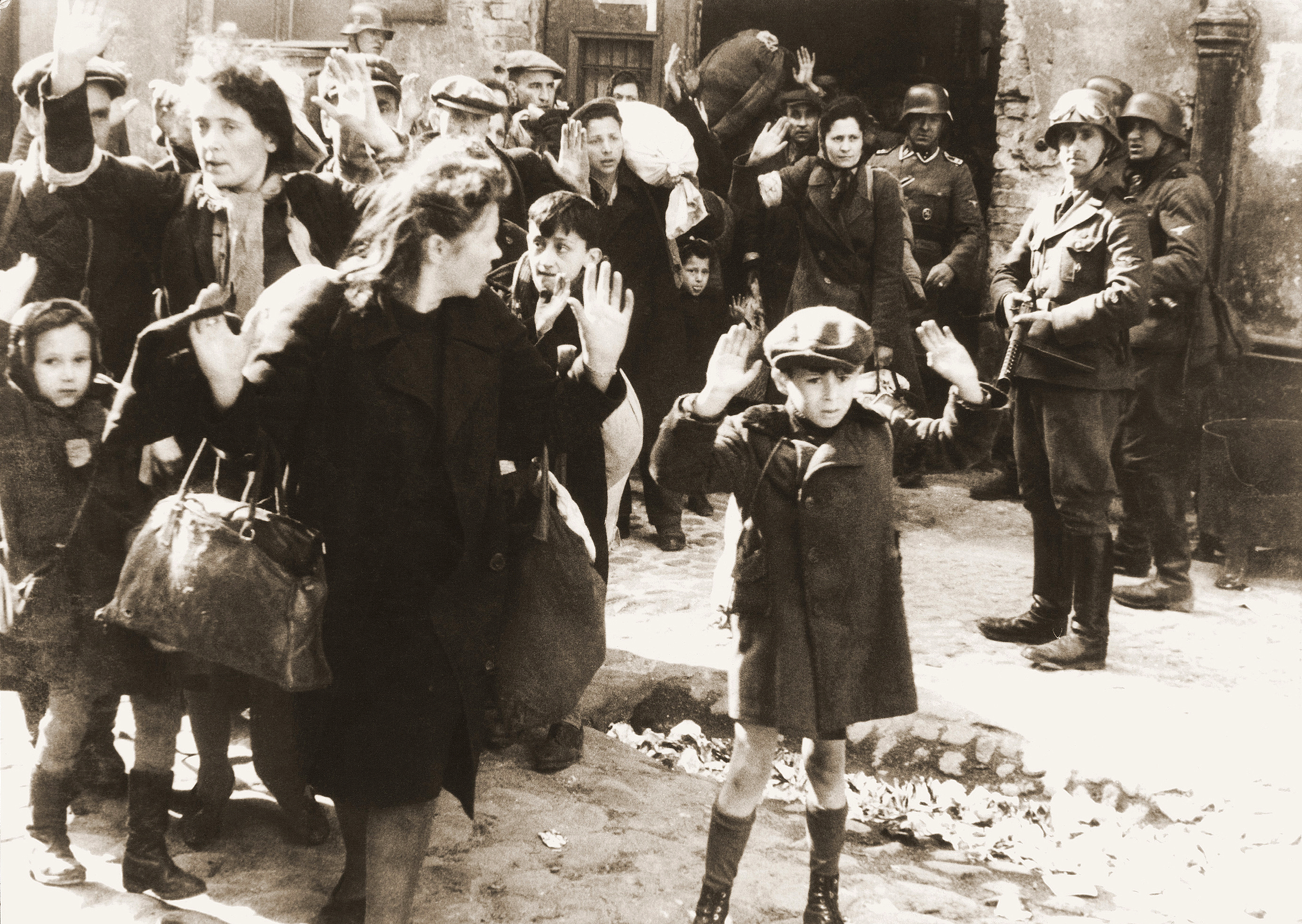
The most extreme manifestation of the apologetic Jew was seen during the tumultuous years of the 20th century, particularly in Eastern Europe.  Jews were shipped from pillar to post without any regard for their humanity.  This culminated in the biggest genocide known to mankind, the Shoa.  It was contended by many, that Jews went to the gas chambers like "sheep to the slaughter', an accusation that does great injustice to the massive resistance that was instigated by Jews over the years of the Shoa.  A picture that was widely distributed as representing the plight of the Jews at that time, has also contributed to the view of the apologetic Jew.  The picture, believed to be of young Tsvi Chaim Nussbaum in the Warsaw Ghetto, tells a thousand words.  This was the apologetic nature that many Jews such as Zeev Jabotinsky wished to try eradicate from the Jewish psyche.  Jabotinsky used the example of Joseph Trumpeldor as the new type of Jew for his people to aspire to emulate.

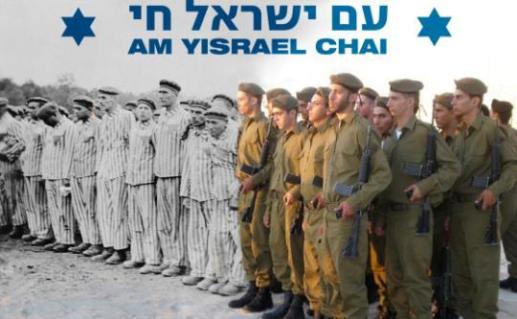
The new type of Jew was born in 1948 with the declaration of independence of the State of Israel, the Jewish state.  With the knowledge that Jews would never again be homeless, there was no longer the need to pander to the host countries in which Jews had lived in fear for so long.  The Jewish army not only defended the safety and security of the Jewish state against the odds, it also protected and defended the rights and existence of Jews wherever they were around the world.  Jewish confidence grew, and the need to be the weak and apologetic Jew was eradicated.

Despite 66 years having passed since this earth-shattering event in the Jewish world, and despite there being clear evidence that the Jewish state has truly given rise to a new type of Jew, we still find evidence of the apologetic Jew in our midst.  Our brave IDF soldiers, true examples to Jews and non-Jews around the world, are the epitome of the new type of Jew.  They volunteer to take on difficult and dangerous tasks to defend our state and our people, they are unafraid to go into battle when called upon to do so, they are as patriotic and proud as any Jew in history, while ensuring that they are humans at all times, even in the heat of battle.  They are everything that Jabotinsky dreamed of, and more.  And yet, this humanity has allowed the old, unpleasant apologetic characteristic to creep back into the psyche of our people.

Never before has an army been built with the strength and determination of the Israeli army.  This army is considered to be one of the strongest in the world, and perhaps even the strongest on a man-for-man basis.  And yet, one of the key characteristics that the army demonstrates, as part of the application of the Jewish values upon which it is built, is also regarded as a key weakness.  The Israeli army has always gone out of its way to avoid civilian casualties, almost at any price.  It is well documented that the Israeli army has called off important military strikes, and changed battle plans at the last minute, in order to avoid civilian casualties.  The enemy has responded accordingly - by fighting entire wars in civilian clothing using civilian neighbourhoods to fire missiles from, and using civilians as human shields.  All of this is done in the hope that Israel may be dissuaded from taking certain actions, due to its principle of avoiding civilian casualties.  And if civilians become involved in the battle despite Israel's attempts to avoid this, the Palestinians stand ready with their access to the international media and social networks, to advertise that Israel targets innocent civilians.  This has led Israel to adapt its way of engaging in battle, in order to be ready to justify every action that it takes and every attack that it launches.

Instead of using the obvious big picture that shows Palestinians using tactics to draw Israel into a battle involving civilians at every opportunity, Israel has become defensive and, dare I say it, somewhat apologetic.  We see movies from the battleground showing pilots calling off critical attacks at the last minute due to the entry of a civilian to the area.  We see Israel spending millions of dollars in developing defensive systems to shoot down missiles that are fired towards its own civilian population, instead of the easier and cheaper option of simply annihilating the location which is the source of the rocket fire.  And when there is a necessity to attack areas that are known to house civilians, Israel uses personal telephone calls and SMS messages to warn civilians to leave the area.  The fact that the Palestinian leadership forces civilians to remain in these areas despite Israel's warnings, never seems to be taken into serious consideration as a crime against civilians despite Israel having to endure huge criticism for its so-called targeting of civilians.  Instead of being recognised for is efforts to act in a humanitarian way, it seems as though these actions attract more criticism.  In turn, Israel has become increasingly defensive about the way in which it operates.  Instead of being proud of what we have achieved on the battlefield and the humanity that we show, Israel is constantly trying to disprove the accusations that are levelled against it and is always concerned about the prospect of having to defend its accusations at the International Criminal Court.  Entire teams of people are deployed to justify Israel's actions to the world in anticipation of the criticism after the fact.  This would seem to be a very defensive position to take, and perhaps even invites criticism.

Israel is a democracy that allows people to use their seats in the Knesset to plot subversive activities against the security of the state, and gives citizenship and social benefits to the families of people who have carried out terror activities against innocent citizens of the country.  It gives free access to religious sites, even to those who come to cause unrest and are open in their desire to eradicate the Jewish state and the Jews who live in it.  The original concept of the Jewish state was to have a democracy, and to allow others to be welcome to live in it in the way that Jews were denied during the period of exile.  Despite having achieved this and a great deal more, Israel is constantly being accused of being an apartheid state.  Israel is the most criticised country at the United Nations Human Rights Council, and is forced to answer to human rights accusations posed by countries that are not democracies, and that kill hundreds of people each year as part of their policy of capital punishment.  Israel finds itself treading carefully in the international community, almost apologetically, to avoid running the risk of being accused and singled out once again.

The unjustified attempts to make a scapegoat out of Israel are clearly fuelled by anti-Semitism.  The plight of the innocent Palestinians, who suffer due to the policies and actions of their own leadership and not because of Israel, has served to effectively make anti-Semitism politically and socially acceptable.  Left-wing groups around the world have united in support of the downtrodden Palestinians, something that is a worthy cause to support.  The Palestinian leadership, who is to blame for this situation, conveniently deflects the blame onto Israel.  This, in turn, provides an open season for those wishing to make anti-Israeli and anti-Semitic comments and actions politically acceptable and even correct.

I am concerned that Israel's over-sensitivity and apologetic response may well be further enabling those who seek to discredit and destroy her.  I often wonder whether it would not be better for Israel to take a tough, unapologetic stand that shows pride in all her actions, while requiring to be held to the same standards as all others within the international community.  Perhaps this would reduce the level of international attack that she is under.  After all, Israel has every right to feel proud of what she has achieved.  She has been at constant war and under constant attack for the 66 years of her existence.  And yet, she remains concerned about not harming the innocent civilians of her enemies.  This must surely be a first in international warfare.  Let us not forget the bombings carried out over Dresden, Hiroshima and Nagasaki, to name but a few.  Where were the recriminations for those actions, and the actions at the International Criminal Court?  How would those who criticise Israel have responded to 66 years of constant warfare?  I doubt that any other nation on earth would have acted with the same humanity as Israel has, given the same circumstances.

I believe that the time has come for Israel to change its approach in the international community, and for her to be prepared to stand more firmly behind her actions and behaviours.  By being less apologetic, it is my view that the international community will also respond differently.  Being nervous of the international reaction and showing even the slightest doubt about the justification of the actions simply invites attack and criticism.  I hope that Israelis will continue to be very sensitive about all actions and responses to the threats to her security and existence, and will always behave with humanity.  But Israel, and those who live here, should be apologetic no more.

Thursday, 4 December 2014

Is the "Jewish State" Bill Really Needed?

The Israeli government decided last week to submit the so-called "Jewish State" bill for consideration to the Knesset to be incorporated in the Basic Law.  The decision by the government to approve this law has proved to be enormously controversial, both within Israel as well as by the international community.  There are many questions about whether the Jewish State bill is really needed in Israel at this time, whether the bill is really required at all, and whether the introduction of such a bill will make any difference to the facts on the ground in Israel?

The main purpose of the Jewish State bill is to enshrine in Israel's Basic Law (which acts as a type of constitution in the absence of an official constitution) that Israel is the national state of the Jewish people and that Israel is a Jewish state.  Despite the fact that there are various references in different Israeli laws to the Jewish nature of Israel, and despite the fact that it is mentioned in the Declaration of Independence, members of the government have deemed it necessary and appropriate at this time to entrench it in the Basic Law.

While the proposed bill has yet to be passed into law, it seems as though the proposed bill in its current form will not make any difference to the way in which Israel operates.  Israel has always been governed as a Jewish state.  This manifests itself in a number of different aspects of Israeli everyday life.  National holidays are according to the Jewish calendar, the day of rest is Saturday while Sunday is a regular school and working day, Jewish religious law is applicable in certain situations specifically those relating to family matters, and people with one Jewish grandparent are entitled to claim immediate citizenship of Israel under the Law of Return.  None of these aspects of Israeli society will change as a result of the Jewish State bill.  It is anticipated that all matters that relate to the Jewish nature of Israel will continue to apply in the same way as they have applied until now.

Some of the Jewish aspects of Israel have been controversial, in a country that prides itself on its democracy.  There are those who believe that the Jewish nature of the state is a contradiction to democracy, due to the fact that these aspects disadvantage non-Jewish citizens of the state.  Despite the fact that all Israelis, Jewish and non-Jewish, are entitled to vote, are entitled to be a member of Knesset, have the right to freedom of speech and receive state education and health, there are many who feel that the Jewish nature of the state discriminates against those who are not Jewish.  As a counter-balance, non-Jewish citizens are not obliged to be conscripted to the army while young Jewish men and women are mostly required to sign up.  Non-Jews are free to volunteer for military service, and many choose to do so.  The question is whether these points of law, that favour Jews over non-Jews, result in a democracy that is not really democratic?  How does this compare, for example, to affirmative action that has been employed in a number of democracies around the world.  It is contended that favouring one group or race over another, even where this is designed to correct wrongs in the society, is an undemocratic policy.  Does this make the entire country undemocratic?  In cases outside of Israel, employing policies that may be considered questionable on a purely democratic scale, have not resulted in the country's democracy being called into question.  By the same token, it is my view that the Law of Return and the Jewish nature of the state, do not change the fact that Israel is a real democracy,  the only one in the Middle East.

If this is true, why would there be such opposition to formally adopting a Jewish State bill?  Many people believe that the idea of reinforcing the Jewish nature of the state is, in itself, not objectionable.  The problem for them is that the draft bill does not specifically balance this out against the democratic nature of the state.  They object to the bill for its form rather than for its substance.  These objectors wish to see some open statements in the draft bill to reinforce the democracy of the State of Israel, while also confirming the Jewish nature of the state.  For other objectors, their opposition comes to the timing of the introduction of the bill.  Israel is currently experiencing a wave of terror attacks that some are calling the start of the third Intifada.  Israel has been criticised for events that have taken place on the Temple Mount in Jerusalem, and some have even accused Israel of attempting to change the current modus operandi of the Temple Mount.  The situation is extremely sensitive, and there can be no doubt that the introduction of such a bill at this time contributes to stirring up this sensitive situation.

What is the reason behind Prime Minister Netanyahu's desire to introduce the Jewish state bill at this time?  Perhaps it is about countering the current Palestinian violence and uprising that is being experienced in Jerusalem and other areas.  The prime minister has been known to take unilateral steps against the Palestinians to counter the unilateral steps that the Palestinians take.  I believe that it runs deeper than that.  We know that the peace talks between the Palestinian Authority and Israel are currently stalled on the issue of the recognition of Israel as a Jewish state.  Prime Minister Netanyahu has insisted that Palestinian Authority President Mahmoud Abbas acknowledges this fact before the talks can move forward.  Abbas has failed to do this, and the talks are stalled.  Netanyahu has come under criticism in the international community for this position, and it is presented that this is his own demand that has been made without justification.  By passing this into law, Netanyahu can turn this argument around by saying that this fact is now in Israel's Basic Law.  Failure to recognise this on the part of Abbas is tantamount to denying a fundamental tenet of the State of Israel.  Have the Jewish State law on the books may cause further delays to the peace talks, but may also help to clear the logjam and progress the talks.  Abbas will be forced to turn to his people to say that he has no choice where this is concerned because it is a law of the land, and not a whim of Netanyahu.

The Jewish nature of Israel is undeniable.  This was clear to those who escaped the ashes of the Shoa and found Israel to be the only place that Jews can really feel safe, and it is clear now when anti-Semitism is rife around the world.  Members of other religions have more than one country in which they can to choose to live, that will give them the religious freedom that they desire.   Jews only have one.  It is inconceivable that the Jewish nature of Israel can be denied, in the same way as the democracy of the State of Israel cannot be denied.  The fact that some members of the international community are questioning the concept of the Jewish State bill, is perhaps enough reason to insist that it be passed into law.  We have an obligation to future generations of Jews to ensure that the Jewish nature of Israel can never be denied, not by those who live here and not be those who do not.  Israel will always be the safe haven for Jewish people, and placing this on the law books is a natural extension of the intentions  of the founding fathers of our country as set out in the Declaration of Independence.  It also reflects the views of the majority of those living in Israel, including many of those who are objecting to the introduction of the bill for technical reasons.

I do not believe that balancing the Jewish State bill with statements reinforcing Israel's democratic nature, dilutes the statement of the Jewish nature of Israel.  As such, it seems sensible to balance the statement out in order to gain wider support in favour of the bill.  Those non-Jews who wish to accept these principles upon which Israel is premised, are welcome to live here and enjoy our democracy.  Despite the fact that the bill will change little or nothing on the ground about the way that Israel operates, I personally support having this on the statute books and including it in the Basic Law.  After all, it is one of the fundamental premises upon which the State of Israel was built, and upon which the state continues to be built.  And we should not be ashamed to say so. 

Friday, 15 August 2014

Sunday Times Shame

We, as South African Jews, are appalled and devastated by
Israel's assault on Gaza.


This was the headline to a half page advert taken out in the Sunday Times in South Africa on 10 August 2014.  The advert is signed by "500 Jewish South Africans for peace, democracy and human rights in Israel and Palestine", some of whom asked to remain anonymous out of concern that they or their families have faced or may face intimidation or marginalisation by members of our Jewish community.

I read the text of the advertisement carefully a few times.  There are certainly more than a few points that I could take issue with.  The text is worded in such a way to lead the reader to believe that the Israeli actions that are criticised by the signatories, were the first actions taken while the Palestinian actions were retaliatory.  The Palestinian casualties of Operation Protective Edge are mentioned as the headline, followed by Israeli casualties.  There is no context offered that demonstrates that reality of the Israeli attacks coming in retaliation to constant, indiscriminate rocket-fire towards Israeli civilians over a number of years.  Whose statistics show that 70% of the Palestinian casualties were civilians?  This needs to be questioned and verified before it can be used as a statistic to justify a petition of this nature.  Who could be foolish enough to suggest that Israel's actions are "disproportionate"?  Not only does Israel have the right to defend her civilians against the constant barrage of rockets that they have been forced to endure, Israel has the obligation to do so.  Even when discounting the more than 3,000 rockets fired towards Israel during Operation Protective Edge, there are statistics to show that the last 5 years have seen 4,500 missiles fired from Gaza towards Israel.  I wonder what "proportionate" response another sovereign government would deem appropriate under these circumstances.  It seems disproportionate to use this term against Israel, when it is clear that the same threat against another country would be taken care of in a much stronger manner in order to end the threat without a further consideration.

My main objection to this advert is not what is written in the text, or the fact that many of the signatories are not even Jewish despite holding themselves out to be.  My objection is the aggressive way in which it has been drafted, and the fact that it was found appropriate for these supposedly proud Jews to air their grievances against Israel in this public and critical manner.  I respect the fact that people have empathy for innocent civilians, and for suffering brought upon them through no fault of their own.  I even respect the rights of each Jew to have critical views of Israel, and for them to have the right to freely air their views.  My problem is that this advert goes a lot further than these rights to hold independent views, and to freedom of speech.

The signatories to this advert found the necessity to show non-Jewish South Africa that there is a split within the Jewish community, and to demonstrate the extent to which Jews in South Africa oppose Israel.  If they were trying to show their objections to their Jewish colleagues, there are surely different and less damaging ways of achieving this.  By taking out a large advert in a national newspaper read predominantly by non-Jews, I understand that their message of objection to Israel was directed towards a wider audience than simply the Jewish community.  Why is this?  Are they hoping that their business customers and colleagues will see that they are on the anti-Israel list, and therefore continue to give them business support?  Is it because they hope that they may not be shunned by their non-Jewish friends who may otherwise isolate them for supporting Israel?  Are they afraid that the politicians and influencers in the country may assume that they are Israel supporters, and that they may lose their influence and access as a result?  I fail to understand the need to go out and have your name attached to a public statement of this nature.

Anti-Semitism around the world has been fanned by Operation Protective Edge.  Countries around Europe are all reporting substantially increased levels of anti-Jewish (not necessarily anti-Israel) behaviour, and threats to the local Jewish communities are much greater than before.  Chants of "Hitler was right", are being heard and tolerated on streets and squares around the world, including in South Africa.  Jews in the diaspora are clearly under attack.  I don't believe that Operation Protective Edge has suddenly created new anti-Semites who, previously, loved Jews.  Instead, I believe that the environment of vitriol and hatred towards Israel fanned by the latest Gaza operation has made it more acceptable for people to show their anti-Jewish sentiments in public.  Whereas swastikas were reviled and considered to be an attack on humanity over the course of many years following the Shoah, we see them openly advertised and tolerated in public as never before.

The public advertisement in the Sunday Times is a clear demonstration to our enemies of a split within the ranks of the Jewish community.  There may only be 500 signatories to the advert, and many of them may not even be Jewish.  It sends a message, however, of disunity and weakness within our community at a time that we need to be united against the evils of anti-Semitism.  And while this does not require us all to agree with each other on points of substance, and even not on points relating to the way in which Israel chooses to defend herself and her citizens, it does require us to stand together against those who would wish to see the end to all Jews.  And it also requires an appreciation and recognition that Israel, with all her strengths and weaknesses, is the ultimate power in protecting Jews against the forces of anti-Semitism.  There are many anti-Semites who hide their true colours behind anti-Zionism when being anti-Israel is regarded as acceptable, even by "some of my friends who are Jews".

On a visit that I made to the Holocaust Museum in Amsterdam a few years ago, I was flabbergasted to learn how the smart  Nazi machinery was able to manipulate some members of the Jewish community to promote a message within their communities that assisted the Nazis in their cause.  Reading the Sunday Times advert took me back to that moment in Amsterdam when this penny dropped in my mind.  I had the feeling that this advert by Jews in our community was working in a way to assist our enemies to promote their anti-Semitic rhetoric.  I am sure that they cannot believe how this has fallen into their laps.

Former Jewish Agency Chairman Zeev Bielski acknowledged Israel's bad points, and summed up the situation for Jews around the world perfectly in a statement that he once made by saying, "If there was another Jewish state, I would advise you to go there.  Israel is the only Jewish state and, therefore, that is where I recommend you should be".  We know that Israel has made many mistakes over the years, and has questions that require answers.  Israel is, however, unrelenting in the way that she fights for her survival, fights for the safety and security of her citizens and fights to protect the rights of Jews around the world.  It would be fitting for Jews around the world to show an element of loyalty to this cause by being selective in the way in which they air their grievances about Israel.  It is acceptable to be critical of Israel's actions, as long as you are sure that you have all your facts right.  It is acceptable to hold discussions and debates (apparently we have some of the country's best debaters on our team) within our community to make their complaints known, and to invite those who disagree to respond.  In my view, it is unacceptable to take out anti-Israel adverts in national newspapers, in a way that weakens the fabric and the security of the Jewish community.  For me, this crosses the line.

Saturday, 9 August 2014

Open Letter to Josh Broomberg

The attached picture of Jewish South African high school students has outraged me and many others.   One student, Josh Broomberg, has issued a statement in defense of his actions.  Below is his statement, which is followed by my open letter to him in response to these events:

For those of you reading this, my name is Josh Broomberg. I am the currently the Deputy Head Boy of King David Victory Park and the Captain of the SA National Debating Team.

What follows is my statement regarding the recent controversy over my stand against the human rights abuses currently being perpetrated against the citizens of Gaza.

Firstly, I would like to apologise. It was not intended to create the uproar it has, it was not designed to offend or upset. Because this has occurred, I apologise. But what I will say is this:

I am proud to be a South African Jew, and I am proud to attend a Jewish Day School. I am also a Zionist. I believe in Israel’s right to exist, and her right to defend herself from the threat presented by those seeking to hurt her citizens. All citizens of Israel, the West Bank and Gaza have the absolute right to live in peace and security.

It was with this in mind that I, and my team, chose to take the stand we did. It was not about politics, or about states. It was about humanity. We stand with the thousands of civilians who have lost their lives in the conflict. We stand with a people who do not yet have a state to protect themselves. We stand with the innocents. We stand for two states. We do not stand against Israel. All of this applies to me personally as well.

While I apologise for the hurt we seem to have caused, I do not apologise for standing with Palestine on this issue. This is not because I do not believe in Israel or its people. I do believe in Israel, and I take this stand because I can love and suppoprt the state of Israel but still reject and criticize some of its actions. In fact, I consider it my duty to contribute to the growing worldwide discussion surrounding the desperate need for a quick end and lasting solution to this pernicious conflict.

In my eyes, this criticism is not a betrayal, but actually the only honest and true way to show my patriotism and commitment to Israel, as well as my belief in human rights and the entitlement of all citizens of all countries to those right. To improve, we must criticise.

I will note, explicitly, that our support and sympathy also lies with the innocent Israelis exposed to threat at the hands of terrorists. The conflict is a tragedy for all, and once again, all innocent life is equally valuable.

We took a stand for the thousands and for those without a voice but we do not for a second condone any violence what so ever. We stand for peace.

Most importantly, the issues are complex but we can never let go of the ability to talk and engage with the other side. if we lose this ability we lose our claim to be an enlightened community. We lose what it means to be human.

I am proud to bear the responsibility of continuing the discussion.

Josh Broomberg


Open letter to Josh Broomberg from Anthony Reich

Dear Josh,

I have been following the unfortunate events surrounding your appearance in public with a Palestinian scarf around your neck.  I have also read your statement following these events.  In my view, your statement serves to confuse your position rather than clarify it.  You have managed to get yourself into a very unfortunate set of circumstances.

How can you honestly state that you did not intend to create an uproar or to offend or upset?  How can you say that “it was not about politics, or about states”?  Your apology, based as it is on this absurd statement, is extremely difficult to accept.  What did you think could be interpreted from a boy posing as a representative of KDVP, with a Palestinian scarf draped around his neck?  If you are sincere about standing with humanity, you have numerous other ways to do so.  By choosing this particular “humanitarian” gesture, you are clearly making a statement which is highly charged and highly political.  Perhaps it would be more honest for you to acknowledge that taking a political stand of this nature was a big mistake on your part.

As a former South African living in Israel for the past 16 years, I believe that there are a few important points that you may wish to consider about the conflict between Israel and the Arabs who now call themselves Palestinians.   It may surprise you to learn that most Israelis have a great deal of sympathy for the innocent Palestinian civilians, who are probably the greatest victims of this conflict.  Despite this fact, you will not find them parading with Palestinian scarves around their necks.  Doing so demonstrates support for the political cause and for the Palestinian leadership, rather than for the humanitarian difficulties experienced by innocent civilians.  Support for the politicians and their cause is the position that you are clearly taking by your actions.  We pity the Palestinians because of the way in which their own leadership treats them.  Whereas the Israeli civilians under fire have a government and an army that make every effort to protect them wherever possible, the Palestinians do not.  Not only does their leadership not take any action to protect them at all,  their leadership actually uses them against Israel.  This is because they know that Israelis care more about the Palestinian children than they do.  They know that Israeli pilots will rather not release a bomb from their plane if they know that it risks injuring innocent people.  The fact that this decision could cost Israeli lives in the future due to the rocket launch site being used again to launch further missiles, does not enter into their immediate consideration.  Where is your protest against the lack of humanity shown by the Palestinian leaders against their own people?  Where is your acknowledgement of the IDF field hospital that has been set up on the Gaza border to treat Palestinians injured in the conflict?  Where is your protest against the fact that their leaders are preventing them from taking advantage of this treatment, but also not offering alternative methods of treatment?

Although we have infinite sympathy for the innocent civilians, we do not feel the same for their leadership.  These are individuals who feel no qualms about allowing their own children to be strapped with explosives in the name of being martyred.  If this is how they treat their own children, how can we expect them to respond to ours?  Whereas they rejoice in the fact that their children have been martyred for the cause, we grieve for each and every Jewish life lost.  Whereas they spend all their foreign aid on building an infrastructure to attack and destroy Israel, even if this means that their children go hungry, we spend our money on building bomb shelters and developing the Iron Dome so that our children will be safe and sound.  Whereas we think twice and three times before taking action that could hurt their innocent civilians, they throw their children in the path of our bombs to gain world sympathy and PR advantage.  And they fire their missiles aimlessly into the centres of Israel’s most densely populated civilian areas.  These are facts that have been proven on more than one occasion.  Whereas we are prepared to take a risk in order to allow them the opportunity to prove that they are sincere about the “two states for two peoples” concept, they use every opportunity to destroy us so that they can have all the land, Jew-free, for themselves.

Please do not be fooled into believing that this is about the “occupation”.  This is about the future existence of a Jewish homeland.  The words in the charter of the PLO and in the Hamas charter, stating that their objective is to completely destroy the State of Israel seem blatant enough.  If they are not, the events in Gaza over the past 9 years should be clear enough for those who are interested to listen.  We all know that the Palestinians only arose and claimed the West Bank and Gaza as a Palestinian homeland after Israel captured these territories in the Six Day War of 1967.  Until Israel had possession of this land, there was never a reason for them to lay claim to it.  When the Israeli government turned Gaza over to them on a silver platter in 2005, we all hoped that times had changed and that they would use the opportunity to build on the two states for two peoples.  Instead of grabbing the chance to really build a state and a future for their people, they have spent millions of dollars and 9 years to build an infrastructure that is designed to attack and destroy Israel.

In wars and conflicts, you cannot support both sides.  You cannot bat for both teams.  At best, you can be a disinterested, objective bystander that takes neither one side nor the other.  More likely, you will take the side of one of the parties in the conflict.  When taking a stand, you are by definition in opposition to the second party to the conflict.  Despite your nice words about believing in Israel’s right to exist and her right to defend herself, you chose to don a Palestinian scarf at a time of war in Gaza.  You cannot sympathise with Israel, and appear with a Palestinian scarf around your neck at the same time.  Your actions speak much louder than your words.  When it came to making a public statement, you chose the Palestinians at the expense of Israel.  Why do you feel that it is acceptable to say that your “sympathy also lies with innocent Israelis exposed to threat at the hands of terrorists”?  Why does your sympathy not lie primarily with innocent Israelis, who have taken the risk time after time to search for the elusive path to peace in our land?  After all, these are your people.  These are the people who will look after you in the event that you may, G-d forbid, find yourself in serious trouble.  When you turn up at Ben-Gurion airport with your parents’ ketuba in your hand asking for citizenship of the Jewish homeland, they will not remember that you appeared in public with a Palestinian scarf.  You will be welcomed home to your ancestral homeland like all other Jews.  The Palestinians, for whom you stood up so brazenly in public, will also conveniently forget your scarf when they are searching for Jews to annihilate in the search for their version of the “final solution”.  Remember that, like you, the vast majority of Israelis seek peace and not war.  Unfortunately, this is a war that we are forced to fight, rather than doing so by choice.  Even when forced into something against our will, our new type of Jew does not shy away from this challenge.  We are brave and willing to do all that is needed to protect ourselves.  We are determined to succeed.  Your actions insult thousands of young men and women of the IDF (including my own sons) who go out of their way to fight a war in the most humane and humanitarian way possible, and whose actions give you the freedom to be a Jew representing your country in debating competitions in safety around the world.

You are most fortunate to have been born into a world that has a Jewish homeland.  I feel sure that your grandparents and great-grandparents would have wished to do all that they can to make you understand what it was like to live in world without one.  This privilege that you have, is also the one that allows you to live in relative safety and security as a Jew in your bubble in Victory Park.  It allows you to have a comfortable life in the knowledge that you have somewhere to fall back to in the event of any emergency.  Beware of taking this for granted.  Anti-Semitism is ever prevalent around the world.  The only force that prevents anti-Semites from destroying the Jews as they tried to do during the Shoah, is the State of Israel.  My recommendation to you is to appreciate, value and protect this huge asset.  Be grateful to those who are prepared to risk and to give their lives in the interests of ensuring that our Jewish homeland continues to exist, and continues to strengthen.  Do not be misled and misguided by those in the international press who confuse you into protecting our enemies at the expense of our Jewish state.  Her actions are not always perfect, and there is a great deal that you can criticise.  But nobody is perfect and no country is perfect.  If you search for faults, you will surely find them.  But be grateful and proud for the wonderful things that have been achieved, and for the way in which Israel gives all Jews around the world the backing to live as proud Jews wherever they are.  Israel will always protect you, and will give you much to be proud about.

Try to envisage for a moment what would happen if Israel unilaterally laid down its arms today, and refused to fire another bullet or missile.  Now try to envisage what would happen if the Palestinians did the same thing.  Which situation do you think is most likely to lead to peaceful coexistence between the parties?

I cannot hide the shame and anger that I felt in seeing you grab your five minutes of fame with that scarf around your neck.  You have shamed yourself, your family, your school and your community in my eyes, and in the eyes of many others.  You have misused your position in an unforgivable way.  I hope that, one day, you will have the huge honour to experience life as Jew in Israel, and will be able to understand the error of your ways.  Only when living here can you really understand the significance of what you have done.  I never wish you to lose your sympathy and support for the weak.  This is a characteristic that Jews have, and should be proud of.  But this should not be confused with the insult that you have dished out to Israel and her people by your actions at this time.  Shame on you.

Regards
Anthony Reich