Showing posts with label Jewish Leaders. Show all posts

Tuesday, 14 April 2020

Leading By Personal Example

Attribution:  United States Department of State
 The problems that we have had in holding Israel's leaders to personal accountability is not new.  The notion that politicians are above the law and not subject to the same rules as everybody else is unfortunately one that pervades Israel's political system.  This has reached the highest echelons in the hierarchy with a former president and a former prime minister having already served jail time for criminal offences committed.  The current list of charges levelled against Prime Minister Netanyahu do not help in any way to restore our faith in politicians and their behaviour.

Against this backdrop, little should surprise me in the way of politicians and leaders misbehaving.  And yet, some things over the past few weeks have surprised me into giving this matter some further thought.  My disgust has finally reached levels that have compelled me to air my thoughts in public.
Attribution: Kobi Gideon / GPO Israel

I was absolutely horrified at the inaction of the ultra-Orthodox leadership on the issue of the Coronavirus, both in Israel and around the world.  While doctors, scientists and international leaders were pronouncing the necessity of social distancing as a way to avoid the spread of the virus and to save lives, the leaders of the ultra-Orthodox community were imploring their followers to continue life as usual.  Their communities were advised to continue to attend wedding parties, brit celebrations, attend shiurim and study classes and to pray in a minyan, a quorum of at least ten men.  This extended even to Israel's Minister of Health, Yaakov Litzman, himself a follower of the ultra-Orthodox Ger Hasidic dynasty.  Soon after appearing live on the news laying down legal restrictions on the number of people allowed to gather in any place, he was attending wedding functions that hosted many more than the permitted maximum that he had earlier been responsible for imposing upon the nation.

By the same token, Rabbi Chaim Kanievsky, one of the senior leaders of the Israeli Haredi community, refused to consider the pleas of the civilian authorities for social distancing.  Instead, he instructed his followers to continue to pray in a minyan.  A number of weeks after the social distancing rules had been implemented in Israel, he was finally convinced to instruct his followers not to pray in a minyan.  In spite of this,  he was seen praying in a minyan himself at his home in Bnei Brak not long after that.  These life-threatening actions not only violated laws of the land that he lives in, they also directly contradicted his own instructions.  Perhaps, more tellingly, the act of endangering humans and taking action that could threaten human life goes against the highest-ranking principle in the religion of preserving human life at any price.

Prime Minster Netanyahu appeared on prime time TV on two separate occasions to prepare Israelis for the Pesach (Passover) holiday.  He told the nation that the government had taken decisions that would not allow Pesach to be Purim.  It was believed that Purim parties were attended by many carriers or sufferers of the Coronavirus, perhaps unknowingly, and were a source of many secondary infections.  The Pesach Seder is usually a time when friends and family gather together to celebrate the start of the holiday.  But not this year, said the prime minister.  "A small Seder is a healthy Seder", were his words on TV to convince people that they would be allowed only to celebrate the Seder at their registered place of residence and in the attendance of their nuclear family.  A full lock-down and curfew was imposed on the whole country to prevent anybody from venturing more than 100 metres from their residence on Seder night.  Police were deployed across the country to enforce the lock-down in the most determined manner possible.  Apparently, that applied to everybody except for members of the families of the prime minister himself and the president of Israel, who both hosted family members who were not part of their immediate household for Seder night.  Yisrael Beiteinu leader Avigdor Lieberman was also apparently exempt from the restrictions after it was alleged that he hosted members of his family at his Seder who do not live in his household.


Health Minister Yaakov Litzman was forced to pay the price for his indiscretion having contracted the Coronavirus and passed it onto his wife.  He also succeeded in sending many members of the Ministry of Health into self-isolation to prevent them from the possibility of passing his virus onto other unsuspecting and innocent people.  Just at a time when the Ministry of Health needs all of its team at their healthiest, most available and strongest to fight the greatest health crisis in living memory.  And, while we wish the Netanyahu, Rivlin and Lieberman families good health in spite of their indiscretions, their actions are clearly unforgivable under the circumstances that we find ourselves.  Gushing apologies and excuses were naturally forthcoming, but this falls well short of the behaviour that we expect from our leaders.  We particularly expect more from those who stand in front of the TV cameras advising what people will be forced to do, at risk of fines or even prison sentences, then go about doing exactly the opposite themselves.  Leaders in earlier times were forced to resign and vacate their office for infringements far less serious than these.  I do miss the days of leaders who are held accountable and responsible for their words and actions.

This sorry episode demonstrates a two-tier system that spells future disaster for any country.  If the leaders are unable to adhere to the rules, how can they expect other citizens to do so?  The simple answer is that they cannot.  The leaders set the tone for how others will behave.  Actions speak louder than words, and it is impossible to expect that ordinary citizens will not follow suit in their actions too.  This ultimately creates an environment where the unacceptable will become acceptable by virtue of common infringement of the laws.  Time has come for a return to leaders who not only set the rules, but adhere to them as well.  If not, our society will unavoidably fall into decline.

Wednesday, 8 April 2020

A New Modern-Day Plague

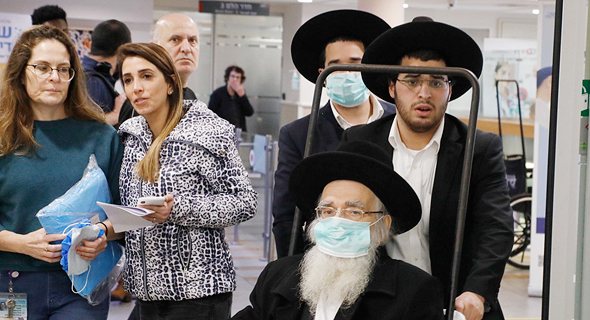
Image from calcalist.co.il
We are entering the Pesach (Passover) holiday in the midst of the greatest health challenge that the world has had to confront in living memory.  The Coronavirus epidemic has changed the world that we know in so many different ways.  It is almost difficult to see how things can ever go back to the way that they were a few months ago.

In Israel, in spite of having gone into lock-down at a relatively early stage of the outbreak of the virus, we are now having to deal with an infection rate in some ultra-Orthodox areas which is threatening to infect as many as one third of the citizens living there.  The government has already placed the city of Bnei Brak into a quasi-military rule in attempt to stem the further spread of the infection, and other neighbourhoods and towns are set to follow suit.  Much has been written about how it has transpired that the ultra-Orthodox neighbourhoods in Israel, and indeed in other parts of the world, have become disproportionately infected by the Coronavirus.  Most of the theories range from the fact that this element of the population is disconnected from much of what surrounds them, including news media and online information.  These theories also discuss the fact that instructions are only respected when they come from the community's Rabbis, rather than from secular or governmental authorities.  And the fact that the Rabbis are generally reluctant to quickly assimilate the assessment of the civilian authorities, when they prefer to allow their religious-based responses to take effect.  In this case, the Rabbis ruled to keep schools, yeshivas and places of learning open when the government ordered them closed.  The Rabbis insisted upon praying in the presence of a minyan (a quorum of ten men) when the laws of social distancing implemented by the government prevented this.  Additionally, functions to celebrate weddings and other family events were ruled to continue when the civilian authorities decided that these presented a risk to life and limb.  One of the most recognised leaders of the ultra-Orthodox community in Israel, 92 year-old Rabbi Chaim Kanievsky, was found to be praying with a minyan at his home as recently as last week in spite of having finally publicly ordered his followers not to do so.

As a result of these actions and inactions, Israel heads into the Pesach holiday period with great uncertainty.  It seems as though the huge number of people who were recently diagnosed as suffering from the Coronavirus from the ultra-Orthodox community have set us on an irreversable track to a medical catastrophe that will result in tens, possibly hundreds of deaths from the virus in the coming weeks.  It is ironic that this is set to coincide with the first few weeks of the counting of the Omer (the 7 week period that links Pesach to Shavuot) during which it is traditional to observe rituals of mourning.  The reason for the observation of these mourning rituals is because of the events that took place in the first century AD when 24,000 students of Rabbi Akiva died in a plague.  It is believed that they stopped dying on Lag B'Omer, the 33rd day of the Omer.  In a strange but very sad and unfortunate déjà vus, we are on a path to relive this to some degree, although hopefully not nearly to the same extent.  The reason that is commonly given and widely believed for the death of Rabbi Akiva's students is lashon hara, the speaking of negative things behind people's backs, whether true or not.  Lashon hara is one of the reasons being used as a way to explain why the world is having to endure the effects of the Coronavirus.

There can be little doubt that lashon hara is prevalent in all communities, is undesirable and is a problem in our society.  It is a problem that has been in evidence over the centuries, and seems very difficult to control or reduce.  It has been used to explain the occurrence of many disasters in Jewish history over the centuries, including the destruction of the Temples.  To me, on this occasion, it seems too easy to use this as an excuse for the current pandemic that we are suffering, and to explain the deaths of those who are suffering from it.  It is simply not acceptable to explain this as being because of lashon hara, and not to take a deep introspective view about the community's general lack of adherance to the orders of the civilian authorities.

There can be little doubt that the leaders of the community chose not to take note of the deliberate and highly-justified restrictions that were quickly imposed on our society to retard the spread of the virus.  They decided, in direct contradiction, to command their followers to continue to behave as before.  Word went out to keep shuls operating when others in Israel were closed, to keep schools open when others in the country were closed, and to keep operating as usual without consideration of the instructions by which everybody else was living.  This indicates that the leadership knew exactly what the civilian authorities were ordering, and they took their own independent decision to ignore these orders.  The Israeli minister of health, himself a follower and Rabbi from an ultra-Orthodox sect, should have brought the government's message to the ultra-Orthodox leadership and ensured that they followed the instructions in the same way as all other citizens in the country were required to do.  Instead, he stands accused of ignoring these instructions himself, and attending public events at a time when this was expressly forbidden by the government that he is a minister of.  The fact that he is also now inflicted by the virus cannot necessarily be inferred from this, but it is certainly shameful that he did not take heed of his own government's instructions.  More than that, the fact that he did not take it upon himself to bring this critical message to all leaders within the ultra-Orthodox community will surely hang as a black cloud over his head when the final death toll is tallied.  This is equally true of all senior leaders within the ultra-Orthodox community, who simply chose to ignore and contradict the expert opinions that are unanimous in their views that staying home saves lives.

When the dust settles on this set of tragic events and things revert back to some semblance of what we knew before, it is my sincere hope that lessons will be learned.  It is difficult for me to believe that the ultra-Orthodox community will not be affected by what is happening in their neighbourhoods now, and the disastrous mistake in ignoring civilian warnings and instructions.  The tension between them and the democratically-elected government in Israel has been one of the enduring stories of the State of Israel from its founding moments, and the current evens have the possibility of changing all of that.  In spite of the tolerance that has been shown to the ultra-Orthodox community by successive Israeli governments, including exemption from military service, government funding in a significantly disproportionate manner, incorporation of ultra-Orthodox parties in government coalitions and many other leniencies and concessions shown over the years, the ultra-Orthodox community has incessantly battled against governments and civilian authorities.  There are many within the ultra-Orthodox community who do not recognise the existence of the State of Israel and its government, while still being willing to accept social benefits from the state.  The sight of members of the ultra-Orthodox community screaming insults at Israeli police and accusing them of being Nazis, while police were instructing them to maintain social distancing in order to protect their own lives, is part of this tense and unacceptable relationship.  If the events surrounding the Coronavirus cannot change that, it seems that nothing will.  It is my hope that one of the most important outcomes of the virus and its effects, is a change in the relationship between government and ultra-Orthodox.  And a general change in the relationship between the ultra-Orthodox and other sectors of the population.  There is enough space for all of us to live with mutual respect.  Are my dreams unrealistic?  I hope not.

 The leaders of the ultra-Orthodox community have been exposed and shown up during the course of this pandemic.  Their refusal to take heed of the advice of scientists and civilian authorities has cost some of them their lives, and has cost the lives of many of their followers.  It raises a real question regarding the direction in which their leadership is taking their community.  Their advice on many real-world issues must surely now be in doubt.  I hope that the new generation of leaders that rise up following this episode will never forget the failures of their predecessors, and will find a way to do things differently going forward.

Chag sameach.


Saturday, 30 July 2016

The Legacy of Entebbe Lives On

Forty years have passed since the rescue of Jewish hostages was carried out by IDF soldiers at Uganda's Entebbe airport.  A number of events were held recently to mark the occasion, and to remember all that happened in the hijacking of the Air France plane, the separation of the Jewish hostages from the others and the ultimate rescue of the hostages in an astonishing operation by IDF troops.  With a heavy heart, the victims of this hijacking and rescue operation were also remembered and commemorated.  In total, 4 of the hostages were killed as well as the IDF commander of the operation, Lt. Col. Yonni Netanyahu.  Prime Minister Benjamin Netanyahu chose this opportunity to visit Entebbe for the first time, to personally witness the place where his older brother was killed.

Operation Thunderbolt  was renamed Operation Yonatan to commemorate its fallen commander.  With the luxury of hindsight to look back on this operation, the legacy that Operation Yonatan has left for Israel and its security establishment can be assessed.  This rescue mission was undoubtedly one of the most daring and audacious missions of its type during its day, and even since then.  It has been the subject of numerous books, movies and military case studies, such has been the level of interest into the operation.  Besides the audacity and sheer chutzpa involved in pulling off this operation, the tiny details that were taken into consideration and the very short period of time within which all the preparations were made, have served to elevate the mission to legendary status.

The ramifications of this operation in Israel, and in the Jewish world in general, have been profound.  The operation has elevated Israel's secret service, the Mossad, to be afforded greater respect and recognition by lay people and peers in a way that other secret service organisations do not enjoy.  Because much of the work undertaken by secret service organisations, particularly the Mossad, is secret by its nature and is seldom made public, it is difficult to measure the effectiveness and the successes of the organisation.  Operation Yonatan was a visible sign of success, not only for the IDF, but indeed for the Israeli secret service.  It was, after all, the Mossad who were responsible for much of the intelligence-gathering, and who were integrally involved in every step of the operation.  It was one of the few visible successes that the Mossad would be happy to be publicly associated with, and which served to demonstrate its amazing capabilities.  This operation (along with a few others), has given the Mossad the status of a legend in the secret service world.  Israel's enemies know that they should be on their guard to expect the unexpected.  They have learned from this that very little is beyond the Mossad's capabilities.  Not only does the Mossad have the ability to carry out these types of operations, it also has the audacity and fearlessness to do so.  That legend continues to the current day.  Frequently, when crazy and improbable "accidents" occur that impair the work being done by Israel's enemies, the Mossad is the first organisation suspected of involvement.  Despite the automatic suspicion of the Mossad and the close monitoring of its operations, it is extremely seldom that hard evidence can be brought to confirm involvement of Mossad agents in an operation.  Rather than causing the Mossad to operate with impunity or carelessness, it gives the Mossad the impetus to carry out more and greater operations in the protection of the State of Israel and Jews around the world.

The fact that Operation Yonatan rescued both Israeli and non-Israeli Jews has also left its mark.  There is no other country around the world, whose secret service operates to protect the citizens of countries that are not its own.  And yet, this is the hallmark of the Mossad, as borne out by Operation Yonatan, when it comes to the protection of Jews who are not citizens of Israel.  The reason that the hostages were separated in Entebbe as they were, had nothing to do with them being citizens of Israel.  Instead, they were separated on the basis of whether they were Jewish or not.  Exactly as was the case during the Shoah.  Clearly, the Israelis were automatically included in the group of Jews, but they were not alone.  When Operation Yonatan was carried out, it was carried out in the name of all the Jews in the group, whether they were Israeli or not.  This was further evidence from the government of Israel, and from the instruments of the government, that the country stands ready to help Jews from all corners of the earth.  This was cemented into law when the Law of Return was enacted to allow Jews to claim immediate citizenship of the State of Israel, and has been demonstrated in numerous rescue missions of Jews when they were considered to be in danger.  Operation Yonatan was another significant sign of this commitment.

Little has changed over the past 40 years in terms of the threat that confronts Jews, no matter where they happen to be in the world.  We have seen Jews establish a level of comfort in their host countries, only to come under threat again.  The latest wave of violence in Europe, and in France in particular, has certainly been directed against Jews.  It is with pride and confidence that the State of Israel reaches out to these Jews to offer them protection in their homes, but also to offer them a home with greater protection.  And we have seen these Jews take up on this in their droves.  This is, amongst other things, the legend of Operation Yonatan.  Wherever Jews are in the world, the Jewish state will protect them.

Perhaps the greatest legacy left by Operation Yonatan comes in a much more personal form.  The death of Yonni Netanyahu left a scar on his family, and left a profound mark on a 27 year-old MIT student.  This student was Benjamin Netanyahu, younger brother of Yonni.  In his own words, the death of his older brother, "changed my life and steered it to its current course".  It is tough to judge to what extent the death of Yonni really spurred Benjamin to achieve what he has achieved over the years.  It is possible that he would have risen to be prime minister of Israel and one of the most influential leaders on earth, even without the push that he received from Yonni's death.  But we know about what he has managed to do in rising to be one of the best known and most influential people, and the influence that he has exerted over the years.  And we know that much of this has been with Yonni in mind.  The visit to Entebbe by the prime minister was not only in his capacity as prime minister, but was intensely personal as he mourned at the location where  his older brother and hero met his death.  One could not help wondering what Yonni would be thinking as he looked down on the scene from his seat in heaven.

As we look at the events at Entebbe with the benefit of 40 years of hindsight, the legacy is probably stronger now than it was in the euphoric days that followed the operation.  The strong message sent out by the Israeli government regarding its commitment to protect Jews around the world, and the message sent out by the IDF and the Mossad regarding their ability to do so, are louder and clearer than before.  And the personal impact left on one young student who went on to be one of the world's most recognisable personalities is unquestionable.  If the same set of circumstances presented themselves again, I have no doubt that the response would be no different.  This ultimately proves the greatness of the operation.

Saturday, 28 March 2015

The People of Israel Have Spoken

The ballots have been counted in Israel's election 2015, and people have recovered from the surprise of a result which has deviated substantially from the opinion polls and exit polls.  I believe that the surprise comes, not from the result itself, but because of the extent to which people's expectations were inaccurately set by the polls in the media.  The people of Israel have spoken, and they have spoken loud and clear.
 
It is possible to draw a number of conclusions from the comprehensive and unexpected manner in which Prime Minister Netanyahu and his Likud party have been returned to power.

1.  Security issues are at the top of the national agenda.
Prime Minister Netanyahu's election platform was based upon security issues, and the nature of the threat that exists against the State of Israel.  Some have called it scare-mongering people to believe that Israel is under an existential threat, in order to convince people to vote for him.  He even appeared in front of the American Congress during the latter stages of the election campaign,  in an attempt to reinforce this point for the Israeli public, the American public and the world at large.  With the strength of anti-Israel feeling evident within the international community, within the United Nations and evident from individuals around the world, it hardly comes as a surprise that the Israeli people believe him when he is says that Israel is under threat.  And when considering the rhetoric coming from countries like Iran and countries along Israel's borders, it is easy to understand why this feeling is so great.  When adding the growing levels of anti-Semitism, much of it dressed up as anti-Israel views, I don't believe that this threat arises from paranoia.  It is true to say that Israel is not on the verge of being wiped out, as was the case a few times in the past.  The Israeli army is certainly strong enough to stand up to any physical threat to our country.  This does not, however, diminish the threat and the desires of Israel's enemies to destroy her.  The majority of the Israeli electorate believe that Israel is under a substantial international threat, and have good reason to believe this.

2.  Peace with the Palestinians is not a priority.
It is noticeable that the issue of peace with the Palestinians played no role in the election campaigns of any of the parties.  The left-wing parties did not seek election on the strength of promises to bring compromises in the interests of reaching peace with the Palestinians, and the right-wing parties did not seek election on the basis that they would not be prepared to enter into peace with the Palestinians.  It would appear as though the Israeli public has understood that peace is unattainable with people who are not prepared to recognise that Israel is a Jewish country.  This is despite the fact that it is a most basic Israeli aspiration to seek a just and equitable peace.  The realisation that the Palestinians are not willing or ready to agree upon the compromises that are necessary to reach a peace, has not been easy to understand.  It is tough to accept that the Palestinian leadership has no intention of entering into a peace agreement at all.  It is unfortunate that the international community continues to try to squeeze a square peg into a round hole, and to insist that now is the time to force the parties to negotiate to reach a peace agreement.  It is even more unfortunate that the international community places the blame on Israel for the lack of progress towards peace.

3.  Tzipi Livni is unelectable.
Isaac Herzog sought out Tzipi Livni to join him at the head of the Zionist Union list.  The combined list was regarded as greater than the sum of its component parts, and this was borne out by the election result.  It seems unlikely that Labour and Hatnua could have secured 24 seats if they had run as separate lists.  When agreeing to form the Zionist Union list, Herzog and Livni also agreed to rotate the position of prime minister between the two of them in the event that their list should win the election.  There were many in the Labour Party and across the country who wondered why Herzog had agreed to conceed such a strong position to Livni, when her power to bring support to the Zionist Union was questionable.  Only one day before the election, Tzipi Livni announced that she was giving up on her right to be prime minister in the rotation agreement.  This was widely interpreted as the Zionist Union acknowledging that more people would be inclined to vote for them if they knew that Livni would not be prime minister.  The act was also seen as an immense act of weakness on the part of the tough lady.  It was also the final word in confirming that Tzipi Livni is unelectable as prime minister.  She lost credibility while she migrated from the Likud, across Kadima and Hatnua to ultimately team up with Labour at the opposite end of the political spectrum.  She was unable to form a government in 2009, despite her Kadima party won the highest number of seats in the general election.  This act of her giving up her right to be prime minister is the final nail in her prime ministerial ambitions.  It also opens a broad debate about whether Isaac Herzog is electable as prime minster.

4.  Toughness by Israel's leaders on the international stage is desirable and respected.
Prime Minister Netanyahu has always been a master at presenting Israel's case on the international stage, and showing toughness and being unashamed and uncompromising in doing so.  He is the new type of Jew that Jabotinsky could only dream of during the years of the pogroms in Eastern Europe.  Despite the fact that a number of generations have come and gone since Jabotinsky's time when he dreamed of this Jew, it seems as though Israelis continue to like, respect and desire this quality that Netanyahu possesses.  At a time when attacks on Israel in the international community  are at an unprecedented high and when anti-Semitism around the world is rising to levels that are unknown since the Shoah, there is something appealing to Israeli eyes and ears in a leader who is prepared to confront and beat these attacks by facing them head-on.  The sight of him addressing the US Congress just before the election will have confirmed Netanyahu's ability and willingness to do this for any Israeli who doubted it.

5.  Bias in the media counts for nothing.
There can be no doubt that the Israeli media waged a campaign against Prime Minister Netanyahu in order to remove him from the prime minister's residence.  He tried calling out the Yediot Haachronot and its online version Ynet during the course of the election campaign, by accusing the editor Noni Moses of publishing untruths in an attempt to discredit him.  Israel's media, and its lack of independence and editorial integrity, has come under scrutiny in recent months.  It is not only the anti-Netanyahu camp that stands accused, but equally Sheldon Adelson's Yisrael Hayom, and its unashamed support for Netanyahu.  The Israeli people have shown that, despite the vicious and overwhelming anti-Netanyahu sentiments published in many Israel printed and online newspapers, they have been able to make up their minds independently about who they wish to lead the country over the next 4 years.  Even the opinion polls, that did not even get close to the election result at any point, could not influence the electorate.  Since the election result has been made known, the anti-Netanyahu lobby has not given up and continues to castigate Israelis for making the wrong choice in the election.  They make an even greater laughing stock of themselves by doing this.

6.  Even Obama cannot unseat Netanyahu.
US President Barack Obama refused to meet with Prime Minister Netanyahu during his recent trip to address the US Congress in Washington.  The reason given for him not meeting with Netanyahu was that he did not wish to influence Israel's election result in any way.  When looking at Obama's actions in the period leading up to the election, and particularly his response to the election result, it seems that nothing could be further from the truth.  There is no secret that Obama has no time or patience for Prime Minister Netanyahu.  There is no secret that Obama would have been much happier if somebody else, anybody, would have been elected as the prime minister in the election.  There were strong rumours that Obama was somehow behind funding the V15 group that rose up in Israel prior to the election in attempt to unseat Netanyahu almost at any price.  The slogan of this group, and also much of the rhetoric behind the Zionist Union's election campaign, was anti-Netanyahu.  They were encouraging people to vote against Netanyahu, as opposed to enticing people to make a positive choice and to vote for something that they do want.  My interpretation of Obama's decision not to meet Netanyahu prior to the election, was a real attempt to influence people to vote against him, and not to stay neutral as he was trying to get us to believe.  Perhaps he was concerned that a meeting may have helped to convince people to vote for a man that he would like to see consigned to the dustbin of history.  The Israeli people have shown that even the most powerful politician in the world cannot influence their choice.  This is not a happy moment for Obama, and his concerted campaign against Netanyahu and Israel since the election has demonstrated that he is a very sore loser.   It seems inconceivable that US foreign policy in the Middle East can suddenly change as a result of an election result and a few statements from Netanyahu.  Obama's message that "this is not personal" has shown to be completely false.  Ultimately, the vote of the Israeli people is stronger, even than Obama.

Israelis are notoriously independent in their views and actions, and have a reputation for being steadfast and stubborn.  This has come through very loudly in the 2015 election.  And all of this with a turnout of voters in excess of 70%, the highest number since 1999.  Even the number of Arab voters was more than 60%, the highest number in history.  Despite numerous attempts to influence against the re-election of Prime Minister Netanyahu, he has returned to power with a stronger mandate than before.  He is on the verge of becoming Israel's longest-serving prime minister in history.  Israel is held up as the only real democracy in the Middle East, and the democratic process has spoken.  The time has come for those who preferred a different result, and who would have liked to see Herzog as prime minster, to rally around and accept the result that Israeli democracy has selected.  Continuing to fight against it does not serve a purpose.  This is not to say that those who justifiably oppose Netanyahu's policies should be silent and not express their views.  There is, however, a democratic way of doing this.  This does not include intervention from the US president, or unjustified attacks from the media.  Democracy is alive and well in Israel, and the people have spoken.

Wednesday, 12 December 2012

Egotism and Politics

There was a time when people went into politics with the intention of serving their community, and making a difference to society.  The main imperative was public service, and offering personal skills and talents for the benefit of the country.  Unfortunately, those days appear to be long gone.  These days, politicians seem more interested in the power that their position brings, and the personal benefits that can be gained by entering office.

This is seen in many, if not most countries around the world.   Israel is no exception.  This has been very clearly demonstrated over the past week with the announcement that Tzipi Livni has formed a new party to contest the upcoming election.  The new party, Hatnua (the movement), seems to bring nothing new to the political arena.  So why would Livni form the new party?  When the press announcement of the new party was made, the main subtitle under the name of the party on the publicity boards was the tag line "under the leadership of Tzipi Livni".  This is the main point which supports the new party.  It is a place where Livni can be the leader.

Livni has already been a Member of Knesset representing two parties in the past, Likud and Kadima.  When she was ousted as leader of Kadima, she decided to leave the party.  It demonstrated what was important to her as a member of Kadima - the fact that she could be the leader and have control over the party.  As soon as she was voted out of the leadership position, there was nothing left in the party to keep her there.  The election platform of Hatnua looks remarkably similar to that of Kadima, which is also not too far away from the ideologies followed by Labour.  The centre left space in Israeli politics is an incredibly crowded area, and the addition of a new party serves to create even more congestion and probably reduce the number of seats that they can collectively win at the election.  The only real difference between the parties, is the people who lead them.  Perhaps this explains why Kadima has gone from a party with nearly 30 Knesset seats, to predictions of only 2 seats in the next election.  The original leader, Ariel Sharon, is no longer there.  Without him, there is no real substance to the party.  Perhaps there was no real substance even while he was there?

The electorate would like to believe that Tzipi Livni is in politics to progress the cause of the State of Israel.  This is not an easy task at the current time.  Instead, we find that she moves from one party to another, seemingly dependent on how well each party serves her personal interests.  Getting lost in this pursuit of personal glory, are the interests of the State of Israel and her citizens.  One of the members of Kadima was fully justified when asking what Livni thinks she can achieve with her new party, that she failed to achieve with Kadima's 28 seats when she was at the helm.  I suspect that whatever she failed to achieve with Kadima will probably also not be achieved with Hatnua.

What is even more remarkable in the politics of personal egos, is the fact that the centre left parties were unable to find a way to unite their lists for the purpose of progressing their policies and platform in a more effective way for the election.  Egos once again got in the way of sensible politics, thereby diluting the real message that the centre left groups are trying to promote.

There are some who would say that the aphrodisiac effect of power is not such a new phenomenon.  Lord Acton wrote in 1887, "Power tends to corrupt, and absolute power corrupts absolutely".  This seems as true now as it was then, and is clearly evident in these latest moves by Tzipi Livni and others like her.  Nobody expects politicians to do their job for free or without personal remuneration.  There is, however, an expectation that, in return for reasonable pay and reward, they will carry out the requirements of their office which expects them to serve the people by whom they were elected.  This is in short supply at this time.

While the new Hatnua party may well succeed in securing 8 or 9 seats in this election, the longer-term prospects seem slim.  Any party that is built on the strength of individual personalities rather than on the basis of solid ideologies and policies, seems destined to land on the rubbish heap of failed political parties.  Hatnua will almost surely end up in this junk pile in the fullness of time.

Despite Lord Acton commenting on political corruption all those years ago, there was a time not too long ago when politicians had a completely different and more modest approach to their work.  Names like David Ben-Gurion and Menachem Begin seem to be from a bygone era, even though they were both people who some of us still remember with fondness.  They were happy to live in a small apartment, and to invite members of the public to their official residences whenever they could, even while they were serving in a lofty public office.  Somehow, the office in which they served never allowed them to become corrupt, or to stray from the values that formed their character.


I have considered the possibility that the general public demand too much of politicians when we expect them to behave selfllessly in the interests of the electorate.  The more I think about it, the more I seem to convince myself that this behaviour is really the minimum that we should expect of politicians.   How can we trust them to act in the best interests of our country, and to build a future for our children if this is not the case?  Tzipi Livni has not only disappointed the public by her behaviour, she has let herself down and many others who do behave appropriately.  We cannot help but tar all politicians with the same brush, and she is setting the standard.

Sunday, 21 October 2012

Lack of Election Excitement

Months of speculation have now been put to rest with the announcement that Israel will hold a general election on 22 January 2013 for the 19th Knesset since the founding of the state in 1948.  The Knesset returned to sit this week after the summer recess, and  almost immediately dissolved itself to allow 3 months until the election is held.

Prime Minister Netanyahu announced the early election on national television last week.  He acknowledged that the main driver behind his decision to bring forward the date of the election, is his belief that he will be unable to pass the state budget for 2013 with the existing coalition.  Differently stated, I think that the prime minister has decided that the concessions that he would be forced to make in order to pass the state budget, do not warrant waiting until summer to hold the election.  It is clear that one of the terms that coalition partners will be forced to agree to when the new government is constructed, is that they will support the vote on the state budget.  The new government will aim to pass this as one of its very first acts when it comes into power after the election.

The Israeli public is particularly unenthusiastic about the prospects of being involved in a general election at this time.  This is not an indication that the public does not value the democracy that is such an important part of every aspect of Israeli lifestyle.  It is just that, at this juncture, most believe that an election will not bring about any change to the current set of circumstances that Israelis find themselves in.  If things were going well, this would be OK.  The issue is that things could be a lot better.  The list of challenges that Israel finds herself up against now stretch from economic issues to the conflict with Iran.  We should not forget the ongoing civil war on the border in Syria, and the downturn in relations with the USA.  Rocket fire from Gaza towards Israeli civilians continues unabated, and the politicians have failed to find a solution to resolve the conundrum of how to draft religious young people to the army.  Many of these problems are pressing, and require urgent attention by the political establishment.

The above list of problematic issues may make us seem ungrateful for what we have.  This is not the case, and there are indeed many good things about living in Israel for which we are extremely grateful.  The country continues to develop and grow, and is a miracle of modern times in terms of what has been achieved here in a short period of time.  The good things are not ignored or forgotten by those living here.  It is also true that we all desire more and better, even when things are good.  These desires can sometimes be tangled up with the real problems threatening the existence of the state, and the well-being of its citizens.  There can be no mistake, however, that there are some extremely urgent problems to be taken care of, upon which the future wellbeing of Israel and her citizens rests.  Economic information shows that a high percentage of citizens are living on or below the bread line.  This, in itself, is a very serious election issue and not a luxury or a "nice to have".  There are a number of other issues that are equally as important.

The problem with the current political environment leading into the next election, is that Prime Minister Netanyahu has no serious competition facing him.  The only real question which currently needs answering is how much of a majority his coalition will have in the next government.  There is no competitor to Bibi who looks remotely electable as prime minister.  This fact leads to apathy within the electorate, as there is a feeling that there is not the same ability to influence the outcome of the election.  As a result, many people prefer to stay at home rather than turn out to vote.  This, in turn, could influence the outcome of the election if too many people who would vote for a certain party decide not to cast their votes.  The other issue with the current situation is that governments are generally held more accountable when the opposition is stronger.  The current circumstances provide a real danger that the opposition will be weak after the election, which potentially gives the government too much of a free hand.

The public is increasingly disillusioned with politics and politicians.  There seems to be endless corruption and dishonesty inherent in Israeli politics, and this causes the electorate to distance itself from participating in the democratic process.  All of this means, sadly, that there is probably more interest in November's US presidential election than there is in our own general election.

The Israeli economy requires a state budget for 2013 to be passed as a matter of priority by the new government.  Thereafter, there is much more work to be done to ensure that the Iran issue is properly dealt with.  The list of important internal matters which awaits the new government is lengthy.  Even though it seems unexciting and the result appears to be inevitable, the Israeli public are advised to carry out their democratic responsibility and participate in the vote.  We understand that Bibi will continue in office as prime minister, but the make-up of the government is still undecided.  The public has the opportunity to at least influence this.

If we wish to ensure that Israel continues in its role as one of the only democracies in the Middle East, it is critical for all citizens to participate in this democracy, even when it seems that the result is difficult to influence.  It is important to strengthen this democracy by participating in it at every opportunity.  This is no exception.

Wednesday, 16 May 2012

Bibi Does Election U-Turn

Within the space of three short days, early elections were on and then off again.  The timescale of this U-turn was quite astonishing.  On Sunday evening, Prime Minister Netanyahu announced to his Likud party convention that early elections would be held.  On Monday morning, the first reading of the bill to dissolve the Knesset was passed.  In the early hours of Tuesday morning, the new coalition agreement was signed with Shaul Mofaz and the Kadima Party, and early elections were cancelled.  By bringing Kadima into the coalition, Bibi has almost created a government of national unity.  The only main party which is now outside of the coalition is the Labour Party, and its new leader Shelly Yachimovich becomes the leader of the official opposition.

There are a number of people, both within political circles and outside, who feel that Bibi's conduct on the issue of the elections has been less than fair and honest.  It transpires that he was holding coalition discussions with Shaul Mofaz for at least a week before the announcement that an agreement had been reached.  This begs the question why Bibi decided to make a public announcement about early elections and allow the Knesset to debate the first reading of the dissolution bill, when he was on the verge of concluding a new coalition agreement?  Was this a negotiating tactic to force Mofaz to make the final concession?  The formal announcement that an early election would take place certainly put the cat amongst the pigeons.  No sooner had electioneering got into full force, when it was all frozen.

Even though the way in which it was done raises big questions, I believe that the act of delaying the election is probably more beneficial for the State of Israel and its citizens than proceeding to early elections.  Israel is currently confronting a number of critical issues, and there was a huge danger of these issues becoming too wrapped up with a general election.  Despite the international focus having been moved away from Iran over the past few months, this issue probably remains Israel's largest challenge in the short to medium term.  Some parties are taking a much more aggressive approach advising Israel to take military action against Iran.  Others are advising a more cautious and conciliatory approach.  Even former heads of intelligence have weighed in with their "words of wisdom", only in an attempt to exact political revenge on those that they don't like.  This is a fraught subject that has major implications for Israel and her citizens.  A decision taken by a stable almost-unity government is surely better than airing this issue in election platforms.

There is also the controversial issue of the replacement to the Tal Law.  This is an issue which is split down party political lines as the religious parties are doing their utmost to convince lawmakers to enact a replacement law that will still allow yeshivah boys to be exempt from military service.  Opponents wish to see at least some minimum form of national service which will apply to all of Israel's citizens, without exceptions.  This is a messy political hot potato that is best kept out of election platform politics.

The passing of the new budget is almost always held to ransom by coalition negotiations.  Parties negotiating possible inclusion in the coalition frequently predicate their support of the budget on receiving key concessions in the coalition agreement.  At a time when the economic stability of many countries in the world is so much under threat, economic high jinks cannot be afforded in Israel.  It would be good to get the budget approved without the need to bow to parties looking to extract value from the coalition negotiations.

For Kadima, the extension of the Knesset term has saved it from election decimation.  There is little doubt that a general election at this time would have substantially reduced its Knesset faction.  At the same time the new coalition agreement has raised doubts in the minds of many Kadima members, particularly those who came from parties on the left of the political spectrum, about whether this is a first step towards uniting with the Likud.  The most senior of these doubters, Kadima council chairman Haim Ramon, immediately tendered his resignation from the party.  He was followed by many grass-roots members of the party in a move which threatens to split the party, even before a single ballot is cast in a general election.

The big winner in this move is Prime Minister Netanyahu.  He has shown himself to be a shrewd political player, even though he has trodden on more than a few toes in the process.  The upshot of all of his political manoeuvring is that Bibi is king of Israel, just as his supporters like to chant at public gatherings.  He currently holds all the cards in his hands, and has a very strong political position to see him through to the end of the Knesset session and into the next general election.  He will need to see out at least one more summer, which is promising to be a summer with greater social protest than we saw last summer.  This is certainly a threat to him, but the electorate has little or no alternative choices to select from.  Opposition parties to the Likud are disparate and decimated.

The electorate has been spared an election this summer.  This will save a substantial sum of money, and will delay the inevitable filthy negative politics associated with election campaigns for at least another year.  I hope that, by the time we reach the start of the next campaign in a year or 18 months from now, many of the critical issues mentioned above that urgently require attention will have been dealt with.

Sunday, 6 May 2012

A Little Election Excitement

Despite the fact that Prime Minister Netanyahu has been out of circulation as he has been sitting shiva following the death of his father, the Likud machine is working hard to arrange the next general election.  According to the law, the election could be called anytime until November 2013.  The prime minister and his advisers, however,  have decided to accelerate the date to September this year.

A bill to dissolve parliament ahead of the next election is due to be discussed in the Knesset today (Sunday 6th May) which could see the Knesset dissolved in one week’s time.  Even before the Knesset has been dissolved, I notice that campaigning has begun.  Advertisements have already been plastered onto buses and primary campaigns have sprung into action.  The election campaign has gained such rapid momentum that it is difficult to believe that only two weeks ago, there was no official speak of an election at all.

The prime minister has decided to call an election now because he is obviously riding something of a wave of popularity right now.  He has had a fairly stable term in office without any major ups and downs.  He has done nothing remarkable, but has also not really put a foot wrong.  His popularity seems largely to have depended on the things that have been happening in the other parties rather than actions of his government.  The other parties have been very helpful in assisting Netanyahu’s fortunes over the term of this Knesset.  The contest for the leadership of the Labour Party resulted in considerable damage to the party as the two main rivals bitterly vied for the top position.  Since then, the new leader, Shelly Yachimovich, has not really asserted herself in any major way in the public eye.  Now that there is talk of an early general election, she has suddenly made a public statement saying that Labour could defeat Likud in the election.  This is nothing more than wishful thinking.  Tzipi Livni’s defeat as leader of Kadima and her subsequent resignation from the Knesset have left the party languishing.  Opinion polls suggest that Kadima could be demoted from the largest party to the fifth largest after the next election.

In addition, the prime minister would have been dreading another summer of social protests.  He managed, somehow, to cling on last summer during the height of the tent protest when his government was being held responsible for the constant and dramatic increases in the cost of living.  He certainly would not wish to repeat that experience if he can possibly avoid it.  The election campaign over the summer months is, I think, partially designed to divert attention away from the social protests and bring other parties into play in the economic discussion.

It will take the Israeli public a little more time to get enthusiastic about the election.  The truth is that it would be very surprising if Netanyahu is not reelected as prime minister.  Most people have already resigned themselves to this outcome, and have moved on.  So what is there to be excited about in an election that is not expected to deliver anything new?  Many will be voting for Netanyahu to register a protest vote against the others, who all seem unelectable.  Even Ehud Barak, who is a previous prime minister, seems a million miles away from the prime minister’s residence in Jerusalem’s Balfour Street in the eyes of most voters.  The minor details of whether the Likud gains 31 seats in place of its current 27 seats, or if Kadima is the largest or the smallest party in the Knesset all seem unimportant in the grand scheme of things.  Voters may be tempted to vote for one of the smaller parties if they believe that strengthening this party’s position within a coalition government may help to promote certain policies or legislation.  This been proven to be effective by the Yisrael Beiteinu party in the existing coalition, which has been prepared to vigorously pursue issues that are of unique interest only to its voting constituency.  It has enjoyed some success where this is concerned, and this fact is likely to secure it a similarly strong position in the next Knesset.

Despite the fact that the election seems not to inspire much excitement amongst the Israeli voting public, especially at this stage of the campaign, there are many reasons why Israelis should be excited and motivated by the election.  We need always to bear in mind that this is the only true democracy in the Middle East, a fact for us all to be proud of.  The election campaign is the greatest example of this democracy at work.  This is also, uniquely, a Jewish democracy.  This gives the chance to debate and vote on issues that are particular to us as Jews, and especially issues that concern our ongoing safety and security within the family of nations.  In this respect, the Israeli elections have an impact on Jews living outside of Israel as well as within her borders.  The more democratic the outcome of the election, the greater is our security and the more secure our future as Jews in the world.  We should remember that the Arab citizens of Israel are also voters, and have their own parties which will send representatives to the Knesset as they have done since Israel was founded.

This democracy is not only important to Israelis and Jews, but is also important to the free world.  Israel is a beacon of light in a dark Middle Eastern ocean that supports and finances Muslim extremism and terrorism in all corners of the earth.  The fact that Israel contributes to a first line of defense against the threats of Iranian nuclear plans, Syrian government violence and Hamas and Hezbollah terrorism amongst others things, will always be a source of comfort and relief to many in the free world.

Unfortunately, democracy does not always deliver the right or the desired result.  There are times that it could be argued that democracy has got things wrong.  The best thing about democracy, however, is that it ensures the people the right to have their say again within a few years, and to hopefully put the wrongs right.  This is certainly the character of Israel’s democracy, and is a cause for celebration.  For so many years, Jews were denied the right to vote in the countries of their residence, and yearned for the opportunity to control their own destiny even in the smallest way.  With the birth of the democratic State of Israel, Jews have been granted the opportunity to exercise this right under the Law of Return.  It requires simply to prove that you are the grandchild of a Jew, and to turn up at the immigration desk at Ben Gurion Airport.

So, while Israelis consider who will deliver the best economic solution for them for the next four years or who will give them the best religious or ecological answers, we should not lose sight of the big picture that this election represents for Jews within and outside of Israel.  Many generations of Jews would have been astonished and grateful for the little things that we take for granted.  We are living their dream.  Long live democracy in the State of Israel.

Wednesday, 14 December 2011

How to Bring Israelis Home


The Jewish Agency recently took a decision to make a change to their usual activities to attract Jews to come and live in the Jewish homeland. Until now, the activities of the Jewish Agency have been focused towards attracting Jews who have lived their lives in the Jewish Diaspora, to come and make their homes in Israel.  They have concentrated on two main targets.  Firstly,  they have concentrated on Jewish communities at risk or in need, such as the Jews in Morocco, Yemen, Russia and Ethiopia who were shipped to Israel in large projects, and sometimes in some haste. The Jewish Agency has also focused on attracting the attention of Jews in communities which were not under threat, such as Jews in the USA, the UK, South Africa, Australia, South America and other locations. The tactics employed in these communities has largely targeted the youth and the young adults to experience the vibrancy that Israel offers people of this age, in the hope that parents and other family members will follow the youngsters to Israel.
The new campaign that the Jewish Agency has embarked upon recently is aimed at an entirely different community. This time, the Jewish Agency is trying to attract former Israelis to come back home. In some parts of the world, and particularly around the USA, fairly large groups of former-Israelis (or yordim as they are sometimes known) have established themselves. It is estimated that as many as half a million Israelis live in the USA, and that this number has grown by 30,000 in the past ten years alone.  Most yordim continue to have a close connection with Israel, and visit members of their family on a fairly frequent basis. Although many voice an intention to return to live in Israel at some point in the future, the numbers of yordim continues to grow.  The link to Israel for these people is stronger during times of security crisis. They obviously have a strong concern for individual friends and family who may be at risk during times of unrest, and those who are serving in the IDF during periods of war.  There is a concern, however, that their link to Israel and Judaism gets weaker the longer they live outside of Israel.

The Jewish Agency campaign to try to convince yardarm to return home, has caused a great deal of negative reaction in the USA where adverts have appeared on billboards in areas where large communities of Israelis reside.  This has been supported by online video adverts that have been launched. The campaign focuses largely on the fact that the intermarriage of children of yardarm may result in assimilation. One video advert shows Israel grandparents communicating with their grandchild, in the USA on Chanukah. The parents ask what holiday the child is celebrating, to which he answers “Christmas”. In another advert, a yored father is upset by the fact that his child is calling him “daddy” rather than “abba”. The message is clear. The longer these people stay in their current environments, the more assimilated they become.


The Jewish community in the USA has come out in strong objection to the advertising campaign.  The main reason for their objection is that the assimilation referred to in the adverts is not limited to Israelis who marry non-Jews.  It also  includes the situation where Israelis marry Diaspora Jews.  This is particularly reflected in advert which shows a young Israeli woman watching a Yom Hazikaron ceremony on-line, while her American husband is seeing asking her to go out to a party.  The insinuation that  American Jews are somehow disconnected, is seen as being a slap in the face of the Jewish community in the USA, and their attempts to maintain their Judaism and their links to Israel.  I can understand the insult felt by the USA Jewish communities.  Apparently the Israeli government has also understood this as they have pulled the campaign since the uproar flared up.

As much as the campaign is disparaging towards the American Jewish community, it also contains a great deal of truth.  There can be no doubt that assimilation has ravaged the world’s Jewish population in the period following the Shoah, particularly that in the USA.  Recent statistics suggest that 40-50% of American Jews marry non-Jews.  Of these, only 33%  provide their children with a Jewish upbringing.  This means that there is an increasing number of “Jewish” children who are not halachically Jewish due to their mothers not converting to Judaism.  There are also a large number of children who are simply lost to Judaism as a result of their Jewish parent marrying a non-Jew,  and the family not identifying with the Jewish community at all.  This trend will have an impact on the Israeli community in the USA as well, even those who have a strong national identification with the State of Israel.

Israel has one of the few Jewish communities in the world that are growing.  This is not only because of aliyah and population growth.  It is also because there is much less of a problem of assimilation in Israel.  It is sometimes amusing to note the effect of the Jewish and Israeli national holidays, even on the non-Jewish foreign workers in Israel.  It is simply impossible for a child in Israel, even those raised in homes that don’t have a strong sense of Jewish identity, to miss a Jewish festival or not to be familiar with its main aspects.  This must surely be a strong reason why it is right to do all that we can to attract Israelis back home, as much as we wish to attract others to make Israel their home.  While I have a great deal of respect for the efforts made by the Jews in the USA and elsewhere to identify with Judaism and Israel, I feel that the only way to assure ourselves of Jewish continuity is to have as many Jews in Israel as possible.


Monday, 25 July 2011

Diaspora Jewish Leaders Have a Responsibility Towards Israel

I have been following with interest, the comments that have been made about Israel by UK Jewish leader Mick Davis. Davis is chairman of the United Jewish Israel Appeal (UJIA) in the UK, and one of the UK's pre-eminent Jewish leaders and businessmen. He has been an outspoken critic of Israeli Prime Minister Netanyahu, particularly with regard to the lack of progress in peace talks with the Palestinians. His latest barb, however, went further than simply criticising the prime minister. When addressing a group of people at the London Jewish Cultural Centre, Davis warned that Israel could become an apartheid state if a two-state solution with the Palestinians is not implemented.

Davis' language was clearly designed to be provocative and emotional when using the "a" word, something that we have seen Israel's enemies do a great deal of in recent times. By invoking the comparison with the South African apartheid regime, there is an attempt to relegate Israel to the gutters of politics and throw it into the category of the worst and most oppressive political regimes. Even Davis' attempt to clarify his point by saying that this apartheid state arises by virtue of the fact that the minority is being governed by the majority, does not serve to rescue him from his unforgiveable crime against the State of Israel and her citizens.

If anybody amongst the UK Jewish leadership should understand what apartheid really is, it should be Mick Davis. After all, he grew up in apartheid South Africa before moving onto the UK scene. I remember Mick Davis when he studied at Rhodes University in Grahamstown, where I grew up. He stood out then, not only because of his substantial physical frame, but also as a Jewish leader who identified closely with Judaism and Jewish causes. This was somewhat different from many of the Jewish students studying at the university at that time, who did not identify with their Jewish roots. It is interesting that Davis has chosen to invoke the apartheid theme to criticise the Israeli government's current direction, even though there is really no link at all between the Israeli situation and apartheid. The truth is that this comparison is highly inappropriate and does not fit Israel in any way, even if it was true that the majority was governing the minority (it is not true). I have not seen the Jordanian government accused of apartheid because the minority Hashemites rule over the majority. I have not seen the Syrian government accused of apartheid because the minority Hashemites are in power. The administration of George W. Bush was not accused of apartheid because it took power despite the fact that Al Gore scored half a million more votes across America than he did. Even if the minority does rule over the majority, this fact does not automatically turn the government into an apartheid administration.

Israel finds itself in times which are substantially different from the early years of her existence. Israel was founded in the aftermath of the Holocaust, and has provided a refuge for many a Jew who has had nowhere else in the world to go. Despite this fact, Israel relied heavily on help and assistance from Jews in the Diaspora for her survival. These days, the equilibrium has shifted to the point that Israel is no longer as reliant on the Jews in the Diaspora as she was in the earlier days. In fact, in the current times, the Jews in the Diaspora rely more on Israel in order to fight the scourge of anti-Semitism that is being experienced in so many different countries. Davis' derogatory statements about Israel must surely place further pressure and risk on the Jews in his UK constituency, and provide ammunition for the enemies of Israel and the Jewish people. This point was not lost on Mick Davis as he commented on the fact the British Jews feel that they cannot voice their criticisms of Israel for fear of their ideas being used by Israel's enemies. So why has he felt it appropriate to make these unwarranted and unjust accusations against Israel?

It is the right of every Jew, Israeli or not, to disagree with the policies and actions followed by the Israeli government. After all, this government is only a collection of imperfect human beings, who do get things wrong on a frequent basis. Criticisms voiced by Jews in the Diaspora do, however, need to be carefully considered. The way in which criticisms are expressed should equally be given thought. At risk here is not only the safety of the State of Israel, but also the safety and well-being of Jews around the world. Expressing justified criticism could do irreparable damage, so how much more criticism that has no basis or justification.

Mick Davis may feel that Israel risks becoming an apartheid state (even though there is no evidence at all to support this concern). Expressing this in a public forum, in his capacity as a senior Jewish leader in the UK, is regrettable and wrong. This serves to weaken Israel's international standing, and place unnecessary pressure on Jews around the world. The time has come for Jewish leaders in the Diaspora to accept that they have a responsibility towards the State of Israel as the real protector of Jews around the world. In spite of all the good and positive things that he has achieved for himself and the Jewish community, Mick Davis has not fulfilled his responsibility on this occasion.